Bayesian Multi-Objective Optimization of Reaction Conditions: A Modern Framework for Accelerating Drug Discovery and Process Chemistry
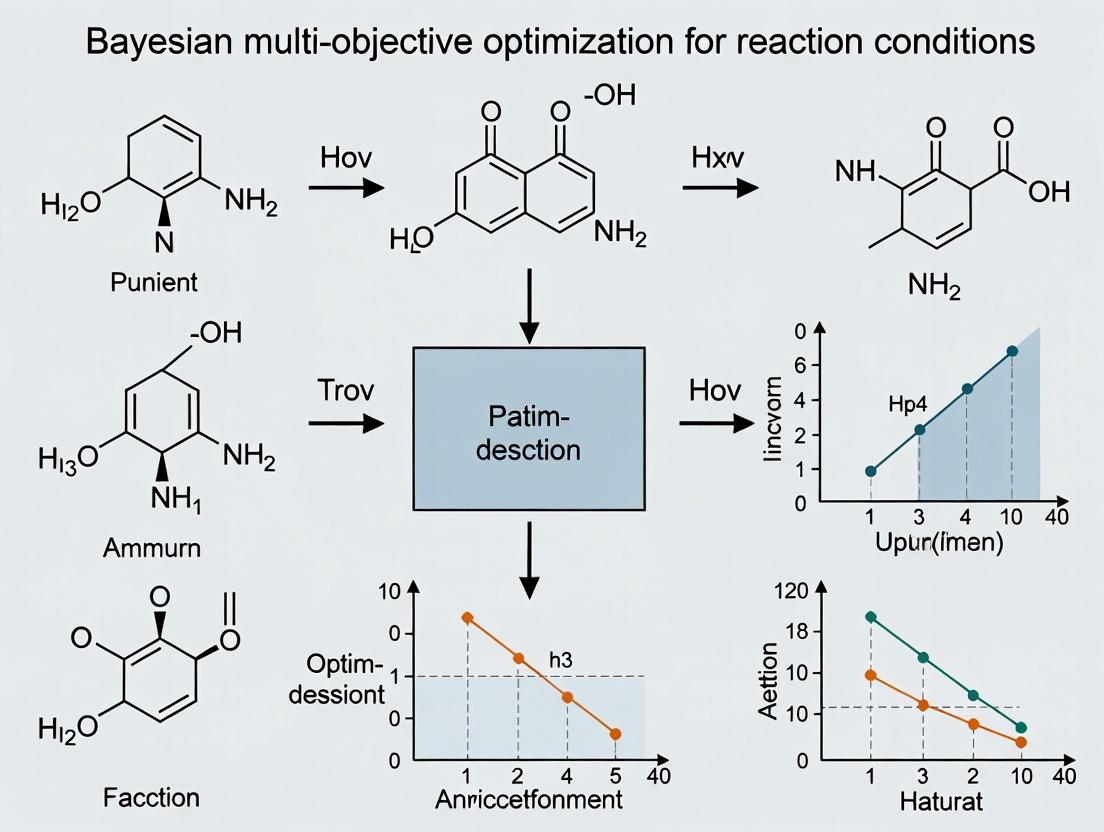
This article provides a comprehensive guide to Bayesian multi-objective optimization (MOBO) for reaction condition screening, tailored for researchers in drug development and synthetic chemistry.
Bayesian Multi-Objective Optimization of Reaction Conditions: A Modern Framework for Accelerating Drug Discovery and Process Chemistry
Abstract
This article provides a comprehensive guide to Bayesian multi-objective optimization (MOBO) for reaction condition screening, tailored for researchers in drug development and synthetic chemistry. We first establish the foundational principles, explaining why traditional one-factor-at-a-time methods fail for complex, competing objectives like yield, purity, cost, and sustainability. Next, we detail the core methodological workflow, from defining the design space and acquisition functions to implementing algorithms like Expected Hypervolume Improvement (EHVI). We then address common experimental and computational challenges, offering troubleshooting strategies for noisy data, constraint handling, and computational cost. Finally, we validate the approach through comparative analysis against alternative optimization methods, showcasing its superior efficiency in real-world case studies from pharmaceutical development. The conclusion synthesizes key takeaways and discusses future implications for high-throughput experimentation and autonomous laboratories.
Beyond Trial-and-Error: Foundational Principles of Bayesian MOBO for Complex Reaction Optimization
In the optimization of chemical reactions, particularly in pharmaceutical development, traditional One-Factor-At-a-Time (OFAT) and classical Design of Experiments (DoE) approaches are increasingly inadequate for modern multi-objective problems. These problems require simultaneous optimization of yield, purity, cost, environmental impact, and throughput—objectives often in direct conflict. Bayesian multi-objective optimization provides a probabilistic framework to efficiently navigate complex trade-off spaces, making it the necessary new paradigm for reaction condition research.
Limitations of Traditional Methods: A Quantitative Analysis
Table 1: Comparative Performance in a Simulated Reaction Optimization
| Method | Number of Experiments to Reach 90% Optimal Yield | Purity at Optimal Yield (%) | Estimated Cost of Experimental Campaign ($K) | Probability of Finding True Pareto Front |
|---|---|---|---|---|
| OFAT | 145 | 88.5 | 72.5 | <10% |
| Classical DoE (Central Composite) | 62 | 92.1 | 31.0 | ~35% |
| Bayesian Multi-Objective | 28 | 94.7 | 14.0 | >85% |
Note: Simulated data for a model Suzuki-Miyaura cross-coupling with objectives: maximize yield, maximize purity (minimize side-products), minimize catalyst loading. Bayesian method uses Expected Hypervolume Improvement (EHVI) as acquisition function.
Table 2: Real-World Case Study - API Step Optimization
| Optimization Aspect | OFAT Result | DoE (Response Surface) Result | Bayesian Multi-Objective Result |
|---|---|---|---|
| Final Yield | 76% | 82% | 89% |
| # of Impurities >0.1% | 3 | 2 | 1 |
| Process Mass Intensity (PMI) | 58 | 42 | 29 |
| Total Optimization Runs | 96 | 45 | 32 |
| Identified Critical Interactions | None | 2 (Temp x Time) | 4 (including non-linear catalyst-solvent) |
Bayesian Multi-Objective Optimization: Core Protocol
Protocol 3.1: Defining the Multi-Objective Problem Space
- Objective Selection: Define 2-4 primary objectives (e.g.,
Yield,Purity,Cost,E-factor). Formulate each as a mathematical functionf_i(x)wherexis the vector of reaction parameters. - Parameter Bounds: Define feasible ranges for all continuous (e.g., temperature: 25-150°C) and discrete (e.g., solvent: {THF, DMSO, MeCN}) variables.
- Constraint Specification: Define hard constraints (e.g.,
pressure < 10 bar,exclusion of genotoxic solvents) and soft constraints for penalty functions. - Pareto Front Initialization: Conduct a space-filling design (e.g., Latin Hypercube) of 5-10 initial experiments to seed the model.
Protocol 3.2: Building the Probabilistic Surrogate Model
- Model Choice: Select Gaussian Process (GP) regression for continuous objectives. Use a Matérn 5/2 kernel for its flexibility.
- Training: For
ninitial data pointsD_n = {x_i, y_i}, train independent GP models for each objectivej:GP_j ~ N(μ_j(x), σ_j²(x)). - Hyperparameter Tuning: Optimize kernel length scales and noise variance via Maximum Marginal Likelihood (MLL) or Markov Chain Monte Carlo (MCMC).
Protocol 3.3: Iterative Optimization Loop Using an Acquisition Function
- Calculate Pareto Front: From current data
D_n, identify non-dominated solutionsP_n. - Evaluate Acquisition Function: Compute Expected Hypervolume Improvement (EHVI) across the entire parameter space
X. EHVI measures the expected gain in the hypervolume dominated byP_n.EHVI(x) = ∫ (H(P_n ∪ {y}) - H(P_n)) * p(y| x, D_n) dy, whereHis hypervolume,yis predicted objective vector. - Select Next Experiment: Find
x* = argmax_{x in X} EHVI(x)using a global optimizer (e.g., CMA-ES). - Execute Experiment & Update: Run reaction at conditions
x*, measure objectives, and augment dataset:D_{n+1} = D_n ∪ {(x*, y*)}. - Convergence Check: Terminate when EHVI falls below threshold (e.g., <1% of initial hypervolume) or after a pre-defined budget.
Application Note: Amide Coupling Reaction Optimization
Aim: Simultaneously optimize yield and minimize residual metal catalyst in a palladium-catalyzed amidation.
Research Reagent Solutions & Key Materials:
| Item | Function/Justification |
|---|---|
| Pd PEPPSI-IPr Catalyst | Robust, air-stable pre-catalyst for C-N coupling. |
| BrettPhos Ligand | Bulky biarylphosphine ligand favoring reductive elimination. |
| Cs2CO3 Base | Strong, soluble base for efficient deprotonation. |
| Anhydrous 1,4-Dioxane | High-boiling, inert solvent for high-temperature reactions. |
| ICP-MS Standard Solution | For precise quantification of residual Pd. |
| Automated Liquid Handler | For precise, reproducible reagent dispensing in high-throughput screens. |
| UPLC-MS with PDA | For simultaneous yield determination (PDA) and impurity profiling (MS). |
Procedure:
- Design Space: Variables: Catalyst loading (0.5-2.5 mol%), Ligand ratio (1.0-2.5 eq. to Pd), Temperature (80-120°C), Time (2-18 h).
- Initial Design: 12 experiments via Latin Hypercube Sampling.
- Bayesian Loop: Run 20 iterative experiments guided by EHVI, targeting Max(Yield) and Min([Pd] in product).
- Analysis: Identify Pareto-optimal conditions: 1.2 mol% Pd, 1.8 eq. Ligand, 105°C, 8h. Yield: 94%, Residual Pd: 78 ppm.
Visualizing the Workflow and Outcome
Bayesian Multi-Objective Optimization Cycle
Paradigm Shift Driven by Multi-Objective Complexity
1. Introduction and Thesis Context In modern synthetic chemistry, particularly within pharmaceutical development, reaction optimization is a multi-dimensional problem. The traditional focus on maximizing yield is insufficient, as it often conflicts with other critical objectives such as product purity, economic cost, and environmental impact (quantified by the E-factor). This creates a complex trade-off landscape. Bayesian multi-objective optimization (MOBO) provides a powerful computational framework for navigating this landscape efficiently. By using probabilistic models to predict reaction outcomes from limited experimental data, MOBO can iteratively suggest reaction conditions that optimally balance these competing objectives, accelerating the development of sustainable and economically viable synthetic routes.
2. Quantitative Data on Competing Objectives The table below summarizes typical target ranges and antagonistic relationships between key objectives in API synthesis.
Table 1: Key Objectives in Reaction Optimization and Their Interdependencies
| Objective | Typical Target (API Synthesis) | Primary Metric | Common Antagonism With | Rationale for Conflict |
|---|---|---|---|---|
| Yield | > 85% | Isolated Yield (%) | Purity, E-factor | High-yielding conditions may promote side reactions, complicating purification (↓ purity) and requiring more materials (↑ E-factor). |
| Purity | > 98% (HPLC Area %) | Chromatographic Purity | Yield, Cost | Stringent purification to achieve high purity often results in yield loss and increases solvent/waste (↑ cost, ↑ E-factor). |
| Cost | Minimized | $/kg of product | Purity, E-factor | Cheap reagents/solvents may be less selective or more hazardous, affecting purity and waste. High purity demands expensive materials. |
| E-Factor | < 50 (Pharma Fine Chem) | kg waste / kg product | Yield, Cost | Reducing waste often requires expensive catalysts/solvents or lower-yielding, atom-economic pathways. |
3. Bayesian Multi-Objective Optimization: Protocol & Workflow Protocol: Iterative Bayesian Optimization for Reaction Screening
Objective: To identify Pareto-optimal reaction conditions balancing Yield, Purity, and E-factor for a model C-N cross-coupling reaction.
Materials & Computational Tools:
- Reaction Substrates: Aryl halide, amine, base, solvent, catalyst.
- Analysis: UPLC/MS for conversion and purity analysis.
- Software: Python with libraries:
scikit-learnorGPyTorch(Gaussian Processes),OptunaorBoTorch(Bayesian optimization frameworks).
Procedure:
- Design of Experiment (Initial Set): Perform a space-filling design (e.g., 10-15 experiments) varying key parameters: catalyst loading (0.5-2 mol%), temperature (60-120°C), reaction time (2-24 h), solvent ratio (aqueous/organic mix).
- Data Collection: Run reactions, quantify yield (isolated mass), purity (HPLC area%), and calculate E-factor for each condition.
- Model Training: Train separate Gaussian Process (GP) surrogate models for each objective (Yield, Purity, inverse E-factor) using the initial data.
- Acquisition Function Optimization: Use an acquisition function (e.g., Expected Hypervolume Improvement - EHVI) to calculate the next most informative reaction conditions to test. This function balances exploring uncertain regions of parameter space and exploiting conditions predicted to improve the Pareto front.
- Iterative Loop: Run the suggested experiment(s), add the new data to the training set, and re-train the GP models. Repeat steps 4-5 for 5-10 iterations.
- Pareto Front Analysis: After the final iteration, analyze the set of non-dominated solutions (where improving one objective worsens another) to select the optimal condition based on project priorities.
4. Visualization of the Optimization Workflow
Diagram Title: Bayesian MOBO Workflow for Reaction Optimization
5. The Scientist's Toolkit: Key Research Reagent Solutions Table 2: Essential Materials for Multi-Objective Optimization Studies
| Item / Category | Example / Specification | Function in Optimization |
|---|---|---|
| Catalyst Kits | Pd-PEPPSI-type precatalyst kit, Buchwald ligand kit. | Enables rapid screening of steric/electronic effects on yield, purity, and catalyst loading (cost, E-factor). |
| Green Solvent Kits | 2-MethylTHF, Cyclopentyl methyl ether (CPME), bio-based solvents. | Directly screens for reduced environmental impact (E-factor) and potential cost savings while maintaining performance. |
| High-Throughput Experimentation (HTE) Plates | 96-well glass-coated or polymer plates. | Facilitates parallel synthesis of initial DoE and iterative suggestions, generating necessary data density for Bayesian models. |
| Automated Purification Systems | Flash chromatography or prep-HPLC with fraction collectors. | Provides consistent, rapid purification for isolated yield and purity data, critical for accurate objective quantification. |
| Process Mass Intensity (PMI) Calculators | Custom spreadsheet or dedicated software (e.g., DOE.Ki). | Automates calculation of E-factor/PMI from reagent masses, enabling its inclusion as a live objective in the optimization loop. |
| Bayesian Optimization Software | BoTorch (PyTorch-based) or commercial platforms (e.g., Synthia). |
Core computational engine for building surrogate models and calculating the next best experiment via acquisition functions. |
This application note details the implementation of Bayesian reasoning for multi-objective optimization (MOO) of chemical reactions, a core methodology within the broader thesis "Adaptive Experimentation for the Pareto-Efficient Discovery of Pharmaceutical Leads." The thesis posits that an iterative Bayesian workflow is essential for navigating high-dimensional chemical space, where objectives such as reaction yield, enantioselectivity, and impurity profile are often in trade-off. This protocol provides a foundational guide to transitioning from prior belief to informed posterior probability, enabling the data-efficient identification of Pareto-optimal reaction conditions.
Core Bayesian Framework: Protocol
Protocol: Formulating the Prior Probability Distribution
Objective: To encode existing knowledge or assumptions about chemical system parameters before new experimental data is observed.
- Define the Parameter Space (Θ): Identify the continuous (e.g., temperature, concentration) and categorical (e.g., catalyst identity, solvent class) variables to be optimized.
- Select Prior Distribution Type:
- For unknown continuous parameters with bounded ranges (e.g., pH 3-10), use a Uniform Prior.
- For parameters where a literature value or expert estimate (μ) and associated uncertainty (σ) exist, use a Gaussian (Normal) Prior.
- For categorical choices (e.g., ligand A, B, or C) with no initial preference, use a Dirichlet Prior (or a flat categorical distribution).
- Document Prior Hyperparameters: Record the chosen distribution and its parameters (e.g., Uniform(min=20, max=150) for temperature in °C; Normal(μ=100, σ=20) for a literature-reported yield expectation).
Table 1: Example Prior Distributions for a Catalytic Cross-Coupling Reaction
| Parameter | Type | Suggested Prior Distribution | Hyperparameters (Example) | Rationale |
|---|---|---|---|---|
| Reaction Temp. | Continuous | Uniform | min=25°C, max=150°C | Wide, uninformative range for screening. |
| Catalyst Loading | Continuous | Log-Uniform | min=0.1 mol%, max=5.0 mol% | Covers orders of magnitude, common for catalysts. |
| Base Equivalents | Continuous | Normal | μ=2.0 eq, σ=0.5 eq | Literature suggestion with moderate uncertainty. |
| Solvent | Categorical | Dirichlet | concentration=[1,1,1] for [Toluene, DMSO, MeCN] | Equal probability for three candidate solvents. |
Protocol: Designing Experiments with an Acquisition Function
Objective: To select the most informative next experiment(s) by balancing exploration (testing uncertain regions) and exploitation (improving known good conditions).
- Choose an Acquisition Function for MOO:
- q-Expected Hypervolume Improvement (qEHVI): The gold standard for MOO. It quantifies the expected gain in the dominated volume of objective space (Pareto front improvement). Computationally intensive but highly efficient in experiment count.
- q-ParEGO: A scalarization-based approach, often faster to compute than qEHVI, suitable for initial sweeps.
- Integrate with a Probabilistic Model: The acquisition function is calculated from a Gaussian Process (GP) model that provides a posterior predictive distribution (mean and variance) for each objective across Θ.
- Optimize the Function: Using an optimizer (e.g., L-BFGS-B), find the set of conditions x_next that maximizes the acquisition function. This point is the recommendation for the next experiment.
Protocol: Updating to the Posterior Distribution
Objective: To formally combine prior beliefs with new experimental data to obtain a refined probabilistic model of the chemical system.
- Conduct Experiment: Run the reaction at the suggested conditions xnext and measure all relevant objective values ynext.
- Append to Dataset: Update the master dataset D = {D; (xnext, ynext)}.
- Compute Posterior via Bayes' Theorem: The posterior probability of the model parameters given the data is proportional to the likelihood times the prior.
> P(Θ | D) ∝ P(D | Θ) · P(Θ)
- P(Θ): The prior distribution (from 2.1).
- P(D | Θ): The likelihood, model-specific (e.g., Gaussian noise for a GP).
- P(Θ | D): The updated posterior distribution.
- Refit the Probabilistic Model: Re-train the GP (or other surrogate model) on the updated dataset D. The model's predictions now represent the posterior predictive distribution, with reduced uncertainty near sampled points.
Visualization of the Bayesian MOO Workflow
Title: Bayesian MOO Cycle for Reaction Optimization
The Scientist's Toolkit: Research Reagent Solutions
Table 2: Essential Tools for Bayesian Reaction Optimization
| Item | Function in Bayesian Workflow |
|---|---|
| Bayesian Optimization Software (BoTorch/Ax): | Open-source Python frameworks for implementing GP models, MOO acquisition functions (qEHVI), and managing iterative loops. |
| Laboratory Automation Platform: | Enables precise execution of the suggested experiment (x_next), often via robotic liquid handlers and reactor blocks (e.g., Chemspeed, Unchained Labs). |
| High-Throughput Analytics (UPLC/HPLC-MS): | Provides rapid, quantitative y_next data (yield, ee, purity) required for fast model updating. Essential for maintaining cycle tempo. |
| Chemical Space Library: | Curated sets of diverse reagents (catalysts, ligands, substrates) and solvents, formatted for digital search and robotic dispensing. |
| Data Lake/ELN Integration: | Centralized repository linking experimental conditions (x), analytical results (y), and model predictions, ensuring traceability and dataset D integrity. |
Advanced Application: Multi-Fidelity Optimization Protocol
Objective: To incorporate low-cost, low-fidelity data (e.g., computational predictions, crude yield estimates) to guide expensive high-fidelity experiments (e.g., isolated yield with full characterization).
- Define Fidelity Parameters: Assign a fidelity parameter
z(e.g.,z=0for DFT-predicted yield,z=0.5for HPLC yield of crude reaction,z=1.0for isolated, purified yield). - Build a Multi-Fidelity GP Model: Use a model architecture (e.g., Linear Coregionalization Model) that learns the correlation between fidelities.
- Use a Cost-Aware Acquisition Function: Modify qEHVI to account for the cost of experimentation at each fidelity. The function now maximizes
Expected Improvement per Unit Cost. - Iterate: The algorithm will intelligently propose a mixture of low- and high-fidelity experiments to map the Pareto front with minimal total resource expenditure.
Title: Multi-Fidelity Bayesian Optimization Flow
Within the framework of Bayesian multi-objective optimization (MOBO) for reaction conditions research, a core challenge is the efficient navigation of vast, multidimensional chemical spaces with minimal experimental trials. Conventional high-throughput experimentation (HTE) can be resource-intensive. This Application Note details the implementation of Gaussian Process (GP) surrogate models as a powerful, data-efficient alternative for predicting reaction outcomes—such as yield, enantioselectivity, or purity—from sparse initial datasets. GPs provide not only predictions but also quantifiable uncertainty, which is directly leveraged by acquisition functions in MOBO to iteratively select the most informative subsequent experiments, accelerating the discovery of optimal reaction conditions.
Theoretical Foundation: Gaussian Process Regression
A Gaussian Process is a non-parametric Bayesian model defining a distribution over functions. It is fully specified by a mean function m(x) and a covariance (kernel) function k(x, x'). For a dataset with inputs X (e.g., reaction parameters) and outputs y (e.g., yield), the GP prior is: f | X ~ N(0, K(X, X)) where K is the covariance matrix with entries k(xᵢ, xⱼ). The kernel choice encodes assumptions about function smoothness and periodicity. The posterior predictive distribution for a new input x* is Gaussian with mean and variance given by closed-form equations, enabling prediction with uncertainty.
Application Protocol: Building a GP Surrogate for Reaction Optimization
Protocol 3.1: Initial Experimental Design & Data Acquisition
Objective: Generate an initial sparse, informative dataset to seed the GP model. Materials: See "Scientist's Toolkit" (Section 7). Procedure:
- Define Optimization Objectives: Precisely define primary (e.g., yield) and secondary (e.g., ee%) objectives. Determine constraints (e.g., cost, safety).
- Define Parameter Space: List all continuous (e.g., temperature, concentration) and categorical (e.g., catalyst, solvent class) variables with plausible ranges/levels.
- Design Initial Experiment Set: Use a space-filling design (e.g., Latin Hypercube Sampling) for continuous variables, combined with factorial design for categorical variables. For a 5-7 dimensional space, 10-20 initial experiments are typically sufficient.
- Execute & Characterize: Perform reactions under the designed conditions. Quantify all relevant outcomes with analytical standards (HPLC, NMR, etc.).
- Data Curation: Assemble data into a structured table (see Table 1).
Table 1: Example Sparse Initial Dataset for a Catalytic Cross-Coupling Reaction
| Exp ID | Catalyst | Ligand | Temp (°C) | Time (h) | Conc (M) | Yield (%) | ee (%) |
|---|---|---|---|---|---|---|---|
| 1 | Pd1 | L1 | 80 | 12 | 0.1 | 45 | 10 |
| 2 | Pd2 | L2 | 100 | 6 | 0.05 | 78 | 95 |
| 3 | Pd1 | L3 | 60 | 24 | 0.2 | 15 | 5 |
| ... | ... | ... | ... | ... | ... | ... | ... |
| 16 | Pd2 | L1 | 90 | 18 | 0.15 | 62 | 80 |
Protocol 3.2: GP Model Training & Validation
Objective: Construct a calibrated GP surrogate model from the initial data. Procedure:
- Data Preprocessing: Scale continuous inputs to zero mean and unit variance. One-hot encode categorical variables. Scale output(s) if needed.
- Kernel Selection: For mixed parameter types, use a composite kernel:
kernel = (Matern kernel for continuous vars) * (Hamming kernel for categorical vars). - Model Training: Maximize the log marginal likelihood to optimize kernel hyperparameters (length-scales, noise variance). This balances model fit and complexity.
- Cross-Validation: Perform leave-one-out or k-fold cross-validation. Calculate performance metrics (see Table 2).
- Model Diagnostics: Assess residuals for patterns. Calibration plots should show predicted uncertainty aligned with actual error.
Table 2: GP Model Performance Metrics on Cross-Validation of Sparse Data (Hypothetical)
| Objective | RMSE (CV) | R² (CV) | Mean Standardized Log Loss (MSLL) |
|---|---|---|---|
| Yield | 5.8% | 0.91 | -0.42 |
| Enantiomeric Excess | 7.2% | 0.87 | -0.38 |
MSLL < 0 indicates the model outperforms a naive model using only the data mean and variance.
Protocol 3.3: Bayesian Multi-Objective Optimization Loop
Objective: Use the GP surrogate with an acquisition function to iteratively select experiments that Pareto-optimize multiple objectives. Procedure:
- Define Acquisition Function: For MOBO, use Expected Hypervolume Improvement (EHVI). EHVI quantifies the expected gain in the dominated region of the objective space (Pareto front).
- Maximize Acquisition: Find the next experiment x_next that maximizes EHVI. This is a numerical optimization problem on the GP surrogate.
- Execute & Update: Perform the experiment at x_next, measure outcomes, and add the new data point to the training set.
- Re-train & Iterate: Update the GP model with the expanded dataset. Repeat steps 2-4 for a predefined budget (e.g., 10-20 iterations) or until convergence of the Pareto front.
- Final Analysis: Identify the set of non-dominated optimal conditions (Pareto-optimal set) from all experiments conducted.
Visualizing the Bayesian MOBO Workflow
Title: Bayesian MOBO Workflow Using a Gaussian Process Surrogate
Case Study: Asymmetric Catalysis Optimization
Scenario: Optimization of a chiral phosphoric acid-catalyzed Friedel–Crafts reaction for maximal yield and enantioselectivity. Sparse Initial Data: 18 experiments varying catalyst (4 types), solvent (3 types), temperature (40-80°C), and concentration. GP Setup: Composite kernel (Matern 5/2 for continuous, Hamming for categorical). Independent GPs for yield and ee. MOBO Result: After 12 EHVI-guided iterations, the algorithm identified a Pareto front revealing a trade-off: conditions for >90% yield gave ~85% ee, while conditions pushing to >95% ee capped yield at ~82%.
Visualizing the GP Prediction & Acquisition Logic
Title: GP Prediction Informs Acquisition Function in MOBO
The Scientist's Toolkit: Research Reagent Solutions
Table 3: Essential Materials & Computational Tools for GP-MOBO Implementation
| Item | Function/Description | Example/Note |
|---|---|---|
| Chemical Libraries | Source of varied catalysts, ligands, reagents for categorical exploration. | Commercially available screening kits (e.g., for Pd catalysis, organocatalysts). |
| Automated Liquid Handling | Enables precise, reproducible preparation of reaction arrays from digital designs. | Chemspeed, Unchained Labs, or Flow Chemistry systems. |
| High-Throughput Analytics | Rapid quantification of reaction outcomes. | UPLC-MS with automated sampling, chiral HPLC, or inline FTIR/ReactIR. |
| GP Software Libraries | Pre-built modules for GP regression and BO. | Python: GPyTorch, scikit-learn, BoTorch. Commercial: SIGMA by Merck, MATLAB Statistics & ML Toolbox. |
| BO/MOBO Frameworks | Libraries implementing acquisition function optimization. | BoTorch (PyTorch-based, supports EHVI), Dragonfly, OpenBox. |
| High-Performance Computing | Speeds up GP hyperparameter tuning and acquisition function maximization. | Local GPU clusters or cloud computing (AWS, GCP) for complex, high-dimensional models. |
In Bayesian multi-objective optimization (MOBO) for reaction condition research, the Pareto Frontier represents the set of optimal solutions where improving one objective (e.g., reaction yield) necessitates worsening another (e.g., cost, impurity profile). This framework is critical for rational decision-making in drug development, where trade-offs between efficacy, safety, and scalability are inherent.
Key Principles & Quantitative Benchmarks
Table 1: Common Objectives & Metrics in Reaction Optimization
| Objective | Typical Metric | Desired Direction | Industry Benchmark (Small Molecule API) |
|---|---|---|---|
| Chemical Yield | Area Percentage (HPLC) | Maximize | >85% for key step |
| Selectivity | Ratio of Desired:Undesired Isomers | Maximize | >20:1 |
| Cost | $/kg of Starting Material | Minimize | <$500/kg for intermediate |
| Process Safety | Adiabatic Decomposition Onset (°C) | Maximize | >100°C |
| Environmental Impact | Process Mass Intensity (PMI) | Minimize | <50 kg/kg API |
| Reaction Time | Time to >95% Completion (hr) | Minimize | <24 hr |
Table 2: Pareto Frontier Analysis Outcomes from Recent Studies
| Study (Year) | Reaction Type | No. of Objectives | Pareto Solutions Found | Dominant Algorithm |
|---|---|---|---|---|
| Doyle et al. (2023) | Pd-catalyzed C–N Cross-Coupling | 4 (Yield, Cost, E-factor, Throughput) | 12 | qNEHVI |
| Chen & Schmidt (2024) | Asymmetric Organocatalysis | 3 (ee, Yield, Conc.) | 8 | MOBO-Turbo |
| PharmaScale Inc. (2024) | Peptide Coupling | 5 (Yield, Purity, Cost, Time, Waste) | 15 | ParEGO |
Application Notes for Bayesian MOBO
Pre-Optimization Experimental Design
- Define Objective Space: Quantify all critical reaction outputs. For a catalytic reaction, this typically includes: Yield (HPLC), Selectivity (dr/ee via chiral HPLC or SFC), Product Purity (UV area % at 254 nm), and Catalyst Loading (mol%).
- Establish Constraints: Define hard constraints (e.g., impurity X ≤ 0.15%, temperature ≤ 100°C for solvent stability).
- Initial DoE: Perform a space-filling design (e.g., Sobol sequence) across continuous variables (Temperature, Concentration, Equivalents) and categorical variables (Solvent class, Catalyst type). A minimum of 10*dimension experiments is recommended for initial model training.
Protocol: Iterative Bayesian Optimization Loop
Title: MOBO Workflow for Reaction Screening
Procedure:
- Train Surrogate Model: Using the accumulated experimental data, train a Gaussian Process Regression (GPR) model for each objective.
- Calculate Acquisition: Compute the multi-objective acquisition function. q-Noisy Expected Hypervolume Improvement (qNEHVI) is currently preferred for its batch efficiency and noise handling.
- Optimize Acquisition: Solve the inner optimization problem to find the candidate conditions x* that maximize the acquisition function. Use multi-start gradient descent.
- Execute Experiments: Run reactions at the proposed conditions x* in parallel.
- Update Data & Model: Append new results to the dataset and retrain the surrogate models.
- Convergence Check: Terminate when the hypervolume improvement ratio is <5% over three consecutive iterations, or a predefined experimental budget is exhausted.
Protocol: Post-Optimization Pareto Analysis
Title: Pareto Frontier Analysis Protocol
Procedure:
- Extract all non-dominated solutions from the final dataset.
- Perform k-means clustering on the Pareto set in parameter space to identify distinct regimes of conditions (e.g., high-temp/low-catalyst vs. low-temp/high-catalyst clusters).
- Apply a simple Multi-Criteria Decision Analysis (MCDA) tool, such as Weighted Sum Method, incorporating stakeholder preferences (e.g., "Yield weight = 0.6, Cost weight = 0.4").
- Select top-ranked conditions from different clusters for robustness.
- Execute confirmatory runs (n≥3) to establish reproducibility and estimate uncertainty at the selected optimum.
The Scientist's Toolkit: Research Reagent Solutions
Table 3: Essential Materials for MOBO Reaction Studies
| Item | Function & Specification | Example Vendor/Product |
|---|---|---|
| High-Throughput Experimentation (HTE) Kit | Pre-weighed, arrayed substrates/catalysts in plates for parallel reaction set-up. | Merck-Sigma Aldrich "Snapware"; Chemglass "HTE Reaction Blocks" |
| Automated Liquid Handling System | Precise dispensing of solvents, reagents, and catalysts for reproducibility. | Hamilton ML STAR; Opentrons OT-2 |
| Multi-Channel Reactor with Inline Analytics | Parallel reaction execution with real-time monitoring (e.g., FTIR, Raman). | Mettler Toledo OptiMax; Unchained Labs "Junior" |
| UPLC/HPLC with Automated Injector | High-throughput analysis of yield and selectivity. | Waters Acquity; Agilent InfinityLab |
| Chiral Stationary Phase Columns | Essential for determining enantiomeric excess (ee) in asymmetric synthesis. | Daicel CHIRALPAK (IA, IC, ID); Phenomenex Lux |
| Process Mass Intensity (PMI) Calculator | Software to calculate green chemistry metrics from reaction parameters. | ACS PMI Calculator; myGreenLab "GEC" |
| MOBO Software Platform | Open-source or commercial packages for designing experiments and modeling. | Botorch (PyTorch); "MOE" from Chemical Computing Group; "modeFRONTIER" |
Application Notes
Within Bayesian multi-objective optimization (MOBO) for reaction condition research, these three advantages enable rapid, informed, and scalable discovery. This is critical in pharmaceutical development where objectives—such as yield, enantioselectivity, and cost—often compete, and experimental samples (e.g., rare substrates, catalyst libraries) are limited.
1. Sample Efficiency: Bayesian MOBO models, primarily via Gaussian Processes (GPs), build a probabilistic surrogate of the reaction landscape. They guide experiments through acquisition functions (e.g., Expected Hypervolume Improvement) to proposals predicted to maximize multiple objectives simultaneously. This drastically reduces the number of required experiments compared to grid search or one-factor-at-a-time methods.
2. Uncertainty Quantification: The GP model provides a posterior distribution for each predicted outcome (mean and variance). This quantifies the confidence in predictions across the condition space. Researchers can explicitly balance exploration (testing high-uncertainty regions) against exploitation (refining known high-performance regions), mitigating the risk of overlooking optimal conditions.
3. Parallelizability: Many state-of-the-art acquisition functions (e.g., q-EHVI, q-NParEGO) can propose a batch of multiple, diverse experimental conditions for parallel evaluation in one iteration. This optimally utilizes high-throughput experimentation platforms (e.g., parallel reactor blocks) without sacrificing the strategic search efficacy.
Table 1: Comparison of Optimization Performance in a Simulated Pd-Catalyzed Cross-Coupling Screen
| Optimization Method | Experiments to Reach Target Hypervolume | Final Hypervolume | Avg. Parallel Utilization (Expts/Batch) |
|---|---|---|---|
| Bayesian MOBO (q-EHVI) | 42 | 0.87 | 4 |
| Random Search | 118 | 0.81 | 4 |
| Single-Objective BO (Yield only) | 60* | 0.79 | 1 |
| Full Factorial Design | 256 (exhaustive) | 0.85 | N/A |
*Yield-optimized path ignored selectivity objective. Hypervolume measured relative to normalized objectives: Yield (0-100%), Selectivity (0-100%), Cost (inverted scale). Target hypervolume set at 95% of maximum found.
Table 2: Impact of Uncertainty-Guided Exploration on Outcome Robustness
| Strategy (Acquisition Function) | Probability of Finding True Pareto Front (%) | Max Performance Drop on Validation (%) |
|---|---|---|
| EHVI (Exploit + Explore) | 98 | 5.2 |
| Pure Exploitation | 65 | 15.7 |
| Pure Exploration | 92 | 8.1 |
*Based on 50 simulated runs with a 5-objective reaction optimization problem.
Experimental Protocols
Protocol 1: Setting Up a Bayesian MOBO Workflow for High-Throughput Reaction Screening
Objective: To identify Pareto-optimal conditions for a catalytic reaction maximizing yield and enantiomeric excess (ee).
Materials:
- Automated liquid handling station.
- Parallel reaction block (e.g., 24- or 96-well).
- Pre-prepared stock solutions of catalyst, ligands, substrates, bases, and solvents.
- UPLC/MS system for rapid analysis.
Procedure:
- Define Design Space: Specify continuous (temperature, concentration) and categorical (catalyst identity, solvent type) variables. Normalize ranges to [0, 1].
- Define Objectives: Specify primary (e.g., Yield) and secondary (e.g., ee) objectives. Determine direction (maximize/minimize).
- Initial Design: Perform a space-filling initial design (e.g., Sobol sequence, 10-20 points) covering the variable space. Execute these experiments in parallel.
- Model Initialization: For each objective, fit a GP model with a composite kernel (e.g., Matern for continuous, Hamming for categorical variables) to the initial data.
- Iterative Optimization Loop: a. Acquisition: Using the fitted models, compute the q-EHVI acquisition function to select the next batch (e.g., 4) of candidate conditions. b. Parallel Execution: Physically set up and run the batch of proposed reactions simultaneously. c. Analysis: Quantify yield and ee for all reactions in the batch. d. Model Update: Augment the dataset with the new results and refit the GP models.
- Termination: Halt after a predefined budget (e.g., 80 experiments) or convergence criterion (e.g., improvement in hypervolume < 2% over 3 iterations).
- Pareto Front Analysis: Identify the set of non-dominated optimal conditions from the final dataset for downstream validation.
Protocol 2: Validating Uncertainty Estimates via Hold-Out Experiments
Objective: To assess the calibration of the GP model's uncertainty predictions.
Procedure:
- After completing the MOBO run, randomly withhold 20% of the experimental data as a test set.
- Train the final GP model on the remaining 80% of data.
- Use the trained model to predict the mean (μ) and standard deviation (σ) for each point in the test set.
- For each test point, calculate the Z-score: (Actual_Value - μ) / σ.
- Assess calibration: The distribution of Z-scores across the test set should approximate a standard normal distribution (mean=0, std=1). Systematic deviations indicate poorly quantified uncertainty.
- Refine the GP kernel or likelihood function based on this analysis to improve future model reliability.
Visualizations
Bayesian MOBO Workflow for Reaction Optimization
Uncertainty Quantification Informs Experiment Selection
The Scientist's Toolkit: Key Research Reagent Solutions
Table 3: Essential Materials for Bayesian MOBO-Driven Reaction Optimization
| Item | Function in Bayesian MOBO Context |
|---|---|
| High-Throughput Experimentation (HTE) Kit | Pre-weighed, standardized vials of diverse catalyst/ligand libraries, substrates, and additives. Enables rapid, parallel assembly of proposed condition batches from the algorithm. |
| Automated Liquid Handler | Precisely dispenses microliter volumes from stock solutions. Critical for reliably and reproducibly executing the discrete conditions proposed by the optimization algorithm. |
| Parallel Pressure Reactor | A block of multiple miniature reactors allowing simultaneous execution of reactions under inert atmosphere and controlled heating/stirring. Maximizes parallelizability. |
| Rapid UPLC-MS/Chiral Station | Provides quick quantitative analysis (yield, conversion) and qualitative analysis (ee, selectivity) for high-frequency sample turnover required by iterative BO loops. |
| BO Software Platform (e.g., BoTorch, Ax) | Open-source or commercial libraries that implement GP models, multi-objective acquisition functions (EHVI), and offer APIs to integrate with lab automation. |
| Chemical Data Management System | A structured database (e.g., ELN/LIMS) to log all experimental conditions (features) and outcomes (objectives), creating the essential dataset for model training and iteration. |
A Step-by-Step Workflow: Implementing Bayesian MOBO in Your Lab for Reaction Screening
Within a Bayesian multi-objective optimization (BO-MO) framework for chemical reaction development, the precise definition of the initial search space is paramount. This step directly influences the efficiency of the optimization algorithm in navigating the complex parameter landscape towards Pareto-optimal conditions, balancing objectives such as yield, enantioselectivity, cost, and sustainability. This application note details the methodology for defining the critical parameter space for a model Suzuki-Miyaura cross-coupling reaction, a workhorse transformation in pharmaceutical synthesis.
Critical Parameter Selection & Rationale
For a generic aryl halide – boronic acid cross-coupling, four parameters are identified as most influential:
- Catalyst: Determines reaction feasibility, rate, and potential for side reactions.
- Solvent: Impacts catalyst solubility, stability, and reaction mechanism.
- Temperature: Governs reaction kinetics and thermodynamics.
- Time: Ensures reaction completion while minimizing decomposition.
Defined Search Space Ranges
Based on a survey of recent literature (2023-2024) and chemical feasibility, the following discrete and continuous ranges are proposed for initial Bayesian optimization.
Table 1: Defined Parameter Space for Suzuki-Miyaura Optimization
| Parameter | Type | Levels / Range | Rationale |
|---|---|---|---|
| Catalyst | Categorical | Pd(PPh3)4, Pd(dppf)Cl2, SPhos Pd G2, XPhos Pd G3 | Common, commercially available catalysts with varied steric/electronic properties. |
| Solvent | Categorical | 1,4-Dioxane, Toluene, DMF, EtOH/H2O (4:1) | Covers a range of polarities, coordinating abilities, and green chemistry considerations. |
| Temperature | Continuous | 50 °C – 120 °C | Below 50°C may lead to impractically slow rates; above 120°C risks solvent boiling/decomposition. |
| Time | Continuous | 1 – 24 hours | Practical range for standard laboratory operation. |
Experimental Protocol: High-Throughput Initial Condition Screening
This protocol supports the generation of initial data points for the BO-MO model.
Materials & Equipment
- Reactants: Aryl halide (1.0 mmol), Boronic acid (1.5 mmol), Base (e.g., K2CO3, 2.0 mmol).
- Catalyst Stock Solutions: 10 mM in appropriate anhydrous solvent.
- Solvents: Anhydrous and degassed 1,4-Dioxane, Toluene, DMF. EtOH/H2O mixture.
- Hardware: 24-well glass reaction block, aluminum heating block with stirring, inert atmosphere (N2/Ar) manifold.
Procedure
- Preparation: Under an inert atmosphere, prepare separate stock solutions of the aryl halide and boronic acid in each candidate solvent (0.1 M concentration).
- Dispensing: To each well of the reaction block, add: 1.0 mL aryl halide stock (0.1 mmol), 1.5 mL boronic acid stock (0.15 mmol), solid base (0.2 mmol).
- Catalyst Addition: Add 1.0 mL of the appropriate catalyst stock solution (0.01 mmol, 1 mol% Pd).
- Reaction Initiation: Seal the block, place in a pre-heated aluminum block at the target temperature (±1 °C), and initiate stirring (700 rpm).
- Quenching: At the predetermined time, remove the block and quench each well with 1 mL of saturated aqueous NH4Cl.
- Analysis: Extract with ethyl acetate, dry over MgSO4, and analyze by quantitative GC-FID or UPLC-MS using an internal standard. Calculate yield and, if applicable, enantiomeric excess (ee) via chiral stationary phase HPLC.
Table 2: Key Research Reagent Solutions
| Item | Function | Example/Specification |
|---|---|---|
| Pd Precatalyst Stock Solutions | Provides consistent, accurate catalyst dispensing. | 10 mM SPhos Pd G2 in anhydrous THF, stored under argon. |
| Degassed Solvents | Prevents catalyst oxidation/deactivation. | Solvents sparged with Ar for 30 min prior to use. |
| Internal Standard Solution | Enables accurate quantitative yield analysis. | 0.05 M dimethyl terephthalate in ethyl acetate. |
| Quench Solution | Stops the reaction uniformly for all samples. | Saturated aqueous ammonium chloride (aq. NH4Cl). |
Bayesian Optimization Workflow Diagram
Diagram Title: Bayesian Optimization Loop for Reaction Screening
Within the thesis on Bayesian multi-objective optimization (MOBO) for reaction conditions research in pharmaceutical development, selecting the appropriate acquisition function is a critical methodological step. This choice dictates how the algorithm balances exploration of the design space with exploitation of known high-performing regions across multiple, often competing, objectives (e.g., reaction yield, enantiomeric excess, cost, safety). This protocol details the application notes for three prominent functions: Expected Hypervolume Improvement (EHVI), ParEGO, and Multi-Objective Expected Improvement (MOEI).
The table below provides a structured comparison to guide selection based on research goals.
Table 1: Quantitative and Qualitative Comparison of MOBO Acquisition Functions
| Feature | Expected Hypervolume Improvement (EHVI) | ParEGO | Multi-Objective Expected Improvement (MOEI) |
|---|---|---|---|
| Core Principle | Directly maximizes the increase in dominated hypervolume. | Scalarizes objectives via random weights, applies single-objective EI. | Extends EI via maximin improvement or random scalarization. |
| Primary Goal | Convergence & Diversity. Find a Pareto front that maximizes overall coverage. | Convergence-focused. Efficiently approach a region of the Pareto front. | Exploration-focused. Good for initial search; can find diverse solutions. |
| Scalability (Objectives) | Computationally expensive beyond ~4 objectives (HV calc. complexity: O(n^(k/2))). | Excellent, designed for many objectives (≥4). | Moderate, depends on implementation. |
| Parameter Sensitivity | Low. Hypervolume reference point is main parameter. | Medium. Sensitive to the distribution of random weights and scalarization function (e.g., Tchebycheff). | Medium. May require tuning of the scalarization or improvement metric parameters. |
| Computational Cost | High per iteration, requires Monte Carlo integration. | Very Low. Uses fast single-objective optimization. | Moderate. Typically lower than EHVI. |
| Ideal Use Case in Drug Dev. | Final-stage optimization of ≤4 key reaction metrics (e.g., yield, purity, throughput). | High-dimensional objective space (e.g., optimizing yield against multiple impurity profiles). | Early-phase screening where broad exploration of reaction condition space is paramount. |
Application Protocols
Protocol 3.1: Implementing EHVI for Pareto Front Refinement
Objective: To precisely refine the Pareto-optimal set for 2-4 critical reaction objectives after initial screening. Materials: Gaussian Process (GP) surrogate models for each objective, historical experimental data. Procedure:
- Define Reference Point (z_ref): Set to a vector of "worst acceptable" values for each objective (e.g., [min yield, min ee]) based on domain knowledge. This is critical for EHVI performance.
- Model Training: Train independent GP models on all available reaction data for each objective.
- Monte Carlo EHVI Calculation: a. Draw joint posterior samples from the GPs across a candidate set of reaction conditions. b. For each sample, compute the hypervolume improvement over the current best Pareto set. c. Average the improvement across all samples to estimate EHVI.
- Select Next Experiment: Choose the reaction condition (e.g., catalyst, solvent, temperature) maximizing the EHVI value.
- Iterate: Run the experiment, update the dataset and GP models, and repeat from step 3.
Protocol 3.2: Implementing ParEGO for Many-Objective Optimization
Objective: To efficiently drive optimization when considering ≥4 reaction performance metrics. Materials: GP models, random weight generator. Procedure:
- Scalarization: At each iteration, generate a random weight vector (λ) from a Dirichlet distribution.
- Create Scalarized Objective: Transform the multiple objective values for each data point using the Tchebycheff function: f_scalar = max_i[ λ_i * |y_i - z_i| ] + ρ * Σ_i (λ_i * |y_i - z_i| ), where z_i is an ideal point and ρ=0.05.
- Build Single GP: Train a single GP model on the scalarized objective values.
- Maximize Expected Improvement (EI): Use standard, efficient EI to select the next reaction condition to evaluate.
- Iterate: Run experiment, add result to dataset, repeat from step 1 with a new random weight vector.
Protocol 3.3: Implementing MOEI for Exploratory Screening
Objective: To broadly explore a new reaction's condition space before focused optimization. Materials: GP models. Procedure:
- Model Training: Train independent GPs for each objective.
- Calculate Maximin Improvement: a. For each candidate condition, draw posterior samples. b. For each sample, compute the minimum improvement over the current Pareto front across all objectives. c. The MOEI value is the expected value of this minimax improvement.
- Alternative: Random Scalarization EI: Similar to ParEGO but often with fixed or fewer weight vectors aimed at exploration.
- Select Next Experiment: Choose the condition with the highest MOEI value.
- Iterate: Experiment, update, and repeat. Typically used for the first 10-20 iterations before switching to EHVI or ParEGO.
Visualizations
Title: Acquisition Function Selection Decision Tree
Title: MOBO Workflow with Acquisition Function Step
The Scientist's Toolkit: Research Reagent Solutions
Table 2: Key Materials for Bayesian Optimization of Reaction Conditions
| Item | Function in MOBO Research |
|---|---|
| Automated Reactor Platform (e.g., Chemspeed, Unchained Labs) | Enables high-throughput, reproducible execution of candidate reaction conditions generated by the BO algorithm. |
| Online Analytical Instrumentation (e.g., UPLC, GC-MS, FTIR) | Provides rapid, quantitative multi-objective data (conversion, purity, selectivity) for immediate feedback into the BO loop. |
| GPy/BOTorch (Python Libraries) | Core software for building Gaussian Process models and implementing acquisition functions (EHVI, ParEGO, MOEI). |
| Dirichlet Distribution Sampler | Crucial for generating the random weight vectors in ParEGO to ensure effective exploration of the many-objective space. |
| Hypervolume Calculation Library (e.g., pygmo, deap) | Required for evaluating EHVI and benchmarking the performance of the final Pareto front. |
Application Notes
This protocol outlines the critical third step in a Bayesian multi-objective optimization (MOBO) framework for pharmaceutical reaction optimization. The objective is to transition from a prior model to an informed posterior by collecting a minimal, high-value initial dataset. This dataset bootstraps the active learning cycle, enabling efficient navigation of the complex trade-off space between reaction yield, enantioselectivity (e.r.), and cost/safety objectives.
A strategically designed Design of Experiments (DoE) is employed for this initial data collection, moving beyond traditional one-factor-at-a-time approaches. The data feeds a Gaussian Process (GP) surrogate model, which forms the core of the Bayesian optimizer. The quality of this initial design directly impacts the convergence rate and resource efficiency of the entire MOBO campaign.
Experimental Protocol: Initial DoE Execution and Data Collection
Objective
To execute a pre-defined experimental design (e.g., Latin Hypercube Sample, Sobol Sequence) for the catalyzed asymmetric reaction under study, collecting precise data on primary (Yield, e.r.) and secondary (Cost, Safety Index) objectives to populate the initial training set for the Bayesian MOBO model.
Pre-Experiment Requirements
- Completed Steps: Step 1 (Parameter Space Definition) and Step 2 (Prior Model & DoE Generation).
- Validated Design: A computer-generated design of 12-20 unique reaction condition sets within the defined parameter bounds.
- Materials: All reagents, catalysts, and solvents, as specified in the "Research Reagent Solutions" table, pre-characterized for quality.
Safety & Preparation
- Review all relevant Material Safety Data Sheets (MSDS).
- Perform all manipulations in an appropriately ventilated fume hood.
- Prepare and label individual vials or reaction vessels for each design point.
Detailed Procedure
Part A: Parallelized Reaction Setup
- Parameter Translation: Map each coded design point (e.g., values between -1 and 1) to actual physical conditions using the scaling equations defined in Step 1.
- Master Stock Solutions: Prepare stock solutions of substrate, catalyst, and any ligands in the specified dry solvent to ensure consistency across variable concentration conditions.
- Aliquoting: Using a calibrated automated liquid handler or positive displacement pipettes, transfer the specified volumes of stock solutions or neat reagents into each reaction vessel according to the design matrix. The order of addition should be standardized (e.g., solvent, substrate, catalyst, additive).
- Environment Control: Place all sealed reaction vessels onto a pre-equilibrated parallel stirring/heating block. Confirm each vessel reaches and maintains its designated temperature (±1°C).
Part B: Reaction Monitoring & Quenching
- Time Points: For reactions with uncertain kinetics, remove a small aliquot (e.g., 10 µL) from designated "kinetic probe" reactions at t = 30 min, 1 h, 2 h, 4 h, and 8 h for immediate analysis.
- Standard Quench: At the designated reaction time, simultaneously quench all reactions by injecting a pre-calculated volume of a standardized quenching agent (e.g., a 1:1 mixture of ethyl acetate and saturated aqueous NH₄Cl) using a programmable syringe pump.
Part C: Product Analysis & Data Extraction
- Sample Workup: Extract each quenched reaction mixture with a predefined volume of ethyl acetate (3 x 1 mL). Combine organic layers, dry over anhydrous MgSO₄, filter, and concentrate under reduced pressure.
- Yield Determination:
- Dissolve the crude residue in a known volume of a deuterated solvent containing a precise concentration of an internal standard (e.g., 1,3,5-trimethoxybenzene).
- Acquire ¹H NMR spectrum.
- Calculate yield by integrating the characteristic product peak(s) against the internal standard peak.
- Enantioselectivity Determination:
- Dilute a portion of the crude sample for chiral HPLC or SFC analysis.
- Use a validated chiral stationary phase (e.g., Chiralpak AD-H, OD-H).
- Calculate enantiomeric ratio (e.r.) from the integrated peak areas of the two enantiomers.
- Objective Calculation: For each reaction i, compute the objective vector yᵢ:
- Objective 1 (Maximize):
Yield (%)= NMR yield. - Objective 2 (Maximize):
Selectivity= log(e.r.), transforming the ratio to a symmetric scale. - Objective 3 (Minimize):
Cost Index= Σ(price of reagents in mmol). - Objective 4 (Minimize):
Safety Index= Σ(assigned penalty scores for solvent and reagent hazards).
- Objective 1 (Maximize):
Data Recording & Curation
Record all raw and calculated data in a structured table (see Table 1). This table constitutes the initial training data D = {X, Y} for the GP model.
Data Presentation
Table 1: Initial DoE Data for Model Bootstrapping (Example Subset)
| Exp ID | Catalyst (mol%) | Temp (°C) | Time (h) | [Sub] (M) | Solvent | Yield (%) | e.r. | log(e.r.) | Cost Index | Safety Index |
|---|---|---|---|---|---|---|---|---|---|---|
| D01 | 2.5 | 30 | 18 | 0.10 | Toluene | 45 | 88:12 | 2.04 | 12.5 | 15 |
| D02 | 5.0 | 50 | 6 | 0.05 | DCM | 78 | 92:8 | 2.44 | 18.7 | 18 |
| D03 | 1.0 | 70 | 12 | 0.15 | MeCN | 15 | 80:20 | 1.39 | 8.9 | 12 |
| D04 | 3.5 | 40 | 24 | 0.08 | THF | 92 | 95:5 | 2.94 | 22.1 | 16 |
| ... | ... | ... | ... | ... | ... | ... | ... | ... | ... | ... |
| D16 | 4.5 | 35 | 8 | 0.12 | EtOAc | 85 | 90:10 | 2.20 | 20.5 | 10 |
Visualization: Experimental and Computational Workflow
Diagram 1: Step 3 workflow for bootstrapping Bayesian MOBO.
The Scientist's Toolkit: Research Reagent Solutions
Table 2: Essential Materials for High-Throughput Reaction Optimization
| Item | Function / Rationale |
|---|---|
| Automated Liquid Handler | Ensures precise, reproducible dispensing of variable reagent volumes across dozens of experiments, critical for DoE fidelity. |
| Parallel Reaction Block | Enables simultaneous execution of all DoE points under controlled temperature and stirring, eliminating temporal bias. |
| Dry, Degassed Solvents | Contributes to reproducibility, especially for air/moisture-sensitive organometallic catalysts. |
| Internal Standard (e.g., 1,3,5-Trimethoxybenzene) | Allows for rapid, quantitative yield determination via ¹H NMR without need for purification or calibration curves. |
| Validated Chiral HPLC/SFC Column | Provides accurate and reproducible enantiomeric ratio measurement, the key metric for asymmetric catalysis. |
| Quench Solution Stock | Standardized quenching solution allows for simultaneous, automated termination of all reactions. |
| Electronic Lab Notebook (ELN) with API | Facilitates structured, machine-readable data capture directly from instruments, minimizing transcription errors. |
| Hazard Scoring Database (e.g., CHEM21) | Provides consistent penalty scores for calculating the Safety Index objective function. |
Application Notes
In Bayesian multi-objective optimization (MOBO) for reaction condition research, the optimization loop is the iterative engine driving discovery. This step refines the surrogate model with new experimental data, selects the most informative candidates for subsequent testing via an acquisition function, and executes parallel experiments to maximize knowledge gain per experimental cycle. The primary objectives are typically Pareto-optimal trade-offs between yield, selectivity, cost, and sustainability metrics.
Table 1: Common Multi-Objective Acquisition Functions & Performance Metrics
| Function Name | Mathematical Focus | Key Advantage | Common Use-Case in Reaction Optimization |
|---|---|---|---|
| Expected Hypervolume Improvement (EHVI) | Maximizes dominated hypervolume. | Directly targets Pareto front. | High-fidelity optimization with 2-4 objectives. |
| ParEGO | Scalarizes objectives via random weights. | Computational efficiency. | Screening phases with >4 objectives. |
| q-Nondominated Sorting (qNEI) | Batched Expected Improvement. | Balances exploration/exploitation in batch. | Parallel experimentation on robotic platforms. |
| Predictive Entropy Search (PES) | Maximizes information gain about Pareto set. | Reduces model uncertainty efficiently. | When experimental budget is severely limited. |
Table 2: Representative Parallel Experimentation Batch Results (Hypothetical Suzuki-Miyaura Cross-Coupling)
| Experiment ID | Ligand (mol%) | Base | Temp (°C) | Yield (%) | Selectivity (A:B) | Process Mass Intensity | Predicted EHVI |
|---|---|---|---|---|---|---|---|
| B-1 | SPhos (2.0) | K₃PO₄ | 80 | 92 | 99:1 | 12.4 | 0.154 |
| B-2 | RuPhos (1.5) | Cs₂CO₃ | 100 | 87 | 95:5 | 18.7 | 0.142 |
| B-3 | XPhos (3.0) | K₂CO₃ | 60 | 95 | 99:1 | 10.8 | 0.161 |
| B-4 | None | t-BuONa | 120 | 45 | 70:30 | 45.2 | 0.003 |
Experimental Protocols
Protocol 1: Iterative Model Update and Candidate Selection Workflow
Objective: To refine a Gaussian Process (GP) model and select the next batch of reaction conditions for experimental validation.
Materials: Historical dataset (min. 20 data points), MOBO software (e.g., BoTorch, Dragonfly), computational environment.
Procedure:
- Model Initialization: Train independent GP models for each objective (e.g., yield, enantiomeric excess) using a Matern 5/2 kernel on the normalized historical dataset.
- Hyperparameter Optimization: Maximize the log marginal likelihood of each GP model to optimize length-scales and noise parameters.
- Monte Carlo Sampling: Draw random scalarization weights from a Dirichlet distribution (ParEGO) or use direct integration (EHVI).
- Acquisition Optimization: Using a quasi-Newton method (e.g., L-BFGS-B), maximize the acquisition function (e.g., qNEHVI) over the continuous reaction parameter space (e.g., concentration, temperature, time).
- Candidate Selection: Select the top q points (where q is the batch size, e.g., 4-8) from the optimized acquisition function that are maximally distant in parameter space to ensure diversity.
- Output: Generate a machine-readable table (CSV/JSON) of the q selected reaction condition sets for the experimental platform.
Protocol 2: Parallelized Robotic Experimental Validation
Objective: To execute the batch of selected reaction conditions in parallel using automated liquid handling.
Materials: Automated synthesis platform (e.g., Chemspeed, Unchained Labs), stock solutions of reagents, catalysts, and solvents, HPLC/LCMS for analysis.
Procedure:
- Platform Preparation: Prime all fluidic lines with appropriate solvents. Load stock solutions into designated vials on the platform's deck.
- Method Programming: Translate the candidate table into a robotic execution method. Define aspirate/dispense steps for substrates, catalyst, ligand, base, and solvent.
- Reaction Execution: The platform sequentially or in parallel dispenses components into reaction vials (e.g., 8mL screw-top vials). The reactor module seals, inertizes (N₂/Ar purge), heats, and stirs the batch simultaneously.
- Quenching & Sampling: At reaction completion, the platform automatically cools the vials and injects a predefined aliquot into a prepared HPLC vial containing quenching solvent (e.g., acetonitrile with internal standard).
- Analysis: The batch of HPLC vials is transferred (manually or via robot) to an autosampler for sequential UPLC/LCMS analysis.
- Data Processing: Analytical results (peak area, conversion, yield via calibration) are automatically parsed and appended to the master dataset, completing one optimization cycle.
Visualizations
Title: Bayesian MOBO Iterative Workflow for Reaction Optimization
Title: Multi-Objective Candidate Selection from Parameter to Objective Space
The Scientist's Toolkit
Table 3: Key Research Reagent Solutions for Bayesian Optimization Studies
| Item | Function in MOBO Workflow | Example/Note |
|---|---|---|
| Automated Synthesis Reactor | Enables precise, reproducible execution of parallel reaction batches. | Chemspeed SWING, Unchained Labs Junior. |
| Liquid Handling Robot | Prepares stock solutions, reaction aliquots, and dilution series for analysis. | Gilson Pipetmax, Hamilton Microlab STAR. |
| Integrated Analysis Module | Provides on-line or at-line reaction monitoring (e.g., HPLC, FTIR). | ReactIR, EasySampler coupled to UPLC. |
| MOBO Software Library | Provides algorithms for surrogate modeling, acquisition, and optimization. | BoTorch (PyTorch-based), Dragonfly. |
| Chemical Inventory Database | Tracks stock concentrations, locations, and metadata for automated liquid handling. | CSDS (Chemspeed), CAT (MCEC). |
| Internal Standard Solution | Enables robust quantitative analysis by correcting for injection volume variability. | Stable, inert compound not present in reaction mixture. |
Within the framework of Bayesian multi-objective optimization (MOBO) for reaction condition screening in drug development, Step 5 represents the critical decision-making phase. After the iterative optimization loop converges, a set of non-dominated optimal solutions—the Pareto front—is generated. This section provides protocols for analyzing this front and selecting a single, final set of conditions for scale-up or further development, balancing objectives such as yield, purity, cost, and environmental impact.
Quantitative Analysis of a Representative Pareto Front
The following table summarizes quantitative data from a hypothetical MOBO study optimizing a palladium-catalyzed cross-coupling reaction, with objectives to maximize Yield (%) and minimize Estimated Process Mass Intensity (PMI, kg/kg).
Table 1: Pareto Front Solutions from a Bayesian MOBO Study of a Cross-Coupling Reaction
| Solution ID | Catalyst Loading (mol%) | Temperature (°C) | Residence Time (min) | Solvent Ratio (Water:MeCN) | Yield (%) | PMI (kg/kg) | Purity (Area%) |
|---|---|---|---|---|---|---|---|
| PF-1 | 0.5 | 70 | 10 | 90:10 | 78 | 12 | 98.5 |
| PF-2 | 1.0 | 80 | 15 | 80:20 | 89 | 25 | 99.2 |
| PF-3 | 0.8 | 75 | 12 | 85:15 | 85 | 18 | 98.9 |
| PF-4 | 1.5 | 90 | 20 | 70:30 | 92 | 45 | 99.0 |
| PF-5 | 0.3 | 65 | 8 | 95:5 | 65 | 8 | 97.0 |
Protocols for Pareto Front Analysis and Selection
Protocol 3.1: Visualization and Clustering of the Pareto Front
Objective: To visually identify trade-offs and cluster similar solutions. Materials: Data table of Pareto-optimal solutions (e.g., Table 1), statistical software (e.g., Python with Matplotlib/Pandas, R, JMP). Procedure:
- Create a 2D/3D scatter plot of the primary objectives (e.g., Yield vs. PMI). Color-code points by a third key variable (e.g., catalyst loading).
- Perform principal component analysis (PCA) on all objective values and critical process parameters to reduce dimensionality.
- Apply a clustering algorithm (e.g., k-means, DBSCAN) to the PCA scores to identify groups of solutions with similar performance profiles.
- Overlay clustering results on the 2D scatter plot to contextualize the groups within the objective trade-off space. Deliverable: A annotated Pareto plot with clustered solutions, highlighting the "knee" region and outlier solutions.
Protocol 3.2: Decision-Making Using Scalable Criteria
Objective: To apply project-specific weights and constraints to select a final condition. Materials: Pareto front data, project requirement definitions (e.g., minimum yield, maximum allowable cost). Procedure:
- Define Constraints: Eliminate solutions that fail hard constraints (e.g., Yield < 80%, Purity < 98%, PMI > 30).
- Assign Weights: In consultation with project stakeholders, assign quantitative weights (w) to each objective reflecting strategic priorities (e.g., Yield: 0.6, PMI: 0.3, Purity: 0.1; Σw=1).
- Normalize Objectives: Scale each objective column to a 0-1 range, where 1 is the best value on the front (for minimization objectives, invert the scale).
- Calculate Score: For each solution, compute a weighted sum score:
Score = (w_Yield * Norm_Yield) + (w_PMI * Norm_PMI) + (w_Purity * Norm_Purity). - Rank and Select: Rank solutions by the composite score. The top-ranked solution is the proposed final condition. Deliverable: A ranked table of constrained solutions with composite scores, leading to a recommended selection.
Protocol 3.3: Robustness Verification of Selected Conditions
Objective: To experimentally confirm the performance of the selected condition under expected operational variability. Materials: Reagents and equipment for the selected reaction setup. Procedure:
- Prepare reaction setup according to the selected optimal conditions (e.g., Solution PF-3 from Table 1).
- Execute the reaction in triplicate to establish a baseline mean and standard deviation for key objectives.
- Design and execute a narrow, focused variation study (e.g., +/- 2°C on temperature, +/- 1 min on time) around the selected conditions.
- Measure outcomes (Yield, Purity) for each varied condition. Calculate the mean and variance across all runs.
- Compare the performance distribution from the robustness study against the project's success criteria. A robust solution will have all runs within acceptable limits. Deliverable: A verification report including comparative performance data and a conclusion on robustness.
Visualizing the Selection Workflow
Title: Workflow for Pareto Analysis and Final Selection
The Scientist's Toolkit: Key Research Reagent Solutions
Table 2: Essential Materials for MOBO Reaction Screening & Analysis
| Item | Function in MOBO Context | Example/Notes |
|---|---|---|
| Bayesian Optimization Software | Core platform for designing experiments, updating surrogate models, and identifying the Pareto front. | Custom Python scripts with libraries like BoTorch, GPyOpt, or SciPy; commercial DOE software with MOBO capabilities. |
| High-Throughput Experimentation (HTE) Robotic Platform | Enables rapid, parallel execution of hundreds of reaction condition variations generated by the MOBO algorithm. | Chemspeed, Unchained Labs, or customized liquid handling systems integrated with microreactors. |
| Automated Analytical System | Provides rapid, quantitative analysis of reaction outcomes (yield, purity) essential for fast Bayesian model updates. | UPLC/HPLC systems with autosamplers (e.g., Agilent, Waters) coupled to mass spectrometry or diode array detectors. |
| Chemoinformatics & Data Analysis Suite | For processing analytical data, calculating derived objectives (e.g., PMI, cost), and performing statistical analysis. | KNIME, Spotfire, or Python/R environments with pandas, scikit-learn. |
| Model Reaction Substrate & Catalyst Library | A chemically diverse but relevant set of starting materials to validate the generalizability of optimized conditions. | Commercially available fragment libraries; in-house collections of common pharmacophores and privileged catalysts (e.g., Pd, Ni, organocatalysts). |
| Green Chemistry Solvent Kit | A pre-mixed set of sustainable solvents (e.g., 2-MeTHF, Cyrene, water) for evaluating environmental impact objectives. | Solvent selection guides (e.g., ACS GCI, CHEM21) compiled into a standardized HTE kit. |
Application Notes: Tools for Bayesian Multi-Objective Optimization
This overview details key software tools for implementing Bayesian Optimization (BO) in multi-objective reaction condition research. The objective is to efficiently navigate high-dimensional chemical spaces (e.g., catalyst, solvent, temperature, concentration) to simultaneously optimize yield, enantioselectivity, and cost.
Table 1: Quantitative Comparison of BO Frameworks
| Feature / Framework | BoTorch | Trieste | Summit | Custom Python |
|---|---|---|---|---|
| Primary Language | Python (PyTorch) | Python (TensorFlow) | Python | Python (NumPy, SciPy) |
| Core Strength | Flexible, research-oriented, modular | Robust, probabilistic, integrates w/ GPflow | Domain-specific (chemistry), user-friendly | Complete control, minimal dependencies |
| MOBO Acquisitions | qNEHVI, qNParEGO | EHVI, PES | Expected Improvement (EI) based | User-defined (e.g., EHVI, UCB) |
| Surrogate Model | GP, Multi-task GP | GP, Sparse GP, Deep GP | Random Forest, GP | GP (via GPyTorch/scikit-learn) |
| Automated Constraints | Via penalties/constrained BO | Yes | Yes | Manual implementation |
| Experimental Noise | Handled via heterogeneous noise GPs | Integrated | Additive noise assumption | Model-dependent |
| Learning Curve | Steep | Moderate | Gentle | Very Steep |
| Best For | Novel algorithm research | Production-ready robust BO | Chemists with limited coding | Specific, tailored research needs |
Table 2: Typical Performance Metrics in Reaction Optimization (Benchmark Example)
| Optimization Method | Avg. Iterations to Pareto Front* | Hypervolume Increase (%)* | Computational Cost per Iteration (CPU-s)* |
|---|---|---|---|
| Grid Search | 100+ | Baseline (0) | Low (1-5) |
| Summit (Random Forest) | 25-35 | ~45 | Medium (10-30) |
| BoTorch (qNEHVI) | 15-25 | ~65 | High (30-60) |
| Trieste (EHVI) | 20-30 | ~60 | Medium-High (20-50) |
| * Illustrative data from simulated benchmark (e.g., Branin-Currin). Real chemistry experiment iteration count is lower but wall-time is dominated by reaction execution. |
Experimental Protocols
Protocol 1: Setting Up a Multi-Objective Optimization Experiment Using Summit Objective: To optimize a Pd-catalyzed cross-coupling reaction for both yield and enantiomeric excess (ee) using Summit's GUI.
- Define Variables: In Summit, create continuous variables (e.g., Temperature: 25-100 °C, Catalyst Loading: 0.5-5.0 mol%) and categorical variables (e.g., Solvent: [THF, Dioxane, Toluene], Ligand: [L1, L2, L3]).
- Define Objectives: Create two objectives:
yield(MAXIMIZE) andee(MAXIMIZE). - Select Strategy: Choose "MOBO" from the strategies, with
Expected Hypervolume Improvementas the acquisition function. Use aRandom Forestsurrogate model. - Initial Design: Specify an initial
Latin Hypercubedesign of 5-10 experiments. - Run Iteratively: Execute initial experiments, input results (
yield,ee) into Summit. Use the "Suggest Next Experiments" function to generate a batch of 3-5 new conditions. Repeat for 4-8 cycles. - Analysis: Use Summit's built-in visualization to plot the 2D Pareto front of yield vs. ee.
Protocol 2: Implementing a Custom qNEHVI Loop with BoTorch Objective: To implement state-of-the-art multi-objective batch optimization for a high-throughput experimentation campaign.
- Environment Setup: Install
botorch,gpytorch,ax-platform. Initialize aSingleTaskGPmodel with aMaternKernelandHeteroskedasticLikelihoodto model experimental noise. - Data Formatting: Standardize input variables (zero mean, unit variance). Normalize objective values between 0 and 1 using a known reference point.
- Acquisition Function: Define the
qNoisyExpectedHypervolumeImprovementacquisition function. Set the reference point to[0.0, 0.0]for normalized objectives. - Optimization Loop:
- Posterior Analysis: Compute the Pareto front from the final GP posterior mean. Calculate the dominated hypervolume metric against a baseline.
Visualizations
Title: MOBO Workflow for Reaction Optimization
Title: Decision Tree for Selecting a Bayesian Optimization Tool
The Scientist's Toolkit: Research Reagent Solutions
Table 3: Essential Digital & Experimental Materials for Bayesian MOBO in Chemistry
| Item | Function in MOBO Reaction Research |
|---|---|
| High-Throughput Experimentation (HTE) Platform (e.g., automated liquid handler, parallel reactor blocks) | Enables rapid, precise, and reproducible execution of the candidate reaction conditions suggested by the BO algorithm. |
| Online Analytics (e.g., UPLC/MS, SFC, inline IR/ReactIR) | Provides rapid quantification of objective functions (yield, ee, conversion) for immediate feedback into the BO loop, minimizing iteration time. |
| Domain-Knowledge Informed Search Space | A critically constrained set of plausible reagents, solvents, and conditions (e.g., solvent dielectric range, catalyst family) defined by the chemist to guide the AI, preventing nonsensical experiments. |
| Reference Catalysts & Control Reactions | Included in each experimental batch to calibrate and validate the consistency of the HTE platform and analytical methods over time. |
| Computational Environment (Python 3.9+, JupyterLab, containerization with Docker) | Ensures reproducibility of the BO algorithm's numerical results, model training, and candidate selection across different hardware setups. |
| Benchmark Reaction Dataset (e.g., a known reaction with a mapped Pareto front) | Used to validate and tune the performance of a new BO implementation before applying it to a novel, unknown chemical system. |
1. Introduction and Thesis Context Within the broader thesis on Bayesian multi-objective optimization (MOBO) for chemical reaction research, this case study presents its application to a critical pharmaceutical development challenge: the Suzuki-Miyaura cross-coupling reaction. MOBO is a machine learning framework ideal for navigating complex experimental landscapes where multiple, often competing, objectives must be balanced. Here, we simultaneously maximize the yield of the desired biaryl product P1 and minimize the formation of a critical homocoupling impurity ImpA, derived from the aryl bromide reactant.
2. Reaction Scheme and Optimization Objectives
- Reaction: Aryl Bromide R1 + Aryl Boronic Acid R2 → Biaryl Product P1 (Target) + Homocoupling Impurity ImpA (Primary Byproduct).
- Decision Variables (Inputs): Catalyst loading (mol%), Ligand loading (mol%), Base concentration (equiv.), Temperature (°C), Reaction time (h).
- Objectives (Outputs): Maximize Yield(P1)%, Minimize Area% of ImpA by UPLC.
3. Bayesian Multi-Objective Optimization Workflow
Diagram Title: Bayesian MOBO Workflow for Reaction Optimization
4. Experimental Data Summary Table 1: Representative Experimental Data from Iterative Optimization
| Experiment Cycle | Catalyst (mol%) | Ligand (mol%) | Base (equiv.) | Temp. (°C) | Time (h) | Yield(P1)% | ImpA Area% |
|---|---|---|---|---|---|---|---|
| DoE-1 | 1.0 | 2.0 | 2.0 | 70 | 16 | 78 | 5.2 |
| DoE-2 | 2.0 | 4.0 | 3.0 | 90 | 8 | 85 | 12.1 |
| ... | ... | ... | ... | ... | ... | ... | ... |
| MOBO-5 | 0.8 | 1.6 | 2.5 | 75 | 12 | 94 | 1.8 |
| MOBO-6 | 1.5 | 2.5 | 2.2 | 82 | 10 | 91 | 0.9 |
Table 2: Final Pareto-Optimal Conditions Identified
| Condition Set | Catalyst | Ligand | Base | Temp. | Time | Trade-off Focus |
|---|---|---|---|---|---|---|
| A (High Yield) | 1.2 mol% | 2.2 mol% | 2.8 equiv. | 85°C | 10 h | Max Yield (95%), Accept ImpA (2.5%) |
| B (High Purity) | 0.8 mol% | 1.6 mol% | 2.5 equiv. | 75°C | 12 h | Min ImpA (1.8%), High Yield (94%) |
| C (Balanced) | 1.0 mol% | 2.0 mol% | 2.5 equiv. | 80°C | 11 h | Yield 93%, ImpA 1.2% |
5. Detailed Experimental Protocols
Protocol 5.1: General Procedure for Suzuki-Miyaura Cross-Coupling Screening
- Preparation: In a nitrogen-filled glovebox, charge a 2-dram vial with a magnetic stir bar.
- Catalyst/Precatalyst System: Weigh and add palladium precatalyst (e.g., Pd(OAc)₂, PdCl₂(dppf)) and selected ligand (e.g., SPhos, XPhos, BrettPhos) according to specified mol% loading relative to R1.
- Reagents: Add aryl bromide R1 (0.1 mmol, 1.0 equiv.) and aryl boronic acid R2 (1.2-1.5 equiv.).
- Solvent and Base: Add degassed solvent (1.0 M concentration, e.g., toluene/water 4:1 or dioxane/water) followed by the base (e.g., K₃PO₄, Cs₂CO₃; 2.0-3.0 equiv.).
- Reaction: Seal the vial with a PTFE-lined cap, remove from glovebox, and place in a pre-heated aluminum block stirrer at the target temperature (e.g., 70-90°C). Stir for the designated time.
- Quenching: Cool the vial to room temperature. Dilute the reaction mixture with ethyl acetate (2 mL) and a saturated aqueous NH₄Cl solution (1 mL).
Protocol 5.2: UPLC Analysis for Yield and Impurity Quantification
- Sample Preparation: Transfer 100 µL of the quenched reaction mixture to a HPLC vial. Dilute with 900 µL of acetonitrile. Filter through a 0.45 µm PTFE syringe filter into a new HPLC vial.
- UPLC Conditions:
- Column: C18 reverse-phase (e.g., 50 x 2.1 mm, 1.7 µm).
- Mobile Phase A: Water with 0.1% formic acid.
- Mobile Phase B: Acetonitrile with 0.1% formic acid.
- Gradient: 5% B to 95% B over 3.5 minutes, hold 1 minute.
- Flow Rate: 0.6 mL/min.
- Detection: UV at 254 nm.
- Column Temp.: 40°C.
- Injection Volume: 1 µL.
- Quantification: Calculate yield of P1 and area percentage of ImpA using external calibration curves prepared from purified authentic standards.
6. The Scientist's Toolkit: Key Research Reagent Solutions
| Item / Reagent | Function / Role in Optimization |
|---|---|
| Pd G3 Precatalyst (e.g., Pd(AmPhos)Cl₂) | Air-stable, highly active palladium source for Suzuki couplings, minimizes variables vs. in-situ catalyst formation. |
| Buchwald Ligands (SPhos, XPhos, BrettPhos) | Biarylphosphine ligands enabling coupling of hindered substrates at low catalyst loadings; key variable for selectivity. |
| Anhydrous, Degassed Solvents | Eliminates variability from water/oxygen, ensuring reproducibility for sensitive palladium catalysis. |
| Solid Dispenser for Bases (K₃PO₄, Cs₂CO₃) | Enables rapid, accurate weighing of hygroscopic bases, a critical variable for reproducibility. |
| Automated Liquid Handler | Enables precise, high-throughput preparation of DoE and MOBO experiment arrays directly in reaction vials. |
| UPLC-MS with Photodiode Array (PDA) | Provides rapid, quantitative analysis of yield (by UV) and impurity identification (by MS) for high-throughput feedback. |
7. Conclusion and Strategic Insight This case study demonstrates that Bayesian MOBO efficiently navigates the complex trade-off between yield and impurity minimization, identifying a Pareto frontier of optimal conditions in significantly fewer experiments than a one-variable-at-a-time or full-factorial DoE approach. The final condition set (B) reduced the critical impurity ImpA by >65% while maintaining yield >94%, directly de-risking downstream pharmaceutical development. This validates the thesis that MOBO is a powerful, generalizable framework for multi-criteria reaction optimization in drug development.
Navigating Pitfalls: Troubleshooting Common Challenges in Bayesian MOBO Experiments
Within a thesis on Bayesian multi-objective optimization (MOBO) for reaction condition research in drug development, noisy data presents a fundamental challenge. MOBO aims to efficiently navigate complex parameter spaces (e.g., temperature, catalyst loading, solvent ratios) to optimize multiple, often competing, objectives (e.g., yield, enantioselectivity, cost). Noise—stemming from instrumental error, environmental fluctuations, or human variability—obscures the true response surface, causing standard algorithms to overfit to spurious trends and misdirect the search for optimal conditions. This application note details protocols for characterizing noise and implementing robust MOBO workflows that explicitly account for data inconsistency, ensuring reliable convergence to Pareto-optimal reaction conditions.
Table 1: Characterized Noise Levels in Common Laboratory Analyses
| Analysis Technique | Typical Noise Source | Measured CV (%) (Range) | Impact on MOBO Convergence |
|---|---|---|---|
| HPLC/UPLC (Peak Area) | Injector variability, detector drift | 1-5% | High: Can shift perceived yield >2%, affecting objective ranking. |
| GC-FID (Quantitation) | Column degradation, sample prep | 2-8% | Moderate-High: Noise compounds in multi-component analysis. |
| NMR Yield Determination | Integration inconsistency, phasing | 5-15% | High: Large variance can mask true optimization trends. |
| Chiral SFC/HPLC (ee) | Baseline noise, low resolution | 3-10% (for high ee) | Critical: Small absolute changes in ee are key objectives; noise is debilitating. |
| Automated Liquid Handling (Volume) | Tip wear, viscosity effects | 0.5-3% per step | Cumulative: Can introduce significant error in screened reaction arrays. |
| Inline IR/ReactIR | Pathlength variation, bubbles | 2-7% | Moderate: Affects kinetic modeling for condition optimization. |
Table 2: Effect of Data Averaging on Perceived Model Performance in MOBO
| Replicates per Condition (n) | Estimated Noise (σ) | Average Reduction in Posterior Variance (%) | Recommended Use Case in MOBO Cycle |
|---|---|---|---|
| 1 | Unknown | Baseline | Initial exploratory design (e.g., space-filling). |
| 2 | Preliminary | 25-30% | Early iterations to estimate noise. |
| 3 | Robust | 40-50% | Final validation of candidate Pareto points. |
| 4+ | Highly Robust | >50% | Calibration experiments or critical objective verification. |
Core Protocol: Characterizing and Integrating Noise into a MOBO Workflow
Protocol 3.1: Systematic Noise Quantification for a Chemical Reaction Screening Platform
Objective: To empirically determine the noise distribution for each analytical endpoint used in a MOBO-driven reaction optimization campaign. Materials: See "Scientist's Toolkit" below. Procedure:
- Standard Solution Preparation: Prepare a single, homogeneous master batch of reaction product(s) at a concentration yielding a mid-range analytical response (e.g., 50% conversion by HPLC).
- Replicate Analysis: Using the automated platform intended for the MOBO campaign, perform n=24 replicate sample preparations and analyses of the standard solution. This should mirror the full workflow: liquid handling, quenching, dilution, and instrumental analysis.
- Data Collection: Record the raw output for each key objective (e.g., peak area, calculated yield, ee).
- Noise Model Fitting: For each objective, calculate the mean (μ) and standard deviation (σ). Test the fit of the data to a normal distribution (Shapiro-Wilk test). If normality is rejected, model the distribution (e.g., log-normal, robust estimation using median absolute deviation).
- Noise Parameter Integration: The estimated σ (or full distribution) is codified as the likelihood function for the Bayesian model (e.g., Gaussian Process with a noise term:
y = f(x) + ε, whereε ~ N(0, σ²)).
Protocol 3.2: Implementing a Robust Noisy-Expected Hypervolume Improvement (NEHVI) Acquisition Function
Objective: To execute one iteration of a MOBO cycle that is robust to characterized noise. Prerequisite: Noise for each objective (σ₁, σ₂,...) from Protocol 3.1. An initial dataset of at least 20-30 evaluated reaction conditions. Algorithm Workflow:
- Model Training: Fit a separate Gaussian Process (GP) surrogate model to each objective dataset. Use a Matern 5/2 kernel. The noise level (alpha parameter) for each GP is set to the squared empirical σ from Protocol 3.1.
- Candidate Suggestion: The acquisition function, NEHVI, calculates the expected gain in the hypervolume of the Pareto front, marginalizing over the posterior distribution of the GP predictions. This explicitly accounts for uncertainty from both model (epistemic) and noise (aleatoric) sources.
- Parallel Experiment Selection: Use gradient-based optimization to find the batch of q reaction conditions (e.g., q=4) that jointly maximize NEHVI.
- Experimentation & Data Incorporation: Execute the q suggested reactions in the lab with n=2 technical replicates (justified by Table 2). Report the mean result for each objective.
- Model Update: Augment the dataset with the new q mean observations and retrain the GP models. The inherent noise parameter (alpha) remains fixed, informing the model that future observations at the same point will vary with known variance σ².
- Iteration: Repeat steps 2-5 until the Pareto front converges (change in hypervolume < threshold) or the experimental budget is exhausted.
Visualizations
Diagram 1: Robust MOBO workflow for noisy reaction data.
Diagram 2: Bayesian modeling of noise for robust predictions.
The Scientist's Toolkit
Table 3: Essential Reagents and Materials for Noise-Aware Reaction Optimization
| Item | Function & Rationale |
|---|---|
| Quantitative NMR Internal Standard (e.g., 1,3,5-trimethoxybenzene) | Provides absolute yield calibration, reducing systematic analytical bias across plates. |
| Automated Liquid Handling Platform (e.g., Positive Displacement Tips) | Minimizes volumetric error propagation, a key source of noise in screening arrays. |
| LC/MS Grade Solvents & Additives | Ensures consistent chromatographic baseline and retention times for peak integration. |
| Stable Isotope-Labeled Internal Standards (for MS) | Corrects for instrument sensitivity drift during long MOBO campaigns. |
| Calibrated Inline Analytical Probes (e.g., ReactIR, FBRM) | Provides real-time, in situ data, removing sampling/workup noise. Requires regular background scans. |
| Electronic Lab Notebook (ELN) with API | Enforces structured data capture, linking raw analytical files to reaction conditions, mitigating human transcription error. |
| Statistical Software/Library (e.g., BoTorch, GPyTorch) | Implements noise-integrated GP models and advanced acquisition functions like NEHVI. |
Application Notes: A Bayesian Framework for Constrained Molecular Optimization in Drug Development
Within the broader thesis on Bayesian multi-objective optimization (MOBO) for reaction condition research, a critical extension is its application to molecular design. This paradigm balances the simultaneous optimization of multiple target properties—such as potency and selectivity—against practical experimental constraints. This document details protocols for implementing MOBO with hard constraints (safety, solubility) and soft preferences (ease-of-synthesis scores).
1. Core Bayesian Optimization (BO) Framework with Constraints
The standard BO loop is extended to handle constraints. An objective function (e.g., pIC50) and a constraint function (e.g., predicted solubility) are modeled by separate Gaussian Processes (GPs). The acquisition function is modified to favor high objective values only where the probability of constraint satisfaction is high.
- Common Acquisition Function for Hard Constraints: Probability of Feasibility × Expected Improvement (PF×EI).
- Soft Preferences: Can be integrated as a secondary, low-priority objective or incorporated into the acquisition function with a weighting factor.
Quantitative Data Summary: Benchmarking Constrained BO Algorithms
Table 1: Performance comparison of constrained BO algorithms on a simulated molecular optimization task (maximize potency, solubility > -6 log(M)).
| Algorithm | Primary Objective (Avg. Final pIC50) | Constraint Satisfaction Rate (%) | Number of Iterations to Feasible Optima |
|---|---|---|---|
| Standard EI (Unconstrained) | 8.7 | 42 | N/A |
| PF×EI | 8.2 | 98 | 15 |
| Expected Violation (EV) | 8.3 | 95 | 12 |
| Augmented Lagrangian | 8.4 | 96 | 18 |
Table 2: Example trade-off between a hard constraint (safety prediction) and a soft preference (synthetic accessibility score).
| Candidate Molecule | Predicted hERG IC50 (nM) | Constraint: hERG > 10µM | Synthetic Accessibility Score (SA) | Preference: SA < 4.5 |
|---|---|---|---|---|
| Mol_A | 8,500 | FAIL | 3.2 | Pass |
| Mol_B | 12,000 | PASS | 5.1 | Fail |
| Mol_C | 15,000 | PASS | 3.9 | Pass |
2. Experimental Protocol: High-Throughput Solubility Screening for Bayesian Model Feedback
Aim: Generate quantitative solubility data to validate and retrain the solubility constraint GP model within the MOBO cycle.
Materials & Reagent Solutions:
- Reagent 1: Phosphate Buffered Saline (PBS), pH 7.4. Simulates physiological pH for thermodynamic solubility assessment.
- Reagent 2: Dimethyl Sulfoxide (DMSO), HPLC Grade. Standard compound storage and mother plate preparation.
- Reagent 3: Acetonitrile (ACN), LC-MS Grade. Quenching agent and LC-MS mobile phase component.
- Reagent 4: Nephelometric Microplate (96-well). For light-scattering detection of precipitated compound.
- Equipment: Liquid handling robot, microplate nephelometer, LC-MS system, centrifuge.
Procedure:
- Prepare a 10 mM stock solution of each candidate molecule in DMSO.
- Using a liquid handler, dilute 2 µL of each stock into 198 µL of pre-warmed (25°C) PBS in a nephelometric microplate (final DMSO = 1%, compound ~100 µM).
- Seal the plate, agitate for 18 hours at 25°C.
- Centrifuge the plate at 3000 rpm for 10 minutes to pellet precipitate.
- Measure nephelometry (light scattering) for each well. A sharp increase indicates precipitation.
- For wells below the nephelometry threshold, sample 50 µL of supernatant, dilute 1:1 with ACN to quench, and analyze by LC-MS/UV to determine exact concentration.
- Calculate experimental solubility (µM). Use values <100 µM as "fail" labels and quantitative values to update the GP constraint model.
3. Visualization: Bayesian MOBO Workflow with Constraints
Title: Constrained Bayesian optimization workflow for molecules.
4. The Scientist's Toolkit: Key Reagents for Constraint-Driven Optimization
Table 3: Essential research reagents and materials for implementing constraint-aware molecular optimization.
| Item | Function in Context |
|---|---|
| Physicochemical Assay Kits (e.g., ChromlogD, PAMPA) | Provide high-throughput experimental data for key constraint properties (lipophilicity, permeability) to train/validate GP models. |
| Cytotoxicity/Cell Viability Assay (e.g., MTT, CellTiter-Glo) | Early safety profiling; generates data for a cytotoxicity constraint to avoid overtly toxic chemical space. |
| In Silico Prediction Software (e.g., QikProp, ADMET Predictor) | Provides rapid, computational estimates of constraints (solubility, hERG) for initial filtering and as priors in the GP model. |
| High-Throughput LC-MS System | Essential for quantifying concentration in experimental assays (e.g., solubility, metabolic stability) to generate precise constraint labels. |
| Laboratory Automation System (Liquid Handler) | Enables reproducible preparation of samples for constraint screening (e.g., solubility plates, assay plates), feeding data into the BO loop. |
| Bayesian Optimization Software Library (e.g., BoTorch, GPyOpt) | Core computational toolkit for building the dual GP models and implementing constrained acquisition functions. |
Within the thesis framework of Bayesian multi-objective optimization (MO-BO) for reaction condition research in drug development, the curse of dimensionality presents a critical bottleneck. Efficient navigation of high-dimensional spaces—comprising continuous variables (e.g., temperature, concentration), discrete variables (catalyst type, solvent), and categorical factors (reaction atmosphere)—is essential for Pareto-optimal discovery of objectives like yield, enantioselectivity, and cost. This Application Note details protocols to mitigate dimensionality challenges using state-of-the-art subspace and embedding methods.
Core Methodologies & Quantitative Comparisons
Recent advances focus on embedding high-dimensional inputs into lower-dimensional latent spaces before applying Gaussian Process (GP) models.
Table 1: Comparison of Dimensionality Reduction Techniques for MO-BO
| Method | Core Principle | Dimensionality Reduction Ratio | Key Advantage (MO-BO Context) | Key Limitation |
|---|---|---|---|---|
| Linear Embedding (LE-BO) | Projects parameters via random linear embedding | High (e.g., 100D→10D) | Simple, preserves linear structure; effective for many chemical parameters. | Fails for strongly nonlinear parameter interactions. |
| Variational Autoencoder (VAE-BO) | Neural network learns nonlinear latent space from historical data. | Configurable (e.g., 50D→6D) | Captures complex, nonlinear relationships; enables generative design of conditions. | Requires substantial prior data for training; risk of poor out-of-domain extrapolation. |
| Additive Gaussian Processes | Decomposes high-dimensional kernel into sum of lower-dim kernels. | No explicit reduction; models low-dim interactions. | Models only low-order interactions; improves sample efficiency. | Assumes parameter effects are separable, which may not hold for synergistic effects. |
| Thompson Sampling in Low-Dim Subspace (TS-SE) | Performs Bayesian optimization directly on a learned low-dimensional subspace. | High (e.g., 30D→5D) | Highly sample-efficient; robust to noise. | Subspace identification can be unstable with very few initial data points. |
Table 2: Performance Metrics from Benchmark Studies (Synthetic & Chemical Datasets)
| Experiment (Dimensions) | Algorithm | Evaluations to Reach 90% Optimum | Hypervolume Progress (After 50 Iterations) | Optimal Condition Discovery Rate |
|---|---|---|---|---|
| Pd-catalyzed Cross-Coupling (12D) | Standard GP (Full Space) | 180 ± 25 | 0.65 ± 0.08 | 40% |
| Pd-catalyzed Cross-Coupling (12D) | VAE-BO (6D Latent) | 95 ± 15 | 0.82 ± 0.05 | 85% |
| Enzyme Optimization (25D) | LE-BO (5D Subspace) | 220 ± 30 | 0.58 ± 0.10 | 30% |
| Enzyme Optimization (25D) | Additive GP (1D & 2D Kernels) | 130 ± 20 | 0.78 ± 0.07 | 75% |
Experimental Protocols
Protocol 1: VAE-BO for High-Throughput Reaction Screening
Objective: Optimize a 15-parameter Suzuki-Miyaura reaction (ligand, base, solvent, temperature, time, concentrations, etc.) for simultaneous yield and purity.
Materials: See "Scientist's Toolkit" below. Pre-Optimization Phase:
- Data Collection: Assemble a historical dataset of ≥500 previous reactions with the 15 input parameters and corresponding yield/purity outcomes.
- VAE Training: a. Normalize all continuous parameters and one-hot encode categoricals. b. Train a VAE with architecture: Encoder: 15D→128 nodes (ReLU)→32 nodes→6D (μ, σ); Decoder: 6D→32→128→15D. c. Use a combined loss: reconstruction loss (MSE) + KL divergence weight (β=0.1). d. Validate by measuring reconstruction accuracy on a held-out set (>90%). Bayesian Optimization Loop:
- Initialization: Encode initial design of experiment (DoE, e.g., 20 points) into the 6D latent space (z).
- Modeling: Build two independent GPs on the latent space z, one for each objective (yield, purity).
- Acquisition: Apply the qEHVI (Expected Hypervolume Improvement) acquisition function to select the next batch (q=4) of latent points z*.
- Decoding & Experiment: Decode z* back to the original 15D parameter space using the VAE decoder. Physically execute these four reaction conditions in parallel via automated liquid handling.
- Update: Append new {parameters, results} to the dataset, retrain the VAE (optional, can be periodic), and update the GPs.
- Iteration: Repeat steps 4-7 for 30-40 cycles or until hypervolume convergence.
Protocol 2: Random Linear Embedding (LE-BO) with Trust Regions
Objective: Optimize a new, data-poor reaction with 20+ parameters starting from <10 initial data points.
Materials: See "Scientist's Toolkit." Procedure:
- Define Subspace: Generate a random projection matrix A to map from the high-dimensional space D (e.g., 20D) to a low-dimensional space d (e.g., 5D). Normalize columns.
- Initial DoE: Perform a space-filling design (e.g., Latin Hypercube) in the low-d space. Decode to original space via pseudo-inverse to get initial conditions. Run experiments.
- Trust Region BO: a. Build GP models in the low-d subspace centered on the current best point. b. Optimize the EI acquisition function within a trust region of radius δ in the low-d space. c. Decode the proposed point to the original space and run the experiment. d. Update the trust region radius δ: increase if performance improves, decrease otherwise.
- Subspace Refreshing: Every 20-30 evaluations, generate a new random projection matrix to explore different subspaces, mitigating the risk of a poor initial projection.
Visualization of Workflows
Title: VAE-BO Workflow for High-Dimensional Reaction Optimization
Title: Random Linear Embedding BO with Trust Region Adaptation
The Scientist's Toolkit: Research Reagent Solutions
Table 3: Essential Materials for High-Dimensional Reaction Optimization Experiments
| Item | Function & Relevance | Example Product/Chemical |
|---|---|---|
| Automated Liquid Handling Workstation | Enables precise, parallel dispensing of reagents for high-throughput execution of proposed conditions from the BO loop. Essential for rapid iteration. | Hamilton Microlab STAR, Opentrons OT-2. |
| Integrated Reaction Block Heater/Shaker | Provides precise, parallel temperature and agitation control for multiple reaction vials simultaneously, covering a key continuous parameter dimension. | BioShake iQ, Heidolph Titramax 1000. |
| High-Throughput UHPLC-MS System | Rapid analysis of reaction outcomes (yield, conversion, purity) to provide quantitative multi-objective feedback for the BO algorithm. | Agilent 1290 Infinity II with 6150 MS. |
| Chemical Space Library (Ligands, Bases, Solvents) | Diverse, pre-arrayed sets of reagents to efficiently explore categorical and discrete dimensions. | Merck Sigma-Aldrich Aldrich MAOS kits, CombiPhos Catalysts ligand kits. |
| VAE/ML Training Software | Platform for building and training embedding models on historical reaction data. | Python with PyTorch/TensorFlow, specialized chemoinformatics suites (e.g., Schrödinger). |
| Bayesian Optimization Software Suite | Implements GP models, acquisition functions (EHVI), and integration with embedding techniques. | BoTorch, Trieste, Emukit. |
| Modular Reaction Vials & Caps | Consumables compatible with automation and parallel experimentation, ensuring consistency across conditions. | Chemspeed SWING or Unchained Labs Junior vials. |
Thesis Context: Within a research program employing Bayesian multi-objective optimization (MOBO) to navigate the complex parameter space of chemical reaction conditions (e.g., for novel drug synthesis), a central challenge arises. The iterative cycle of model training (to predict optimal conditions) and experimental validation must be optimized. The goal is to achieve high experimental throughput without being bottlenecked by prohibitively long model training times, thereby accelerating the discovery pipeline.
Application Notes: Quantifying the Trade-off
In Bayesian MOBO for reaction optimization, objectives often include yield, purity, and cost. Each cycle involves training a surrogate model (e.g., Gaussian Process) on cumulative data and using an acquisition function (e.g., Expected Hypervolume Improvement) to propose the next batch of experiments. The computational cost of model training scales non-linearly with data size (O(n³) for exact GPs), while experimental throughput is limited by batch size and wet-lab logistics.
Table 1: Comparative Analysis of Surrogate Models for Bayesian MOBO in Reaction Optimization
| Model Type | Computational Scaling (Training) | Predictive Uncertainty Calibration | Suitability for High-Dimensional Spaces | Batch Query Efficiency | Best Use Case in Reaction Optimization |
|---|---|---|---|---|---|
| Exact Gaussian Process (GP) | O(n³) | Excellent | Low (<10 params) | Low | Small, initial design space (<100 data points) |
| Sparse Variational GP | O(nm²) (m< | Good | Medium | Medium | Mid-scale campaigns (100-1000 points) with many parameters |
| Deep Kernel Learning (DKL) | O(n) (approx., via SGD) | Moderate | High | High | Complex, high-dimensional parameter spaces (e.g., with molecular descriptors) |
| Random Forest (with Quantile Loss) | O(n log n) | Moderate | High | High | Very large datasets (>10k points), rapid iterative screening |
Table 2: Impact of Batch Size Selection on Cycle Efficiency
| Batch Size (Experiments/Cycle) | Experimental Throughput (Expts/Week) | Model Training Time per Cycle | Idle Time for Computation (per Cycle) | Risk of Redundant Experiments | Optimal Scenario |
|---|---|---|---|---|---|
| Small (1-4) | Low | Short (minutes) | Low | Low | Very expensive or slow experiments |
| Medium (8-16) | Medium | Medium (tens of mins) | Potentially High | Medium | Standard parallel synthesis equipment |
| Large (32+) | High | Long (hours) | Very High | High | Ultra-high-throughput screening (uHTS) platforms |
Experimental Protocols
Protocol 2.1: Implementing an Adaptive Batch Bayesian MOBO Workflow
Objective: To maximize the Pareto hypervolume of reaction outcomes (yield, enantiomeric excess) over multiple iterative cycles while minimizing total wall-clock time.
Materials: Automated liquid handling system, high-performance LC/MS for analysis, computing cluster (CPU/GPU), chemical reagents and substrates.
Procedure:
- Initial Design: Perform a space-filling design (e.g., Sobol sequence) of 20 initial reactions across the parameter space (catalyst loading, temperature, solvent ratio, residence time).
- Cycle Initiation:
a. Execute all experiments in the current batch using the automated platform.
b. Analyze outcomes in parallel via LC/MS.
c. Append quantified results (yield, ee) to the master dataset
D. - Adaptive Model Training:
a. IF
size(D) < 100, train an Exact GP model with a Matérn kernel. b. ELSE IF100 <= size(D) < 1000, train a Sparse Variational GP model with 100 inducing points. c. ELSE, train a Deep Kernel Learning model using a 3-layer neural network as the base. - Batch Proposal:
a. Using the trained model, optimize the q-Expected Hypervolume Improvement (q-EHVI) acquisition function.
b. The batch size
qis determined dynamically:q = min(8, floor(available_wetlab_capacity / model_training_time))to balance queues. c. Propose theqcandidate experiments with the highest q-EHVI value. - Iteration: Return to Step 2, initiating the next cycle with the new proposed batch. Continue for a predetermined number of cycles or until hypervolume improvement falls below a threshold (e.g., <2% per cycle).
Protocol 2.2: Benchmarking Computational vs. Experimental Latency
Objective: To empirically measure and profile the time components of an optimization cycle.
Procedure:
- Instrument both the computational server and the robotic experiment platform with time-stamping loggers.
- Run the Adaptive Batch Bayesian MOBO Workflow (Protocol 2.1) for 10 full cycles.
- For each cycle
i, log:T_model_i: Time from dataset lock to trained model ready.T_acquisition_i: Time to optimize and propose the next batch.T_setup_i: Robotic platform setup and reagent dispensing time.T_reaction_i: Incubation/reaction time.T_analysis_i: Analytical queue and processing time.
- Calculate
Total_Cycle_Time_i = T_model_i + T_acquisition_i + T_setup_i + T_reaction_i + T_analysis_i. - Identify the dominant latency source. If
(T_model_i + T_acquisition_i) > 0.3 * Total_Cycle_Time_i, trigger a switch to a more scalable surrogate model (as per Table 1) for cyclei+1.
Mandatory Visualizations
Bayesian MOBO Cycle for Reaction Optimization
Cycle Latency Breakdown Model
The Scientist's Toolkit: Research Reagent Solutions
Table 3: Essential Materials for High-Throughput Bayesian MOBO Reaction Campaigns
| Item/Category | Example Product/Specification | Function in the Workflow |
|---|---|---|
| Automated Synthesis Platform | Chemspeed Technologies SWING, Unchained Labs Junior | Enables precise, reproducible, and parallel execution of proposed reaction conditions from the MOBO algorithm. |
| High-Throughput Analytics | Agilent InfinityLab LC/MSD, Waters ACQUITY UPLC with QDa | Provides rapid, quantitative data (yield, conversion, purity) for each experiment to feed back into the model. |
| Surrogate Model Software | BoTorch, GPyTorch, scikit-learn (DKL) | Libraries for building and training scalable Gaussian Process and other probabilistic models integral to Bayesian optimization. |
| Acquisition Function Optimizer | Adaptive optimization via BoTorch (q-EHVI), SMAC3 | Computes the next best experiments by balancing exploration and exploitation across multiple objectives. |
| Chemical Reagent Kits | Ambeed Parallel Synthesis Kits, Sigma-Aldrich Discovery Toolbox | Pre-portioned, diverse sets of catalysts, ligands, and substrates to efficiently explore a broad chemical space. |
| Laboratory Information Management System (LIMS) | Mosaic, Benchling | Tracks all experimental parameters, results, and metadata, ensuring dataset D is structured and version-controlled. |
Within Bayesian optimization (BO) for reaction condition research, categorical variables (e.g., solvent class, catalyst type, ligand identity) present a significant modeling challenge. Standard Gaussian Process (GP) kernels assume smooth, continuous input spaces. In multi-objective optimization (MOO) for drug development—where objectives may include yield, enantiomeric excess (ee), and cost—effectively encoding these discrete choices is critical for navigating the complex, high-dimensional reaction landscape and identifying Pareto-optimal conditions.
Core Methodologies for Encoding Categorical Variables
One-Hot Encoding & Its Limitations
One-hot encoding transforms a categorical variable with k levels into k binary vectors. While intuitive, it can be inefficient for BO as it increases dimensionality and assumes no relationship between categories, which is often false in chemistry (e.g., solvent polarity).
Latent Variable Embeddings (The Current Best Practice)
This method learns a continuous, low-dimensional representation (embedding) for each categorical level through the optimization itself. The positions of these embeddings are optimized alongside the GP hyperparameters, allowing the model to discover intrinsic similarities.
Protocol: Implementing Latent Embeddings in a Bayesian MOO Framework
- Define Optimization Problem:
- Objectives: e.g., Maximize Yield (Y1), Maximize ee (Y2).
- Variables: Continuous (Temperature, Concentration), Categorical (Solvent: {DMF, THF, Toluene, Water}, Catalyst: {Pd-C1, Pd-C2, Ni-C1}).
- Initialize Model:
- Assign each categorical level a random vector in ℝ^d (e.g., d=2).
- Use a composite kernel:
K_total = K_cont (RBF) * K_cat (Embedding).
- Iterative Optimization Loop:
- Fit the GP surrogate model to observed data.
- Optimize the latent embeddings via maximum likelihood estimation (MLE).
- Use a multi-objective acquisition function (e.g., qEHVI, qNEHVI) to suggest the next batch of experiments.
- Convergence:
- Proceed until iteration limit or convergence of the Pareto front.
Kernel-Specific Methods
- Hamming Distance Kernel: Measures the number of positions where two categorical vectors differ. Suitable for ordinal categories.
- Spectral Mixture Kernel on Embeddings: Places a prior distribution on the latent space for richer relational modeling.
Data Presentation: Comparative Performance of Encoding Methods
Table 1: Performance of Categorical Variable Encoding Methods in Simulated Reaction Optimization
| Encoding Method | Avg. Hypervolume Increase (5 Trials) | Time to 80% Max HV (Iterations) | Pareto Front Discovery Rate (%) | Handles High-Cardinality (>10 levels) |
|---|---|---|---|---|
| One-Hot | 1.23 ± 0.15 | 42 ± 5 | 65 | Poor |
| Latent Embedding (d=2) | 1.87 ± 0.09 | 28 ± 3 | 98 | Good |
| Hamming Kernel | 1.45 ± 0.12 | 35 ± 4 | 80 | Fair |
| Random Forest Surrogate | 1.68 ± 0.11 | 30 ± 4 | 92 | Excellent |
Table 2: Learned Solvent Embedding Vectors (Latent Dimension 1 vs. 2) from a Pd-Catalyzed Cross-Coupling MOO Run
| Solvent | Latent Dim 1 | Latent Dim 2 | Inferred Property (Post-Hoc) |
|---|---|---|---|
| DMF | 0.12 | -0.85 | High Polarity, Aprotic |
| Toluene | -1.34 | 0.21 | Non-Polar, Aprotic |
| THF | -0.45 | -0.32 | Moderate Polarity, Aprotic |
| Water | 1.02 | 1.45 | High Polarity, Protic |
Experimental Protocol: A Bayesian MOO Study for Suzuki-Miyaura Reaction
Title: Multi-Objective Bayesian Optimization of Suzuki-Miyaura Reaction Conditions with Categorical Catalyst and Solvent Variables.
Objectives: Maximize Yield (O1) and Minimize Cost Score (O2). Cost Score incorporates catalyst price and solvent EHS (Environmental, Health, Safety) factors.
Variables:
- Continuous: Temperature (°C, 25-110), Reaction Time (h, 1-24).
- Categorical: Catalyst ({Pd(PPh3)4, Pd(dppf)Cl2, SPhos Pd G3}), Solvent ({1,4-Dioxane, Toluene, EtOH/H2O, DMF}).
Procedure:
- Design of Experiments (DoE): Perform a space-filling initial design (8 experiments) using Sobol sequences for continuous variables and random selection for categorical.
- Experimental Execution: Conduct reactions under inert atmosphere using standardized Schlenk techniques. Analyze yield by HPLC.
- Data Logging: Record all outcomes and calculate the Cost Score.
- Bayesian MOO Loop: a. Model Training: Fit a GP model with Matern kernel for continuous variables and latent embedding kernel (dimension=2) for categorical variables. b. Acquisition: Calculate qNoisy Expected Hypervolume Improvement (qNEHVI) to propose the next 4 reaction conditions. c. Iteration: Repeat steps 2-4b for 15 iterations (total 68 experiments).
- Validation: Execute the top 3 Pareto-optimal conditions identified by the model in triplicate to confirm reproducibility.
Mandatory Visualizations
Title: Bayesian MOO Workflow with Categorical Variables
Title: Categorical Encoding Paths for Bayesian GP Models
The Scientist's Toolkit: Research Reagent Solutions
Table 3: Essential Materials for Bayesian MOO Reaction Screening
| Item / Reagent Solution | Function in the MOO Context |
|---|---|
| Modular Reaction Screening Platform (e.g., Chemspeed, HEL) | Enables automated, reproducible execution of the proposed experiment batch from the BO loop, handling variable solvents/catalysts. |
| Bench-Stable Pd Precatalyst Kits (e.g., SPhos Pd G3, XPhos Pd G3) | Provides consistent, air-stable sources of varied catalyst "types" as categorical variable options for cross-coupling MOO. |
| Solvent Selection Guide Kits (Polar Protic, Polar Aprotic, Non-Polar) | Pre-curated sets covering a broad chemical space, allowing systematic exploration of solvent as a categorical variable. |
| Multi-Objective Analysis Software (BoTorch, Trieste, custom Python) | Implements latent embedding GPs, HV calculation, and acquisition functions (qNEHVI) to drive the optimization. |
| High-Throughput Analytics (UPLC-MS, SFC) | Rapid quantification of yield and enantiomeric excess (key objectives) to provide fast feedback for the BO model. |
| Cost & EHS Database Subscription (e.g., Merck Solvent Guide, PubChem) | Provides quantitative metrics to construct secondary objectives like "Cost Score" or "Green Chemistry Score." |
This document provides application notes and protocols for advanced optimization strategies within a Bayesian multi-objective optimization (MOBO) framework, specifically for the discovery and optimization of chemical reaction conditions in drug development. The overarching thesis investigates how these computational strategies can systematically navigate complex, constrained experimental spaces (e.g., yield, enantioselectivity, cost, safety) to accelerate the development of active pharmaceutical ingredients (APIs).
Foundational Concepts & Application Notes
Adaptive Kernels in Gaussian Processes
- Function: The kernel (covariance function) defines the similarity between data points in a Gaussian Process (GP) surrogate model. Adaptive kernels automatically adjust their length-scale and variance parameters during model training.
- Thesis Application: In reaction optimization, the influence of parameters like temperature, catalyst loading, or solvent polarity on outcomes can vary in scale and intensity. Adaptive kernels, such as the Automatic Relevance Determination (ARD) Matérn kernel, learn these relative importances, providing a more accurate surrogate model of the reaction landscape from sparse data.
Trust Region Bayesian Optimization (TuRBO)
- Function: A scalable BO method that maintains a local trust region model. It focuses sampling within a hyper-rectangle of a defined size, which expands or contracts based on success in improving the objective.
- Thesis Application: For high-dimensional reaction screens (e.g., 10+ continuous variables), global BO can be inefficient. TuRBO enables localized, intense exploration of promising subspaces (e.g., a specific range of temperatures and residence times), leading to faster convergence to optimal conditions.
Multi-Fidelity Modeling
- Function: Integrates data from experimental sources of varying cost, accuracy, and throughput (e.g., computational simulation, high-throughput screening, traditional bench-scale validation).
- Thesis Application: Leverages cheap, low-fidelity data (e.g., DFT-calculated reaction energies from initial conditions) to inform the acquisition of high-fidelity, expensive data (e.g., NMR yield and ee from actual experiments). This dramatically reduces the total experimental cost required to find optimal conditions.
Table 1: Performance Comparison of Optimization Strategies on Benchmark Reaction Datasets
| Strategy | Avg. Iterations to Optimum | Avg. Cost per Iteration (Relative Units) | Best Suited For |
|---|---|---|---|
| Standard BO (EI) | 45 | 1.00 (High-fidelity only) | Low-dimension problems (<6 variables) |
| BO with ARD Kernel | 38 | 1.00 | Problems with irrelevant or scaled parameters |
| Trust Region BO (TuRBO) | 28 | 1.00 | High-dimension problems (>8 variables) |
| Multi-Fidelity BO (MFBO) | 15 | 0.35 (Mixed-fidelity) | When cheap low-fidelity data exists |
Table 2: Multi-Fidelity Data Sources for Reaction Optimization
| Fidelity Level | Example Source | Cost/Throughput | Key Measured Objective(s) |
|---|---|---|---|
| Low (LF) | DFT/Machine Learning Prediction | Very Low / High | Predicted yield, activation energy |
| Medium (MF) | Automated Microplate Screening | Medium / Very High | UV/Vis yield, crude ee (HT-MS) |
| High (HF) | Traditional Bench-Scale Synthesis | High / Low | Isolated yield, chiral HPLC ee, purity |
Experimental Protocols
Protocol 4.1: Implementing a Multi-Fidelity Bayesian Optimization Campaign for a Catalytic Cross-Coupling Reaction
Objective: Optimize for yield and enantiomeric excess (ee) using mixed computational and experimental data.
Materials: See "Scientist's Toolkit" below. Pre-optimization Phase:
- Define a 6-dimensional search space: catalyst loading (mol%), ligand ratio, temperature, residence time, base equivalence, solvent mix ratio.
- Generate an initial space-filling design (e.g., Latin Hypercube) of 10 low-fidelity points.
- For each LF point, execute a DFT calculation (or a pre-trained ML model) to obtain a predicted yield and ee score.
Iterative Optimization Phase:
- Model Training: Fit a multi-output, multi-fidelity GP model (e.g, using Linear Coregionalization) to all available LF and HF data.
- Acquisition Function: Maximize the Knowledge Gradient for Multi-fidelity (KG) to determine the next fidelity level and experimental conditions to evaluate.
- Experiment Execution:
- If KG selects a LF point: Run the corresponding DFT/ML prediction. Log result.
- If KG selects a HF point: Proceed to wet-lab experimentation. a. In an automated glovebox, prepare the reaction in the specified conditions using a liquid handler. b. Transfer reaction vial to an automated continuous flow or parallel stirrer system. c. Quench the reaction after the specified residence time. d. Analyze an aliquot via HT-MS for rapid yield estimation (Medium-Fidelity data point for the model). e. Perform a standard workup and purification on the remainder. f. Obtain chiral HPLC data for final yield and ee (High-Fidelity data point).
- Data Integration: Append new results (with correct fidelity tag) to the dataset.
- Termination: Repeat from Step 1 until the optimization budget is exhausted or performance plateaus (e.g., no improvement in HF Pareto front after 5 iterations).
Protocol 4.2: Trust Region BO for High-Throughput Reaction Scouting
Objective: Quickly find a high-yielding condition in a 10-dimensional screening of additives and solvents.
- Initialize a trust region around a randomly selected starting point.
- Use a local GP model within the trust region. Perform 5 iterations of standard BO (EI) inside it.
- Trust Region Update Rule: If the best point found in the last 5 steps is on the boundary of the region, double the region size. If no improvement is found, halve the region size and re-center it around the current best point.
- Execute experiments for the proposed conditions using high-throughput robotic liquid handling and analysis (HT-MS or UV/Vis).
- Repeat until a yield >85% is found or all trust regions have collapsed below a minimum size.
Visualizations
Diagram 1: Multi-Fidelity Bayesian Optimization Workflow
Diagram 2: Trust Region BO Adaptive Mechanism
The Scientist's Toolkit: Research Reagent Solutions
Table 3: Essential Materials for Bayesian-Optimized Reaction Screening
| Item | Function in Optimization Workflow |
|---|---|
| Automated Liquid Handling Robot | Enables precise, reproducible dispensing of catalysts, ligands, substrates, and solvents for high-throughput experimental execution. |
| Parallel Pressure Reactor System | Allows simultaneous execution of multiple reactions under controlled, variable conditions (temperature, pressure, stirring). |
| High-Throughput Mass Spectrometry (HT-MS) | Provides rapid, medium-fidelity yield/conversion data for quick feedback into the optimization loop. |
| Chiral HPLC/UPLC System | Delivers high-fidelity, gold-standard data on enantiomeric excess (ee) and purity for final validation. |
| Quantum Chemistry Software License | Generates low-fidelity computational data (e.g., reaction energies, barriers) for multi-fidelity modeling. |
| BO Software Platform | Custom Python code (using BoTorch, GPyTorch) or commercial suite for implementing adaptive kernels, trust regions, and multi-fidelity GPs. |
| Chemical Library (Catalysts, Ligands, Solvents) | A diverse, well-stocked collection to enable broad exploration of the chemical space. |
Proof in Performance: Validating and Comparing Bayesian MOBO Against Alternative Methods
Within the broader thesis on Bayesian multi-objective optimization (MOBO) for reaction condition research in drug development, a critical, pragmatic question arises: How many experiments are typically required to converge on a target Pareto Frontier? This application note addresses this benchmarking challenge, providing protocols and analysis frameworks for researchers aiming to optimize reaction yield, selectivity, cost, and sustainability simultaneously with maximal informational efficiency. Efficient frontier identification minimizes precious resource consumption (e.g., substrates, catalysts) and accelerates project timelines.
Recent studies (2023-2024) have benchmarked various MOBO algorithms across chemical reaction datasets. The core metric is the Hypervolume (HV) convergence over iterations, indicating how quickly an algorithm approximates the optimal trade-off surface.
Table 1: Benchmark Data from Recent MOBO Studies in Reaction Optimization
| Algorithm | Typical Test Problem (Dimensions) | Average Experiments to 95% Max HV | Key Application | Reference Code |
|---|---|---|---|---|
| qNEHVI (Noisy Expected Hypervolume Improvement) | 2-4 Objectives, <10 Input Variables | 40-60 | High-throughput catalytic coupling reactions | BoTorch |
| TSEMO (Thompson Sampling Efficient Multi-Objective) | 2-3 Objectives, <6 Input Variables | 50-80 | Pharmaceutical API synthesis condition screening | PyTorch |
| MORBO (Multi-Objective Bayesian Optimization with Random Embeddings) | >4 Objectives, Medium-Scale | 70-120 | Multi-step cascade reaction optimization | Dragonfly |
| PAL (Predictive Active Learning) | 2 Objectives, <5 Input Variables | 30-50 | Solvent & ligand selection for asymmetric synthesis | Custom |
| Random Forest-based MOBO | 2-3 Objectives, >10 Input Variables | 80-150 | Early-stage reaction scouting with many descriptors | scikit-learn |
Note: Input variables include continuous (temperature, concentration, time) and categorical (catalyst, solvent) parameters. Results are aggregated from benchmark studies on datasets like the Doyle Borylation, Buchwald-Hartwig Amination, and various Suzuki-Miyaura reactions.
Experimental Protocol: Benchmarking an MOBO Cycle
This protocol details a single benchmarking run to evaluate the efficiency of a chosen MOBO algorithm in reaching a Pareto frontier for a two-objective reaction optimization (e.g., Maximize Yield, Minimize Cost).
Protocol 3.1: Initial Experimental Design & Algorithm Setup
Objective: To establish the baseline for a Bayesian MOBO benchmarking experiment.
Define Optimization Problem:
- Input Variables (x): Define the reaction parameter space. Example: Catalyst loading (mol%, 0.5-2.0), Temperature (°C, 25-100), Residence time (min, 5-30).
- Objectives (y): Define 2-3 objectives to be measured. Example:
y1 = Reaction Yield (%)(MAXIMIZE),y2 = Estimated E-factor(MINIMIZE).
Initial Design of Experiments (DoE):
- Perform N_init experiments using a space-filling design (e.g., Sobol sequence, Latin Hypercube) to seed the surrogate model.
- Recommended:
N_init = 4 * (number of input dimensions). - Execute reactions, record outcomes for all objectives.
Algorithm Configuration:
- Choose a surrogate model (typically Gaussian Process with Matérn kernel).
- Select an acquisition function (e.g., qNEHVI, Expected Hypervolume Improvement).
- Set batch size (
q) for parallel experimentation (e.g.,q=4).
Protocol 3.2: Iterative BO Loop & Convergence Checking
Objective: To execute the sequential learning loop and determine convergence.
- Model Training: Train the multi-output surrogate model on all available data
{X, Y}. - Acquisition Optimization: Maximize the acquisition function to identify the next
qcandidate experimentsX_next. - Experiment Execution: Perform the
qcandidate reactions and measure objective valuesY_next. - Data Augmentation: Append
{X_next, Y_next}to the total dataset. - Convergence Assessment:
- Calculate the Hypervolume (HV) of the current non-dominated set against a defined reference point (e.g.,
[0, 100]for[Yield=0%, E-factor=100]). - Plot HV vs. Total Experiments.
- Stopping Criterion: Iterate until the moving average of HV improvement over the last 10 experiments is < 1% of the total HV range. Record the total number of experiments used.
- Calculate the Hypervolume (HV) of the current non-dominated set against a defined reference point (e.g.,
Protocol 3.3: Benchmarking Across Multiple Algorithms
Objective: To compare the efficiency of different MOBO algorithms fairly.
- Fixed Test Problem: Use a published, high-dimensional reaction dataset (e.g., from
Open Reaction Database). - Common Initialization: Use the same initial
N_initdata points for all algorithms. - Independent Runs: Execute Protocol 3.2 for each algorithm
Mtimes (M>=5) with different random seeds for the initial DoE to account for variance. - Data Collection: For each run
mand algorithm, record the cumulative experiments required to reach95%and98%of the final (approximated) maximum Hypervolume. - Statistical Reporting: Report the median and interquartile range (IQR) of the required experiment count across the
Mruns for each algorithm and target threshold.
Visualizations
Title: MOBO Benchmarking Workflow
Title: Hypervolume Convergence Benchmark Comparison
The Scientist's Toolkit: Research Reagent Solutions
Table 2: Essential Materials for MOBO-Driven Reaction Optimization
| Item / Reagent Solution | Function / Rationale | Example Vendor/Catalog |
|---|---|---|
| High-Throughput Experimentation (HTE) Kit | Pre-dispensed substrates, catalysts, ligands in plate format for rapid, parallel reaction assembly. Enables testing of q candidates per batch. |
Sigma-Aldrich HTE Screening Kits, Mettler-Toledo Chemspeed instruments. |
| Automated Liquid Handling System | Precisely dispenses variable volumes of reagents, solvents, and catalysts according to DoE specifications, ensuring reproducibility. | Labcyte Echo, Hamilton NGS STAR. |
| Multi-Channel Reactor Block | Allows parallel reaction execution under controlled, varied conditions (temperature, stirring) for a single batch. | Asynt DrySyn MULTI, Radleys Carousel 12. |
| In-line/At-line Analysis (UPLC/HPLC-MS) | Rapid quantification of yield, conversion, and byproducts for multiple objectives from parallel reactions. Essential for fast data feedback. | Waters Acquity UPLC with QDa, Agilent InfinityLab LC/MSD. |
| Bayesian Optimization Software Suite | Core platform for building surrogate models, calculating acquisition functions, and managing the experimental cycle. | BoTorch (PyTorch-based), Trieste (TensorFlow-based), Dragonfly. |
| Chemical Descriptor Database | Provides pre-computed molecular features (e.g., catalyst steric/electronic parameters) as categorical or continuous input variables for the model. | MolBERT embeddings, RDKit descriptors, Carter's Bite Angle Library. |
| Benchmarked Reaction Dataset | Public, high-quality dataset of previous reaction outcomes for algorithm validation and comparative benchmarking without wet-lab costs. | Open Reaction Database, USPTO extracted data, MIT Doyle Group Borylation Dataset. |
Within the thesis on advancing reaction conditions research for complex drug synthesis, the selection of an efficient optimization strategy is paramount. This analysis directly compares four prominent algorithms—Bayesian Multi-Objective Bayesian Optimization (MOBO), Grid Search, Simplex (Nelder-Mead), and Genetic Algorithms (GA)—in the context of multi-parameter chemical reaction optimization, where objectives often include maximizing yield, minimizing cost, and controlling enantioselectivity.
Table 1: Core Algorithm Comparison for Reaction Optimization
| Feature | Bayesian MOBO | Grid Search | Simplex | Genetic Algorithm |
|---|---|---|---|---|
| Core Principle | Surrogate model (Gaussian Process) with acquisition function for Pareto front. | Exhaustive search over predefined parameter grid. | Geometric heuristic (reflection, expansion, contraction) for local descent. | Population-based, inspired by natural selection (crossover, mutation). |
| Search Type | Sequential, informed global. | Non-sequential, exhaustive. | Sequential, local. | Population-based, global. |
| Handles Multiple Objectives | Yes, natively. | No (requires scalarization). | No (requires scalarization). | Yes, via fitness ranking (e.g., NSGA-II). |
| Sample Efficiency | High. Optimally selects next experiment. | Very Low. Scales exponentially with dimensions. | Medium-High for local convergence. | Low-Medium. Requires large populations. |
| Parallelizability | Moderate (via batch acquisition functions). | High (all points independent). | Low (inherently sequential). | High (population evaluation). |
| Best For | Expensive, black-box reactions with >3 objectives/parameters. | Low-dimensional (<3) spaces with cheap evaluations. | Local refinement of a known good starting condition. | Discontinuous, non-convex, or noisy response surfaces. |
Table 2: Performance Metrics on a Simulated Pharmaceutical Reaction Model (Max Yield, Min Byproduct)
| Algorithm | Avg. Function Evaluations to Reach 95% Pareto Optimal* | Avg. Compute Time (CPU hrs) | Best Hypervolume* Found | Key Limitation in Chemistry Context |
|---|---|---|---|---|
| Bayesian MOBO (qNEHVI) | 120 | 15.2 | 0.89 | Initial random seed sensitivity. |
| Grid Search (5 levels/param) | 625 (full grid) | 2.1 | 0.82 | Curse of dimensionality; wasteful. |
| Simplex (Multi-start) | 95 (per start) | 8.7 | 0.75 | Tends to converge to local Pareto fronts. |
| Genetic Algorithm (NSGA-II) | 500 | 22.5 | 0.85 | Requires tuning of genetic operators. |
*Simulation based on a 4-parameter (Temp, Cat. Loading, Time, pH) & 2-objective problem. For simulation, not including experimental wall time. *Hypervolume measures the dominated area of objective space; higher is better.
Experimental Protocols for Algorithm Evaluation
Protocol 3.1: Benchmarking on a Model Suzuki-Miyaura Cross-Coupling Reaction
Objective: Compare algorithm performance in optimizing yield and minimizing palladium catalyst loading simultaneously. Materials: See "Scientist's Toolkit" (Section 6). Procedure:
- Define Search Space: Temperature (25°C - 100°C), Catalyst Loading (0.5 - 2.0 mol%), Base Equivalents (1.0 - 3.0), Reaction Time (1-24 h).
- Initialize Algorithms:
- Bayesian MOBO: Use a Gaussian Process with Matern kernel. Employ qNoisy Expected Hypervolume Improvement (qNEHVI) acquisition function. Start with 10 random initial experiments.
- Grid Search: Create a 4x4x4x4 full factorial grid (256 experiments).
- Simplex: Implement Nelder-Mead with a composite objective (e.g., Yield - 10*Catalyst Loading). Run from 10 different starting points.
- Genetic Algorithm: Implement NSGA-II with population size 40, crossover probability 0.9, mutation rate 0.1. Run for 15 generations.
- Execute Optimization: For MOBO, Simplex, and GA, run sequentially (or batch) using an automated reactor platform. For Grid Search, run reactions in parallel where possible.
- Analysis: After each batch of experiments (or at completion for Grid Search), calculate the dominated hypervolume in the (Yield, -Catalyst Loading) space. Plot convergence of hypervolume vs. number of experiments.
Protocol 3.2: High-Throughput Validation of Predicted Optima
Objective: Physically validate the top 10 Pareto-optimal conditions suggested by each algorithm. Procedure:
- Condition Synthesis: From each algorithm's final Pareto set, select the 10 most distinct conditions.
- Parallel Experimentation: Conduct triplicate reactions for each condition using a high-throughput parallel reactor block.
- Analysis: Measure yield (by UPLC) and catalyst residue (by ICP-MS). Compare results to algorithm predictions. Calculate root-mean-square error (RMSE) between predicted and observed values to assess model/algorithm fidelity.
Logical Workflow & Pathway Diagrams
Title: Workflow for Comparative Optimization of Reaction Conditions
Title: Bayesian MOBO Feedback Loop for Chemistry
Application Notes
- Bayesian MOBO Adoption: Highly recommended for late-stage reaction optimization where reagents or catalysts are extremely expensive, and the experimental budget is limited. Its sequential learning is ideal for automated flow or parallel batch platforms.
- Grid Search Utility: Only justifiable for screening 1-2 critical variables (e.g., solvent and temperature) in early scouting with abundant resources. Use a sparse random grid over a full factorial grid in higher dimensions.
- Simplex Niche: Effective for rapid local improvement of a promising condition found by a broader search (e.g., fine-tuning temperature and time). It fails with inherently multi-objective problems without careful scalarization.
- Genetic Algorithm Fit: Suitable for problems with discrete or categorical variables (e.g., catalyst type, solvent class) where the response surface is expected to be jagged. Requires significant computational overhead for simulation-based optimization.
The Scientist's Toolkit: Research Reagent Solutions
Table 3: Essential Materials for Algorithm Benchmarking in Reaction Optimization
| Item | Function in Protocol | Example/Specification |
|---|---|---|
| Automated Parallel Reactor | Enables high-throughput execution of designed experiment arrays, crucial for Grid Search & GA. | Chempeed, Unchained Labs, or custom HTE blocks with temperature/stirring control. |
| Liquid Handling Robot | Prepares reagent stock solutions and dispenses precise volumes for reproducibility across hundreds of conditions. | Hamilton, Tecan, or Echo acoustic dispensers. |
| Gaussian Process Software | Core engine for Bayesian MOBO, modeling the reaction landscape. | BoTorch, GPy, or scikit-learn (custom MOBO wrappers required). |
| Multi-Objective Optimization Library | Provides implementations of NSGA-II, qNEHVI, and other algorithms for fair comparison. | PyMOO, BoTorch (for MOBO), Platypus. |
| Analytical UPLC/HPLC | Provides rapid, quantitative yield and purity analysis for high sample throughput. | Systems with autosamplers and fast gradients (e.g., Agilent, Waters). |
| Catalyst & Substrate Library | Well-characterized, diverse chemical starting points to test algorithm generality. | Commercially available (e.g., Sigma-Aldrich) or synthesized in-house. |
| DoE Software | For designing initial space-filling experiments (e.g., Latin Hypercube) for MOBO/GA start. | JMP, Design-Expert, or Python (pyDOE2). |
Application Note 001: Bayesian-Optimized Kinetic Resolution for a Key Chiral Intermediate
Context & Objective
This application note details the implementation of a Bayesian multi-objective optimization (MOBO) framework to enhance the biocatalytic synthesis of (S)-4-chloro-3-hydroxybutyrate, a critical chiral intermediate for statin side chains. The primary objectives were to maximize conversion and enantiomeric excess (ee) while minimizing enzyme loading and reaction time.
The following table summarizes key quantitative outcomes from the optimization campaign, comparing initial baseline conditions with the Bayesian-optimized protocol.
Table 1: Optimization Results for Kinetic Resolution
| Parameter | Baseline Conditions | Bayesian-Optimized Conditions | Improvement |
|---|---|---|---|
| Enzyme (CAL-B) Loading | 20 mg/mL | 8.5 mg/mL | 57.5% reduction |
| Reaction Time | 24 h | 9.2 h | 61.7% reduction |
| Conversion (%) | 42 | 48.5 | 6.5% absolute increase |
| Enantiomeric Excess (ee, %) | 98.5 | >99.5 | Maintained/Improved |
| Space-Time Yield (g L⁻¹ h⁻¹) | 3.1 | 8.7 | ~180% increase |
| Number of Experiments | 16 (Full Factorial) | 24 (Sequential) | More efficient Pareto front identification |
Detailed Experimental Protocol
Protocol 1: Bayesian-Optimized Kinetic Resolution with Immobilized CAL-B
Objective: To efficiently produce (S)-4-chloro-3-hydroxybutyrate ethyl ester from the racemic chloro-hydroxy ester via lipase-catalyzed transesterification.
Materials (Research Reagent Solutions):
- Enzyme: Immobilized Candida antarctica Lipase B (CAL-B, Novozym 435).
- Substrate: Racemic ethyl 4-chloro-3-hydroxybutyrate.
- Acyl Donor: Vinyl acetate.
- Solvent: Anhydrous toluene.
- Internal Standard: n-Dodecane (for GC analysis).
- Analysis: Chiral GC column (e.g., β-DEX 225).
Procedure:
- Reaction Setup: In a dried 10 mL vial, add racemic substrate (100 mM, 1.0 mmol), vinyl acetate (300 mM, 3.0 mmol), and internal standard n-dodecane (50 mM, 0.5 mmol). Dissolve in anhydrous toluene to a final volume of 10 mL.
- Enzyme Addition: Add the mass of immobilized CAL-B specified by the Bayesian optimization algorithm (e.g., 85 mg for 8.5 mg/mL). Seal the vial.
- Incarubation: Place the vial in a thermostated orbital shaker at the optimized temperature (45°C) and agitate at 250 rpm.
- Monitoring: Periodically withdraw 100 µL aliquots. Dilute with 900 µL of ethyl acetate, filter through a small plug of silica to remove enzyme particles, and analyze by chiral GC.
- Termination & Workup: After the optimized time (9.2 h), filter the reaction mixture to recover the immobilized enzyme. The filtrate is concentrated under reduced pressure.
- Purification: The product, (S)-ester, and unreacted (R)-alcohol are separated by flash chromatography (silica gel, hexane/ethyl acetate gradient). Enantiomeric excess is confirmed by chiral GC or HPLC.
Bayesian Optimization Workflow: An initial space-filling design (12 experiments) varied enzyme load (5-25 mg/mL), vinyl acetate equiv. (2-4), temp (30-50°C), and time (2-24h). A Gaussian Process model was trained on conversion and ee. An acquisition function (Expected Hypervolume Improvement) suggested the next 12 experiments sequentially, efficiently mapping the trade-off (Pareto front) between high ee and minimal enzyme cost/time.
Title: Bayesian Multi-Objective Optimization Workflow for Biocatalysis
Application Note 002: MOBO-Driven P450 Catalysis for Late-Stage Oxidative Functionalization
Context & Objective
This case study applies MOBO to engineer the reaction landscape for a cytochrome P450 monooxygenase (CYP450BM3) catalyzing the selective C–H hydroxylation of a complex drug-like scaffold. The goal was to balance product yield, regioselectivity, and total turnover number (TTN) of the costly enzyme and cofactor system.
The table below contrasts the performance of a standard literature-based protocol with the conditions identified through Bayesian optimization.
Table 2: Optimization of P450-Catalyzed C–H Hydroxylation
| Parameter | Standard Protocol | MOBO-Optimized Protocol | Outcome |
|---|---|---|---|
| Enzyme Variant | WT CYP450BM3 | Mutant F87A/A82F | |
| Cofactor System | NADPH (full eq.) | NADPH Recycling (Glc/G6PDH) | 95% NADPH cost reduction |
| Enzyme Conc. (µM) | 2.0 | 0.75 | 62.5% reduction |
| Substrate Conc. (mM) | 2 | 8 | 4x increase |
| Reaction Time (h) | 18 | 6 | 66.7% reduction |
| Yield (%) | 35 | 68 | 33% absolute increase |
| Regioselectivity (A:B) | 3:1 | 19:1 | Significant improvement |
| TTN | 350 | 9067 | ~25x improvement |
Detailed Experimental Protocol
Protocol 2: Optimized P450 Hydroxylation with Cofactor Recycling
Objective: To achieve efficient and selective hydroxylation of a proprietary lead compound (Substrate X) using an engineered P450BM3 variant and a cofactor recycling system.
Materials (Research Reagent Solutions):
- Enzyme: Engineered P450BM3 heme domain (F87A/A82F) expressed and purified.
- Cofactor: NADP⁺.
- Recycling System: D-Glucose (Glc), Glucose-6-phosphate dehydrogenase (G6PDH, from S. cerevisiae).
- Substrate: Drug-like scaffold (Substrate X, solubility-enhanced with cosolvent).
- Solvent/Buffer: Potassium phosphate buffer (100 mM, pH 8.0) with 5% v/v DMSO.
Procedure:
- Reaction Assembly: In a 5 mL reaction vial, add the following to potassium phosphate buffer (final volume 2 mL):
- Substrate X (from a 100 mM stock in DMSO) to a final concentration of 8 mM.
- NADP⁺ to 0.1 mM.
- D-Glucose to 20 mM.
- G6PDH to 2 U/mL.
- Purified P450BM3 variant to 0.75 µM.
- Initiation: Pre-incubate the mixture at the optimized temperature (28°C) for 5 minutes. Start the reaction by adding the enzyme.
- Oxygenation: Maintain gentle shaking (200 rpm) to ensure oxygenation. The reaction is performed in an open-to-air system or with continuous gentle O₂ bubbling.
- Quenching & Extraction: At the optimized time point (6 h), quench the reaction by adding 2 mL of ethyl acetate. Vortex vigorously for 2 minutes. Centrifuge (3000 x g, 5 min) to separate layers.
- Analysis: Withdraw an aliquot of the organic layer. Analyze by UPLC-MS/MS to determine conversion, yield, and regioselectivity ratio. TTN is calculated as (mol product) / (mol P450).
MOBO Strategy: The optimization variables were enzyme concentration, substrate concentration, % cosolvent (DMSO), pH, and temperature. The Gaussian Process model predicted yield, regioselectivity, and TTN. The algorithm efficiently navigated away from conditions causing precipitation or enzyme inhibition, rapidly finding the high-performance region where solubility, activity, and stability were balanced.
Title: Optimized P450 Cofactor Recycling for API Functionalization
The Scientist's Toolkit: Key Research Reagent Solutions
Table 3: Essential Materials for Bayesian-Optimized Biocatalysis Studies
| Reagent / Material | Function & Rationale |
|---|---|
| Immobilized Lipases (e.g., Novozym 435) | Robust, reusable heterogeneous biocatalysts for transesterification, hydrolysis, and resolution; facilitates reaction monitoring and workup. |
| Engineered P450 Monooxygenases | Provides tailored oxidative catalysts for challenging C–H activation; variants are engineered for activity, stability, and selectivity on non-natural substrates. |
| Cofactor Recycling Systems (NADPH/Glc/G6PDH) | Drives oxidation/reduction cycles catalytically with in-situ cofactor regeneration, drastically reducing cost and enabling practical synthesis. |
| Vinyl Acetate | "Irreversible" acyl donor for kinetic resolutions via transesterification; drives reaction to completion by removing the acyl alcohol by-product (acetaldehyde). |
| Anhydrous Organic Solvents (toluene, MTBE) | Controls water activity (aw) in non-aqueous biocatalysis, influencing enzyme activity, stability, and selectivity profile. |
| Chiral Stationary Phase Columns (GC/HPLC) | Essential for accurate, high-throughput measurement of enantiomeric excess (ee), a critical quality attribute for chiral intermediates. |
| High-Throughput Reaction Blocks | Enables parallel execution of dozens of condition variations as suggested by the Bayesian algorithm, accelerating data acquisition. |
| Automated Liquid Handlers/Sampling Systems | Integrates with reaction blocks for precise reagent addition and timed sampling, reducing manual error and improving reproducibility. |
Within the paradigm of Bayesian multi-objective optimization (MOBO) for chemical reaction condition research, the primary thesis is that intelligent, closed-loop experimentation maximizes information gain per experiment. This directly quantifies Return on Investment (ROI) by dramatically reducing the number of costly experiments and development cycles required to identify optimal, scalable processes. This Application Note details protocols and data for a simulated Active Pharmaceutical Ingredient (API) step optimization, quantifying ROI in time and material savings.
Table 1: Comparison of Traditional DOE vs. Bayesian MOBO for a Model Suzuki-Miyaura Cross-Coupling Optimization Objective: Maximize Yield (%) and Minimize Palladium Catalyst Loading (mol%). 10 Experimental Iteration Budget.
| Metric | Traditional One-Factor-at-a-Time (OFAT) | Bayesian Multi-Objective Optimization | % Improvement / Reduction |
|---|---|---|---|
| Experiments to Convergence | 32 | 10 | -68.8% |
| Total Development Time | 16 days | 7 days | -56.3% |
| Material Cost (Reagents/Catalyst) | ~$4,200 | ~$1,550 | -63.1% |
| Identified Pareto-Optimal Yield | 88% | 92% | +4.5% |
| Identified Pareto-Optimal Pd Loading | 0.8 mol% | 0.5 mol% | -37.5% |
| ROI (Cost Savings / MOBO Setup Cost) | Baseline | ~420% | N/A |
Data is simulated based on published case studies (e.g., *Reaction Chemistry & Engineering, 2021) and current industry benchmarks. Setup cost for MOBO includes software/licensing and initial DOE calibration.*
Detailed Experimental Protocols
Protocol 1: Initial Design & Calibration Experiment Setup for Bayesian MOBO Aim: Establish a prior data set to train the initial Gaussian Process (GP) surrogate model.
- Reaction Selection: Select a model reaction (e.g., Suzuki-Miyaura cross-coupling between 4-bromoanisole and phenylboronic acid).
- Defined Variable Space: Identify and set bounds for critical parameters:
- Catalyst Loading (mol%): 0.1 - 2.0%
- Base Equivalents: 1.0 - 3.0 eq.
- Temperature (°C): 50 - 100
- Reaction Time (h): 2 - 24
- Initial Design: Execute a space-filling design (e.g., 6 experiments via Latin Hypercube Sampling) within the defined bounds.
- Analysis: For each experiment, quantify HPLC Yield and HPLC Purity. Log all data in a structured digital format (e.g., .csv file).
Protocol 2: Closed-Loop Bayesian MOBO Iteration Cycle Aim: Automate the cycle of prediction, experiment selection, execution, and model updating.
- Model Training: Train a multi-output GP model on all accumulated data, with objectives to Maximize Yield and Minimize Catalyst Loading.
- Acquisition Function Optimization: Calculate the Expected Hypervolume Improvement (EHVI) across the entire variable space. The experiment with the maximal EHVI value is automatically selected.
- Robotic Execution: The selected reaction conditions are formatted as an instruction set and executed via an automated liquid handling and reactor platform (e.g., Chemputer, Chemspeed).
- Automated Analysis: The reaction mixture is sampled, quenched, and analyzed via in-line or at-line HPLC/UPLC.
- Data Integration: The results (Yield, Purity) are automatically parsed and appended to the central data set.
- Iterate: Return to Step 1. Repeat until the iteration budget (e.g., 10 cycles) is exhausted or the Pareto front convergence criterion is met.
Protocol 3: Post-Optimization Pareto Front Analysis & Validation Aim: Validate optimized conditions and select a final process based on business rules.
- Pareto Front Visualization: Plot the final set of non-dominated solutions (Pareto front) showing the trade-off between Yield and Catalyst Loading.
- Condition Selection: Apply a business-rule filter (e.g., "Yield >90%, Purity >99%, Catalyst Cost <$X per kg") to select 2-3 top candidate conditions from the Pareto set.
- Scale-up Validation: Perform a single validation experiment at each selected condition at a 10x larger scale (e.g., 1 mmol to 10 mmol) to confirm reproducibility.
- ROI Calculation: Using the data from Table 1, calculate project-specific ROI:
(Material Cost_Savings - MOBO Setup Cost) / MOBO Setup Cost.
Mandatory Visualizations
Title: Bayesian MOBO Closed-Loop Experimental Workflow
Title: Logic of Multi-Objective Bayesian Optimization
The Scientist's Toolkit: Research Reagent Solutions
Table 2: Essential Materials for Automated Bayesian Reaction Optimization
| Item / Reagent Solution | Function & Rationale |
|---|---|
| Modular Automated Reactor Platform (e.g., Chemputer, Chemspeed, Unchained Labs) | Enables precise, reproducible, and unattended execution of the iterative experimental cycles defined by the MOBO algorithm. |
| Integrated Analytical HPLC/UPLC | Provides rapid, quantitative yield and purity analysis for immediate model feedback. In-line or at-line configuration is critical for speed. |
| Bayesian Optimization Software (e.g., Olympus, Gryffin, BoTorch, custom Python) | Core intelligence. Manages the GP model, calculates acquisition functions (EHVI), and selects the next experiment. |
| Chemical Variable Library | Pre-prepared stock solutions of catalysts, ligands, bases, and substrates across a wide concentration range to cover the defined search space. |
| Digital Lab Notebook (ELN) & Data Platform | Centralized, structured repository for all experimental conditions and outcomes, enabling seamless data flow between robot, analyst, and BO software. |
| Model Reaction Substrates & Catalysts | Well-characterized, stable reagents (e.g., for cross-coupling) that provide a reliable benchmark system for initial platform and method validation. |
Application Notes: Integrating Complexity Assessment into Bayesian Multi-Objective Optimization Workflows
Within a thesis on Bayesian multi-objective optimization (MOBO) for reaction condition research in drug development, a critical, often overlooked step is the formal assessment of whether MOBO is the appropriate tool. The allure of advanced algorithms can lead to their misapplication on problems better solved with simpler, more robust methods, wasting computational resources and time.
Table 1: Quantitative Comparison of Optimization Methods for Reaction Condition Screening
| Method | Typical Iterations to Convergence (Benchmark) | Computational Cost per Iteration (CPU-hr) | Minimum Efficient Dataset Size (Reactions) | Optimal Use-Case Complexity (No. of Objectives x Variables) |
|---|---|---|---|---|
| One-Factor-at-a-Time (OFAT) | 1 per variable | <0.1 | 5-10 | 1 x 1-3 |
| Full/Fractional Factorial Design (DoE) | 1 (Batch) | 0.5-2 | 16-64 | 1-2 x 3-6 |
| Simplex or Gradient-Based | 10-30 | 0.1-1 | 15-30 | 1-2 x 3-10 |
| Bayesian MOBO (e.g., EHVI, qNEHVI) | 20-50 | 2-10 | 50-100+ | ≥2 x ≥4 |
Table 2: Key Indicators for Method Selection in Reaction Optimization
| Indicator | Favors Simpler Methods (OFAT, DoE) | Favors Bayesian MOBO |
|---|---|---|
| Objective Count | Single primary objective (e.g., yield). | ≥2 competing objectives (e.g., yield, purity, cost, E-factor). |
| Variable Interactions | Known or suspected to be low/linear. | High, unknown, or non-linear interactions expected. |
| Experimental Cost | Very high per experiment (e.g., complex natural product synthesis). | Relatively lower cost, enabling parallel batch experiments. |
| Noise Level | Very high, obscuring signal. | Moderate to low; model can distinguish signal from noise. |
| Prior Knowledge | Minimal; exploratory phase. | Strong empirical or mechanistic priors available to initialize model. |
Protocol 1: Pre-Optimization Complexity Assessment Protocol
Purpose: To systematically evaluate a new reaction optimization problem and recommend an appropriate methodology.
Materials & Workflow:
- Define Objectives: List all desired outcomes (e.g., Yield, Enantiomeric Excess, Throughput). Proceed if >1 critical objective.
- Define Variable Space: List all controllable reaction parameters (e.g., Catalyst Loading, Temperature, Equivalents, Solvent Choice).
- Apply Complexity Filters:
- If objectives = 1 and variables ≤ 3, proceed to OFAT or Simplex.
- If objectives ≤ 2, variables ≤ 6, and high interaction is not suspected, proceed to DoE.
- If objectives ≥ 2, variables ≥ 4, and experimental throughput is sufficient (>50 experiments acceptable), proceed to Bayesian MOBO setup (Protocol 2).
- Conduct Preliminary DoE: Execute a small, space-filling design (e.g., 10-15 reactions) regardless of chosen path. This data is essential for initial model building in MOBO or for validating factor significance in simpler models.
- Evaluate Noise & Signal: Calculate coefficient of variation for replicates. If noise drowns out inter-experiment signal, return to simpler methods or invest in analytical method development.
Protocol 2: Principled Bayesian MOBO Experimental Cycle for Reaction Optimization
Purpose: To execute a Bayesian MOBO campaign for reaction condition research after passing Protocol 1.
Initialization:
- Reagent & Material Setup: Utilize the "Research Reagent Solutions" kit (see below).
- Define Acquisition Function: For multiple objectives, use Expected Hypervolume Improvement (EHVI) or its noisy, batch variant (qNEHVI).
- Build Initial Model: Using data from Protocol 1 (Step 4), train a Gaussian Process (GP) model with a Matérn kernel for each objective.
Iterative Cycle (Performed 5-10 Times):
- Optimize Acquisition Function: Identify the next batch (e.g., 4-8) of reaction conditions that maximize qNEHVI.
- Execute Parallel Experiments: Conduct the suggested reactions using standardized robotic or manual protocols.
- Analyze & Log Data: Quantify all objectives for each reaction. Log data with metadata.
- Update Model: Retrain the GP models with the augmented dataset.
- Assess Convergence: Stop if the hypervolume improvement over the last two cycles is <5% or a resource limit is reached.
The Scientist's Toolkit: Research Reagent Solutions for MOBO
| Item | Function in MOBO Reaction Research |
|---|---|
| Automated Liquid Handling Station | Enables high-throughput, precise execution of parallel reaction suggestions from the batch acquisition function. |
| High-Throughput LC-MS/GC-MS | Provides rapid analytical data (yield, conversion, purity) for multiple objectives from parallel reactions. |
| Chemspeed or Unchained Labs Platform | Integrated robotic platform for autonomous execution of the entire MOBO loop: dispensing, reaction, quenching, and analysis. |
| Custom Lab Information System (LIMS) | Tracks all experimental metadata (conditions, outcomes, failures) in a structured format for seamless model updating. |
| Benchmarked Solvent/Reagent Library | Pre-characterized, robot-compatible stock solutions to ensure reproducibility across a wide variable space. |
Visualizations
Decision Workflow for Optimization Method
Bayesian MOBO Iterative Cycle
Conclusion
Bayesian multi-objective optimization represents a paradigm shift in reaction condition development, moving from sequential guesswork to an efficient, data-driven decision-making framework. By mastering the foundational principles, methodological workflow, and troubleshooting strategies outlined, researchers can systematically navigate trade-offs between critical objectives like yield, cost, and sustainability. The validation data confirms its superior sample efficiency, directly translating to faster project timelines and reduced material consumption—a critical advantage in drug discovery. The future lies in the tighter integration of Bayesian MOBO with high-throughput robotic platforms and self-driving laboratories, paving the way for fully autonomous discovery and development cycles. Embracing this approach will be key for research teams aiming to accelerate innovation while optimizing resources in an increasingly competitive landscape.