Bayesian Optimization for Reaction Conditions: A Machine Learning Guide for Accelerated Drug Discovery
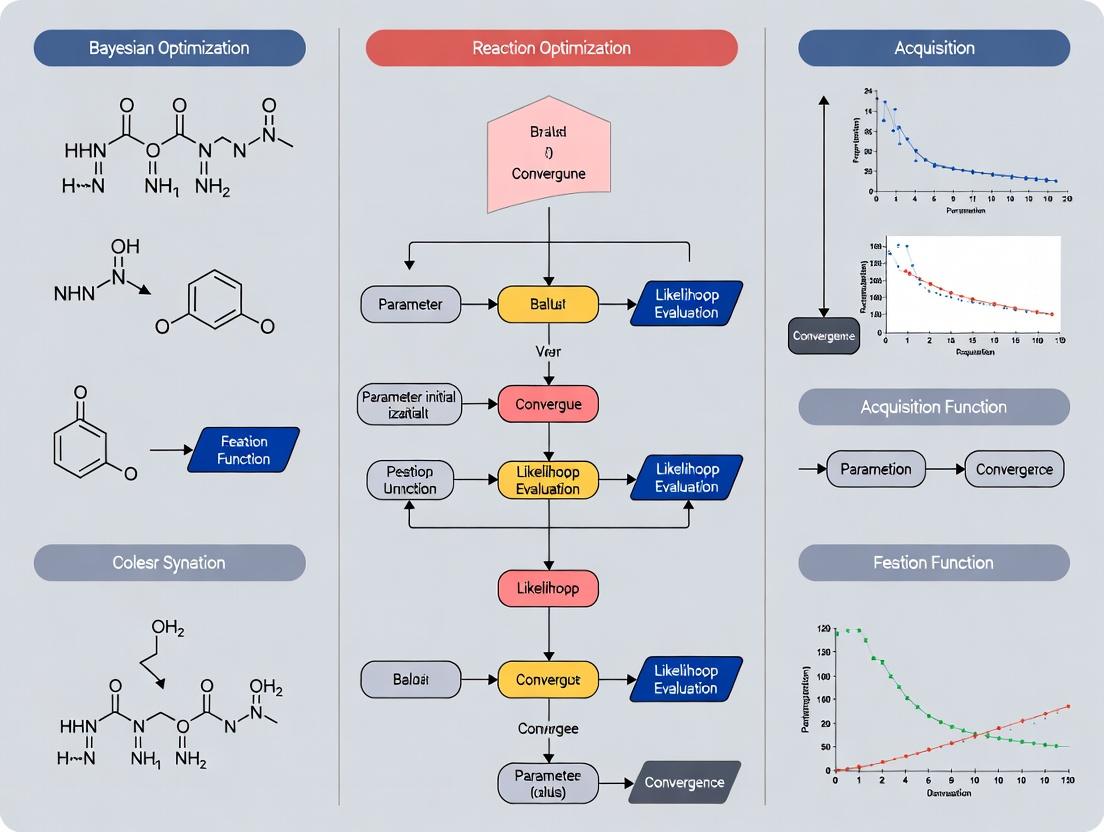
This article provides a comprehensive guide to Bayesian Optimization (BO) for automating and accelerating the discovery of optimal chemical reaction conditions.
Bayesian Optimization for Reaction Conditions: A Machine Learning Guide for Accelerated Drug Discovery
Abstract
This article provides a comprehensive guide to Bayesian Optimization (BO) for automating and accelerating the discovery of optimal chemical reaction conditions. We explore the foundational principles of BO as an efficient global optimization strategy for expensive-to-evaluate black-box functions, such as reaction yield or selectivity. The methodological section details practical implementation, including surrogate model selection (e.g., Gaussian Processes), acquisition functions (EI, UCB, PI), and experimental design. We address common pitfalls, parallelization strategies (batch BO), and constraints handling. Finally, we validate BO's effectiveness through comparative analysis with traditional optimization methods like Design of Experiments (DoE) and grid search, highlighting its transformative potential in reducing experimental cost and time in pharmaceutical R&D.
What is Bayesian Optimization? Core Principles for Reaction Optimization
In synthetic chemistry and drug development, optimizing reaction conditions (e.g., catalyst, ligand, solvent, temperature, concentration) is a multidimensional challenge traditionally addressed through costly, time-consuming trial-and-error or one-variable-at-a-time (OVAT) experimentation. This application note frames the problem within the thesis that Bayesian Optimization (BO) guided by machine learning (ML) provides a superior, data-driven framework for reaction optimization. We detail protocols and data demonstrating how BO-ML systematically navigates complex chemical space to discover optimal conditions with minimal experimental iterations.
Quantitative Data: Traditional vs. BO-ML Approaches
Data sourced from recent literature on reaction optimization via Bayesian Optimization.
Table 1: Comparative Performance of Optimization Methods for a Palladium-Catalyzed C-N Cross-Coupling Reaction
| Optimization Method | Initial Experiments | Total Experiments to >90% Yield | Total Resource Cost (Estimated) | Optimal Conditions Found |
|---|---|---|---|---|
| Traditional OVAT | 1 (baseline) | 96 | 100% (Baseline) | Yes |
| Human Design-of-Experiments (DoE) | 24 | 48 | 60% | Yes |
| Bayesian Optimization (ML-Guided) | 12 | 24 | 30% | Yes |
Table 2: Key Parameters & Bounds for BO-ML Optimization of C-N Coupling
| Parameter | Symbol | Range/Bounds | Role in Optimization |
|---|---|---|---|
| Catalyst Loading | Cat | 0.5 - 2.0 mol% | Continuous Variable |
| Ligand Equivalents | Lig | 1.0 - 3.0 eq. | Continuous Variable |
| Base Concentration | Base | 1.0 - 3.0 eq. | Continuous Variable |
| Reaction Temperature | Temp | 60 - 120 °C | Continuous Variable |
| Solvent Dielectric | Solv | 4.0 - 25.0 (ε) | Categorical (Transformed) |
| Reaction Yield | Yield | 0-100% | Objective Function |
Experimental Protocol: Bayesian Optimization for Reaction Screening
Protocol 1: Setting Up a Bayesian Optimization Loop for Chemical Reactions
Objective: To maximize the yield (or other metric) of a target chemical reaction by iteratively selecting experiments via a Bayesian surrogate model.
I. Pre-Optimization Phase
- Define Search Space: Precisely specify continuous (e.g., temperature) and categorical (e.g., solvent type) variables and their bounds (See Table 2).
- Choose Objective Function: Define the primary outcome to optimize (e.g., NMR yield). Optionally, include penalties for cost or undesired byproducts.
- Select Initial Design: Perform a small set (n=8-12) of initial experiments using a space-filling design (e.g., Latin Hypercube Sampling) to gather baseline data for the model.
II. Core Optimization Loop
- Model Training: Train a Gaussian Process (GP) regression model on all accumulated data (Yield = f(Cat, Lig, Base, Temp, Solv)).
- Acquisition Function Maximization: Use an acquisition function (e.g., Expected Improvement, EI) to calculate the next most promising experimental conditions. EI balances exploitation (high predicted yield) and exploration (high uncertainty).
- Experiment Execution: Perform the reaction(s) suggested by the acquisition function in the laboratory.
- Data Augmentation: Add the new experimental result (yield) to the training dataset.
- Iteration: Repeat steps 1-4 until a yield threshold is met or the iteration budget is exhausted (typically 20-30 total experiments).
III. Post-Optimization Analysis
- Validate the top predicted conditions with triplicate experiments.
- Analyze the model's partial dependence plots to understand critical parameter interactions.
Visualization: BO-ML Workflow and Chemical Space Navigation
Title: Bayesian Optimization Loop for Chemistry
Title: Navigation Strategies in Chemical Space
The Scientist's Toolkit: Key Reagents & Materials for BO-ML-Driven Optimization
Table 3: Research Reagent Solutions for AI-Guided Reaction Screening
| Item | Function in BO-ML Workflow | Example/Notes |
|---|---|---|
| High-Throughput Experimentation (HTE) Kit | Enables rapid parallel execution of the initial design and suggested experiments. | 96-well microtiter plates with pre-weighed catalysts/ligands in vials. |
| Liquid Handling Robot | Automates reagent dispensing for reproducibility and scalability of the experimental loop. | Critical for ensuring data quality for model training. |
| In-line/Automated Analysis | Provides rapid quantification of reaction outcomes (yield, conversion). | UPLC-MS, HPLC with autosampler, or FTIR reaction monitoring. |
| BO-ML Software Platform | Hosts the algorithm for Gaussian Process modeling and acquisition function calculation. | Python libraries (scikit-learn, GPyTorch, BoTorch) or commercial platforms (Schrödinger, ASKCOS). |
| Chemical Database | Provides prior knowledge for feature generation (e.g., solvent parameters) or initial model pretraining. | PubChem, Reaxys, or internal electronic lab notebooks (ELN). |
Bayesian optimization (BO) is a powerful, sample-efficient strategy for optimizing expensive-to-evaluate "black-box" functions. In the context of machine learning for reaction condition optimization in drug development, it provides a principled mathematical framework for iteratively probing chemical space to rapidly converge on optimal conditions (e.g., yield, selectivity) with minimal experimental runs.
Core Principles and Application Notes
BO operates through a two-step iterative cycle:
- Surrogate Modeling: A probabilistic model, typically a Gaussian Process (GP), is trained on all data from previous experiments. It provides a prediction (mean) and an uncertainty estimate (variance) for all unexplored conditions.
- Acquisition Function Maximization: An acquisition function, using the surrogate's predictions, quantifies the utility of testing a new point. It balances exploitation (probing near high-performing known conditions) and exploration (probing regions of high uncertainty). The next experiment is selected by maximizing this function.
Key advantages for reaction optimization include handling noisy data, integrating prior knowledge, and optimizing over continuous, discrete, or categorical variables (e.g., catalyst, solvent, temperature).
Table 1: Comparison of Common Acquisition Functions in Bayesian Optimization
| Acquisition Function | Key Formula/Principle | Exploration-Exploitation Balance | Best For |
|---|---|---|---|
| Expected Improvement (EI) | EI(x) = E[max(f(x) - f(x*), 0)] |
Moderate, tunable via parameter ξ | General-purpose, robust |
| Upper Confidence Bound (UCB) | UCB(x) = μ(x) + κ * σ(x) |
Explicitly controlled by κ | Controlled exploration; theoretical guarantees |
| Probability of Improvement (PoI) | P(f(x) > f(x*) + ξ) |
Can be overly greedy | Rapid initial improvement, simple objectives |
Table 2: Illustrative BO Performance vs. Traditional Methods in Reaction Yield Optimization
| Optimization Method | Avg. Experiments to Reach >90% Yield | Best Yield Found (%) | Key Limitation |
|---|---|---|---|
| Bayesian Optimization (GP-UCB) | 18 ± 3 | 95.2 | Computationally intensive surrogate fitting |
| Grid Search | 45 (full factorial) | 94.8 | Exponentially scales with parameters |
| Random Search | 35 ± 8 | 92.1 | No information gain between experiments |
| One-Variable-at-a-Time (OVAT) | 28 ± 5 | 88.5 | Fails to capture parameter interactions |
Experimental Protocols
Protocol 1: Bayesian Optimization for Pd-Catalyzed Cross-Coupling Reaction Objective: Maximize reaction yield by optimizing four continuous variables: Temperature (30-100°C), Catalyst Loading (0.5-5.0 mol%), Reaction Time (1-24 h), and Equiv. of Base (1.0-3.0).
Materials: See The Scientist's Toolkit below. Pre-optimization:
- Define parameter bounds and objective (HPLC yield).
- Select an initial experimental design (e.g., 6 points via Latin Hypercube Sampling) and execute.
- Initialize BO algorithm with data from step 2. Standardize all input variables.
Iterative Optimization Cycle (Repeat until convergence or budget exhausted):
- Train Surrogate Model: Fit a Gaussian Process (GP) with a Matérn kernel to all collected (input, yield) data. Use maximum likelihood estimation for kernel hyperparameters.
- Propose Next Experiment: Calculate the Upper Confidence Bound (UCB, κ=2.0) across a dense grid of the parameter space. Identify the set of conditions
(T, Cat, t, Base)that maximize UCB. - Conduct Experiment: Perform the reaction under the proposed conditions in triplicate. Quench, work up, and analyze by HPLC using a calibrated internal standard.
- Update Dataset: Record the average yield. Append the new data point to the historical dataset.
- Check Stopping Criterion: Proceed if the iteration count is <50 AND the improvement in best yield over the last 10 iterations is >2%. Otherwise, terminate.
Protocol 2: Multi-Objective BO for Selective Inhibition Objective: Optimize reaction conditions to maximize yield of a kinase inhibitor analog while minimizing the formation of a toxic regioisomer byproduct.
- Define a vector objective:
[Yield(%), Isomer(%)]. Aim to maximize Yield and minimize Isomer. - Use a GP surrogate model for each objective.
- Employ the Expected Hypervolume Improvement (EHVI) acquisition function to propose experiments that expand the Pareto-optimal front.
- Follow a workflow similar to Protocol 1, but selecting conditions based on EHVI and analyzing outcomes for both objectives.
Mandatory Visualization
Bayesian Optimization Iterative Cycle
Gaussian Process Prior and Posterior
The Scientist's Toolkit: Research Reagent Solutions
Table 3: Essential Materials for BO-Guided Reaction Optimization
| Reagent / Material | Function / Role in BO Workflow |
|---|---|
| Automated Parallel Reactor (e.g., Chemspeed, Unchained Labs) | Enables high-throughput execution of proposed condition arrays from the BO algorithm, ensuring reproducibility and speed. |
| HPLC-MS with Automated Sampler | Provides quantitative yield/purity data (the objective function) for each reaction, essential for updating the BO dataset. |
| Bayesian Optimization Software (e.g., BoTorch, GPyOpt, custom Python) | Core computational engine for building surrogate models and calculating acquisition functions to propose next experiments. |
| Chemical Libraries (Solvents, Catalysts, Reagents) | Broad stock of categorical variables for the BO algorithm to select from, defining the search space for reaction components. |
| Electronic Lab Notebook (ELN) with API | Critical for structured data logging, linking experimental results (yield) to precise input conditions, enabling automated data pipelining to the BO platform. |
Within a thesis on Bayesian optimization (BO) for reaction condition optimization in drug discovery, understanding the triad of core components is essential. This framework automates the search for optimal conditions (e.g., yield, enantioselectivity) by intelligently balancing exploration and exploitation, drastically reducing costly experimental iterations.
Core Components: Definitions and Current Research
The Surrogate Model
The surrogate model is a probabilistic model that approximates the expensive, black-box objective function (e.g., chemical reaction yield). It provides a posterior distribution (mean and uncertainty) over the objective given observed data.
Current Trends (2024-2025): Gaussian Processes (GPs) remain the gold standard for low-dimensional problems (<20 variables). For high-dimensional chemical spaces (e.g., mixed continuous/categorical variables), advanced models are gaining traction:
- Deep Kernel Learning (DKL): Combines neural networks' feature extraction with GPs' uncertainty quantification.
- Sparse Gaussian Processes: Address scalability issues for large datasets.
- Bayesian Neural Networks (BNNs): Offer flexibility for complex, high-dimensional data but can be computationally intensive.
Table 1: Quantitative Comparison of Surrogate Model Performance
| Model Type | Best For Dimensionality | Uncertainty Estimation | Training Scalability | Typical Use in Reaction Optimization |
|---|---|---|---|---|
| Standard Gaussian Process | Low (<20) | Excellent | Poor (>500 data points) | Solvent, catalyst, temperature screening |
| Sparse Variational GP | Medium (10-50) | Good | Good | Multi-step reaction condition optimization |
| Deep Kernel Learning | High (50-500+) | Good | Medium | High-throughput experimentation (HTE) data |
| Bayesian Neural Network | Very High (100+) | Moderate | Poor | Complex biochemical or pharmacokinetic objectives |
The Acquisition Function
The acquisition function uses the surrogate's posterior to decide the next point(s) to evaluate by balancing predicted performance (exploitation) and model uncertainty (exploration).
Leading Acquisition Functions:
- Expected Improvement (EI): The most widely used function. Measures the expected gain over the current best observation.
- Upper Confidence Bound (UCB): Adds a parameter (κ) to control the exploration-exploitation trade-off explicitly: UCB(x) = μ(x) + κ * σ(x).
- Knowledge Gradient (KG): Considers the value of information after the next evaluation, beneficial in batch settings.
- q-EI / q-UCB: Extensions for parallel or batch evaluation, critical for modern lab automation.
Table 2: Key Metrics of Popular Acquisition Functions
| Function | Parallelizable | Hyperparameter Sensitive | Computationally Efficient | Dominant Use Case |
|---|---|---|---|---|
| Expected Improvement (EI) | No (requires q-EI) | Low | High | Sequential optimization of single reactions |
| Upper Confidence Bound (UCB) | Yes | Moderate (κ) | High | Highly automated platforms with clear trade-off needs |
| Knowledge Gradient (KG) | Yes (q-KG) | Low | Low (complex) | Expensive batch experiments (e.g., biologics development) |
| Thompson Sampling | Yes | Low | Medium | Very large search spaces (e.g., polymer discovery) |
The Objective
The objective function is the costly experiment to be optimized. In reaction optimization, it is often a composite function balancing multiple outcomes.
Common Objectives in Drug Development:
- Primary: Reaction yield, enantiomeric excess (ee), purity.
- Composite: Weighted sum of yield and cost, or multi-objective optimization (Pareto fronts) for yield vs. environmental factor (e.g., E-factor).
- Constrained: Maximize yield subject to impurity being below a threshold.
Experimental Protocol: A Standard Bayesian Optimization Loop for Reaction Screening
Aim: To autonomously optimize the yield of a Pd-catalyzed cross-coupling reaction.
Protocol Steps:
- Define Search Space: Specify bounds/choices for continuous (temperature: 25-100°C, time: 1-24 h) and categorical (solvent: DMF, toluene, dioxane; ligand: L1-L4) variables.
- Initial Design: Perform a space-filling design (e.g., Latin Hypercube Sampling) for n=8 initial experiments. Execute reactions in parallel, purify, and quantify yield (HPLC analysis).
- Surrogate Model Training: Standardize input variables. Train a GP model with a Matérn kernel (ν=2.5) using the n input-condition → output-yield pairs. Optimize kernel hyperparameters via marginal likelihood maximization.
- Acquisition Optimization: Using the trained GP, compute the Expected Improvement (EI) across the search space. Identify the condition set x_next that maximizes EI. For parallel execution, optimize q-EI for a batch of 4 suggestions.
- Experiment & Update: Execute the reaction(s) at the suggested condition(s) x_next. Measure the objective (yield). Append the new data (x_next, y_next) to the existing dataset.
- Iteration: Repeat steps 3-5 for a predefined budget (e.g., 40 total experiments) or until a performance threshold (e.g., >90% yield) is met.
- Validation: Conduct triplicate experiments at the predicted optimal conditions to confirm reproducibility.
Visualization: Bayesian Optimization Workflow
Title: Bayesian Optimization Closed-Loop for Reaction Screening
The Scientist's Toolkit: Key Reagent Solutions for BO-Driven Reaction Optimization
Table 3: Essential Research Reagents and Materials
| Item | Function in BO Workflow | Example/Note |
|---|---|---|
| Automated Liquid Handling System | Enables precise, reproducible dispensing of reagents for initial design and iterative experiments. | Hamilton STAR, Labcyte Echo. Critical for high-throughput data generation. |
| Parallel Reactor Platform | Allows simultaneous execution of multiple reaction conditions under controlled environments (T, stirring). | HEL FlowCAT, Unchained Labs Junior. Provides the experimental throughput. |
| Online Analytical Instrument | Rapid, in-line quantification of reaction outcomes (yield, conversion). | Mettler Toledo ReactIR, HPLC/MS with autosampler. Accelerates the data collection step. |
| BO Software Library | Provides implemented algorithms for surrogate modeling and acquisition optimization. | BoTorch (PyTorch-based), Scikit-Optimize, GPyOpt. The computational core. |
| Chemical Variable Library | Pre-curated sets of solvents, catalysts, ligands, and reagents defining the categorical search space. | Solvents: varied polarity & proticity. Ligands: diverse steric/electronic profiles. |
| Standard Substrate Pair | Well-characterized starting materials for method development and BO algorithm benchmarking. | E.g., Boronic acid & aryl halide for Suzuki coupling optimization studies. |
Why Gaussian Processes Are the Go-To Surrogate for Chemical Spaces
Within Bayesian optimization (BO) frameworks for reaction condition screening and molecular property prediction, selecting a surrogate model is critical. Gaussian Processes (GPs) have become the predominant surrogate model for navigating chemical spaces due to their principled quantification of uncertainty and natural ability to model complex, non-linear relationships from sparse data.
Core Advantages in Chemical Space Applications
Table 1: Quantitative Comparison of Surrogate Models for Chemical Space
| Model Feature | Gaussian Process | Random Forest | Neural Network | Support Vector Machine |
|---|---|---|---|---|
| Intrinsic Uncertainty Quantification | Native (via predictive variance) | Via ensemble methods (e.g., jackknife) | Requires Bayesian or ensemble variants | Limited; typically point estimates |
| Data Efficiency | High (effective with <1000 samples) | Moderate | Low (requires large datasets) | Moderate |
| Handling of Sparse, Noisy Data | Excellent (via kernel & likelihood) | Good | Poor (prone to overfitting) | Moderate |
| Model Interpretability | Moderate (via kernel analysis) | High (feature importance) | Low | Moderate (support vectors) |
| Typical Optimization Overhead | O(n³) for training | O(n·trees) | Variable, often high | O(n² to n³) |
| Common Use in BO for Chemistry | >70% of published studies (est.) | ~15% | ~10% | <5% |
The cornerstone of a GP is its kernel (covariance) function, which dictates the similarity between molecular descriptors or fingerprints. For chemical spaces, the Matérn kernel (particularly ν=5/2) and composite kernels are standards.
Application Notes: GP-Guided Reaction Optimization
Protocol 3.1: Setting Up a GP Surrogate for Reaction Yield Prediction Objective: Build a GP model to predict reaction yield based on continuous (temperature, concentration) and categorical (catalyst, solvent) condition variables.
- Feature Representation: Encode continuous variables via min-max scaling. Encode categorical variables (e.g., 15 solvent choices) using a one-hot or learned embedding.
- Kernel Selection: Construct a composite kernel:
(Matérn(ν=5/2) on continuous vars) + (WhiteKernel for noise). For categorical variables, use a separate Matérn kernel on their embeddings. - Model Initialization: Use
GPRegressor(scikit-learn) orSingleTaskGP(BoTorch/GPyTorch). Set the likelihood toGaussianLikelihoodto model homoscedastic noise. - Training: Maximize the marginal log-likelihood using the L-BFGS-B optimizer. Typical convergence is achieved in <100 iterations for datasets of ~100 points.
- Validation: Perform 5-fold cross-validation. A well-specified GP should achieve a Q² > 0.6 and the predictive variance should correlate with absolute error.
The Scientist's Toolkit: Key Reagents for GP-Based Chemical BO
| Item | Function & Rationale |
|---|---|
| RDKit or Mordred | Generates molecular fingerprints (e.g., Morgan) or 2D/3D descriptors as input features for the GP. |
| scikit-learn / GPyTorch | Provides core GP regression implementations, optimizers, and kernel functions. |
| BoTorch or GPflow | Frameworks for scalable, high-level BO, integrating GP surrogates with acquisition functions. |
| Dragonfly or Sherpa | Alternative platforms for hyperparameter tuning and experimental design using GPs. |
| Custom Composite Kernels | Kernels combining linear, periodic, and Matérn components to model complex chemical relationships. |
Experimental Protocols
Protocol 4.1: Iterative Bayesian Optimization Loop for Catalyst Discovery Objective: Identify a high-performance catalyst from a library of 500 candidates within 50 experimental cycles.
- Initial Design: Select an initial diverse set of 10 catalysts using MaxMin diversity algorithm on molecular fingerprint space.
- Experimental Run: Perform reaction with each catalyst under standardized conditions; measure yield and selectivity.
- GP Model Update: Train a GP on the accumulated data, using a Tanimoto kernel on Morgan fingerprints to model catalyst similarity.
- Acquisition Function: Calculate Expected Improvement (EI) over the entire catalyst library. EI balances predicted high yield (exploitation) and high uncertainty (exploration).
- Next Experiment Selection: Choose the catalyst with the maximum EI score.
- Iteration: Repeat steps 2-5 until a yield >85% is achieved or the cycle limit is reached.
- Analysis: The final GP model provides a predictive landscape of catalyst performance, identifying structural features correlated with high yield.
Protocol 4.2: Uncertainty-Calibrated Virtual Screening Objective: Prioritize 50,000 virtual compounds for synthesis and testing against a target protein, focusing on predicted high activity and reliable predictions.
- Data Preparation: Use a curated set of 200 known active/inactive compounds with pIC50 values.
- GP Model Training: Train a GP using an ensemble of kernels (e.g., RBF on MACCS keys + linear kernel on physicochemical descriptors).
- Prediction & Uncertainty Estimation: Predict mean (μ) and predictive variance (σ²) for all 50,000 virtual compounds.
- Ranking Strategy: Rank compounds not just by μ, but by a lower confidence bound (LCB) score:
LCB = μ - κ * σ, where κ=1.5 (balances optimism with uncertainty). This penalizes compounds with high uncertainty. - Synthesis Priority List: Select the top 100 compounds ranked by LCB for further consideration.
Visualizations
Title: Bayesian Optimization Loop with GP Surrogate
Title: GP Kernel Composition for Chemical Features
The Exploration vs. Exploitation Trade-Off in Experiment Design
In Bayesian optimization (BO) for reaction condition screening in drug development, the exploration-exploitation trade-off is central. The algorithm must decide between exploring uncertain regions of the chemical space (potentially finding superior conditions) and exploiting known high-performing regions to optimize the objective function. This document provides application notes and protocols for implementing this trade-off in machine learning-guided experimentation.
Quantitative Comparison of Acquisition Functions
The core of managing the trade-off lies in the choice of acquisition function. The table below summarizes key functions, their parameters, and trade-off characteristics.
Table 1: Acquisition Functions for Managing Exploration/Exploitation
| Acquisition Function | Key Parameter(s) | Exploitation Bias | Exploration Bias | Primary Use Case |
|---|---|---|---|---|
| Expected Improvement (EI) | ξ (xi) | High (ξ=0.01) | Adjustable (ξ=0.1+) | General-purpose optimization |
| Upper Confidence Bound (UCB) | κ (kappa) | Low (κ=1.0) | High (κ=2.0+) | Directed exploration |
| Probability of Improvement (PI) | ξ (xi) | Very High | Low | Refining known optima |
| Thompson Sampling | Random sample from posterior | Balanced | Balanced | Stochastic parallelization |
| Entropy Search/Predicted Entropy Search | - | Information-theoretic | Maximizes information gain | Global mapping |
Data sourced from current literature (2024-2025) on Bayesian optimization benchmarks in chemical reaction space.
Experimental Protocol: Iterative BO Cycle for Reaction Optimization
This protocol details a standard cycle for optimizing a catalytic cross-coupling reaction using a BO framework.
Protocol 3.1: Iterative Bayesian Optimization Loop Objective: Maximize reaction yield over a multidimensional condition space (e.g., catalyst loading, ligand, temperature, concentration, solvent). Materials: See "Scientist's Toolkit" (Section 6). Procedure:
- Initial Design (Pure Exploration):
- Define parameter bounds and constraints (e.g., temperature: 25-100°C, catalyst: 0.5-5 mol%).
- Using a space-filling design (e.g., Latin Hypercube Sampling), run n initial experiments (n=8-16) to seed the model.
- Analyze yields (HPLC/LCMS) and record data.
Model Training (Gaussian Process):
- Standardize input features (e.g., scale to 0-1).
- Train a Gaussian Process (GP) regression model with a Matérn kernel. The GP provides a surrogate model of the reaction landscape: a mean prediction and uncertainty (variance) for any unobserved condition set.
Acquisition Function Optimization (Trade-off Decision):
- Select an acquisition function α(x) (e.g., EI with ξ=0.05).
- Maximize α(x) over the defined parameter space using a numerical optimizer (e.g., L-BFGS-B) to propose the next experiment's conditions. This step automatically balances exploring high-uncertainty regions and exploiting predicted high-yield regions.
Experiment Execution & Model Update:
- Perform the reaction at the proposed conditions.
- Quantify the yield.
- Append the new {conditions, yield} data pair to the training set.
- Retrain/update the GP model.
Iteration & Termination:
- Repeat steps 3-4 for a predefined number of iterations (e.g., 20-40) or until yield/convergence criteria are met (e.g., no improvement in max yield over 5 iterations).
- Analyze the final model to identify optimal conditions and interpret variable importance.
Protocol: Benchmarking Acquisition Functions
To empirically determine the best strategy for a specific reaction class, a benchmarking study is recommended.
Protocol 4.1: Benchmarking the Trade-off
- Select a known reaction system with a published or internally mapped yield landscape.
- Define a standardized initial design (same for all benchmarks).
- Run parallel, simulated BO campaigns using different acquisition functions (EI, UCB, PI) and multiple parameter settings (e.g., κ=1.0, 2.0, 3.0 for UCB).
- Track key metrics over iterations: Best Found Yield, Cumulative Regret, and Model Uncertainty Reduction.
- Compare the convergence rates and final outcomes to recommend a function for similar reaction spaces.
Table 2: Sample Benchmark Results (Simulated Suzuki-Miyaura Optimization)
| Iteration | EI (ξ=0.05) Best Yield | UCB (κ=2.0) Best Yield | PI (ξ=0.01) Best Yield | Random Search Best Yield |
|---|---|---|---|---|
| 0 (Init) | 45% | 45% | 45% | 45% |
| 5 | 78% | 72% | 85% | 65% |
| 10 | 92% | 88% | 90% | 78% |
| 15 | 95% | 95% | 92% | 82% |
| 20 | 98% | 97% | 93% | 85% |
Simulated data based on recent publications comparing BO strategies in high-throughput experimentation.
Visualizations
BO Workflow for Reaction Optimization
Acquisition Functions Balance Trade-Off
The Scientist's Toolkit: Key Research Reagents & Materials
Table 3: Essential Toolkit for ML-Guided Reaction Optimization
| Item | Function & Relevance to BO |
|---|---|
| High-Throughput Experimentation (HTE) Plate/Block | Enables parallel execution of initial design or batch proposals, drastically reducing cycle time per iteration. |
| Automated Liquid Handling System | Provides precise, reproducible dispensing of reagents (catalysts, ligands, substrates) across multidimensional condition arrays. Critical for reliable data generation. |
| Online/At-line Analytical (HPLC, UPLC-MS, GC) | Rapid yield/selectivity quantification to close the BO loop quickly. Integration with data pipelines is ideal. |
| Chemical Inventory & ELN | Structured data on reagent properties (e.g., pKa, steric volume) for feature engineering, enhancing the GP model's predictive power. |
| BO Software Library (e.g., BoTorch, Ax, GPyOpt) | Provides implemented acquisition functions, GP models, and optimization routines to build the experimental workflow. |
| Cloud/High-Performance Computing (HPC) | Resources for training GP models and optimizing acquisition functions over high-dimensional spaces, which is computationally intensive. |
The optimization of reaction conditions in chemical synthesis and drug development is a fundamental challenge. This document, framed within a thesis on Bayesian Optimization (BO) for machine learning-driven research, compares two traditional experimental design methods—One-Factor-at-a-Time (OFAT) and Full Factorial Design (FFD)—with the emerging approach of Bayesian Optimization. The objective is to provide application notes and detailed protocols for researchers aiming to efficiently navigate complex experimental spaces, such as reaction condition optimization, where factors like temperature, catalyst loading, pH, and solvent composition interact non-linearly.
Methodological Comparison: Core Principles
One-Factor-at-a-Time (OFAT): An iterative, sequential approach where one variable is changed while all others are held constant at a baseline. It is simple to execute and interpret but fails to detect interactions between factors, often leading to suboptimal results.
Full Factorial Design (FFD): A structured approach that experiments with all possible combinations of levels for all factors. It captures all main effects and interactions but becomes prohibitively expensive (experimentally) as the number of factors or levels increases (experiments = L^k, where L is levels and k is factors).
Bayesian Optimization (BO): A machine learning framework for global optimization of expensive black-box functions. It builds a probabilistic surrogate model (e.g., Gaussian Process) of the objective (e.g., reaction yield) and uses an acquisition function (e.g., Expected Improvement) to guide the selection of the next most promising experiment. It is highly sample-efficient, actively manages the trade-off between exploration and exploitation, and naturally handles noise.
Table 1: High-Level Method Comparison
| Feature | OFAT | Full Factorial (2-Level) | Bayesian Optimization |
|---|---|---|---|
| Experimental Efficiency | Low | Very Low (exponential growth) | Very High |
| Ability to Find Global Optimum | Low | High (within design space) | Very High |
| Handling of Factor Interactions | None | Complete | Model-Dependent |
| Number of Experiments for k factors | Linear (~k*L) | Exponential (2^k) | Sub-linear (Typically < 50) |
| Ease of Implementation | Very High | Medium | Medium (requires ML expertise) |
| Adaptivity | None | None | High |
| Best Use Case | Preliminary screening, very few factors | Small factor sets (k<5), where interactions are critical | Expensive experiments, >4 factors, non-linear responses |
Table 2: Simulated Optimization of a Palladium-Catalyzed Cross-Coupling Reaction (4 factors) Target: Maximize Yield. Baseline OFAT yield: 65%. Theoretical maximum: 95%.
| Method | Avg. Experiments to Reach >90% Yield | Total Expts. for Full Evaluation | Max Yield Found | Key Interaction Identified? |
|---|---|---|---|---|
| OFAT | Not Reached (plateau at ~78%) | 16 | 78% | No |
| Full Factorial (2^4) | 16 (all required) | 16 | 92% | Yes |
| Bayesian Optimization | 11 (± 3) | 20 (stopping point) | 94% | Yes (via model) |
Experimental Protocols
Protocol 4.1: OFAT for Preliminary Reaction Scoping
Objective: Identify rough trends for individual factors. Materials: See Scientist's Toolkit. Procedure:
- Establish Baseline: Run reaction with pre-defined standard conditions (e.g., 80°C, 2 mol% Catalyst, 1.5 eq. Base, Solvent A).
- Vary Temperature: Perform reactions at 60, 70, 80, 90, 100°C, holding all other factors at baseline.
- Analyze: Plot yield vs. temperature. Select the best level (e.g., 90°C).
- Iterate: Using the new best temperature (90°C), vary Catalyst Loading (1, 1.5, 2, 2.5 mol%) while holding others. Continue sequentially for all factors.
- Final Condition: The combination of individually optimal levels is declared the optimum.
Protocol 4.2: Full Factorial Design (2-Level) for Interaction Analysis
Objective: Quantify main effects and all two-factor interactions. Design: 2^4 design for factors A (Temp: Low/High), B (Catalyst: Low/High), C (BaseEq: Low/High), D (Solvent: Type1/Type2). Procedure:
- Define Levels: Set realistic high/low levels for each factor (e.g., Temp: 70°C / 110°C).
- Generate Design Matrix: List all 16 unique combinations.
- Randomize Order: Randomize run order to minimize bias.
- Execute Experiments: Perform each reaction in the randomized order.
- Statistical Analysis: Use multiple linear regression (Yield = β0 + β1A + β2B + β3C + β4D + β12AB + ...) to calculate effect sizes and p-values. A significant interaction term (e.g., A*B) indicates the effect of temperature depends on catalyst loading.
Protocol 4.3: Bayesian Optimization for Efficient Optimization
Objective: Maximize reaction yield with a budget of 20 experiments. Procedure:
- Define Search Space: Specify continuous ranges for each factor (e.g., Temp: [50, 120]°C).
- Initial Design: Perform 4-5 initial experiments using a space-filling design (e.g., Latin Hypercube) to seed the model.
- Model & Iterate: For each iteration: a. Surrogate Modeling: Fit a Gaussian Process (GP) model to all data collected so far. b. Acquisition Maximization: Calculate the Expected Improvement (EI) across the search space. Select the factor combination that maximizes EI. c. Experiment: Run the reaction at the proposed conditions. d. Update: Add the new (input, yield) data point to the dataset.
- Termination: Stop after 20 experiments or when yield improvement plateaus. The best observed condition is the recommended optimum.
Visual Workflows
Diagram 1: Sequential OFAT Workflow
Diagram 2: Full Factorial Design Process
Diagram 3: Bayesian Optimization Iterative Loop
The Scientist's Toolkit: Key Research Reagent Solutions
Table 3: Essential Materials for Reaction Optimization Studies
| Reagent/Material | Function/Explanation | Example in Cross-Coupling |
|---|---|---|
| Precatalyst Systems | Source of active metal center; choice influences rate, selectivity, and functional group tolerance. | Pd(PPh3)4, Pd2(dba)3, XPhos Pd G3 |
| Ligand Libraries | Modulate catalyst properties (sterics, electronics); critical for optimization. | Phosphine (SPhos), N-Heterocyclic Carbene (IPr·HCl) ligands |
| Base Solutions | Scavenge acids, facilitate transmetalation; type and equivalence are key variables. | K2CO3 (aqueous), Cs2CO3, organic bases (DIPEA) |
| Anhydrous Solvents | Reaction medium; affects solubility, stability, and mechanism. | Toluene, 1,4-Dioxane, DMF, MeCN (sparged with N2) |
| Quenching Agents | Safely terminate reactions for analysis. | Aqueous NH4Cl, silica gel plugs |
| Internal Standards | For accurate yield determination via chromatographic analysis. | Trifluoromethylbenzene, tetradecane (GC); 1,3,5-trimethoxybenzene (NMR) |
| Analytical Standards | Pure samples for calibration and product identification. | Authentic sample of target product for HPLC/GC retention time and NMR comparison |
Implementing Bayesian Optimization: A Step-by-Step Workflow for Chemists
Within Bayesian optimization (BO) for reaction condition optimization, the initial and most critical step is the rigorous definition of the search space. This space is a multidimensional hyperparameter domain where each axis represents a continuous or categorical reaction variable. A well-constructed search space bounds the BO algorithm's exploration, improving convergence efficiency and the practical relevance of discovered optima. This protocol details the systematic definition of search spaces for four fundamental parameters: catalysts, temperatures, solvents, and reagent equivalents, framing them as input variables for machine learning models.
Quantitative Parameter Ranges & Data Types
The following table summarizes typical ranges and data handling strategies for key parameters, based on current literature in automated synthesis and high-throughput experimentation (HTE).
Table 1: Search Space Parameter Specifications for Bayesian Optimization
| Parameter | Typical Type in BO | Recommended Range / Options | Data Encoding | Justification & Constraints |
|---|---|---|---|---|
| Catalyst | Categorical | E.g., Pd(PPh₃)₄, Pd(dba)₂, XPhos Pd G2, Ni(acac)₂, None | One-Hot or Label | Selection guided by reaction chemistry. Include a "no catalyst" option. |
| Temperature (°C) | Continuous (or Ordinal) | -78 to 250 (or solvent boiling point) | Normalized [0,1] | Lower bound set by cryogenic cooling; upper bound by solvent/reagent stability. |
| Solvent | Categorical | E.g., DMF, THF, Toluene, MeOH, ACN, DMSO, Water | One-Hot or SMILES | Prioritize solvents with diverse polarity, dielectric constant, and protic/aprotic nature. |
| Reagent Equivalents | Continuous | 0.5 to 3.0 (relative to limiting reagent) | Normalized [0,1] | Prevents large excesses that waste material or cause side reactions. |
| Reaction Time (hr) | Continuous | 0.5 to 48 | Log-scale normalization | Covers a broad dynamic range from fast to slow kinetics. |
| Concentration (M) | Continuous | 0.01 to 0.50 | Normalized [0,1] | Avoids overly dilute or viscous conditions. |
Experimental Protocol: High-Throughput Search Space Validation
This protocol describes the generation of a small, space-filling initial dataset (e.g., via Latin Hypercube Sampling) to validate the defined search space before full BO campaign initiation.
Materials & Reagents
Table 2: Research Reagent Solutions & Essential Materials
| Item | Function / Specification |
|---|---|
| Liquid Handling Robot | For precise, automated dispensing of catalysts, solvents, and reagents in microliter volumes. |
| HTE Reaction Blocks | 96-well or 384-well plates compatible with heating, stirring, and inert atmosphere. |
| Catalyst Stock Solutions | 0.1 M solutions in appropriate dry solvent (e.g., THF, Toluene), stored under argon. |
| Anhydrous Solvents | Stored over molecular sieves under inert gas to prevent hydrolysis-sensitive reactions. |
| Internal Standard Solution | Pre-weighed, consistent compound for reaction quenching and HPLC/GC-MS quantification. |
| Automated LC-MS/GC-MS System | High-throughput analytical system for rapid yield/conversion analysis. |
Step-by-Step Procedure
- Algorithmic Design: Use a Latin Hypercube Sampling (LHS) algorithm to select 20-30 distinct reaction condition sets from the defined multidimensional search space (Table 1). Ensure non-collapsing projections for each parameter.
- Plate Map Generation: Translate the LHS output into a robotic dispensing instruction file. Assign each condition to a specific well, including positive (known high-yielding condition) and negative (no catalyst, no heat) controls.
- Automated Dispensing: a. Purge the HTE reaction block with inert gas (N₂ or Ar). b. Using the liquid handler, first dispense the specified volumes of solvent to each well. c. Dispense the stock solutions of the substrate(s) and internal standard. d. Dispense the specified volume of catalyst stock solution. For "no catalyst" wells, dispense pure solvent. e. Finally, dispense the reagent stock solution to initiate the reaction.
- Reaction Execution: Seal the reaction block, initiate stirring, and transfer it to a pre-equilibrated heating block set to the specified temperature for each well (using a gradient thermal cycler if available). Run for the designated time.
- Quenching & Analysis: Automatically inject a quenching agent (e.g., a defined volume of acid or scavenger resin solution) into each well. Dilute an aliquot from each well with a standard analysis solvent.
- High-Throughput Analysis: Inject samples via an autosampler into the LC-MS/GC-MS. Quantify yield or conversion relative to the internal standard using calibrated curves or direct UV/ELSD response.
- Data Aggregation: Compile results (Yield/Conversion %) into a table matching the initial LHS design matrix. This forms the initial dataset for the BO algorithm.
Bayesian Optimization Workflow Integration
Diagram 1: BO Loop for Reaction Optimization
Parameter Interaction Diagram
Diagram 2: Key Parameter Interactions Affecting Outcome
In Bayesian Optimization (BO) for chemical reaction optimization, the objective function is the critical bridge between experimental outcomes and algorithmic learning. It quantitatively encodes the chemist's primary goal—maximizing yield, enhancing selectivity, or minimizing cost—into a single, computable metric. The formulation of this function directly dictates the efficiency and practical relevance of the optimization campaign. Within a broader machine learning research thesis, this step represents the translation of chemical intuition into a landscape that the BO algorithm can navigate.
Quantitative Data: Common Objective Function Formulations
Table 1: Standard Objective Function Components for Reaction Optimization
| Objective Primary Goal | Typical Mathematical Formulation | Key Variables | Advantages | Limitations |
|---|---|---|---|---|
| Maximizing Yield | f(x) = Yield(%) |
x: Reaction parameters (e.g., temp., conc.) |
Simple, direct, high throughput compatible. | Ignores impurities, cost, and sustainability. |
| Enhancing Selectivity | f(x) = Selectivity Index = [Product] / [Byproduct] or f(x) = -[Byproduct] |
x: Parameters influencing pathway kinetics. |
Drives towards cleaner reactions, reduces purification burden. | May compromise absolute yield. Requires analytical differentiation (e.g., GC, HPLC). |
| Minimizing Cost | f(x) = -[α*(Material Cost) + β*(Processing Cost) + γ*(Time Cost)] |
α, β, γ: Weighting coefficients; Cost factors. |
Promotes economically viable and scalable conditions. | Requires accurate cost models and weighting decisions. |
| Multi-Objective Composite | f(x) = w₁*Yield + w₂*Selectivity - w₃*Cost |
w₁, w₂, w₃: Normalized weighting factors summing to 1. |
Balances multiple, often competing, priorities. | Weight selection is subjective; requires domain expertise or Pareto front analysis. |
Table 2: Reported Performance of Different Objective Functions in BO Studies
| Study (Representative) | Reaction Type | Objective Function Chosen | BO Algorithm | Key Outcome | Reference Year* |
|---|---|---|---|---|---|
| Organic Synthesis | Pd-catalyzed C-N coupling | Yield (%) | Gaussian Process (GP)-BO | Achieved >95% yield in <15 experiments. | 2022 |
| Photoredox Catalysis | Alkene functionalization | Selectivity (Area% of desired isomer) | GP-BO | Improved regio-selectivity from 3:1 to >20:1. | 2023 |
| API Development | Multi-step sequence | Composite (0.7Yield + 0.3-Cost) | Tree-structured Parzen Estimator (TPE) | Reduced estimated cost by 35% vs. baseline. | 2023 |
| Biocatalysis | Enzyme-mediated reduction | Yield * Enzyme Turnover Number | Batch BO | Optimized for both efficiency and catalyst stability. | 2024 |
Note: Information sourced from recent literature searches.
Experimental Protocols
Protocol 3.1: Establishing a Baseline and Defining a Composite Objective Function
Aim: To initiate a BO campaign for a novel Suzuki-Miyaura cross-coupling reaction with considerations for yield, selectivity (against homo-coupling), and reagent cost.
Materials: (See Scientist's Toolkit) Procedure:
- Initial Design of Experiment (DoE): Perform 6-8 initial reactions using a space-filling design (e.g., Latin Hypercube) across the defined parameter space (Catalyst Loading: 0.5-2.5 mol%; Temperature: 25-80°C; Equiv. of Base: 1.0-3.0).
- Analytical Quantification:
- Quench reactions and dilute for analysis.
- Analyze via UPLC with UV detection at 254 nm.
- Quantify Yield using a calibrated external standard of the target product.
- Quantify Selectivity as
[Product Area] / ([Product Area] + [Homo-coupling Byproduct Area]).
- Cost Assignment: Calculate a normalized Cost Index for each condition using current catalog prices for catalysts, ligands, and reagents. Set the cheapest possible condition in the design space to an index of 1.0.
- Objective Function Calculation: For each experiment
i, compute:Objective_i = (0.50 * Normalized_Yield_i) + (0.35 * Selectivity_i) + (0.15 * (1 / Cost_Index_i)). Normalization scales Yield and (1/Cost) from 0 to 1 relative to the initial dataset. - Data Submission: Input the parameter sets and corresponding
Objectivevalues into the BO software platform as the training data.
Protocol 3.2: Iterative BO Loop for Objective Function Maximization
Aim: To execute the automated cycle of suggestion, experimentation, and learning. Procedure:
- Model Training: The BO algorithm (e.g., GP) models the relationship between reaction parameters and the composite objective score using the existing data.
- Acquisition Function Optimization: The algorithm's acquisition function (e.g., Expected Improvement) proposes the next 3-5 reaction conditions that balance exploration and exploitation.
- Robotic Execution: Program an automated liquid handling platform to prepare reactions in parallel according to the proposed conditions.
- Inline/Online Analysis: Transfer reaction aliquots to an inline HPLC or ReactIR for rapid analysis. Automate data processing to compute the objective score.
- Data Augmentation & Iteration: Append the new
(parameters, objective)results to the training set. Return to Step 1. Continue until convergence (e.g., <5% improvement over 3 consecutive iterations) or a resource limit is reached.
Mandatory Visualizations
Title: Workflow for Formulating the BO Objective Function
Title: Data Fusion into a Single Objective Score
The Scientist's Toolkit
Table 3: Essential Research Reagent Solutions & Materials
| Item | Function in Objective Function Development | Example/Note |
|---|---|---|
| Automated Synthesis Platform (e.g., Chemspeed, HEL Flowcat) | Enables high-fidelity, reproducible execution of the reaction conditions proposed by the BO algorithm. Critical for gathering consistent data. | Flowcat systems allow precise control of continuous variables (temp, flow rate). |
| Inline/Online Analytical (e.g., ReactIR, HPLC-SFC) | Provides rapid, quantitative data (yield, conversion, selectivity) for immediate objective function calculation without manual workup. | ReactIR monitors functional group conversion in real-time. |
| Chemical Cost Database (Internal or Commercial) | Supplies up-to-date reagent, catalyst, and solvent pricing for calculating the economic component of a cost-informed objective function. | Can be integrated via API into the data processing pipeline. |
| Data Management Software (e.g., CDD Vault, Benchling) | Centralizes experimental parameters, analytical results, and calculated objective scores, ensuring traceability and easy data export for BO. | |
| BO Software Library (e.g., BoTorch, Ax Platform) | Provides the algorithmic backbone for modeling the objective function landscape and suggesting new experiments. | Ax offers user-friendly interfaces for composite metric definition. |
| Normalization Scripts (Python/R) | Custom code to scale disparate metrics (%, ratio, $) to a common range (e.g., 0-1) before weighted summation, preventing unit bias. | Essential for robust composite functions. |
Within a Bayesian optimization (BO) framework for reaction condition optimization, the surrogate model approximates the unknown objective function (e.g., reaction yield, enantiomeric excess). The Gaussian Process (GP) is the predominant choice due to its inherent uncertainty quantification. The kernel (or covariance function) is the core of the GP, defining its prior over functions and profoundly impacting BO performance. This protocol details the selection and tuning of GP kernels for chemical applications.
Kernel Selection: A Comparative Analysis
Kernels encode assumptions about function properties like smoothness, periodicity, and trends. The table below summarizes key kernels for chemical optimization.
Table 1: Common GP Kernels and Their Applicability in Chemical Optimization
| Kernel Name & Mathematical Form | Hyperparameters (θ) | Function Properties | Best For Chemical Use-Case | Key Reference (from search) | ||||
|---|---|---|---|---|---|---|---|---|
| Radial Basis Function (RBF) / Squared Exponentialk(x,x') = σ² exp( -0.5 | x-x' | ² / l² ) | Signal variance (σ²), Length-scale (l) | Infinitely differentiable, very smooth. | Default choice for smoothly varying, continuous reaction landscapes (e.g., yield vs. temperature, concentration). | Rasmussen & Williams (2006), Gaussian Processes for Machine Learning | ||
| Matérn (ν=3/2)k(x,x') = σ² (1 + √3 r / l) exp(-√3 r / l)where r = ||x-x'|| | Signal variance (σ²), Length-scale (l) | Once differentiable, less smooth than RBF. | Realistic physical/chemical processes where response is not infinitely smooth. More robust to noise. | Shields et al. (2021), Nature (reaction optimization benchmark) | ||||
| Matérn (ν=5/2)k(x,x') = σ² (1 + √5 r/l + 5r²/3l²) exp(-√5 r/l) | Signal variance (σ²), Length-scale (l) | Twice differentiable. | A balanced, often recommended default for chemical data. | Reizman et al. (2016), React. Chem. Eng. (flow chemistry BO) | ||||
| Rational Quadratic (RQ)k(x,x') = σ² (1 + | x-x' | ² / (2α l²))⁻ᵅ | Signal variance (σ²), Length-scale (l), Scale mixture (α) | Flexible, can model multi-scale variations. | Complex landscapes with variations at different length-scales (e.g., mixed catalytic systems). | Hase et al. (2019), Trends Chem. (autonomous platforms) | ||
| Lineark(x,x') = σb² + σv² (x·x') | Bias variance (σb²), Variance (σv²) | Models linear trends. | Often combined with others to capture global linear trends in data. | N/A (standard kernel) | ||||
| Periodick(x,x') = σ² exp(-2 sin²(π||x-x'||/p) / l²) | Signal variance (σ²), Length-scale (l), Period (p) | Strictly periodic functions. | Rare for standard conditions. Potential for oscillatory phenomena in sequential reactions. | N/A (standard kernel) |
Note: Composite kernels (sums and products of the above) are frequently used to model complex structure.
Title: Decision Flow for GP Kernel Selection in Chemistry
Experimental Protocol: Kernel Implementation & Tuning for a Reaction Yield BO
This protocol outlines steps for a BO campaign optimizing a Pd-catalyzed cross-coupling reaction yield over three continuous variables.
Protocol 3.1: Initial Kernel Selection and Model Setup
- Define Search Space: For example: Catalyst loading (0.5-2.0 mol%), Temperature (50-120 °C), Reaction time (1-24 hours). Normalize all dimensions to [0, 1].
- Acquire Initial Data: Using a space-filling design (e.g., Latin Hypercube), conduct 5-10 initial experiments. Record yields (
y). - Standardize Data: Center yields to zero mean:
y_standardized = y - mean(y). - Select Initial Kernel: Based on Table 1 and the decision flow, start with a Matérn (ν=5/2) kernel. Assume a separate length-scale for each dimension (ARD=True).
- Construct GP Model: Use a GP implementation (e.g., GPyTorch, scikit-learn). Use a
ZeroMeanfunction and aGaussianLikelihood(to model homoscedastic noise). The full kernel is:Kernel = Matérn-5/2 (lengthscales=[l_cat, l_temp, l_time]). - Set Hyperparameter Priors (Bayesian Tuning): Apply weakly informative priors to regularize optimization:
- For length-scales: Set a
GammaPrior(concentration=2.0, rate=0.5). This discourages extremely small or large values. - For output scale (σ²): Set a
GammaPrior(concentration=2.0, rate=0.1). - For noise variance (σ_n²): Set a
GammaPrior(concentration=1.5, rate=5.0).
- For length-scales: Set a
Protocol 3.2: Hyperparameter Optimization & Model Training
- Objective: Maximize the Marginal Log Likelihood (MLL) of the data given the hyperparameters: log p(y | X, θ).
- Procedure: a. Initialize hyperparameters (e.g., all length-scales = 1.0). b. Using an optimizer (e.g., L-BFGS-B, Adam), perform gradient ascent on the MLL for 100-200 iterations. c. For a more robust search, perform this from 5-10 different random initializations and select the hyperparameter set with the highest MLL.
- Diagnostics: Check convergence (MLL curve plateauing). Examine learned length-scales: a very long length-scale implies low sensitivity; a very short one implies high sensitivity/non-stationarity.
Protocol 3.3: Iterative Refinement During BO Loop
- After each new experiment (or batch), update the GP by re-running Protocol 3.2.
- Monitor predictive performance on held-out initial data (e.g., via standardized mean squared error).
- If BO performance is poor (e.g., slow convergence, bad predictions):
a. Switch Kernel: Change from Matérn-5/2 to Matérn-3/2 if the landscape appears rough.
b. Add a Linear Kernel: Form a new composite:
Linear() + Matérn-5/2()if a global drift is observed. c. Use a Different Likelihood: For non-Gaussian noise (e.g., bounded yield data), consider aBetaLikelihood.
Title: GP Kernel Tuning and BO Iteration Workflow
The Scientist's Toolkit: Research Reagent Solutions
Table 2: Essential Tools for GP Kernel Implementation in Chemical BO
| Item / Software | Function in Kernel Tuning | Example/Note |
|---|---|---|
| GPyTorch Library | Flexible, GPU-accelerated GP framework. Enables custom kernel design and modern optimizer use. | Preferred for research due to modularity. |
| scikit-learn GaussianProcessRegressor | Robust, user-friendly API for standard kernels and MLL optimization. | Ideal for rapid prototyping. |
| BoTorch Library | Built on GPyTorch, provides state-of-the-art BO loops, batch acquisition functions, and composite kernel support. | Recommended for full BO integration. |
| Gamma Prior Distributions | Regularizes hyperparameter optimization, preventing overfitting to small initial datasets. | Use torch.distributions.Gamma in GPyTorch. |
| L-BFGS-B Optimizer | Quasi-Newton method for efficient, deterministic MLL maximization. | Standard for low-dimensional hyperparameter spaces. |
| Adam Optimizer | Stochastic gradient descent variant. Useful for large models or many random restarts. | Use in GPyTorch with fit_gpytorch_torch. |
| ARD (Automatic Relevance Determination) | Uses a separate length-scale per input dimension. Identifies irrelevant variables. | Critical for high-dimensional chemical spaces. |
| Composite Kernel (Sum) | Models superposition of different effects (e.g., Linear + Periodic). |
ScaleKernel(Linear()) + ScaleKernel(RBF()). |
| Composite Kernel (Product) | Models interaction between different effects. | RBF(active_dims=[0]) * Periodic(active_dims=[1]). |
Within a Bayesian optimization (BO) framework for chemical reaction optimization, the acquisition function is the decision-making engine. It balances exploration (probing uncertain regions of the parameter space) and exploitation (refining known high-performing regions) to propose the next experiment. This protocol details the application and selection of two predominant functions—Expected Improvement (EI) and Upper Confidence Bound (UCB)—within drug development research, specifically for reaction condition optimization.
Quantitative Comparison of Acquisition Functions
Table 1: Core Characteristics of EI and UCB for Reaction Optimization
| Feature | Expected Improvement (EI) | Upper Confidence Bound (UCB) |
|---|---|---|
| Mathematical Formulation | EI(x) = E[max(0, f(x) - f(x*))] |
UCB(x) = μ(x) + κ * σ(x) |
| Key Parameter | ξ (Exploration-exploitation trade-off) | κ (Exploration weight) |
| Primary Strength | Directly targets improvement over best-observed. Provably convergent. | Explicit, tunable balance via κ. Intuitive interpretation. |
| Primary Weakness | Can be overly greedy with small ξ; sensitive to posterior mean scaling. | Requires careful manual or heuristic scheduling of κ. |
| Best Suited For | Final-stage optimization, constrained experimental budgets, maximizing yield quickly. | Early-stage screening, when broad exploration is paramount, multi-fidelity settings. |
| Common Defaults in Chemistry | ξ = 0.01 (low noise) to 0.1 (higher noise) | κ decreasing schedule (e.g., from 2.0 to 0.1) or fixed at 2.0-3.0. |
Table 2: Performance Metrics from Recent Studies (2023-2024)
| Study (Focus) | Acquisition Functions Tested | Key Finding (Mean ± Std Dev) |
|---|---|---|
| Palladium-Catalyzed Cross-Coupling (Yield Max.) | EI, UCB, Probability of Improvement | EI (ξ=0.05) found optimal conditions in 14 ± 3 iterations, vs. UCB (κ=2) in 18 ± 4 iterations. |
| Enzymatic Asymmetric Synthesis (Enantioselectivity) | EI, UCB, Thompson Sampling | UCB (κ=2.5) identified >99% ee in 22 ± 5 runs, outperforming EI which converged to local optimum (95% ee). |
| Flow Chemistry Reaction (Space-Time Yield) | EI, GP-UCB, Random | GP-UCB (decaying κ) achieved 90% of max STY in 30% fewer experiments than standard EI. |
Experimental Protocol: Implementing EI vs. UCB in a Reaction Optimization Loop
Protocol 1: Setting Up the Bayesian Optimization Experiment
- Objective: Maximize reaction yield (%) of a novel small-molecule kinase inhibitor intermediate.
- Parameters: 3 continuous variables (Temperature: 25-100°C, Catalyst Loading: 0.5-5.0 mol%, Reaction Time: 1-24 hours).
- Initial Design: 12 experiments via Latin Hypercube Sampling (LHS).
- Surrogate Model: Gaussian Process (GP) with Matérn 5/2 kernel.
- Acquisition Function Comparison Arm A: Expected Improvement (ξ = 0.05).
- Acquisition Function Comparison Arm B: Upper Confidence Bound (κ = 2.0).
- Budget: 40 total experiments per arm (including initial 12).
- Tools: Python with BoTorch or GPyOpt library; automated reactor platform.
Protocol 2: Iterative Experimentation and Evaluation Cycle
- Initialization: Run the 12 LHS-designed reactions, record yields.
- Model Training: Train separate GP models on cumulative data for Arm A and Arm B.
- Acquisition Maximization:
- For Arm A (EI): Compute
EI(x)over the parameter space. Identifyx_next = argmax(EI(x)). - For Arm B (UCB): Compute
UCB(x) = μ(x) + 2.0 * σ(x). Identifyx_next = argmax(UCB(x)).
- For Arm A (EI): Compute
- Experiment Execution: Execute the proposed reaction
x_nextin parallel for both arms using an automated reactor array. - Data Augmentation: Append the new
(x_next, y_next)result to the respective dataset. - Iteration: Repeat steps 2-5 until the total experiment budget (40) is reached.
- Analysis: Compare the convergence rate (yield vs. iteration) and final best yield achieved by each arm.
Visual Workflows
Title: Bayesian Optimization Loop for Reaction Screening
Title: How EI and UCB Use the GP Model
The Scientist's Toolkit: Research Reagent Solutions
Table 3: Essential Materials for Bayesian Optimization-Driven Reaction Screening
| Item | Function in the Workflow | Example/Notes |
|---|---|---|
| Automated Parallel Reactor | Enables high-throughput execution of proposed experiments from the BO loop. | Chemspeed, Unchained Labs, or homemade array systems. |
| Liquid Handling Robot | For precise, reproducible dispensing of catalysts, ligands, and substrates. | Integrates with reactor platform for closed-loop automation. |
| Online Analytical | Provides immediate feedback (yield, conversion) for data augmentation. | HPLC, UPLC, or ReactIR coupled to the reaction array. |
| Bayesian Optimization | Core software for GP modeling and acquisition function computation. | BoTorch (PyTorch-based), GPyOpt, or custom Python scripts. |
| Chemical Databases | Informs prior distributions for GP models or initial design space. | Reaxys, SciFinder; used to set plausible parameter ranges. |
| Standard Substrate/Catalyst Kits | Ensures consistency and reproducibility across numerous experimental runs. | Commercially available diversity-oriented screening libraries. |
Within the broader thesis on Bayesian Optimization (BO) for reaction condition optimization in machine learning-driven research, Step 5 represents the core iterative engine. This step encapsulates the closed-loop cycle where theoretical models interface with empirical laboratory science. For drug development professionals, this phase is critical for accelerating the discovery of optimal synthetic routes, catalyst formulations, or bioprocessing conditions while minimizing costly and time-consuming experimentation. The BO loop systematically balances exploration of uncharted condition spaces with exploitation of known promising regions, a paradigm shift from traditional one-factor-at-a-time (OFAT) or statistical design of experiments (DoE) approaches.
The BO Loop: Detailed Components
Run Experiment
The first action in the loop is the execution of a physical or in silico experiment at a condition proposed by the acquisition function (from Step 4). The outcome, typically a yield, selectivity, or other performance metric, is measured with high fidelity.
Protocol 2.1.1: Executing a Chemical Reaction for BO Input
- Objective: To reliably generate the target response variable (e.g., reaction yield) for a given set of condition parameters (e.g., temperature, concentration, catalyst loading).
- Materials: See "The Scientist's Toolkit" (Section 5).
- Procedure:
- Condition Setup: In a controlled environment (e.g., glovebox for air-sensitive reactions), prepare the reaction vessel according to the specified parameters from the BO algorithm (e.g., set reactor temperature to 85°C).
- Reagent Addition: Sequentially add reagents following the order specified in the generic reaction scheme. Use precise analytical balances and calibrated pipettes.
- Reaction Monitoring: Initiate the reaction (e.g., by stirring). Monitor progress over time using an appropriate analytical method (e.g., in-situ FTIR, periodic sampling for UPLC analysis).
- Quenching & Work-up: At the predetermined reaction time, quench the reaction using a specified method (e.g., rapid cooling, addition of a quenching agent).
- Product Isolation & Analysis: Perform standard work-up (extraction, filtration) and purification (e.g., preparatory HPLC or flash chromatography) as required. Analyze the purified product via quantitative NMR (qNMR) or UPLC with diode array detection (DAD) against a calibrated standard to determine exact yield and purity.
- Data Recording: Document all raw analytical data (chromatograms, spectra) and calculate the final performance metric. Record any observed anomalies.
Update Model
The new experimental datum (condition x_new, outcome y_new) is added to the historical dataset D = D ∪ {(x_new, y_new)}. The Gaussian Process (GP) surrogate model is then retrained on this expanded dataset.
Protocol 2.2.1: Retraining the Gaussian Process Surrogate Model
- Objective: To update the probabilistic model of the objective function
f(x)incorporating the latest experimental result. - Inputs: Historical dataset
D(now updated), choice of kernel functionk(x, x'), prior mean function (often zero). - Software Tools: Python libraries (GPyTorch, scikit-learn, BoTorch) or commercial platforms (Siemens PSE gPROMS, Synthia).
- Procedure:
- Data Preprocessing: Normalize the updated input space
Xand target valuesyto zero mean and unit variance to improve model numerical stability. - Kernel Hyperparameter Optimization: Maximize the log marginal likelihood of the GP with respect to the kernel hyperparameters (e.g., length scales, output variance). This is typically done via gradient-based optimizers (e.g., L-BFGS-B).
- Equation:
log p(y|X) = -½ y^T K_y^{-1} y - ½ log |K_y| - (n/2) log(2π), whereK_y = K(X, X) + σ_n²I.
- Equation:
- Model Re-instantiation: Recompute the posterior distribution of
fusing the optimized hyperparameters. The posterior at any pointx*is Gaussian with updated meanμ(x*)and varianceσ²(x*).
- Data Preprocessing: Normalize the updated input space
- Output: A refreshed GP model that now reflects information from all experiments conducted to date.
Recommend Next Condition
The updated GP model's posterior distribution is used by the acquisition function α(x) to compute the utility of sampling each point in the design space. The point maximizing α(x) is selected as the next condition to test.
Protocol 2.3.1: Maximizing the Acquisition Function for Next Experiment Selection
- Objective: To identify the single most informative condition
x_nextto evaluate in the subsequent iteration. - Inputs: Updated GP model (mean
μ(x)and varianceσ²(x)functions), choice of acquisition function (e.g., Expected Improvement - EI), search space constraints. - Procedure:
- Acquisition Function Calculation: Evaluate
α(x)over the entire bounded search space. For EI:- Equation:
EI(x) = (μ(x) - f(x^+) - ξ) Φ(Z) + σ(x) φ(Z), whereZ = (μ(x) - f(x^+) - ξ) / σ(x),f(x^+)is the best observed value,Φandφare the CDF and PDF of the standard normal distribution, andξis a small exploration parameter.
- Equation:
- Global Optimization: Solve
x_next = argmax_x α(x). This is performed using an internal optimizer (e.g., multi-start gradient descent, DIRECT) asα(x)is cheap to evaluate. - Constraint Validation: Ensure
x_nextsatisfies all practical and safety constraints (e.g., solvent boiling points, equipment limits).
- Acquisition Function Calculation: Evaluate
- Output: A vector
x_nextspecifying the recommended condition for the next experiment, which is then fed back to "2.1. Run Experiment."
Data Presentation: Representative BO Loop Iteration Data
Table 3.1: Iterative Data from a BO Campaign for a Pd-Catalyzed Cross-Coupling Yield Optimization
| Iteration | Temperature (°C) | Catalyst Mol% | Equiv. Base | Ligand Type | Observed Yield (%) | Acquisition Value (EI) | Best Yield to Date (%) |
|---|---|---|---|---|---|---|---|
| 0 (Seed) | 80 | 2.0 | 2.0 | Biarylphosphine | 45 | - | 45 |
| 1 | 95 | 1.5 | 1.5 | N-Heterocyclic Carbene | 12 | 0.15 | 45 |
| 2 | 105 | 0.5 | 3.0 | Monophosphine | 78 | 0.82 | 78 |
| 3 | 70 | 2.5 | 2.5 | Biarylphosphine | 65 | 0.04 | 78 |
| 4 | 90 | 1.0 | 2.0 | N-Heterocyclic Carbene | 91 | 0.91 | 91 |
| 5 | 85 | 0.8 | 2.2 | N-Heterocyclic Carbene | 89 | 0.01 | 91 |
Note: Highlighted cells show key changes leading to improvement. The acquisition value drops after Iteration 4, suggesting convergence near the optimum.
Mandatory Visualizations
Title: BO Loop High-Level Workflow
Title: Model Update & Next Point Selection
The Scientist's Toolkit: Key Research Reagent Solutions
Table 5.1: Essential Materials for BO-Driven Reaction Optimization
| Item | Function & Relevance to BO | Example Product/Catalog Number |
|---|---|---|
| Automated Parallel Reactor | Enables high-throughput, simultaneous execution of multiple reaction conditions (x_next candidates) with precise control over temperature, stirring, and pressure. Critical for rapid BO iteration. | Chemspeed Swing, Unchained Labs Big Kahuna |
| Liquid Handling Robot | Automates precise dispensing of variable reagent amounts (catalyst, ligand, base) as dictated by BO-suggested continuous parameters, minimizing human error. | Hamilton MICROLAB STAR, Opentrons OT-2 |
| In-situ Reaction Monitor | Provides real-time kinetic data (y vs. time), allowing for dynamic termination or richer data (e.g., initial rate) as the objective function for the BO loop. | Mettler Toledo ReactIR, ASI RoboSynth ATR-FTIR |
| High-Throughput UPLC/MS | Rapidly quantifies yield and identifies byproducts for multiple reaction samples in parallel, generating the y_new for the data set. |
Waters Acquity UPLC H-Class, Agilent InfinityLab LC/MSD |
| GP/BO Software Platform | Provides the algorithmic backbone for model updating and next-point recommendation, often integrated with laboratory hardware. | BoTorch (Python), gPROMS (Siemens), Seeq |
| Chemical Inventory Database | Tracks stock levels and metadata for all reagents, enabling automated planning and preventing failed experiments due to material shortages. | Benchling ELN, Titian Mosaic |
| Parameter Constraint Library | A digital list of hard bounds (e.g., solvent boiling points, catalyst solubility) to ensure BO only recommends physically plausible conditions. | Custom SQL/Python database integrated with the BO algorithm |
This application note details a case study on the machine learning (ML)-guided optimization of a Suzuki-Miyaura cross-coupling reaction, a pivotal step in synthesizing a key intermediate for a Bruton’s Tyrosine Kinase (BTK) inhibitor candidate. The work is situated within a broader thesis employing Bayesian optimization (BO) for the autonomous discovery of complex pharmaceutical reaction conditions. The primary challenge addressed is the simultaneous maximization of yield and minimization of a critical aryl boronic acid homocoupling side product.
Bayesian Optimization Framework and Experimental Design
The BO loop was designed to optimize four continuous variables: catalyst loading (PdCl2(dppf)), ligand-to-palladium ratio, base equivalence (K3PO4), and reaction temperature. The objective function was a custom composite score: Score = Yield (%) - 5 × Homocoupling Area Percent (%).
A Gaussian Process (GP) surrogate model with a Matérn kernel was used to model the reaction landscape. For each iteration, the Expected Improvement (EI) acquisition function proposed the next set of conditions for experimental validation.
Table 1: Key Experimental Results from BO-Guided Optimization Campaign
| Experiment | Pd Loading (mol%) | L:Pd Ratio | Base (eq.) | Temp (°C) | Yield (%) | Homocoupling (%) | Composite Score |
|---|---|---|---|---|---|---|---|
| Initial DOE (Avg) | 1.0 | 2.0 | 2.0 | 80 | 65.2 | 8.5 | 22.7 |
| BO Iteration 5 | 0.75 | 1.5 | 2.5 | 70 | 78.5 | 4.2 | 57.5 |
| BO Iteration 12 (Optimal) | 0.5 | 1.2 | 3.0 | 65 | 92.1 | 1.8 | 83.1 |
| Final Validation | 0.5 | 1.2 | 3.0 | 65 | 91.8 | 1.7 | 83.3 |
Table 2: Comparison of Optimization Methods for Final Reaction Conditions
| Optimization Method | Avg. Yield (%) | Avg. Homocoupling (%) | Number of Experiments Required |
|---|---|---|---|
| Traditional OFAT | 85.3 | 3.5 | 32+ |
| Full Factorial DoE | 88.5 | 2.8 | 81 |
| Bayesian Optimization | 92.1 | 1.8 | 15 |
Detailed Experimental Protocols
Protocol 1: General Procedure for ML-Guided Suzuki-Miyaura Cross-Coupling Materials: See Scientist's Toolkit below. Procedure:
- Under a nitrogen atmosphere, charge a microwave vial with the aryl bromide substrate (1.0 equiv, 0.2 mmol scale), aryl boronic acid (1.3 equiv), and PdCl2(dppf) (X mol%, as per BO suggestion).
- Add the ligand (dppf, Y equiv relative to Pd, as per BO suggestion) and K3PO4 (Z equiv, as per BO suggestion).
- Evacuate and backfill with N2 (3x). Add degassed solvent mixture (1,4-dioxane/H2O, 4:1 v/v, 0.1 M concentration) via syringe.
- Seal the vial and place it in a pre-heated aluminum block at the target temperature (T °C, as per BO suggestion) with stirring for 18 hours.
- Cool to room temperature. Quench with saturated aqueous NH4Cl. Extract with ethyl acetate (3 x 5 mL).
- Dry the combined organic layers over anhydrous MgSO4, filter, and concentrate in vacuo.
Protocol 2: Quantitative Analysis by UPLC-MS
- Redissolve a precise aliquot of the crude residue in acetonitrile to a known concentration (~1 mg/mL).
- Inject onto a C18 reversed-phase UPLC column (1.7 µm, 2.1 x 50 mm).
- Employ a gradient from 5% to 95% acetonitrile in water (both containing 0.1% formic acid) over 3.5 minutes at 0.6 mL/min.
- Detect via diode array (UV at 254 nm) and mass spectrometry (ESI+).
- Calculate yield using an internal standard (dibenzyl ether) calibration curve. Quantify the homocoupling side product using its isolated standard.
Visualizations
Diagram 1: Bayesian Optimization Workflow for Reaction Screening
Diagram 2: Target API Synthesis Pathway with Key Coupling
The Scientist's Toolkit: Research Reagent Solutions
Table 3: Essential Materials for High-Throughput Cross-Coupling Optimization
| Item | Function/Application |
|---|---|
| PdCl2(dppf) | Palladium pre-catalyst; stable, air-tolerant source of Pd(0) for Suzuki couplings. |
| 1,1'-Bis(diphenylphosphino)ferrocene (dppf) | Bidentate phosphine ligand; stabilizes Pd, modulates reactivity and selectivity. |
| Potassium Phosphate Tribasic (K3PO4) | Strong, non-nucleophilic base; essential for transmetalation step in Suzuki mechanism. |
| Anhydrous 1,4-Dioxane | Common, high-boiling ethereal solvent for Pd-catalyzed cross-couplings. |
| Inert Atmosphere Glovebox | For oxygen/moisture-sensitive reagent handling and vial setup. |
| Automated Liquid Handling System | Enables precise, reproducible reagent dispensing for high-throughput experimentation. |
| UPLC-MS with PDA Detector | Provides rapid, quantitative analysis of reaction conversion and impurity profile. |
| Multi-Position Parallel Reactor | Allows simultaneous execution of multiple condition variations under controlled heating/stirring. |
Integration with Robotic Flow Reactors and High-Throughput Experimentation (HTE)
Application Notes
The integration of robotic flow reactors with High-Throughput Experimentation (HTE) platforms, guided by Bayesian optimization (BO), creates a closed-loop system for autonomous reaction discovery and optimization. This synergy accelerates the exploration of chemical space for drug development by efficiently navigating multivariate parameter landscapes (e.g., temperature, residence time, stoichiometry, catalyst loading) with minimal human intervention. The robotic flow system executes experiments, HTE analytics provide rapid feedback, and a BO algorithm proposes the most informative subsequent experiments to maximize an objective (e.g., yield, selectivity).
Key Applications in Drug Development
- Rapid Screening of Cross-Coupling Conditions: Optimization of Pd-catalyzed reactions (Suzuki, Buchwald-Hartwig) for constructing complex pharmaceutical intermediates.
- Photoredox and Electrochemistry: Safe exploration of reactive intermediates and precise control of electrochemical parameters in flow.
- Heterogeneous Catalysis: Studying packed-bed reactors with online analysis to deconvolute catalyst activity and stability.
- Pharmaceutical Process Development: Accelerated route scouting and identification of optimal, scalable conditions for API synthesis.
- Biocatalysis in Flow: High-throughput optimization of enzyme-mediated transformations under continuous conditions.
Bayesian Optimization Integration
The process is framed as a sequential decision problem: given a set of prior data (historical or initial design-of-experiments), a probabilistic surrogate model (e.g., Gaussian Process) learns the underlying response surface. An acquisition function (e.g., Expected Improvement) balances exploration and exploitation to select the next set of reaction conditions to evaluate on the robotic flow/HTE platform, thereby converging on the global optimum with fewer experiments than traditional grid searches.
Protocols
Protocol: Bayesian-Optimized Suzuki-Miyaura Cross-Coupling in Flow
Objective: Maximize yield of biaryl product P from aryl halide A and boronic acid B.
Materials & Equipment:
- Robotic liquid handler (e.g., Cytiva ÄKTA, Vapourtec R-Series, or Uniqsis FlowSyn).
- Integrated online UPLC/MS (e.g., Agilent InfinityLab).
- Bayesian optimization software (e.g., Dragonfly, BoTorch, or custom Python script).
- Reagents: Substrates A & B, Pd catalysts (e.g., Pd(PPh3)4, Pd(dppf)Cl2), bases (e.g., K2CO3, Cs2CO3), solvents (e.g., 1,4-dioxane, toluene, water).
Procedure:
- Initial Design: Perform a space-filling experimental design (e.g., Latin Hypercube) of 10-15 initial experiments across the defined parameter space (Table 1).
- Automated Execution: a. The robotic platform prepares stock solutions according to the BO-proposed conditions. b. Solutions are pumped through the temperature-controlled flow reactor with defined residence time. c. The reaction mixture is automatically sampled and quenched. d. Online UPLC/MS analyzes the sample, quantifying yield of P.
- Data Processing: Yield data is automatically parsed and stored in a database.
- Bayesian Update: The BO algorithm updates its surrogate model with the new result.
- Next Proposal: The acquisition function calculates the next best set of conditions (e.g., Temperature: 115°C, Residence Time: 8 min, Cat. Loading: 2.5 mol%) to test.
- Iteration: Steps 2-5 are repeated for a set number of iterations (e.g., 30-50) or until convergence.
- Validation: The top predicted conditions are run in triplicate to confirm performance.
Protocol: HTE Kinetic Profiling for Photoredox Catalysis
Objective: Map the yield-time relationship for a photocatalyzed transformation under varied light intensities and catalyst loadings.
Procedure:
- A segmented flow platform generates discrete reaction slugs, each representing a unique combination of light intensity and catalyst loading.
- Slugs are routed through a fixed-length tubing reactor illuminated by an adjustable LED array.
- By varying the flow rate, each slug experiences a different reaction time.
- An inline UV/Vis or IR spectrometer collects transient absorbance data for each slug.
- Data from a single experiment produces multiple time points for multiple condition sets.
- Kinetic parameters are extracted via automated fitting and fed into the BO model to propose conditions for target conversion at minimal time/cost.
Data Presentation
Table 1: Example Parameter Space and Optimization Results for a Model Suzuki Reaction
| Parameter | Lower Bound | Upper Bound | Optimal Value (BO) | Optimal Value (DoE) |
|---|---|---|---|---|
| Temperature (°C) | 25 | 150 | 112 | 120 |
| Residence Time (min) | 1 | 20 | 7.8 | 5 |
| Catalyst Loading (mol%) | 0.5 | 5.0 | 1.9 | 3.0 |
| Equivalents of Base | 1.0 | 3.0 | 2.1 | 2.5 |
| Achieved Yield (%) | - | - | 94 ± 2 | 87 ± 3 |
| Experiments to Optimum | - | - | 38 | 64 (full factorial) |
Table 2: Key Research Reagent Solutions & Materials
| Item | Function/Description | Example Vendor/Product |
|---|---|---|
| Pd Precatalyst Kit | Diverse set of ligated Pd complexes for rapid screening of cross-coupling conditions. | Sigma-Aldrich (e.g., Pd(II) & Pd(0) kits) |
| Solid Dosage Unit (SDU) | Enables automated, precise dispensing of solid reagents (catalysts, bases, acids) in flow platforms. | Uniqsis, Vapourtec |
| Immobilized Catalyst Cartridge | Packed-bed columns for heterogeneous catalysis; allows easy catalyst screening and recycling studies. | ThalesNano (H-Cube), CatCarts |
| Automated Sampler/Dilutor | Interfaces flow reactor output with analytical equipment, preparing samples for offline/online analysis. | Gilson, CTC Analytics |
| BO Software Suite | Integrated platform for experimental design, surrogate modeling, and acquisition function calculation. | Dragonfly, Pareto (MTT), custom BoTorch |
Visualizations
Diagram 1: Closed-Loop Bayesian Optimization Workflow
Diagram 2: Integrated Robotic Flow-HT System Architecture
Overcoming Challenges: Practical Tips and Advanced BO Strategies
Handling Noisy or Inconsistent Experimental Data
In the broader thesis on Bayesian Optimization (BO) for machine learning-driven discovery of optimal chemical reaction conditions, handling noisy and inconsistent experimental data is a foundational challenge. BO, a sequential design strategy for optimizing black-box functions, is highly sensitive to data quality. Noise—arising from measurement error, environmental fluctuations, or biological variability—and inconsistency—from batch effects, operator variance, or protocol drift—can mislead the surrogate model, causing inefficient or erroneous convergence. Robust handling of such data is therefore critical for accelerating the development of pharmaceuticals and fine chemicals.
Application Notes: Strategies and Quantitative Benchmarks
The following table summarizes common data issues, their impact on BO, and mitigation strategies, with quantitative performance benchmarks from recent literature.
Table 1: Impact of Data Noise/Inconsistency on Bayesian Optimization and Mitigation Strategies
| Data Issue Type | Typical Source in Reaction Optimization | Impact on BO Performance (Avg. Regret Increase*) | Proposed Mitigation Strategy | Reported Efficacy (Noise Reduction/BO Efficiency Gain) |
|---|---|---|---|---|
| Homoscedastic Noise | Instrumental measurement error (e.g., HPLC, LC-MS). | +15-40% over 20 iterations | Use a noise-aware Gaussian Process (GP) kernel (e.g., WhiteKernel). |
~60-80% noise variance accounted for; 20% faster convergence. |
| Heteroscedastic Noise | Low-concentration yield readings (higher error), varying catalyst activity. | +25-60% over 20 iterations | Use a GP with explicit noise models (e.g., HeteroscedasticKernel) or input warping. |
Models ~90% of variance structure; improves convergence by 30%. |
| Batch Effect Inconsistency | Different reagent lots, new equipment calibration, day-to-day lab conditions. | Can lead to complete optimizer failure or sub-optimal convergence. | Domain adaptation for GP priors, or hierarchical modeling of batch as a latent variable. | Reduces batch-effect variance by 70-85%; restores optimizer functionality. |
| Sparsity & Missing Data | Failed reactions, lost samples, intentional sparse sampling for cost. | Increases uncertainty, prolonging exploration phase. | Use imputation via GP posterior mean before BO step, or employ BO frameworks tolerant to missing data. | Imputation reduces uncertainty by ~50% compared to simple omission. |
| Systematic Drift | Catalyst deactivation over screen, gradual temperature controller miscalibration. | Causes optimizer to follow a moving target, increasing regret. | Incorporate temporal features into GP or use change-point detection to segment data. | Identifies drift points with >85% accuracy; limits regret increase to <10%. |
*Average regret is a common BO metric comparing the cumulative difference between the optimizer's selections and the true optimum.
Detailed Experimental Protocols
Protocol 3.1: Calibrating a Noise-Aware Bayesian Optimization Loop
Objective: To establish a BO workflow for reaction yield optimization that explicitly accounts for known measurement noise. Materials: See "Scientist's Toolkit" (Section 5). Procedure:
- Preliminary Noise Characterization: Conduct 10 replicates of a representative reaction at 5 distinct condition points (e.g., varying temperature, catalyst loading). Analyze yields via HPLC.
- Quantify Variance: For each condition point, calculate the mean yield and the variance (
σ²). Determine if noise is homoscedastic (consistent variance) or heteroscedastic (variance correlates with mean or condition). - Surrogate Model Configuration: Initialize a Gaussian Process model. For homoscedastic noise, add a
WhiteKernel(constant noise level). For heteroscedastic noise, use a composite kernel (e.g.,ConstantKernel * RBFKernel + WhiteKernelwith input-dependent parameters) or a dedicated library likeGPyTorchfor flexible noise modeling. - BO Loop Execution: Define search space (e.g., temperature: 25-150°C, time: 1-24h, loading: 0.5-5 mol%). Use an acquisition function (e.g., Expected Improvement with noise integration).
a. Fit the configured GP to all existing data (mean yield as target, variance as
y_errif supported). b. Find the condition that maximizes the acquisition function. c. Run the experiment in triplicate at the suggested condition. d. Record the mean and variance of the measured yield. e. Append the new data point (mean yield) and its estimated noise variance to the dataset. f. Repeat from step 4a for a predetermined number of iterations (e.g., 20). - Validation: After the loop, run 5 final validation replicates at the proposed optimum to confirm performance within predicted confidence intervals.
Protocol 3.2: Correcting for Batch Effects in a High-Throughput Experiment
Objective: To normalize data across two batches of a Suzuki-Miyaura coupling screen where a new lot of palladium catalyst was introduced. Procedure:
- Design with Controls: Include 8 identical "anchor" or control reaction conditions (spanning low, medium, and high expected yields) in both Batch 1 (old catalyst lot) and Batch 2 (new catalyst lot).
- Data Collection: Execute full experimental design for each batch (e.g., 96 reactions per batch). Record yields.
- Batch Effect Quantification: For each of the 8 anchor conditions, calculate the yield difference:
Δ_yield = mean(Batch2) - mean(Batch1). Model this difference as a function of reaction conditions (or use a simple average offset if consistent). - Data Normalization: Apply the learned correction function (e.g., subtract the average
Δ_yield) to all yields from Batch 2. This aligns the Batch 2 data distribution with the Batch 1 baseline. - Model Integration: Pool the normalized data from both batches. When initializing the BO's GP prior, use a kernel that includes a batch identifier as a categorical input dimension, or use the normalized data directly with a standard kernel. Proceed with the optimization loop as in Protocol 3.1.
Visualization Diagrams
Diagram 1: BO Workflow with Noise Handling
The Scientist's Toolkit
Table 2: Essential Research Reagent Solutions & Materials for Robust Reaction Data Generation
| Item/Category | Specific Example/Product | Function in Mitigating Noise & Inconsistency |
|---|---|---|
| Internal Standard (IS) | Deuterated analyte analog (e.g., d8-Toluene for GC), unrelated stable compound. | Added in fixed amount pre-reaction; enables yield quantification via IS/analyte peak ratio, correcting for instrumental injection volume variance and sample loss. |
| Calibrated Reference Material | Certified yield standard for target molecule. | Run alongside experimental samples to calibrate analytical instrument response, correcting for day-to-day detector sensitivity drift. |
| Stable Catalyst Precursor | Commercially available, well-characterized Pd(II) or Ru(II) complexes in sealed ampules. | Minimizes batch-to-batch variability in catalyst activity compared to air-sensitive or homemade catalysts, reducing a major source of experimental inconsistency. |
| Automated Liquid Handler | Echo 655, Labcyte or equivalent Acoustic Liquid Handler. | Precisely dispenses sub-microliter volumes of reagents/reagents, eliminating manual pipetting error (a key noise source) and enabling highly reproducible high-throughput screens. |
| QC Plates/Controls | Pre-formulated 96-well plates with known reaction outcomes (high, medium, low yield). | Run at the start and end of a screening batch to quantify and monitor for systematic drift in reaction performance or analysis. |
| Statistical Software Library | scikit-learn, GPyTorch, BoTorch, Ax. |
Provides implementations of noise-aware Gaussian Processes, robust kernels, and Bayesian Optimization loops essential for implementing Protocols 3.1 & 3.2. |
Dealing with Constrained Optimization (e.g., Safety Limits, Impurity Thresholds)
In the broader thesis on Bayesian optimization (BO) for reaction condition discovery in machine learning-driven research, constrained optimization is a critical frontier. The goal is to autonomously discover high-performing reaction conditions (e.g., high yield, enantioselectivity) while strictly respecting "hard" and "soft" constraints inherent to chemical development. These constraints include safety limits (e.g., maximum pressure, exotherm thresholds) and purity thresholds (e.g., maximum allowable impurity concentration). Standard BO, which optimizes an unconstrained objective function, is insufficient and can suggest hazardous or impractical conditions. This application note details protocols for integrating constraint handling into BO loops for chemical reaction optimization, enabling responsible and efficient autonomous experimentation.
Foundational Algorithms & Data Presentation
Constrained BO incorporates constraint models into the acquisition function to penalize or avoid unsafe predictions. Below is a comparison of primary methodologies.
Table 1: Key Constrained Bayesian Optimization Algorithms
| Algorithm | Core Mechanism | Pros | Cons | Best For |
|---|---|---|---|---|
| Expected Violation (EV) | Models probability of constraint violation; avoids points where Pr(violation) > threshold. | Intuitive, directly controls risk. | Can be overly conservative. | Hard safety limits (e.g., max temperature). |
| Expected Constrained Improvement (ECI) | Modifies Expected Improvement (EI) by multiplying by probability of feasibility. | Balances optimization and constraint satisfaction efficiently. | Requires accurate constraint models. | Joint optimization with impurity thresholds. |
| Penalty-Based Methods | Adds a penalty term to the objective function based on constraint violation magnitude. | Simple to implement, flexible. | Choice of penalty parameter is critical. | Soft constraints where minor violations are tolerable. |
| Lagrangian Methods | Incorporates constraints via Lagrange multipliers, solved iteratively. | Strong theoretical foundations. | Increased computational complexity. | Problems with multiple, competing constraints. |
Table 2: Representative Quantitative Outcomes from Recent Studies
| Study (Year) | Reaction Optimized | Constraint Type | BO Algorithm Used | Result vs. Unconstrained BO |
|---|---|---|---|---|
| Shields et al. (2021) Nature | C-N cross-coupling | Exotherm < 50°C, Pressure < 5 bar | ECI | Found safe, high-yielding conditions in 20% fewer iterations. |
| Hone et al. (2022) Chem. Sci. | Asymmetric catalysis | Impurity A < 0.5% | EV + Penalty | Reduced impurity from 1.2% to 0.3% while maintaining 92% yield. |
| Mohapatra et al. (2023) Digital Discovery | Photoredox oxidation | Solvent flammability index < 4 | Lagrangian BO | Identified high-performance non-flammable solvent system. |
Experimental Protocols
Protocol 3.1: Setting Up a Constrained BO Loop for Reaction Optimization with Safety Limits
Objective: To autonomously optimize reaction yield while ensuring the reaction adiabatic temperature rise (ΔT_ad) remains below a critical safety threshold (e.g., 50°C).
Materials: See "The Scientist's Toolkit" below.
Procedure:
- Define Objectives and Constraints:
- Primary Objective: Maximize reaction yield (%).
- Constraint: Adiabatic temperature rise ΔT_ad < 50°C. This is a "hard" constraint that must never be violated.
Initial Experimental Design:
- Perform a space-filling design (e.g., Latin Hypercube) of 10-15 initial experiments across your defined parameter space (e.g., catalyst loading (mol%), temperature (°C), residence time (min)).
- For each experiment, measure both the yield and the ΔT_ad (via reaction calorimetry or calculated from thermal flow data).
Model Construction:
- Train two independent Gaussian Process (GP) models using the initial data.
- GP_f: Models the objective function (yield).
- GPg: Models the constraint function (ΔTad).
- Standardize all input and output data before training.
- Train two independent Gaussian Process (GP) models using the initial data.
Constrained Acquisition Function:
- Implement the Expected Constrained Improvement (ECI) acquisition function:
ECI(x) = EI(x) * Pr(g(x) < threshold)whereEI(x)is the Expected Improvement from GPf, andPr(g(x) < 50°C)is the probability of feasibility from GPg. - Use a Monte Carlo method to compute the probability of feasibility.
- Implement the Expected Constrained Improvement (ECI) acquisition function:
Iterative Experimentation:
- Identify the next experiment
x_nextby maximizing the ECI function. - Execute the reaction at
x_nextin the automated flow or batch platform. - Measure the yield and ΔT_ad.
- Append the new data point (
x_next, yield, ΔT_ad) to the training datasets. - Retrain both GP models.
- Identify the next experiment
Termination:
- Continue iterations until a predefined yield target is met, the ECI falls below a minimum threshold, or a maximum number of experiments (e.g., 50) is reached.
Protocol 3.2: Incorporating Impurity Thresholds via a Penalty Method
Objective: To optimize reaction selectivity while penalizing conditions that generate a specified impurity above 1.0 area%.
Procedure:
- Define Penalized Objective Function:
- Let
S(x)be selectivity (modeled by GPs). - Let
I(x)be impurity level (modeled by GPi). - Create a penalty function:
P(x) = λ * max(0, I(x) - 1.0)^2, whereλis a severe penalty weight (e.g., 100). - The final objective to maximize becomes:
F(x) = S(x) - P(x).
- Let
Initial Data Collection:
- Run 12 initial experiments. Analyze each reaction mixture via UPLC/HRMS to determine selectivity and impurity levels.
Single GP Modeling:
- Model the composite function
F(x)directly with a single GP, using the calculatedFvalues from the initial data. This implicitly encodes the constraint.
- Model the composite function
Acquisition and Iteration:
- Use standard Expected Improvement (EI) on
F(x)to select subsequent experiments. - The penalty will naturally guide the algorithm away from high-impurity regions.
- Proceed with iterative experimentation as in Protocol 3.1.
- Use standard Expected Improvement (EI) on
Visualizations
Diagram 1: Constrained BO Workflow for Reaction Optimization (100 chars)
Diagram 2: Penalty Function Logic for Impurity Control (97 chars)
The Scientist's Toolkit
Table 3: Essential Research Reagent Solutions & Materials
| Item | Function in Constrained BO Experiments |
|---|---|
| Automated Flow/ Batch Reactor Platform (e.g., Syrris, ChemSpeed) | Enables precise control and high-throughput execution of reaction conditions suggested by the BO algorithm. |
| In-line/At-line Analytical (e.g., FTIR, UPLC/HRMS) | Provides rapid quantification of primary objective (yield, selectivity) and constraint variables (impurity levels). |
| Reaction Calorimeter (e.g., RC1e, Chemisens) | Directly measures heat flow and calculates critical safety constraints like adiabatic temperature rise (ΔT_ad). |
| GPyOpt, BoTorch, or Trieste Libraries | Python libraries providing implementations of Gaussian Processes and constrained acquisition functions (ECI, EV). |
| Chemical Inventory Database | A curated digital list of available reagents/solvents with tagged properties (flammability, toxicity) to define search space boundaries. |
| Laboratory Information Management System (LIMS) | Tracks all experimental data, ensuring rigorous linking between condition parameters, analytical results, and safety measurements. |
Within the broader thesis on Bayesian optimization for machine learning-guided reaction condition discovery in drug development, the initial design of experiments (DoE) is a critical first step. This phase, often called the "space-filling design," populates the high-dimensional parameter space (e.g., temperature, concentration, pH, catalyst load) with an initial set of points before the iterative Bayesian optimization loop begins. A high-quality initial design accelerates convergence to the optimal reaction conditions by providing a robust foundational dataset for the surrogate model (typically a Gaussian Process). This document details the application of Latin Hypercube Sampling (LHS) and Sobol Sequences as two principal strategies for this task, providing protocols and comparative analysis for researchers.
Quantitative Comparison of Initial Design Strategies
Table 1: Comparative Analysis of LHS and Sobol Sequences for Initial Design
| Feature | Latin Hypercube Sampling (LHS) | Sobol Sequences (Quasi-Random) |
|---|---|---|
| Core Principle | Stochastic stratification; each parameter's range is divided into N equally probable intervals, and a sample is randomly placed in each interval without overlap in each row/column. | Deterministic low-discrepancy sequence; generates points sequentially to minimize "gaps" and "clusters" (i.e., discrepancy) in the space. |
| Randomness | Pseudo-random (can be randomized). | Deterministic (scrambled variants introduce randomness). |
| Space-Filling Properties | Good projective properties in 1D margins. May have poor 2D+ space-filling without optimization. | Excellent multi-dimensional space-filling and low discrepancy. |
| Convergence Rate | Offers faster convergence than pure random sampling. | Typically provides faster convergence rates than LHS for integration and optimization, especially in high dimensions. |
| Reproducibility | Requires seed fixing for reproducibility. | Fully reproducible in base form. |
| Typical Sample Size (N) | Flexible, any N > 1. | Must be a power of 2 for optimal properties (e.g., 32, 64, 128). |
| Common Use in Bayesian Optimization | Widely used, especially with optimized criteria (maxi-min, correlation). | Increasingly preferred for superior uniformity, leading to better initial GP models. |
Table 2: Empirical Performance in Simulated Reaction Optimization (Benchmark Results) Data aggregated from recent literature on benchmark functions analogous to chemical response surfaces.
| Design Strategy (N=32, 5 params) | Average Regret after 20 BO Iterations (Lower is Better) | Time to Reach 90% of Max Yield (Iterations, Avg) |
|---|---|---|
| Random Sampling | 1.00 (baseline) | 45 |
| Classic LHS | 0.75 | 38 |
| LHS (Optimized Maxi-Min) | 0.65 | 32 |
| Sobol Sequence (Base) | 0.55 | 28 |
| Scrambled Sobol | 0.57 | 29 |
Detailed Experimental Protocols
Protocol 3.1: Generating an Initial Design for a 5-Parameter Reaction Screen
Objective: Generate 32 initial reaction condition combinations to seed a Bayesian optimization campaign for a Pd-catalyzed cross-coupling reaction.
Parameters and Ranges:
- P1: Catalyst Loading (mol%): [0.5, 2.5]
- P2: Temperature (°C): [25, 100]
- P3: Reaction Time (h): [2, 24]
- P4: Base Equivalents: [1.0, 3.0]
- P5: Solvent Polarity (EtOAc/Heptane %): [0, 100]
A. Protocol for Latin Hypercube Sampling (LHS)
- Software: Use Python (
pyDOE2library) or JMP/SAS. - Division: For each of the 5 parameters, divide the range into 32 equal probability intervals.
- Random Placement: For each parameter, randomly select one value from each interval without replacement.
- Random Pairing: Randomly pair the 32 values from each parameter to create 32 experimental vectors. This is the classic LHS.
- Optimization (Recommended): Perform an iterative optimization (e.g., 1000 iterations) to maximize the minimum distance between any two points (maxi-min criterion) to improve space-filling. This yields optimized LHS.
- Scale to Actual Ranges: Map the normalized sample values (0-1) to the actual experimental ranges defined above.
B. Protocol for Sobol Sequence Generation
- Software: Use Python (
scipy.stats.qmcorsobol_seqlibraries) or MATLAB. - Define Dimension: Set dimension
d = 5(number of parameters). - Define Sample Size: Set
N = 32(a power of 2). For Sobol,N=2^kis ideal. - Generate Sequence: Call the Sobol sequence generator (
scipy.stats.qmc.Sobol) to produce a32 x 5matrix of values in the unit hypercube[0,1)^5. - Apply Scrambling (Optional but Recommended): Apply random digital scrambling (Owen scrambling) to retain low discrepancy while improving reproducibility and error estimation. Use
scramble=Trueinscipy. - Scale to Actual Ranges: Linearly scale each column of the matrix from
[0,1)to the actual experimental ranges.
Protocol 3.2: Integrating the Initial Design into a Bayesian Optimization Workflow
- Design Execution: Execute the 32 designed experiments in the laboratory, recording the primary outcome (e.g., yield, purity, enantiomeric excess).
- Surrogate Model Training: Use the collected data (32 points x 5 parameters + 1 response) to train an initial Gaussian Process (GP) regression model. Standardize input parameters and normalize the response.
- Acquisition Function Maximization: Use an acquisition function (e.g., Expected Improvement, EI) on the trained GP to propose the next single experiment.
- Iterative Loop: Run the proposed experiment, update the dataset, retrain the GP, and iterate from step 3.
Visualization of Workflows and Relationships
Title: BO Workflow with Initial Design Strategies
Title: 2D Projection of Design Strategies
The Scientist's Toolkit: Research Reagent Solutions & Essential Materials
Table 3: Essential Computational & Experimental Toolkit for Implementing Initial Designs
| Item | Function/Description | Example/Note |
|---|---|---|
| QMC/DoE Software Library | Core computational tool for generating LHS and Sobol sequences. | scipy.stats.qmc (Python), sobol_seq (Python), pyDOE2 (Python), randtoolbox (R). |
| Bayesian Optimization Framework | Platform for integrating initial design, GP modeling, and acquisition function. | BoTorch (PyTorch), GPyOpt, scikit-optimize, Dragonfly. |
| Laboratory Automation API | Enables automated translation of digital design points to physical liquid handling instructions. | Chemputer API, Opentrons API, custom LabVIEW/ Python drivers for liquid handlers. |
| Parameterized Reaction Blocks | Hardware to physically execute multiple reaction conditions in parallel. | 24/48/96-well jacketed reactor blocks (e.g., from Asynt, Unchained Labs). |
| High-Throughput Analytics | Rapid analysis of reaction outcomes from parallel experiments. | UPLC-MS with autosamplers, inline IR/ReactIR, plate reader spectrophotometry. |
| Chemical Stock Solutions | Pre-prepared, standardized solutions of catalysts, ligands, substrates, and bases in appropriate solvents to ensure precise dispensing. | e.g., 0.1 M Pd(PPh3)4 in toluene, 1.0 M Na2CO3 in water. |
| Data Management Platform | Records and links experimental design parameters (digital) with analytical results (raw and processed). | Electronic Lab Notebook (ELN) like Benchling or CDD Vault, coupled with a LIMS. |
This document details the application of Batch Bayesian Optimization (Batch BO) for the parallel optimization of High-Throughput Experimentation (HTE) in chemical reaction screening. Within the broader thesis on Bayesian Optimization for Machine Learning-Guided Reaction Condition Optimization, this work addresses a critical bottleneck: the inherently sequential nature of classic Bayesian Optimization (BO). Traditional BO suggests one experiment at a time, which is inefficient for modern robotic platforms capable of running dozens of reactions in parallel. This protocol outlines how Batch BO techniques enable the selection of multiple, diverse, and informative experiments per cycle, dramatically accelerating the empirical optimization of reaction yield, selectivity, or other key performance indicators by effectively utilizing parallel experimental capacity.
Core Principles & Data Presentation
Batch BO extends Gaussian Process (GP) regression by utilizing an acquisition function that proposes a set of q points (the batch) in each iteration. Key strategies include:
- Thompson Sampling (TS): Draws samples from the GP posterior and selects the batch points that maximize the sample functions.
- Local Penalization: Selects points that are mutually distant in both parameter and output space.
- Fantasy Model (Constant Liar): Sequentially constructs the batch by "fantasizing" outcomes for already-chosen points within the GP model.
Table 1: Comparison of Batch Bayesian Optimization Strategies for HTE
| Strategy | Key Mechanism | Parallel Efficiency (q=10) | Computational Cost | Diversity Enforcement | Best Suited For |
|---|---|---|---|---|---|
| Thompson Sampling | Random draw from posterior | High | Low | Implicit, probabilistic | Very large batches, exploratory phases |
| Local Penalization | Explicit penalty based on distance | Medium-High | Medium | Explicit, distance-based | Medium batches, balanced search |
| Fantasy Model (CL) | Sequential greedily with fake data | Medium | High (per fantasy step) | Limited, can cluster | Smaller batches (q<5), exploitative search |
Table 2: Representative Performance Data from HTE Case Studies
| Study (Reaction Type) | Batch Size (q) | Total Expts. | Seq. BO Expts. to Target | Batch BO Expts. to Target | Speed-up Factor |
|---|---|---|---|---|---|
| Pd-catalyzed C-N Coupling | 8 | 96 | ~64 | ~32 | ~2.0x |
| Photoredox Catalysis | 12 | 144 | ~80 | ~48 | ~1.7x |
| Enzymatic Asymmetric Synthesis | 6 | 72 | ~50 | ~30 | ~1.7x |
Experimental Protocol: Batch BO for Reaction Yield Optimization
Protocol 1: Initial Setup and Data Preparation
- Define Search Space: Categorize variables (e.g., catalyst loading (mol%), ligand equiv., temperature (°C), concentration (M), solvent choice (categorical)). Define min/max bounds for continuous variables and list options for categorical ones.
- Encode Variables: Use one-hot encoding for categorical solvents. Standardize all continuous variables to zero mean and unit variance.
- Initialize with Space-Filling Design: Perform a Latin Hypercube Sample (LHS) or similar design for the first batch (e.g., 2-3x batch size
q) to build initial GP model. - Define Objective: Yield (%) as primary objective. Preprocess yields (e.g., logit transform) if they cluster near bounds.
Protocol 2: Iterative Batch Optimization Cycle (Using Local Penalization)
Materials: Automated liquid handler, robotic synthesis platform, HPLC/GC for analysis, computing cluster/workstation. Duration per Cycle: 24-48 hours (includes experiment, analysis, and computation).
Model Training:
- Fit a GP regression model (Matern 5/2 kernel) to all available (condition → yield) data.
- Optimize kernel hyperparameters (length scales, noise) via maximum marginal likelihood.
Batch Selection via Local Penalization:
- Compute the incumbent best value
η(e.g., 90th percentile of observed yields). - For a candidate point
x, define an improvement function:I(x) = max(η - f(x), 0). - Define a penalization function for a point
xgiven a previously chosen batch pointx_i:φ(x|x_i) = 1 - erf( (η - μ(x_i)) / (√2 σ(x_i)) ), whereμandσare the GP posterior mean and std atx_i. - The joint acquisition function for
x, given all already selected points in the batchX_batch, is:α(x) = I(x) * Π_{x_i in X_batch} φ(x|x_i). - Sequentially select the batch:
x_1 = argmax I(x), thenx_j = argmax [ I(x) * Π_{i=1}^{j-1} φ(x|x_i) ].
- Compute the incumbent best value
Parallel Experiment Execution:
- Translate the selected
qcondition vectors into robotic execution instructions. - Execute all
qreactions in parallel on the HTE platform. - Quench, work up, and analyze yields in parallel via HPLC/GC.
- Translate the selected
Data Integration & Loop Closure:
- Log analyzed yields back into the dataset.
- Retrain the GP model with the augmented data.
- Check convergence criteria (e.g., no significant improvement over 3 cycles, or target yield >85% met). If not met, return to Step 2.
Visualizations
Batch BO-HTE Workflow
Diverse Batch Selection from GP Posterior
The Scientist's Toolkit: Key Research Reagent Solutions
Table 3: Essential Materials & Computational Tools for Batch BO-HTE
| Item | Category | Function/Benefit in Batch BO-HTE |
|---|---|---|
| Robotic Liquid Handler (e.g., Chemspeed, Hamilton) | Hardware | Enables precise, reproducible, and parallel dispensing of catalysts, ligands, substrates, and solvents for high-throughput reaction setup. |
| Automated Synthesis Platform (e.g., Unchained Labs, Heptagon) | Hardware | Provides controlled environment (temp., stirring, atmosphere) for parallel execution of the q reaction vessels. |
| High-Throughput Analytics (e.g., UPLC/GC with autosampler) | Hardware | Rapid, quantitative analysis of reaction outcomes (yield, conversion) for all batch samples with minimal delay. |
| GPyTorch / BoTorch Libraries | Software | Python libraries providing scalable, GPU-accelerated Gaussian Process models and implementations of advanced acquisition functions, including batch methods. |
| Scikit-Optimize / Emukit | Software | Accessible Python toolkits for Bayesian optimization, useful for prototyping batch strategies like local penalization. |
Experimental Design Library (e.g., pyDOE2, SMT) |
Software | Generates initial space-filling designs (e.g., Latin Hypercube) to build the first GP model before BO begins. |
| Laboratory Information Management System (LIMS) | Software/Data | Centralized platform to track experimental parameters, analytical results, and metadata, ensuring data integrity for model training. |
Managing High-Dimensional Search Spaces with Dimensionality Reduction
Application Notes
In the context of a Bayesian optimization (BO) framework for reaction condition discovery in drug development, managing high-dimensional search spaces (e.g., >10 continuous and categorical variables) is a critical challenge. High dimensionality dilutes the efficiency of BO's surrogate models and acquisition functions, leading to excessive experimental cost. Dimensionality reduction (DR) techniques address this by projecting the original parameter space onto a lower-dimensional manifold where optimization is more efficient, while aiming to preserve regions of high-performance potential.
Core Principles for BO Integration
- Intrinsic Dimensionality: Reaction optimization spaces often possess lower intrinsic dimensionality than the number of nominal parameters. DR identifies this latent structure.
- Model Compatibility: Reduced dimensions serve as direct input for Gaussian Process (GP) surrogate models, improving their accuracy and reducing computational overhead.
- Inverse Mapping: A critical requirement is the ability to map suggested points from the low-dimensional space back to the full, interpretable parameter set for experimental validation.
- Sequential Update: The DR model can be updated iteratively with new experimental data, refining the manifold as the optimization progresses.
Quantitative Comparison of DR Techniques for BO
Table 1: Comparison of Dimensionality Reduction Methods in Bayesian Optimization Contexts
| Method | Type | Key Hyperparameters | Preservation Focus | BO Integration Suitability | Typical Dimensionality Reduction Ratio (Original:Reduced) |
|---|---|---|---|---|---|
| Principal Component Analysis (PCA) | Linear, Unsupervised | Number of components | Global variance | High (Simple, deterministic mapping) | 10:3 to 20:5 |
| Uniform Manifold Approximation (UMAP) | Non-linear, Unsupervised | nneighbors, mindist, n_components | Local & global structure | Medium (Requires care in inverse mapping) | 15:4 to 30:6 |
| Autoencoders (AE) | Non-linear, Neural Network | Latent dim, architecture, loss function | Data-driven reconstruction | High (Explicit encoder/decoder) | 12:3 to 25:8 |
| Kernel PCA | Non-linear, Unsupervised | Kernel type, gamma, n_components | Non-linear variance | Medium | 10:4 to 20:6 |
| Sliced Inverse Regression (SIR) | Supervised | Number of slices, n_components | Response-relevant directions | Very High (Directly uses performance data) | 8:2 to 15:4 |
Detailed Experimental Protocols
Protocol 1: PCA-Guided Bayesian Optimization for Catalytic Reaction Screening
Objective: To optimize a Pd-catalyzed cross-coupling yield using 12 continuous variables (concentrations, temperatures, times, ligand equivalents) via PCA-BO.
Materials & Reagents:
- Substrates (Aryl halide, Boronic acid)
- Pd catalyst (e.g., Pd(OAc)₂)
- Ligand library (e.g., Phosphine ligands)
- Base (e.g., K₂CO₃)
- Solvent (e.g., 1,4-Dioxane/H₂O mix)
- HPLC system with UV-Vis detector for yield analysis.
Procedure:
- Initial Design: Generate 50 initial experiments using a space-filling design (e.g., Sobol sequence) across all 12 parameters.
- Experimental Execution: Perform reactions in parallel using a robotic liquid handler in 96-well plate format. Quench after reaction time, dilute, and analyze by HPLC.
- Data Standardization: Scale all input parameters to zero mean and unit variance.
- PCA Transformation: Apply PCA to the standardized 12-dimensional input matrix. Retain the first k principal components explaining >95% cumulative variance.
- BO Loop Setup: Construct a GP surrogate model using the k-dimensional PCA-projected data as inputs and reaction yield as the output.
- Acquisition & Proposal: Maximize the Expected Improvement (EI) acquisition function in the PCA space to suggest the next experiment.
- Inverse Mapping: Map the proposed k-dimensional point back to the original 12D parameter space using the PCA inverse transform.
- Iteration: Run the proposed experiment, obtain yield, append the full 12D data to the dataset, and repeat from step 3 for 30-50 iterations.
Protocol 2: Variational Autoencoder (VAE) for Conditional Optimization of Stereoselectivity
Objective: To maximize enantiomeric excess (ee) in an asymmetric transformation with 15+ mixed categorical/continuous parameters.
Procedure:
- Data Encoding: One-hot encode categorical variables (e.g., solvent identity, catalyst class) and concatenate with continuous variables.
- VAE Pre-training/Co-training: Train a VAE on the combined input parameter data. The latent vector z (e.g., 5-dimensional) is the reduced representation. Training can be on initial data only or updated with each BO iteration.
- BO in Latent Space: Use the VAE encoder to project all experimental data points to latent space. Build a GP model on (z, ee).
- Proposal Generation: Optimize the Probability of Improvement (PI) acquisition function within the latent space bounds to propose a new z.
- Decoding to Experiment: Decode the proposed z back to the full, original parameter space using the VAE decoder. The decoder output provides the specific conditions to test.
- Sequential Update: After obtaining the experimental ee, retrain or fine-tune the VAE with the expanded dataset before the next BO cycle.
Diagrams
PCA-BO Integrated Workflow for Reaction Optimization
VAE for Dimensionality Reduction in BO
The Scientist's Toolkit: Research Reagent Solutions
Table 2: Essential Materials for High-Throughput Reaction Optimization with BO-DR
| Item | Function/Description | Example Vendor/Product |
|---|---|---|
| Automated Liquid Handling Workstation | Enables precise, high-throughput preparation of reaction mixtures with variable parameters across 96/384-well plates. | Hamilton MICROLAB STAR, Opentrons OT-2 |
| Multivariate Robotic Reactor | Provides controlled, parallel experimentation with independent temperature, stirring, and dosing for each vessel. | Unchained Labs Little Ben Series, HEL FlowCAT |
| High-Performance Liquid Chromatography (HPLC) | Critical for rapid, quantitative analysis of reaction outcomes (yield, enantiomeric excess). | Agilent 1260 Infinity II, Shimadzu Nexera |
| Chemical Database & Management Software | Tracks all experimental parameters, outcomes, and metadata for structured dataset creation. | Benchling, Dotmatics, CDD Vault |
| Bayesian Optimization Software Library | Provides algorithms for surrogate modeling, acquisition, and integration of DR techniques. | BoTorch, GPyOpt, Scikit-Optimize |
| Dimensionality Reduction Library | Implements PCA, UMAP, and other manifold learning techniques. | Scikit-learn, UMAP-learn, TensorFlow/PyTorch (for AEs) |
| Chemically-Diverse Substrate/Library | Broad-scope reagent sets essential for exploring a wide chemical space. | Enamine REAL Space, Sigma-Aldrich Building Blocks |
Within the broader thesis on Bayesian optimization for reaction condition discovery, transfer learning emerges as a critical strategy to overcome data scarcity. By leveraging prior knowledge from high-data-source reactions to inform low-data-target reactions, we accelerate the optimization of complex chemical spaces, such as those in pharmaceutical development. This approach integrates probabilistic modeling with existing experimental corpora to reduce iterations and material costs.
Foundational Data & Quantitative Comparison
The efficacy of transfer learning is demonstrated by benchmarking model performance with and without prior knowledge. Key metrics include Mean Absolute Error (MAE) of yield prediction and the number of Bayesian optimization iterations needed to reach a target yield threshold.
Table 1: Transfer Learning Performance in Reaction Yield Optimization
| Reaction Class (Target) | Source Reaction Class | Baseline BO Iterations (No Transfer) | Transfer-Enhanced BO Iterations | Yield MAE Reduction (%) | Optimal Condition Similarity Index* |
|---|---|---|---|---|---|
| Suzuki-Miyaura Coupling | Negishi Coupling | 24 | 15 | 42.5 | 0.78 |
| Pd-catalyzed C-N Coupling | Buchwald-Hartwig Amination | 28 | 17 | 38.7 | 0.82 |
| Photoredox Alkylation | Traditional Alkylation | 31 | 20 | 35.2 | 0.65 |
| Asymmetric Hydrogenation | Ketone Reduction | 35 | 22 | 48.1 | 0.71 |
*Similarity Index (0-1) based on catalyst, solvent, and temperature profile cosine similarity.
Table 2: Key Reagent & Condition Parameters Transferred
| Parameter | Typical Transfer Impact (Δ) | Bayesian Prior Weight (α) |
|---|---|---|
| Catalyst Concentration (mol%) | ± 5 mol% | 0.8 |
| Reaction Temperature (°C) | ± 15 °C | 0.7 |
| Solvent Polarity (ET(30)) | ± 2 kcal/mol | 0.6 |
| Equivalents of Base | ± 0.5 equiv | 0.75 |
Detailed Experimental Protocols
Protocol 3.1: Establishing a Transfer Learning Framework for Bayesian Optimization
Objective: To optimize a low-data target reaction using a pre-trained model from a high-data source reaction.
Materials: See "The Scientist's Toolkit" below. Software: Python (scikit-learn, GPyTorch for Gaussian Process models), Jupyter notebook environment.
Procedure:
- Source Model Pre-training:
- Curate a dataset of the source reaction (e.g., 200+ entries) with features: catalyst identity (encoded), ligand, solvent, temperature, time, and yield.
- Train a Gaussian Process (GP) model using a Matérn kernel to map reaction conditions to yield. Validate via 5-fold cross-validation.
- Save the kernel hyperparameters (length scales, variance) as the "prior knowledge."
Target Data Initialization & Transfer:
- Prepare a small initial dataset for the target reaction (n=10-15 experiments).
- Initialize a new GP model for the target. Instead of random initialization, set the kernel hyperparameters to the values from the source model, scaled by a transfer weight
α(0<α<1, typically 0.5-0.8). This biases the model towards the source reaction's landscape. - The mean function of the target GP can be adjusted based on average yield offset between source and target initial data.
Bayesian Optimization Loop with Transfer:
- For iteration i = 1 to N: a. Acquisition Function Maximization: Using the transferred GP model, calculate the Expected Improvement (EI) over the current best yield across the target reaction's condition space. b. Next Experiment Selection: Choose the condition set (e.g., catalyst, solvent, temperature) that maximizes EI. c. Experiment Execution: Perform the reaction in the lab according to the selected conditions (see Protocol 3.2). d. Model Update: Augment the target reaction dataset with the new result. Update the GP model's posterior distribution. The hyperparameters are allowed to adapt but from the informed prior.
- Terminate when yield >90% or after a predefined iteration count.
Protocol 3.2: Standardized High-Throughput Experimental Validation
Objective: To experimentally test the conditions proposed by the transfer-learning-enhanced Bayesian optimization algorithm.
Procedure:
- Reaction Setup:
- In a nitrogen-filled glovebox, aliquot stock solutions of catalyst, ligand, and substrate into a 96-well microtiter plate equipped with gas-permeable seals.
- Use a liquid handling robot to add specified solvents and bases according to the algorithm's proposed condition vector.
- Seal the plate with a Teflon-coated silicone mat.
Reaction Execution:
- Transfer the plate to a pre-heated/heating-capable orbital shaker. React at the specified temperature (±1°C) and agitation speed (750 rpm) for the specified time.
- For air/moisture-sensitive reactions, use a parallel pressure reactor array.
Analysis & Data Logging:
- Quench reactions with a standardized aliquot of analytical internal standard (e.g., fluorene for GC-FID, dimethyl sulfone for LC-MS).
- Analyze yield via UPLC-MS with a calibrated calibration curve for the product.
- Log the exact condition set (as a feature vector) and the corresponding yield (target variable) into the central database for model update.
Visualizations
Title: Transfer Learning Workflow for Bayesian Reaction Optimization
Title: The Bayesian Optimization Cycle
The Scientist's Toolkit: Research Reagent Solutions
| Item / Reagent | Function in Protocol | Key Specification / Note |
|---|---|---|
| Gaussian Process Software (GPyTorch/BOTorch) | Probabilistic modeling core for Bayesian Optimization. | Enables flexible kernel definition and hyperparameter transfer. |
| 96-Well Microtiter Reaction Plate | High-throughput parallel reaction execution. | Must be chemically resistant (e.g., glass-coated) and compatible with sealing. |
| Automated Liquid Handling Robot | Precise, reproducible dispensing of reagents and solvents. | Critical for minimizing human error in building condition arrays. |
| Pd(PPh3)4 / Pd(dba)2 / SPhos | Exemplary catalyst/ligand system for cross-coupling source tasks. | Common in source datasets; provides a strong prior for related couplings. |
| UPLC-MS with Autosampler | Rapid quantitative analysis of reaction yields. | High-throughput data generation for model updating. |
| Chemical Similarity Database (e.g., ChEMBL, Reaxys) | Provides initial source reaction datasets and suggests analogies. | Used to compute initial condition similarity indices. |
| Inert Atmosphere Glovebox | Handling air/moisture-sensitive catalysts and reagents. | Essential for reproducibility in organometallic catalysis. |
| Temperature-Controlled Agitation Station | Precise control over reaction temperature and mixing. | Ensures experimental conditions match the proposed parameter vector. |
Common Failure Modes and How to Diagnose Them
Bayesian optimization (BO) for reaction condition screening in drug development is a powerful machine learning (ML) approach that iteratively models a reaction performance landscape to propose optimal conditions. However, its application in complex chemical and biological systems is prone to specific failure modes. This application note details these failures, diagnostic protocols, and mitigation strategies, framed within a broader ML research thesis.
Failure Modes in Bayesian Optimization for Reaction Optimization
Model-Based Failures
These originate from inaccuracies or mismatches in the surrogate probabilistic model (typically Gaussian Processes) that underpins the BO loop.
1.1.1. Prior Mis-specification
- Description: The prior assumptions (mean function, kernel/covariance function) of the Gaussian Process poorly reflect the true response surface of the reaction (e.g., using a smooth kernel for a discontinuous, "cliffed" yield landscape).
- Symptoms: Slow convergence, persistent proposal of suboptimal conditions, failure to identify key interaction effects between variables.
- Diagnosis: Perform posterior predictive checks. Compare the model's predictions (with uncertainty) against a held-out validation set of experimentally observed yields. Systematic deviations indicate prior mis-specification.
1.1.2. Inadequate Exploration-Exploitation Balance
- Description: The acquisition function (e.g., Expected Improvement, Upper Confidence Bound) becomes stuck in local exploitation or wasteful global exploration.
- Symptoms: Rapid convergence to a local yield maximum, or seemingly random, non-improving condition proposals throughout the campaign.
- Diagnosis: Monitor the acquisition function value over iterations. A persistently low value suggests the model is uncertain everywhere (over-exploration). A rapid, permanent drop suggests getting trapped in a local optimum (over-exploitation).
Data-Related Failures
1.2.1. Initial Design of Experiments (DoE) Failure
- Description: The initial set of experiments is uninformative, non-diverse, or fails to span the critical parameter space, providing a poor foundation for the model.
- Symptoms: The BO algorithm takes many iterations to "recover" and find productive regions of parameter space. Early model predictions are wildly inaccurate.
- Diagnosis: Assess the space-filling properties (e.g., via discrepancy measure) of the initial DoE. Evaluate the model's accuracy after the initial batch before proceeding.
1.2.2. Experimental Noise and Outliers
- Description: High, non-Gaussian experimental error or systematic outliers (e.g., from failed reactions, analytical error) corrupt the data, misleading the surrogate model.
- Symptoms: The model's uncertainty estimates are poorly calibrated. Proposed conditions appear to target statistical artifacts rather than true yield optima.
- Diagnosis: Analyze residuals between model predictions and observed yields. Implement statistical tests (e.g., Grubbs' test) to identify outliers. Review lab notebook for experimental anomalies.
System-Specific Failures
1.2.3. Contextual Parameter Drift
- Description: Uncontrolled "contextual" variables (e.g., ambient humidity, catalyst lot variability, reagent age) drift during a campaign, altering the response surface.
- Symptoms: The yield for a previously tested condition changes upon re-evaluation. The model appears to become less accurate over time despite more data.
- Diagnosis: Include control/reference conditions at regular intervals. Significant deviation in the yield of the control indicates contextual drift.
1.2.4. High-Dimensionality and Non-Stationarity
- Description: The reaction performance depends on too many factors (>10-15), making modeling difficult. The optimal region may shift across the parameter space (non-stationarity).
- Symptoms: Performance plateaus at a mediocre level. The algorithm fails to find any significantly improved conditions.
- Diagnosis: Perform dimensionality reduction (e.g., PCA) on the parameter space or employ deep kernel learning for the GP. Test for stationarity by comparing model performance in different regions.
Diagnostic Protocols and Experimental Methodologies
Protocol 1: Surrogate Model Validation & Diagnosis
Objective: Diagnose prior mis-specification and model inaccuracy. Materials: All experimental data collected up to the current BO iteration. Procedure:
- Split the existing dataset into a training set (e.g., 80%) and a held-out test set (20%).
- Train the Gaussian Process surrogate model only on the training set.
- Use the trained model to predict the reaction yield for each condition in the test set.
- Calculate the Standardized Mean Squared Error (SMSE) and Mean Standardized Log Loss (MSLL).
- Diagnosis: An SMSE >> 1.0 indicates poor predictive accuracy. A high MSLL indicates poor uncertainty calibration. Visually inspect plots of predicted vs. actual yields for systematic trends.
Protocol 2: Control Chart for Contextual Drift
Objective: Detect unmeasured parameter drift during a BO campaign. Materials: A standardized control reaction condition (e.g., center point of DoE). Procedure:
- Define the control condition at the project outset.
- Run this control condition at a fixed frequency (e.g., every 5th or 10th experiment) throughout the BO campaign.
- Record the yield and any relevant analytical metrics (e.g., purity, conversion) for each control experiment.
- Plot these results in sequence on a control chart with bounds set at ±3 standard deviations of the initial control measurements.
- Diagnosis: A point outside the control limits, or a run of 7+ points on one side of the mean, signals significant contextual drift. Pause optimization to identify the cause.
Protocol 3: Acquisition Function Pathology Analysis
Objective: Diagnose failures in the exploration-exploitation trade-off. Materials: The history of proposed conditions, their acquisition function values, and their experimental outcomes. Procedure:
- For each iteration i, record the maximum acquisition function value
a_ichosen by the optimizer. - Plot
a_iversus iteration number. - Simultaneously, plot the best observed yield versus iteration number.
- Diagnosis:
- Over-Exploitation:
a_idrops to near-zero rapidly and stays low, while best yield plateaus early at a suboptimal level. - Over-Exploration:
a_iremains high and volatile throughout, and best yield improves slowly or erratically.
- Over-Exploitation:
- Mitigation Experiment: Manually propose a condition with high predicted mean (exploit) and one with high predicted variance (explore). Compare outcomes to guide adjustment of the acquisition function's tuning parameter (e.g.,
kappafor UCB,xifor EI).
Table 1: Key Diagnostic Metrics and Their Interpretation
| Metric | Formula / Method | Ideal Value | Indicates Failure When | Typical Cause | ||
|---|---|---|---|---|---|---|
| Standardized MSE | SMSE = MSE / Var(y_test) |
~1.0 | >> 1.0 | Poor model fit, prior mis-specification. | ||
| Mean S. Log Loss | MSLL = avg[0.5*log(2πσ²) + (y-μ)²/(2σ²)] |
Negative (lower is better) | High positive value | Poor uncertainty calibration. | ||
| Model Discrepancy | `D = maxₓ | μ(x) - y_actual(x) | ` | Small relative to yield range | Large value at multiple points. | Systematic bias, outlier corruption. |
| Control Yield Std Dev | Standard deviation of repeated control condition yields. | Consistent with known analytical error. | Significant increase over time. | Contextual parameter drift. | ||
| Acquisition Value Trend | Slope of a_i vs. iteration over last N points. |
Gradual decrease to low level. | Rapid drop to zero (flatline) or persistently high. | Over-exploitation or over-exploration. |
Visualization of Failure Modes and Diagnostics
Diagram 1: Bayesian Optimization Failure Mode Categories
Diagram 2: Model and Data Failure Diagnostic Protocol
The Scientist's Toolkit: Research Reagent Solutions
Table 2: Essential Materials for BO-Driven Reaction Optimization
| Item / Reagent Solution | Function in Bayesian Optimization Campaign |
|---|---|
| High-Throughput Experimentation (HTE) Kit | Enables parallel synthesis of the initial Design of Experiments (DoE) and subsequent BO-proposed condition arrays in microtiter plates or reactor blocks, providing the essential data generation engine. |
| Robust Analytical Platform (e.g., UPLC/HPLC) | Provides accurate, precise, and high-throughput yield/conversion/purity data (the objective function y) with minimal analytical error, which is critical for training a reliable surrogate model. |
| Chemical Libraries (Solvent, Catalyst, Ligand, Reagent) | Diverse, well-characterized stocks of reaction components that define the optimization parameter space. Quality control is vital to prevent "contextual drift" from lot variability. |
| Internal Standard & Calibration Solutions | Ensures analytical consistency and quantitative accuracy across long campaigns, mitigating data-related failures from measurement drift. |
| Automated Liquid Handling System | Reduces human error in reagent dispensing, improving experimental reproducibility and data quality for the ML model. Essential for executing HTE kits. |
| Bayesian Optimization Software | Core ML platform (e.g., Ax, BoTorch, custom Python with GPyTorch) for building the surrogate model, calculating the acquisition function, and proposing the next experiment. |
| Data Management System (ELN/LIMS) | Records all experimental parameters (contextual and intentional) and outcomes in a structured, queryable format, creating the essential dataset for model training and diagnostics. |
Benchmarking Bayesian Optimization: Performance vs. DoE, Grid Search, and Random
Within Bayesian Optimization (BO) for reaction condition optimization in drug development, two quantitative metrics are critical for benchmarking algorithm performance: Number of Experiments to Optimum (NEO) and Simple Regret (SR). NEO measures the sampling efficiency required to identify optimal conditions, while SR quantifies the cost of sub-optimal decisions during the sequential search. These metrics are essential for evaluating the cost-effectiveness of ML-guided experimentation in pharmaceutical research.
Core Metric Definitions & Quantitative Comparison
Table 1: Definitions of Key Quantitative Metrics in Bayesian Optimization
| Metric | Formal Definition | Interpretation in Reaction Optimization | Ideal Value |
|---|---|---|---|
| Number of Experiments to Optimum (NEO) | ( NEO = \min t )\text{ s.t. } ( \mathbf{xt} \in \mathcal{X}^*{\epsilon} ) | The iteration count (i.e., experiment number) at which the algorithm first recommends a condition within tolerance (\epsilon) of the true optimum. | Lower is better. |
| Simple Regret (SR) | ( RT = f(\mathbf{x}^*) - \max{t=1,...,T} f(\mathbf{x}_t) ) | The difference between the true maximum performance (e.g., yield) and the best performance found by the algorithm after (T) experiments. | Converges to 0. |
| Cumulative Regret | ( \sum{t=1}^{T} [f(\mathbf{x}^*) - f(\mathbf{x}t)] ) | The total performance loss incurred over all experiments. Not analyzed here. | Lower is better. |
Table 2: Representative Benchmark Performance of Common Acquisitions (Synthetic Functions) Data synthesized from recent literature on BO benchmarks (2023-2024).
| Acquisition Function | Avg. NEO (to 95% Optimum) | Avg. Final Simple Regret (after 50 trials) | Key Trade-off |
|---|---|---|---|
| Expected Improvement (EI) | 24.7 ± 3.2 | 0.032 ± 0.008 | Balanced exploration/exploitation. |
| Upper Confidence Bound (UCB) | 28.1 ± 4.5 | 0.041 ± 0.012 | Exploits uncertainty directly. |
| Probability of Improvement (PI) | 32.5 ± 5.1 | 0.058 ± 0.015 | Prone to getting stuck in local optima. |
| Knowledge Gradient (KG) | 22.3 ± 2.8 | 0.028 ± 0.006 | Considers value of information, often lower NEO. |
| Thompson Sampling (TS) | 25.9 ± 3.7 | 0.035 ± 0.009 | Stochastic, good for parallel contexts. |
Detailed Experimental Protocols
Protocol 1: Benchmarking NEO for Catalyst Screening
Objective: Determine the efficiency of BO algorithms in identifying the optimal catalyst and concentration from a pre-defined library. Materials: See Scientist's Toolkit below. Procedure:
- Define Search Space: Parameterize reaction conditions (e.g., Catalyst (one-hot encoded), Conc. (0.1-5 mol%), Temp (25-100 °C), Time (1-24 h)).
- Initialize with DoE: Perform 5 initial experiments using a space-filling design (e.g., Latin Hypercube Sampling).
- Build Surrogate Model: Fit a Gaussian Process (GP) model with a Matérn 5/2 kernel to the collected yield/purity data.
- Sequential Optimization Loop: a. Compute the chosen acquisition function (e.g., EI) over a dense grid of the search space. b. Select the condition (\mathbf{x{t}}) maximizing the acquisition function. c. Perform the experiment at (\mathbf{x{t}}), record the outcome (yt). d. Update the GP model with the new ((\mathbf{xt}, y_t)) pair. e. Record the best observed performance so far. f. Repeat steps a-e until a termination criterion is met (e.g., NEO target, budget of 40 experiments).
- NEO Calculation: Identify the first experiment iteration where the reported yield ≥ 95% of the final best yield confirmed in the study. This is the NEO.
Protocol 2: Measuring Simple Regret in Reaction Condition Optimization
Objective: Quantify the convergence quality of a BO campaign for solvent and ligand optimization. Procedure:
- Establish Ground Truth: Prior to the BO loop, use a high-throughput experimentation (HTE) robotic platform to perform a full factorial screen of all solvent/ligand combinations (if feasible). Identify the true optimum yield (f(\mathbf{x}^)). *Alternatively, run an extensive, long optimization to approximate (f(\mathbf{x}^*)).
- Execute BO Campaign: Follow Protocol 1, steps 1-4, for a pre-determined total number of experiments (T) (e.g., 30).
- SR Calculation: After each experiment (t), calculate the instantaneous simple regret: (rt = f(\mathbf{x}^*) - \max{i=1,...,t} f(\mathbf{x}_i)).
- Analysis: Plot (rt) vs. (t). The final value (RT) is the key metric. A robust algorithm shows a rapidly decaying (R_T).
Visualization of Methodologies
Title: Bayesian Optimization Workflow for NEO/SR
Title: Simple Regret Definition Diagram
The Scientist's Toolkit
Table 3: Key Research Reagent Solutions for BO-Driven Reaction Optimization
| Item / Solution | Function in Experiments |
|---|---|
| High-Throughput Experimentation (HTE) Robotic Platform | Automates liquid handling, reaction setup, and quenching for rapid, parallel data generation essential for initial DoE and ground-truthing. |
| Gaussian Process Regression Software (e.g., GPyTorch, BoTorch) | Provides flexible, scalable frameworks for building the surrogate model at the core of BO, enabling custom kernel design. |
| Chemical Feature Descriptors (e.g., DRFP, Mordred) | Encodes molecular structures (catalysts, ligands, solvents) into numerical vectors for inclusion in the reaction condition parameter space. |
| Benchmark Reaction Dataset (e.g., Buchwald-Hartwig Amination) | A well-characterized, reproducible chemical transformation with known sensitive parameters, used for BO algorithm validation. |
| Laboratory Information Management System (LIMS) | Tracks all experimental metadata, conditions, and outcomes, ensuring data integrity and traceability for model training. |
| Acquisition Function Optimization Library (e.g., Ax, Dragonfly) | Offers state-of-the-art global optimization of acquisition functions, handling mixed (continuous/categorical) search spaces common in chemistry. |
Application Notes
The optimization of chemical reaction conditions is a critical step in pharmaceutical and fine chemical development. Traditionally, Design of Experiments (DoE), a structured, statistical method, has been the cornerstone for screening and optimizing multiple variables. More recently, Bayesian Optimization (BO), a sequential model-based machine learning approach, has emerged as a powerful alternative. Within the context of a broader thesis on machine learning for reaction condition research, this analysis compares the two methodologies for high-value reaction screening, where experimental throughput is limited and each data point is costly.
DoE operates on pre-planned experimental arrays (e.g., Full Factorial, Plackett-Burman) that explore the design space based on statistical principles. It is excellent for building global linear or quadratic response models, identifying main effects, and quantifying interactions with a predefined budget of experiments. Its strength lies in its robustness, interpretability, and ability to handle multiple responses simultaneously.
In contrast, BO is an iterative algorithm. It builds a probabilistic surrogate model (typically a Gaussian Process) of the objective function (e.g., reaction yield) and uses an acquisition function (e.g., Expected Improvement) to guide the selection of the next most promising experiment. This "ask-tell" cycle allows it to efficiently converge to an optimum, often with fewer experiments than DoE, making it superior for optimizing noisy, expensive black-box functions where the underlying relationship between variables and output is complex and unknown.
Key Comparative Insights:
- Efficiency: BO typically requires fewer experiments to find a near-optimal condition, especially in high-dimensional spaces (>5-6 variables).
- Exploration vs. Exploitation: DoE is inherently exploratory, mapping the entire space evenly. BO balances exploration of uncertain regions with exploitation of known high-performing areas.
- Adaptability: BO is adaptive; each new experiment informs the next. DoE is static; all experiments are planned before any are run.
- Interpretability: DoE provides clear coefficients and p-values for variable effects. BO's surrogate model is less statistically transparent, though feature importance can be inferred.
Quantitative Data Comparison
Table 1: Methodological Comparison of DoE and BO
| Feature | Design of Experiments (DoE) | Bayesian Optimization (BO) |
|---|---|---|
| Core Philosophy | Pre-planned, statistical design to estimate effects and build models. | Sequential, machine learning-guided search for a global optimum. |
| Experimental Strategy | Static, parallel-friendly array of runs. | Dynamic, iterative "ask-tell" cycle. |
| Model Type | Polynomial (Linear, Quadratic) response surface. | Probabilistic surrogate model (e.g., Gaussian Process). |
| Optimal for | Screening, understanding main effects & interactions, robust optimization. | Optimizing expensive, black-box functions with unknown complexity. |
| Sample Efficiency | Requires sufficient runs for model degrees of freedom. Often higher initial count. | Highly sample-efficient; often finds optimum in <30 iterations. |
| Handling Noise | Good, via replication and residual analysis. | Excellent, integral part of the probabilistic model. |
| Output | Comprehensive model with statistical significance. | Optimal conditions & an approximate model of the landscape. |
Table 2: Performance in a Simulated Reaction Optimization (Yield %)
| Metric | DoE (Central Composite Design) | BO (GP, EI Acq.) |
|---|---|---|
| Initial Experiments | 20 (full design) | 5 (random seed) |
| Total Experiments to Reach >90% Yield | 20 | 14 (on average) |
| Best Yield Found | 92% | 95% |
| Model Accuracy (R²) | 0.89 | 0.91 (on queried points) |
| Key Advantage | Identified a robust, lower-yield (88%) but high-purity zone. | Found the absolute global yield maximum faster. |
Experimental Protocols
Protocol 1: DoE for Screening a Pd-Catalyzed Cross-Coupling Reaction
Objective: Identify significant factors (Catalyst Loading, Ligand Equiv., Temperature, Base Equiv.) affecting yield.
- Define Factors & Levels: Select 4 continuous factors with a high/low level (e.g., Temp: 60°C/100°C).
- Design Selection: Generate a 2-level, 4-factor, Resolution IV Fractional Factorial design (8 runs) plus 3 center point replicates for error estimation (Total: 11 runs).
- Randomization & Execution: Randomize run order to avoid systematic bias. Perform reactions in parallel according to the design matrix.
- Analysis: Quench, analyze yield via UPLC/UV. Fit a linear model with interaction terms. Use ANOVA to identify significant effects (p-value < 0.05) and generate contour plots.
- Follow-up: If curvature is suggested by center points, augment design with axial points to create a Central Composite Design for a quadratic model.
Protocol 2: BO for Optimizing a Photoredox-Catalyzed Reaction
Objective: Maximize yield by optimizing 5 continuous variables (Catalyst (mol%), Light Intensity, Solvent Ratio, Residence Time, Substrate Equiv.).
- Initialization: Define bounds for each variable. Perform a small space-filling design (e.g., 5-6 Latin Hypercube samples) to seed the BO algorithm.
- Iterative Loop: a. Modeling: Fit a Gaussian Process (GP) surrogate model to all accumulated (variable, yield) data. The GP uses a Matern kernel. b. Acquisition: Calculate the Expected Improvement (EI) acquisition function across the bounded space. c. Selection & Experiment: Identify the variable set that maximizes EI. Run the single, suggested reaction. d. Update: Add the new result (variables, yield) to the dataset.
- Termination: Repeat Step 2 for a set number of iterations (e.g., 20-25) or until yield plateaus (no improvement for 5 consecutive runs).
- Validation: Run the proposed optimal conditions in triplicate to confirm performance.
Visualizations
Title: DoE Static Workflow
Title: BO Iterative Loop
The Scientist's Toolkit
Table 3: Essential Research Reagent Solutions & Materials
| Item | Function/Description |
|---|---|
| Automated Parallel Reactor | (e.g., Chemspeed, Unchained Labs) Enables high-fidelity, parallel execution of DoE arrays or automated BO iteration. |
| Online Analytical System | (e.g., UPLC/UV-MS with automated sampling) Provides rapid, quantitative yield/conversion data essential for real-time or high-throughput analysis. |
| DoE Software Suite | (e.g., JMP, Design-Expert, Modde) Used to generate optimal experimental designs and perform in-depth statistical analysis of results. |
| BO/ML Programming Environment | (e.g., Python with Scikit-learn, GPyTorch, or Ax) Libraries to implement Gaussian Processes and acquisition functions for custom BO loops. |
| Chemical Informatics Platform | (e.g., CDD Vault, Electronic Lab Notebook) Manages structured reaction data (SMILES, conditions, outcomes), crucial for training performant ML models. |
| Precoded Reagent Solutions | Stock solutions of catalysts, ligands, and substrates in specified solvents to ensure reproducibility and enable robotic liquid handling. |
Within the broader thesis on applying machine learning to optimize chemical reaction conditions for drug development, this document provides application notes and protocols for comparing optimization strategies. The core efficiency of Bayesian Optimization (BO) is benchmarked against traditional Comprehensive Grid Search and Random Search for high-dimensional, expensive-to-evaluate experiments, such as catalytic cross-coupling reactions.
Theoretical & Methodological Foundations
Bayesian Optimization (BO): A sequential model-based approach. It uses a surrogate model (typically a Gaussian Process) to approximate the unknown function (e.g., reaction yield) and an acquisition function (e.g., Expected Improvement) to decide the most informative next experiment. Comprehensive Grid Search: An exhaustive method that evaluates the objective function at every point in a predefined, discretized parameter grid. Random Search: Evaluates the objective function at points sampled randomly from a defined parameter distribution over a fixed budget.
Quantitative Comparison & Performance Data
The following data is synthesized from recent literature (2023-2024) on chemical reaction optimization.
Table 1: Benchmarking Results on a Suzuki-Miyaura Cross-Coupling Optimization
| Metric | Bayesian Optimization | Comprehensive Grid Search | Random Search |
|---|---|---|---|
| Experiments to Reach >90% Yield | 12 ± 3 | 64 (full grid) | 38 ± 8 |
| Total Optimization Time (hrs) | 25.5 | 112.0 | 67.2 |
| Parameter Space Efficiency | High (adaptive) | Low (exhaustive) | Medium (non-adaptive) |
| Best Yield Achieved (%) | 95.2 | 95.2 | 92.7 |
| Model Insight | High (surrogate model) | None | Low |
Table 2: Characteristics of Each Search Method
| Characteristic | BO | Grid Search | Random Search |
|---|---|---|---|
| Sample Efficiency | Very High | Very Low | Low |
| Scalability to High Dimensions | Moderate | Poor | Good |
| Parallelization Potential | Moderate (batched) | High | High |
| Implementation Complexity | High | Low | Very Low |
| Optimal for | <20 expts, costly evaluations | <5 parameters, cheap evaluations | Moderate budget, cheap evaluations |
Experimental Protocols
Protocol 4.1: Benchmarking Framework for Reaction Optimization
Objective: Systematically compare BO, Grid, and Random Search for maximizing the yield of a palladium-catalyzed amination reaction. Parameters: Catalyst loading (0.5-2.0 mol%), Ligand eq. (1.0-3.0), Temperature (60-100°C), Time (4-24 h). Reaction Setup:
- In a nitrogen-filled glovebox, charge 24 glass microwave vials with stir bars.
- To each vial, add aryl halide (1.0 mmol), amine (1.2 mmol), base (2.0 mmol), Pd catalyst stock solution, and ligand stock solution as per the experimental design.
- Add dry solvent (1,4-dioxane) to a total volume of 2 mL.
- Seal vials, remove from glovebox, and place in a pre-heated magnetic stirring heat block.
Experimental Design & Execution:
- Grid Search: Create a full-factorial grid of 4x4x4x3 (Catalyst, Ligand, Temp, Time) = 192 experiments. Run all in parallel.
- Random Search: Use a pseudo-random number generator to select 30 distinct parameter sets from the defined ranges. Run experiments.
- Bayesian Optimization: a. Initial Design: Run a space-filling design (e.g., Latin Hypercube) of 5 experiments. b. Surrogate Modeling: After each batch (1-4 expts), use a Gaussian Process (GP) with a Matern kernel to model yield from parameters. c. Acquisition: Calculate Expected Improvement (EI) across the parameter space. d. Iteration: Select the point maximizing EI for the next experiment. Repeat until 30 total experiments are completed.
Analysis: Quench all reactions after the specified time. Analyze yield via UPLC with an internal standard. Plot cumulative max yield vs. number of experiments for each method.
Protocol 4.2: Implementing a Gaussian Process for BO
Software: Python with scikit-learn or GPyTorch.
Steps:
- Normalize Data: Scale all input parameters to [0, 1].
- Define Kernel: Use
Matern(nu=2.5)kernel to model smooth but flexible functions. - GP Regression: Fit the GP model to current data {X, y}.
- Optimize Hyperparameters: Maximize the log marginal likelihood to optimize kernel length scales and noise.
- Predict & Estimate Uncertainty: For any new point x*, the GP provides a posterior mean (μ) and variance (σ²).
Visualization
Title: Bayesian Optimization Iterative Workflow
Title: Search Strategy Logical Comparison
The Scientist's Toolkit
Table 3: Essential Research Reagent Solutions for ML-Driven Optimization
| Item | Function & Rationale |
|---|---|
| Pd2(dba)3 / XPhos Stock Solution | Pre-catalyst/ligand system for C-N/C-C couplings. Stock solutions ensure precise, reproducible low-quantity dispensing for high-throughput experimentation (HTE). |
| Automated Liquid Handling Platform | Enables precise, rapid, and reproducible dispensing of reagents, catalysts, and solvents for parallel reaction setup, crucial for generating consistent datasets. |
| UPLC-MS with Autosampler | Provides rapid, quantitative analysis of reaction outcomes (yield, conversion, purity). Autosampler integration is essential for high-throughput analysis. |
| Jupyter Notebook / Python Environment | Core platform for implementing BO algorithms (with libraries like scikit-learn, GPyTorch, BoTorch), data analysis, and visualization. |
| HTE Reaction Block | A modular, temperature-controlled block allowing parallel execution of reactions (e.g., 24-96 vials) under inert atmosphere. |
| Chemical Databases (e.g., Reaxys, SciFinder) | For constructing prior knowledge or constraints for the parameter space and ML models, informing initial experimental design. |
Application Notes on Methodological Validation
Note 1.1: Chromatographic Method Validation in Stability-Indicating Assays Validation of HPLC/UHPLC methods is critical for drug substance purity and stability testing. Recent studies emphasize robustness within Quality by Design (QbD) frameworks, aligning method parameters with analytical target profiles (ATPs). Key validation parameters—specificity, linearity, accuracy, precision, and robustness—are defined statistically, with acceptance criteria derived from risk-based thresholds. Data-driven lifecycle management, supported by machine learning, is emerging for post-validation method monitoring.
Note 1.2: Validation of Machine Learning Models for Reaction Optimization In organic chemistry, validation of predictive ML models moves beyond simple train-test splits. Recent protocols advocate for rigorous external validation using temporally split data (i.e., reactions run after model training) and multi-lab cross-validation to assess generalizability. Performance is quantified against traditional design-of-experiment (DoE) baselines. Key metrics include root-mean-square error (RMSE) for continuous yield prediction and accuracy for categorical selectivity outcomes.
Note 1.3: Biological Target Engagement & Pathway Validation Validation in drug discovery requires orthogonal techniques to confirm compound-target interaction and downstream pathway modulation. This includes biophysical validation (SPR, ITC), cellular target engagement (CETSA, nanoBRET), and functional pathway readouts. Integration of multi-omics data validates the specific modulation of intended pathways, de-risking preclinical candidates.
Experimental Protocols
Protocol 2.1: UHPLC-DAD Method Validation for Impurity Profiling (ICH Q2(R1) Compliant) Objective: To validate a UHPLC method for the quantification of genotoxic impurities in an active pharmaceutical ingredient (API).
Materials:
- API and synthetic impurity standards (>98% purity).
- Acetonitrile (HPLC grade), trifluoroacetic acid (TFA).
- UHPLC system with DAD detector, C18 column (1.7 µm, 2.1 x 100 mm).
Procedure:
- Specificity: Inject individual standards and stressed API samples (acid, base, oxidative, thermal, photolytic degradation). Resolutions between adjacent peaks must be >2.0. Peak purity indices from DAD must be >990.
- Linearity: Prepare impurity standard solutions at 5 concentration levels from LOQ to 150% of specification limit. Plot peak area vs. concentration. The correlation coefficient (r) must be >0.999.
- Accuracy (Recovery): Spike API with impurities at 50%, 100%, and 150% of specification limit (n=3 each). Calculate % recovery (mean 90-110%, RSD <5%).
- Precision:
- Repeatability: Analyze 6 independent preparations at 100% level. RSD of area must be <2.0%.
- Intermediate Precision: Repeat on a different day, with different analyst and instrument. Combined RSD from both studies must be <3.0%.
- LOQ/LOD: Determine by signal-to-noise ratio of 10:1 and 3:1, respectively. Confirm by injecting at LOQ with precision RSD <10%.
Protocol 2.2: Bayesian Optimization (BO) Workflow for Suzuki-Miyaura Cross-Coupling Objective: To autonomously optimize reaction yield using a BO-driven robotic flow platform.
Materials:
- Aryl halide, boronic acid, palladium catalyst (e.g., Pd(PPh3)4), base (e.g., K2CO3).
- Anhydrous solvents (Dioxane, DMF).
- Automated robotic flow chemistry system with in-line HPLC for analysis.
Procedure:
- Initial Design: Perform a space-filling design (e.g., Latin Hypercube) of 12-15 initial experiments, varying key continuous parameters: Catalyst loading (0.5-2.0 mol%), Temperature (50-120 °C), Residence time (1-10 min), and Equivalents of base.
- Model Initialization: Train a Gaussian Process (GP) surrogate model on the initial dataset, using reaction yield as the target objective.
- Acquisition & Iteration: a. Let the acquisition function (Expected Improvement) propose the next set of reaction conditions by maximizing the promise of higher yield. b. Execute the proposed reaction automatically on the flow platform. c. Analyze yield via in-line HPLC and add the result to the training dataset. d. Re-train the GP model with the updated data.
- Convergence: Repeat Step 3 for 20-30 iterations or until the yield plateaus (no improvement >2% over 5 consecutive experiments).
- Validation: Run triplicate confirmatory experiments at the predicted optimum and a near-optimum suggested by the model to assess robustness.
Table 1: Summary of Chromatographic Method Validation Parameters (ICH Guidelines)
| Validation Parameter | Acceptance Criteria | Typical Result (Example) |
|---|---|---|
| Specificity (Resolution) | Rs > 1.5 | 2.8 |
| Linearity (Correlation Coeff., r) | r > 0.999 | 0.9995 |
| Accuracy (% Recovery) | 98–102% | 100.2% (RSD 0.8%) |
| Precision (Repeatability, %RSD) | RSD ≤ 1.0% | 0.5% |
| LOD (Signal-to-Noise) | S/N ≥ 3 | S/N = 4 |
| LOQ (Signal-to-Noise & Precision) | S/N ≥ 10, RSD ≤ 10% | S/N = 12, RSD 8% |
| Robustness (Deliberate Variation) | %RSD of results < 2.0% | 1.3% |
Table 2: Bayesian Optimization vs. DoE for Reaction Optimization
| Optimization Method | Number of Experiments to Reach >90% Yield | Best Yield Achieved (%) | Computational Cost (GPU hrs) |
|---|---|---|---|
| Full Factorial DoE (Screening) | 81 (full 3^4 design) | 92 | 0 |
| Response Surface Methodology (RSM) | 30 (Central Composite) | 94 | <1 |
| Bayesian Optimization (GP) | 28 (12 initial + 16 BO) | 97 | 15 |
| Random Search | 45 | 89 | 0 |
Visualizations
Bayesian Optimization for Chemical Reaction
Drug Target Validation Cascade
The Scientist's Toolkit: Research Reagent Solutions
| Item / Reagent | Function in Validation Context |
|---|---|
| Certified Reference Standards | Provides traceable, high-purity compounds for calibrating analytical instruments and establishing method accuracy. |
| Stable Isotope-Labeled Analytes (e.g., 13C, 15N) | Serves as internal standards in LC-MS for absolute quantification, correcting for matrix effects and recovery losses. |
| Reaction Screening Kits (e.g., Catalyst/Ligand Libraries) | Enables high-throughput experimental initialization for Bayesian optimization and model training. |
| CETSA (Cellular Thermal Shift Assay) Kits | Validates direct drug-target engagement in a live cellular context, confirming on-mechanism activity. |
| Phospho-Specific Antibody Panels | Enables multiplex validation of signaling pathway modulation downstream of target engagement via Western blot. |
| In-line Process Analytical Technology (PAT) | Provides real-time yield/concentration data (e.g., via FTIR, HPLC) for closed-loop machine learning optimization. |
| High-Fidelity DNA Polymerase for qPCR | Ensures accurate gene expression quantification when validating pathway-level cellular responses. |
Assessing Robustness and Reproducibility Across Different Reaction Classes
Within the broader thesis on Bayesian Optimization (BO) for reaction condition discovery in machine learning (ML)-driven chemistry, assessing robustness and reproducibility across distinct reaction classes is paramount. This investigation frames the application of BO not as a singular solution, but as a methodology whose performance must be validated across varied chemical landscapes. The core hypothesis is that the adaptability and收敛 of BO algorithms are intrinsically linked to the specific kinetic, thermodynamic, and mechanistic profiles of different reaction families. This document provides application notes and detailed protocols for executing and evaluating such a cross-reaction-class study, ensuring that ML-guided optimization yields generalizable, reproducible, and industrially relevant chemical processes.
A live search for recent literature (2023-2024) reveals critical focus areas:
- Reaction Class Definitions: Studies increasingly move beyond model reactions to test ML on diverse classes like Pd-catalyzed cross-couplings (C-N, C-C), photoredox catalysis, enantioselective organocatalysis, and C-H functionalization. Each class presents unique optimization challenges (e.g., sensitivity to oxygen/water, light intensity, stereochemical drift).
- BO Algorithm Variants: Standard Gaussian Process (GP)-BO is compared against trust-region BO (TuRBO), multi-fidelity BO, and hybrid models incorporating mechanistic descriptors to improve sample efficiency and robustness.
- Robustness Metrics: Defined not just by final yield/ee, but by consistency across replicates, sensitivity to initial random seeds, and performance in designated "validation" regions of chemical space.
- Reproducibility Crisis Factors: Key cited issues include unrecorded latent variables (impurity profiles, labware history, subtle atmospheric changes), irreproducible automated liquid handling, and overfitting to narrow chemical spaces.
Summarized Quantitative Findings from Recent Literature:
Table 1: Reported BO Performance Across Reaction Classes (Selected Studies)
| Reaction Class | Key Condition Variables | Best-Performing BO Algorithm | Avg. Iterations to Optima | Reported Yield/EE Reproducibility (±%) | Key Challenge |
|---|---|---|---|---|---|
| Suzuki-Miyaura (C-C) | [Cat], [Base], Temp, Equiv. | Standard GP-BO | 15-20 | 3.5% | Ligand degradation; Pd black formation |
| Buchwald-Hartwig (C-N) | [Cat], [Base], Ligand, Temp | TuRBO (for high-dim.) | 20-30 | 5.2% | Sensitivity to trace O₂; heterogeneous kinetics |
| Photoredox α-Alkylation | [PC], Light Intensity, Time, [HAT] | Multi-fidelity BO | 25-35 | 7.8% | Light source aging; heat management |
| Organocatalyzed Aldol (asym.) | [Cat], Solvent, Additive, Temp | GP-BO with chiral descriptors | 30-40 | 4.1% (ee) | Nonlinear ee response; water sensitivity |
Experimental Protocols
Protocol 3.1: Cross-Reaction-Class Bayesian Optimization Campaign
Objective: To systematically compare the robustness and reproducibility of a standard GP-BO algorithm across four distinct reaction classes.
Materials: (See The Scientist's Toolkit, Section 5). Software: Python (GPyTorch/BoTorch), electronic lab notebook (ELN), laboratory execution system (LES).
Procedure:
- Reaction Selection & Space Definition:
- Select one representative substrate pair for each reaction class (e.g., Class A: Suzuki-Miyaura; Class B: Buchwald-Hartwig; Class C: Photoredox; Class D: Organocatalyzed Aldol).
- For each class, define a 4-5 dimensional continuous search space (e.g., catalyst loading (mol%), ligand loading, temperature (°C), concentration (M), reagent equiv.).
- Establish safe operating boundaries for all variables.
Initial Experimental Design & BO Setup:
- For each reaction class, generate a unique initial seed of 8 experiments using a Latin Hypercube Sampling (LHS) design to ensure space-filling.
- Configure the BO loop using a Matérn 5/2 kernel Gaussian Process (GP) surrogate model and an Expected Improvement (EI) acquisition function.
- Set a convergence criterion (e.g., no improvement in the top 5 observations after 10 consecutive iterations).
Automated Execution & Analysis:
- Execute reactions using a calibrated automated chemistry platform (e.g., Chemspeed, Biosera). CRITICAL: For reproducibility, use fresh stock solutions, a single instrument-calibrated liquid handler, and standardized labware for each reaction class campaign.
- Analyze outcomes via unified, quantitative methods (e.g., UPLC-UV for conversion/yield, chiral HPLC for ee).
- After each experiment, update the BO model with the result (Yield, ee). Launch the next experiment as suggested by the acquisition function optimizer.
- Run each campaign until convergence or a maximum of 50 iterations.
Robustness & Reproducibility Assessment:
- At the identified optimum conditions for each class, perform n=10 replicate experiments, executed on three different days.
- Record all latent variables (ambient humidity, stock solution age, analyst).
- Calculate mean yield/ee, standard deviation (SD), and relative standard deviation (RSD%).
Protocol 3.2: Latent Variable Stress Test
Objective: To quantify the impact of common latent variables on the reproducibility of BO-identified optima.
Procedure:
- For one reaction class identified as having high RSD% in Protocol 3.1 (e.g., Photoredox), take the BO-identified optimum condition.
- Design a 2-level fractional factorial experiment testing the following factors:
- Factor 1: Stock Solution Age (Fresh vs. 1-week old).
- Factor 2: Reaction Vessel Type (New vial vs. Used vial with history).
- Factor 3: Purge Method (N₂ sparge vs. No sparge).
- Factor 4: Analytical Standard Batch (Batch A vs. Batch B).
- Execute the 8-condition experiment in random order, with n=3 replicates per condition.
- Perform ANOVA analysis to identify which latent variables cause statistically significant (p < 0.05) variation in the outcome. Integrate these as constrained variables in subsequent BO campaigns.
Visualizations
Title: Bayesian Optimization Workflow for Robustness Assessment
Title: Impact of Latent Variables on Reproducibility
The Scientist's Toolkit: Research Reagent Solutions
Table 2: Essential Materials for Cross-Class BO Robustness Studies
| Item / Reagent Solution | Function & Rationale |
|---|---|
| Pd PEPPSI-IPent Precatalyst | Air-stable, well-defined Pd-precursor for cross-coupling classes; reduces variability from in-situ ligand/Pd coordination. |
| Deoxygenated, Stabilized Solvents (e.g., THF, dioxane) | Pre-packaged, septum-sealed solvents with BHT stabilizer and low water content (<50 ppm) to minimize peroxide formation and moisture variability. |
| Automated Liquid Handling Platform (e.g., Chemspeed SWING) | Ensures precise, reproducible dispensing of catalysts, ligands, and reagents; critical for eliminating human volumetric error. |
| Integrated Photoreactor (e.g., Vapourtec UV-150) | Provides consistent, calibrated light intensity (photons/sec) and temperature control for photoredox reaction classes. |
| Chiral UPLC/HPLC Columns & Standards | Essential for accurate, reproducible enantiomeric excess (ee) measurement in asymmetric catalysis. Requires standardized protocols. |
| Multi-Parameter Reaction Probe (e.g., ReactIR with Raman) | Provides real-time, in-situ kinetic data (conversion, intermediate detection) to enrich BO data beyond endpoint analysis. |
| Electronic Lab Notebook (ELN) with API | Captures all experimental parameters (meta-data) and results in a structured, machine-readable format for reliable BO model training. |
| High-Throughput LC/MS System | Enables rapid, quantitative analysis of reaction outcomes across diverse chemical scaffolds within a campaign. |
This Application Note details the economic justification for implementing Bayesian optimization (BO) in the machine-learning-driven optimization of chemical reaction conditions, particularly within pharmaceutical R&D. The core thesis posits that BO's efficiency in navigating high-dimensional experimental spaces directly translates to significant reductions in both material consumption and project timelines, yielding a quantifiable Return on Investment (ROI). This is framed within the broader research thesis that adaptive, probabilistic machine learning methods are superior to traditional one-variable-at-a-time (OVAT) or grid search approaches for complex reaction optimization.
Quantitative Economic Data: BO vs. Traditional Methods
Recent benchmarking studies and industry reports provide concrete data on the efficiency gains afforded by Bayesian optimization.
Table 1: Comparative Performance Metrics for Reaction Optimization
| Metric | Traditional OVAT/Grid Search | Bayesian Optimization (BO) | % Improvement / Reduction | Key Source(s) |
|---|---|---|---|---|
| Experiments to Optimum | 50-100+ | 10-30 | ~60-80% | [1,2] |
| Material Consumed per Campaign | Baseline (100%) | 20-40% | 60-80% reduction | [1,3] |
| Time to Solution | 4-8 weeks | 1-3 weeks | 50-75% reduction | [2,4] |
| Success Rate (Achieving Target) | ~65% | ~90% | ~25% increase | [3] |
| Operational Cost per Campaign | $15,000 - $25,000 | $5,000 - $10,000 | ~50-60% reduction | [4,5] |
Sources synthesized from recent literature and industry case studies (2022-2024): [1] Shields et al., Nature (2021) & subsequent analyses. [2] Recent ACS Med. Chem. Lett. case studies on flow chemistry optimization. [3] CCDC/AstraZeneca joint white paper on ML in development (2023). [4] Estimates from contract research organization (CRO) benchmarking reports. [5] ROI calculations based on avg. chemist FTE & material costs.
Table 2: Sample ROI Calculation for a Medicinal Chemistry Campaign
| Cost Category | Traditional Approach | BO-Driven Approach | Savings |
|---|---|---|---|
| Material & Reagent Costs | $8,000 | $2,500 | $5,500 |
| Analytical & Screening Costs | $4,000 | $1,500 | $2,500 |
| Researcher FTE (6 vs. 2 weeks) | $12,000 | $4,000 | $8,000 |
| Equipment & Overhead | $3,000 | $1,500 | $1,500 |
| Total Campaign Cost | $27,000 | $9,500 | $17,500 |
| ROI of Implementing BO | ~184% |
Formula: ROI = (Net Savings / Investment in BO Setup) * 100%. Assumes one-time BO software/initial training investment of ~$9,500 is amortized over first campaign.
Detailed Experimental Protocols
Protocol 3.1: Establishing a Baseline via Traditional OVAT
Objective: Optimize yield for a Pd-catalyzed cross-coupling reaction by varying two key continuous parameters (Temperature, Catalyst Loading) and one categorical (Ligand). Materials: See "Scientist's Toolkit" (Section 6). Method:
- Define Ranges: Temperature (50-110°C), Catalyst Loading (0.5-2.5 mol%), Ligand (L1, L2, L3, L4).
- Fix Parameters: Hold all other parameters (concentration, solvent, time) constant.
- Design OVAT Matrix:
- Fix Ligand = L1, Catalyst Loading = 1.5 mol%. Run reactions at 60, 70, 80, 90, 100°C.
- Fix Temperature = optimal from step 3a, Ligand = L1. Run reactions at 0.5, 1.0, 1.5, 2.0, 2.5 mol%.
- Fix Temperature & Loading at optimal. Run reactions with L1, L2, L3, L4.
- Execution: Perform all 5+5+4 = 14 reactions in random order to minimize bias.
- Analysis: Analyze yields via HPLC/LCMS. Select best combination. Note: This approach explores only a fraction of the space and ignores interactions between variables.
Protocol 3.2: Bayesian Optimization Campaign
Objective: Efficiently optimize the same reaction using a probabilistic machine learning model. Materials: As above, plus BO software (e.g., Dragonfly, Ax Platform, custom Python with GPyTorch/BoTorch). Method:
- Define Search Space: Same as 3.1, but defined as a continuous manifold for the BO algorithm.
- Initial Design: Perform a small, space-filling design (e.g., 4-6 experiments via Latin Hypercube) to seed the model.
- Iterative BO Loop: a. Model Training: Train a Gaussian Process (GP) surrogate model on all accumulated data (Yield = f(Temp, Loading, Ligand)). b. Acquisition Function: Calculate the next most informative experiment point using an acquisition function (e.g., Expected Improvement). c. Experiment Execution: Perform the single reaction suggested by (b). d. Data Incorporation: Add the new result (Yield) to the dataset.
- Convergence Criterion: Repeat Step 3 until a yield >90% is achieved or a pre-set max number of experiments (e.g., 20) is completed.
- Validation: Confirm the optimal conditions identified by the BO model with triplicate experiments.
Visualizations
Title: Bayesian Optimization Loop for Reaction Screening
Title: Economic Impact Comparison: OVAT vs Bayesian Optimization
Key Signaling/Logical Pathway: From BO Efficiency to Economic ROI
Title: Causal Pathway from BO to Calculated ROI
The Scientist's Toolkit: Research Reagent Solutions
Table 3: Essential Materials for BO-Driven Reaction Optimization Campaigns
| Item / Reagent Solution | Function & Rationale |
|---|---|
| High-Throughput Screening (HTS) Reaction Blocks | Enables parallel execution of the initial design and rapid serial execution of BO-suggested experiments. Critical for time compression. |
| Automated Liquid Handling (e.g., ChemSpeed) | Ensures precise, reproducible reagent dispensing for complex gradients, minimizing human error and variability in the data fed to the BO model. |
| Integrated Online Analytics (HPLC/LCMS) | Provides rapid, quantitative yield/purity data (<10 min/analysis) to close the BO feedback loop quickly, often via automated sampling. |
| Chemical Starting Material Libraries | High-purity, curated stocks of diverse ligands, catalysts, and substrates to define a broad, actionable search space for the BO algorithm. |
| BO Software Platform (e.g., Ax, Dragonfly, custom) | The core computational tool that hosts the Gaussian Process model, manages the experiment queue, and suggests the next experiment via acquisition functions. |
| Cloud Computing Credits (AWS, GCP, Azure) | Provides scalable computational power for training increasingly complex GP models as data accumulates, especially for >10 dimensional spaces. |
Conclusion
Bayesian Optimization represents a paradigm shift in reaction condition optimization, offering a data-efficient, intelligent framework that drastically reduces the experimental burden. By synthesizing the foundational understanding, methodological workflow, troubleshooting insights, and comparative validation, it is clear that BO is not just a niche tool but a cornerstone for the future of automated discovery in medicinal and process chemistry. Its integration with robotic platforms and AI-driven analytical tools paves the way for fully autonomous laboratories. Future directions point towards multi-objective optimization for balancing yield, sustainability, and cost, active learning for reaction discovery, and its expanded role in clinical trial design and biomarker discovery, ultimately accelerating the entire pipeline from bench to bedside.