Homogeneous vs. Heterogeneous Catalysis: A Comparative Analysis for Advanced Research and Drug Development
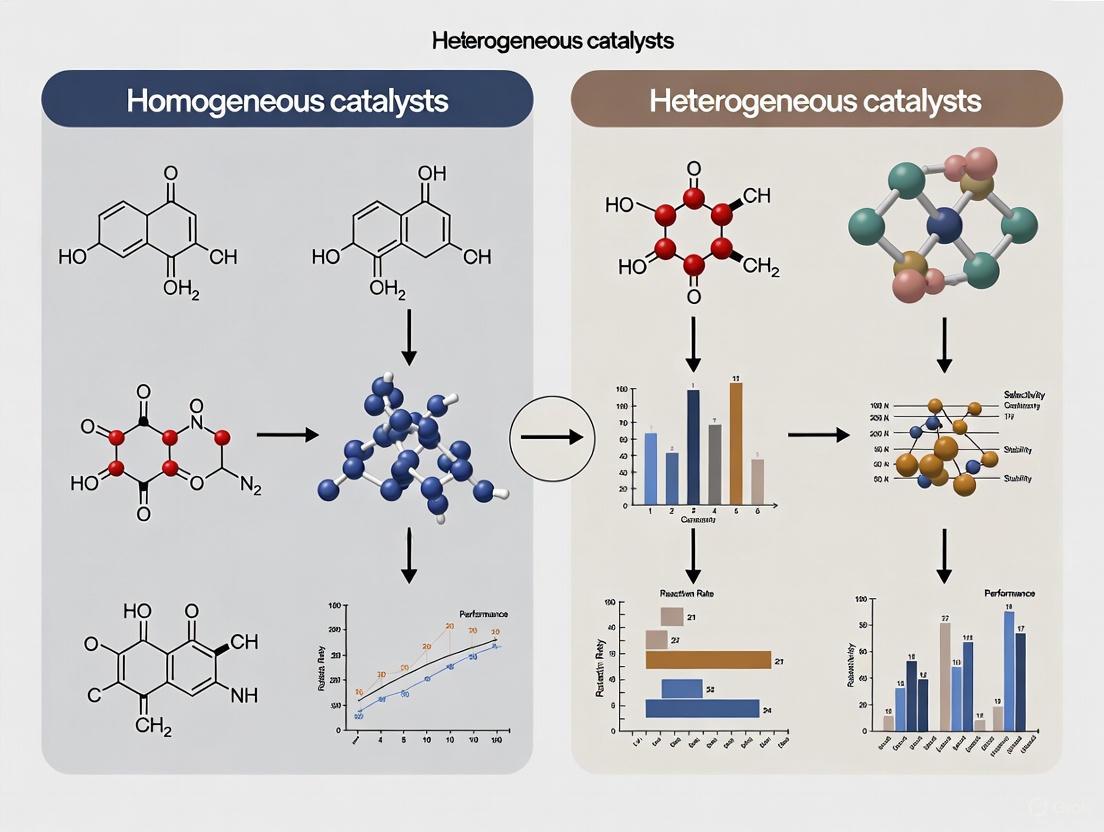
This article provides a comprehensive comparison of homogeneous and heterogeneous catalyst performance, tailored for researchers, scientists, and drug development professionals.
Homogeneous vs. Heterogeneous Catalysis: A Comparative Analysis for Advanced Research and Drug Development
Abstract
This article provides a comprehensive comparison of homogeneous and heterogeneous catalyst performance, tailored for researchers, scientists, and drug development professionals. It explores the fundamental principles, phase behavior, and active site interactions that define each catalyst type. The scope extends to methodological applications across pharmaceuticals, fine chemicals, and environmental remediation, highlighting real-world use cases and efficiency metrics. The content further addresses key challenges in troubleshooting, optimization, and catalyst recovery, offering strategies to enhance performance and longevity. Finally, a rigorous validation framework compares selectivity, activity, and separation efficiency, synthesizing insights to guide catalyst selection for innovative and sustainable biomedical research.
Core Principles: Defining Homogeneous and Heterogeneous Catalysis
Fundamental Definitions and Phase Relationships
Catalysis is a foundational concept in chemical synthesis, defined by three principal features: the acceleration of chemical reaction rates, invariance of the thermodynamic equilibrium composition, and the catalyst itself not being consumed during the reaction process [1]. The widely accepted mechanistic basis for catalytic action is the lowering of the activation energy barrier through specific interactions between reactants and catalytic centers [1]. Catalytic systems are fundamentally classified based on the phase relationship between the catalyst and reactants, with homogeneous and heterogeneous catalysis representing the two primary categories [1].
In homogeneous catalysis, the catalyst and reactants exist in the same phase, typically liquid, allowing for intimate molecular interaction and often resulting in high activity and selectivity [1]. In contrast, heterogeneous catalysis involves catalysts and reactants in different phases, usually solid catalysts interacting with gaseous or liquid reactants, facilitating easier separation and potential catalyst reuse [1]. A rapidly growing area is Single-Atom Catalysis (SAC), where isolated metal atoms anchored to solid supports act as well-defined active catalytic centers, blurring the traditional boundaries between homogeneous and heterogeneous systems [1].
This guide provides an objective comparison of these catalytic approaches, focusing on their fundamental definitions, phase relationships, and performance characteristics relevant to researchers and drug development professionals.
Fundamental Definitions and Phase Characteristics
Core Definitions and Classifications
Homogeneous Catalysis involves a catalyst that exists in the same phase as the reactants, most commonly in the liquid phase [1]. The catalytic species, often molecular organometallic complexes or distinct chemical moieties, are uniformly dispersed among the reactant molecules, enabling all catalytic sites to be potentially accessible for reaction [1]. Gas-phase homogeneous catalysis is rare but exemplified by the oxidation of SO₂ to SO₃ using nitrogen oxides [1].
Heterogeneous Catalysis employs a catalyst in a different phase from the reactants, typically solid catalysts interacting with gaseous, vapor, and/or liquid reactants [1]. Reactions proceed on catalytic centers represented by specific chemical moieties or structural features of solid materials, such as edges, corners, steps, and vacancies, which locally alter surface energy [1].
A noteworthy hybrid class is heterogenized catalysts, where homogeneous active moieties (e.g., organometallic complexes, specific functional groups) are chemically bonded to organic polymers or inorganic supports [1]. These systems combine molecular precision with practical separation advantages.
Expanded Catalytic Classifications
With advances in catalytic science, additional classifications have emerged based on external energy inputs and activation mechanisms [1]:
- Electrocatalysis: Utilizes electrical energy to drive reactions at electrode surfaces [1].
- Photocatalysis: Employs photon energy, typically from light, to excite catalytic species [2].
- Microwave Catalysis: Uses microwave radiation to selectively heat catalysts or reactants [1].
- Sonocatalysis: Applies ultrasonic energy to enhance catalytic activity [1].
- Mechanocatalysis: Relies on mechanical forces to induce catalytic transformations [1].
Table 1: Fundamental Characteristics of Catalytic Systems
| Characteristic | Homogeneous Catalysis | Heterogeneous Catalysis |
|---|---|---|
| Phase Relationship | Catalyst and reactants in same phase (typically liquid) [1] | Catalyst and reactants in different phases (typically solid catalyst with liquid/gas reactants) [1] |
| Catalytic Center | Molecular species (organometallic complexes, functional groups) uniformly dispersed [1] | Surface sites (edges, corners, vacancies) or supported nanoscale structures [1] |
| Active Site Uniformity | High - essentially all active sites are identical [1] | Variable - sites may differ in geometry and energy [1] |
| Typical Examples | Organometallic complexes in solution, enzymes [1] | Metal nanoparticles on supports, zeolites, metal-organic frameworks [1] |
Comparative Performance Analysis
Activity, Selectivity, and Stability
The choice between homogeneous and heterogeneous catalysis involves complex trade-offs across multiple performance dimensions. Homogeneous catalysts typically offer superior activity under mild conditions and excellent selectivity, particularly for enantioselective transformations, due to their well-defined, uniform active sites [1]. However, they present significant challenges in catalyst separation and recovery, often leading to metal contamination in products and limited operational lifetime [1] [2].
Heterogeneous catalysts provide inherent advantages in separation efficiency, enabling continuous operation and straightforward catalyst reuse [1]. They generally exhibit greater thermal stability and longer operational lifetimes, though they often require higher temperatures and pressures to achieve satisfactory activity [1]. Mass transport limitations can reduce effective reaction rates, while selectivity may be compromised due to the heterogeneity of active sites [1].
Table 2: Performance Comparison of Catalytic Systems
| Performance Metric | Homogeneous Catalysis | Heterogeneous Catalysis |
|---|---|---|
| Intrinsic Activity | Typically high under mild conditions [1] | Often requires higher temperatures/pressures [1] |
| Selectivity Control | Excellent, especially for enantioselective reactions [1] | Variable, site heterogeneity can reduce selectivity [1] |
| Catalyst Separation | Difficult, requiring complex processes [1] | Straightforward, via filtration or simple settling [1] |
| Thermal Stability | Generally moderate to low [1] | Typically high [1] |
| Operational Lifetime | Often limited by decomposition [1] | Generally longer, often regenerable [1] |
| Mass Transport Effects | Minimal (single phase) [1] | Often significant, affecting observed kinetics [1] |
Applications in Chemical Synthesis and Energy
Both catalytic approaches find extensive applications across chemical synthesis, energy production, and environmental protection. Heterogeneous catalysts dominate industrial-scale processes such as petroleum refining (fluid catalytic cracking), chemical production (ammonia synthesis, methanol production), and environmental catalysis (automotive exhaust treatment) [1] [3]. The global heterogeneous catalyst market was valued at USD 23.6 billion in 2023, with chemical synthesis applications accounting for the largest share (26.3%), followed by petroleum refining as the fastest-growing segment [3].
Homogeneous catalysts excel in specialized chemical synthesis, particularly in the pharmaceutical industry where their high selectivity enables efficient production of complex molecules, including Active Pharmaceutical Ingredients (APIs) [2]. Recent advances integrate homogeneous catalysis with continuous flow systems, photocatalysis, and electrocatalysis to overcome traditional limitations and unlock novel synthetic pathways [2].
Experimental Protocols and Methodologies
Catalyst Characterization Framework
Comprehensive catalyst characterization employs six main groups of physicochemical parameters [1]:
- Chemical composition and crystallographic structure - Determining elemental makeup and atomic arrangement
- Texture and physical-chemical properties - Analyzing surface area, porosity, and morphology
- Temperature and chemical stability - Assessing durability under operational conditions
- Mechanical stability - Evaluating resistance to attrition and crushing
- Mass, heat, and electrical transport properties - Measuring diffusion characteristics and thermal conductivity
- Catalytic performance - Testing activity, selectivity, and lifetime under reaction conditions
Protocol: Comparative Hydrogenation Activity
Objective: Compare the catalytic performance of homogeneous and heterogeneous catalysts for substrate hydrogenation.
Materials:
- Homogeneous catalyst: Transition metal complex (e.g., RhCl(PPh₃)₃)
- Heterogeneous catalyst: Metal nanoparticles on support (e.g., Pd/C)
- Substrate: Appropriate unsaturated compound (e.g., alkene, carbonyl)
- Solvent: Suitable for both catalytic systems (e.g., ethanol, toluene)
- Hydrogen source: H₂ gas cylinder with pressure regulation
Experimental Setup:
- Reactor System: Use parallel pressurized batch reactors or continuous flow microreactors equipped with temperature control, pressure monitoring, and sampling ports [2].
- Safety Measures: Implement hydrogen detection, pressure relief devices, and appropriate ventilation.
Procedure:
- Charge reactor with catalyst (0.1-1 mol% metal for homogeneous; 1-5 wt% for heterogeneous) and substrate solution.
- Purge system with inert gas (N₂ or Ar) to remove oxygen.
- Pressurize with H₂ to predetermined pressure (1-50 bar).
- Initiate reaction with stirring/flow and maintain at constant temperature.
- Collect periodic samples for analysis.
- For homogeneous system: After reaction, attempt catalyst recovery via solvent extraction or distillation.
- For heterogeneous system: After reaction, separate catalyst via filtration, wash, and dry for potential reuse testing.
Analysis:
- Conversion: Quantify substrate consumption via GC, HPLC, or NMR.
- Selectivity: Determine product distribution using calibrated analytical methods.
- Kinetics: Calculate turnover frequency (TOF) based on active sites.
- Catalyst Stability: Compare metal leaching (ICP-MS), structural changes (XRD, XPS), and activity in recycle experiments.
Advanced Integration with Flow Chemistry
Continuous flow systems represent a paradigm shift for implementing catalytic processes, particularly benefiting homogeneous catalysis through [2]:
- Enhanced mass/heat transfer superior to traditional batch processes
- Precise parameter control (temperature, pressure, residence time)
- Safer operation under extreme conditions (high T/P)
- Seamless integration of Process Analytical Technology (PAT) for real-time monitoring
- Predictable scale-up through numbering-up or smart dimensioning strategies
The integration of homogeneous catalysis with continuous flow systems enables the practical implementation of photoredox catalysis and electrocatalysis, overcoming traditional limitations in scale-up and process control [2].
Visualization of Catalytic Relationships
Diagram 1: Catalyst System Selection Workflow. This decision pathway illustrates the logical process for selecting between homogeneous and heterogeneous catalytic systems based on phase relationships and application requirements.
The Scientist's Toolkit: Essential Research Reagents and Materials
Table 3: Essential Research Reagents and Materials for Catalytic Studies
| Reagent/Material | Function | Application Notes |
|---|---|---|
| Transition Metal Complexes (e.g., Rh, Pd, Ru complexes) | Serve as homogeneous catalysts/precursors with well-defined active sites [1] | Provide high activity and selectivity; require careful handling under inert atmosphere |
| Supported Metal Catalysts (e.g., Pd/C, Pt/Al₂O₃) | Heterogeneous catalysts with metal nanoparticles on high-surface-area supports [1] | Facilitate easy separation; metal leaching can be concern in some applications |
| Zeolites | Crystalline microporous aluminosilicates with shape-selective properties [4] [1] | Excellent for acid-catalyzed reactions and size-selective catalysis; used in refining and chemicals |
| Metal-Organic Frameworks (MOFs) | Porous materials with ultrahigh surface area and tunable functionality [4] | Emerging materials for specialized applications; thermal and chemical stability varies |
| Single-Atom Catalysts (SACs) | Isolated metal atoms on supports bridging homogeneous/heterogeneous catalysis [1] | Maximize metal utilization; stability under reaction conditions can be challenging |
| Ionic Liquids | Low-melting salts serving as solvents or functional reaction media [4] | Enable catalyst immobilization; tunable polarity and solvation properties |
| Process Analytical Technology (PAT) | Inline/online analytical tools (FTIR, HPLC) for real-time reaction monitoring [2] | Critical for kinetic studies and reaction optimization in flow systems |
In the pursuit of efficient and sustainable chemical processes, the choice between homogeneous and heterogeneous catalysis is fundamental. This guide provides an objective comparison of two principal mechanistic pathways: the Langmuir-Hinshelwood (L-H) mechanism, characteristic of heterogeneous catalysis, and the pathway involving homogeneous intermediate complexes, central to homogeneous catalysis. The performance of these systems is evaluated based on activity, selectivity, kinetic behavior, and practical applicability, with a focus on providing researchers and development professionals with supporting experimental data and methodologies.
The core distinction lies in the catalyst's phase and the resulting reaction mechanism. In heterogeneous L-H kinetics, reactants adsorb onto a solid surface before reacting, while in homogeneous catalysis, the catalyst and reactants form intermediate complexes within a single phase. Understanding these differences is critical for selecting the appropriate catalytic system for specific applications, from bulk chemical production to fine chemical and pharmaceutical synthesis.
Fundamental Mechanisms and Kinetic Profiles
The Langmuir-Hinshelwood Mechanism
The Langmuir-Hinshelwood mechanism describes a surface reaction where two adsorbed species react with each other on the catalyst surface. The key principle is that the reaction rate is governed by the surface coverage of each reactant, which is typically described by Langmuir-type adsorption isotherms [5].
- Mechanism Steps: The mechanism involves multiple steps: (1) adsorption of reactants onto the active sites of the catalyst surface, (2) surface reaction between the adjacent adsorbed species to form the product, and (3) desorption of the product from the surface to regenerate the active sites [5]. For a single reactant A, the steps are:
A + S → A_a(Adsorption)A_a → A + S(Desorption)A_a → S + P(Surface Reaction) whereSis an active site andA_ais the adsorbed A species [6]. - Kinetic Equation: For a bimolecular reaction, the rate expression is often complex, but for a monomolecular reaction where the surface reaction is the rate-determining step, the kinetics can be simplified to:
r = (k K C) / (1 + K C)whereris the reaction rate,kis the surface reaction rate constant,Kis the adsorption equilibrium constant, andCis the substrate concentration [5]. - Validation: Proof of the L-H mechanism requires not only that the kinetic data fits this equation but also that the adsorption equilibrium constant
Kobtained from kinetic data matches the value determined from independent dark adsorption measurements [5].
Homogeneous Intermediate Complex Mechanism
In homogeneous catalysis, the catalyst and reactants exist in the same phase, typically a liquid. The mechanism proceeds through the formation of discrete, soluble intermediate complexes.
- Mechanism Steps: The process generally involves (1) coordination of the reactant to the metal center of the catalyst, forming a complex, (2) transformation of the ligand (e.g., insertion, rearrangement) within the coordination sphere to form the product complex, and (3) release of the product and regeneration of the catalyst.
- Kinetic Profile: The kinetics are typically described by the Michaelis-Menten model, which is functionally similar to the L-H equation but operates in a single phase. The rate is proportional to the concentration of the catalyst-substrate complex.
- Distinguishing Feature: A key differentiator from heterogeneous mechanisms like Eley-Rideal is that in homogeneous catalysis, the reacting molecules are both coordinated to the catalyst metal center before the key bond-forming/breaking event occurs.
The following diagram illustrates the fundamental differences in the mechanistic pathways.
Comparative Performance Analysis
The choice between L-H and homogeneous mechanisms has profound implications for catalytic performance. The table below summarizes key comparative metrics.
Table 1: Performance Comparison of L-H Heterogeneous and Homogeneous Catalytic Systems
| Performance Metric | Langmuir-Hinshelwood (Heterogeneous) | Homogeneous Intermediate Complex |
|---|---|---|
| Typical Activity | Variable; can be high but often limited by mass transfer to the surface [5] | Often very high due to uniform accessibility of all catalytic sites |
| Selectivity | Can be high; dependent on surface structure and pore geometry | Typically high and tunable via ligand design |
| Kinetic Profile | Follows Langmuir-type kinetics; rate often decreases at high concentrations due to site saturation [5] | Often follows Michaelis-Menten kinetics |
| Catalyst Stability | Generally high; solid catalyst is robust and sinter-resistant | Can be lower; susceptibility to thermal decomposition and deactivation |
| Reaction Conditions | Often requires elevated temperatures for sufficient surface reaction rates | Can frequently operate under milder conditions |
| Sepovability & Reuse | Excellent; simple filtration allows for full recovery and reuse [7] | Difficult and expensive; often requires complex processes like distillation |
| Applicability | Broad; used in large-scale continuous processes (e.g., DMC synthesis [8], Hg0 oxidation [5]) | Broad; ideal for fine chemicals, pharmaceuticals, and asymmetric synthesis |
Experimental Protocols and Methodologies
High-Throughput Screening for Homogeneous Catalysts
Modern catalyst discovery, particularly for homogeneous systems, leverages high-throughput experimentation (HTE) for rapid optimization.
- Platform: A fluorogenic system in a 24-well plate format enables simultaneous monitoring of multiple reactions [7].
- Reaction Probe: The reduction of a nitronaphthalimide (NN) probe to a fluorescent amine (AN) serves as a model reaction (e.g., for catalyst screening in nitro-to-amine reduction) [7].
- Procedure: Each reaction well contains catalyst, NN probe, and reagents (e.g., aqueous N2H4). A paired reference well contains the product (AN) instead of NN to provide a fluorescence standard. The plate is placed in a multi-mode reader, which performs orbital shaking and then scans fluorescence and absorption spectra at set intervals (e.g., every 5 minutes for 80 minutes) [7].
- Data Analysis: The decay of the NN absorbance peak (350 nm) and the growth of the AN absorbance (430 nm) and fluorescence (ex. 485 nm / em. 590 nm) provide conversion and kinetic data. The stability of the isosbestic point (e.g., 385 nm) indicates a clean conversion without significant side products [7].
Kinetic Model Verification for L-H Mechanisms
Verifying an L-H mechanism requires more than just kinetic fitting; it involves a rigorous multi-step process.
- Kinetic Data Fitting: Initial rate data is fitted to a linearized form of the L-H equation, such as a plot of the reciprocal rate against the reciprocal concentration. This provides initial estimates for the parameters
k(rate constant) andK(adsorption constant) [5]. - Independent Adsorption Measurement: The adsorption equilibrium constant
Kobtained from kinetic fitting must be compared with the value measured from an independent adsorption isotherm experiment in the dark. A significant discrepancy invalidates the L-H mechanism for that system [5]. - Mathematical Validation: The quasi-steady-state assumption (QSSA) underlying L-H kinetics can be validated using Singular Value Decomposition (SVD) to confirm a sufficient separation of time scales between adsorption/desorption and the surface reaction [6].
Case Study: L-H Kinetics in Dimethyl Carbonate (DMC) Synthesis
The direct synthesis of Dimethyl Carbonate (DMC) from CO2 and methanol over a CeO2 catalyst is a practical example of L-H mechanism verification.
- Experimental Setup: Reactions are conducted in a batch reactor with a nano-CeO2 catalyst, varying parameters like temperature, catalyst mass, and CO2/MeOH ratio, typically at elevated pressures [8].
- Mechanism Proposal: Based on experimental data, a L-H mechanism is proposed where both CO2 and methanol adsorb onto the catalyst surface before reacting.
- Model Verification: The proposed kinetic model (e.g.,
r = k θ_CO2 θ_MeOH) is fitted to the experimental data. A close alignment between model predictions and experimental results (e.g., a low mean absolute percentage error of 17%) validates the proposed mechanism [8].
Essential Research Reagents and Materials
The table below lists key materials and their functions for experiments in this field, drawing from the cited methodologies.
Table 2: Key Research Reagent Solutions and Materials
| Reagent/Material | Function in Experimentation | Example/Note |
|---|---|---|
| Solid Catalyst | Provides active surface for adsorption and reaction in L-H mechanism. | CeO2 for DMC synthesis [8]; V2O5 for Hg0 oxidation [5] |
| Homogeneous Catalyst | Molecular metal complex that forms intermediate complexes in solution. | Metal complexes (e.g., Cu, Pd) screened in HTE [7] |
| Fluorogenic Probe | Enables real-time, high-throughput reaction monitoring via optical signals. | Nitronaphthalimide (NN) probe for nitro-reduction [7] |
| Well Plates | Platform for high-throughput, parallel screening of multiple reactions. | 24-well polystyrene plates [7] |
| Spectroscopic Standards | Provides reference for converting fluorescence/absorbance to concentration. | Amine product (AN) in reference well [7] |
| Adsorbate Molecules | Used for independent measurement of adsorption equilibrium constants. | Substrate molecules for dark adsorption tests [5] |
The decision between Langmuir-Hinshelwood heterogeneous catalysts and homogeneous intermediate complex catalysts is not a matter of superiority, but of appropriate application. Heterogeneous L-H systems offer unparalleled advantages in catalyst recovery, stability, and integration into continuous flow reactors, making them ideal for large-scale industrial processes like environmental catalysis and bulk chemical production. Conversely, homogeneous catalysts frequently provide superior activity under milder conditions and exquisite selectivity, which is paramount in the synthesis of complex molecules for the pharmaceutical and fine chemical industries.
The ongoing integration of high-throughput screening and rigorous kinetic modeling, as demonstrated, is crucial for advancing both fields. This comparative guide underscores that the optimal catalytic pathway is determined by the specific economic, environmental, and performance requirements of the intended application.
The precise structure and atomic arrangement of active sites fundamentally determine the performance of both homogeneous and heterogeneous catalysts. This guide provides an objective comparison between two dominant active site architectures: uniform centers, characterized by consistent, well-defined atomic coordination, and surface atoms, which encompass the diverse sites found on nanoparticle surfaces and solid catalysts. Within the broader thesis of homogeneous versus heterogeneous catalyst performance, this distinction is critical. Homogeneous catalysts often exemplify the ideal of uniform centers, where every molecule possesses identical active sites, while traditional heterogeneous catalysts typically present a distribution of surface sites with varying coordination and reactivity.
The emergence of Single Atom Catalysts (SACs) has blurred this traditional dichotomy, introducing atomically dispersed heterogeneous catalysts with uniform, molecular-like active sites. This comparison will analyze the performance of these site types by examining key metrics such as activity, selectivity, and stability, supported by experimental data and detailed methodologies. Understanding these differences is essential for researchers and scientists to rationally design next-generation catalysts for applications ranging from drug development to sustainable energy conversion.
Structural and Chemical Properties Comparison
The intrinsic differences between uniform centers and surface atoms originate from their distinct atomic-scale structures and electronic configurations.
Uniform Active Centers, as exemplified by Single Atom Catalysts (SACs), feature metal atoms individually dispersed on a support material, anchored via coordination to heteroatoms like nitrogen, oxygen, or sulfur [9]. This configuration creates a well-defined, uniform coordination environment for every active site. In homogeneous catalysis, molecular catalysts also present uniform sites, often with precisely designed ligand spheres that create a tailored microenvironment [10]. A key structural advantage of uniform centers is their ability to achieve near-theoretical atom utilization efficiency, as every metal atom can function as an active site [11] [12].
Surface Atoms on nanoparticles or solid catalysts exist in diverse local environments, including terraces, steps, kinks, and defects. This structural heterogeneity leads to a distribution of electronic properties and binding strengths across different surface sites [12]. Traditional supported metal nanoparticles exemplify this architecture, where only a fraction of the total atoms—typically those on the surface with low coordination—participate in catalysis, resulting in lower overall atom efficiency compared to SACs.
Table 1: Fundamental Properties of Active Site Types
| Property | Uniform Centers | Surface Atoms |
|---|---|---|
| Atomic Structure | Well-defined, isolated atoms | Variety of coordination environments |
| Site Uniformity | High | Low to moderate |
| Atom Utilization | Theoretical maximum (≈100%) | Limited to surface atoms |
| Typical Examples | SACs, Molecular complexes | Metal nanoparticles, Polycrystalline surfaces |
| Coordination Number | Typically low and uniform | Ranges from under-coordinated to fully coordinated |
Tailoring strategies further differentiate these active sites. For uniform centers, techniques like strain engineering, ligand engineering, and axial functionalization can precisely modulate the electronic state of metal centers to optimize intermediate adsorption [9]. For surface architectures, alloying creates diverse atomic neighborhoods. For instance, in a PdCuNi medium entropy alloy, electron-deficient surface Ni atoms were shown to reduce the thermodynamic energy barrier for the formic acid oxidation reaction [13].
Experimental Protocols for Characterization and Analysis
Protocol for X-Ray Absorption Spectroscopy (XAS)
XAS is a powerful technique for determining the local coordination environment and electronic state of metal centers, especially in uniform catalysts.
- Sample Preparation: Grind the catalyst powder finely and mix uniformly with cellulose or boron nitride. Press the mixture into a thin, uniform pellet suitable for transmission mode measurement. For dilute samples, fluorescence mode may be used.
- Data Collection: Perform experiments at a synchrotron radiation facility. Collect data at the metal edge of interest (e.g., Ru K-edge for Ru SACs) at cryogenic temperatures (e.g., 77 K) to minimize thermal disorder.
- XANES Analysis: Analyze the X-ray Absorption Near Edge Structure (XANES) region to determine the average oxidation state of the metal center by comparing the edge position with standard foil references.
- EXAFS Analysis: Process the Extended X-Ray Absorption Fine Structure (EXAFS) region by Fourier transformation. Fit the spectra to determine key structural parameters: coordination numbers, bond distances, and disorder factors for each scattering shell [14].
Protocol for Electrochemical Activity and Stability Measurement
This protocol assesses catalytic performance, particularly for energy-related reactions.
- Electrode Preparation: Disperse 5 mg of catalyst powder in a solution containing 500 µL of ethanol, 450 µL of water, and 50 µL of Nafion solution. Sonicate for 60 minutes to form a homogeneous ink. Pipette a precise volume (e.g., 10 µL) onto a polished glassy carbon electrode and air-dry.
- Electrochemical Testing: Use a standard three-electrode cell with the catalyst-coated electrode as the working electrode. Conduct Cyclic Voltammetry (CV) in an inert electrolyte (e.g., 0.1 M KOH) to determine the Electrochemical Surface Area (ECSA) from the double-layer capacitance.
- Activity Measurement: Perform CV or Linear Sweep Voltammetry (LSV) in an electrolyte containing the reactant (e.g., 0.5 M HCOOH for formic acid oxidation). Report activity normalized by both geometric area and metal mass loading.
- Stability Test: Use Chronoamperometry at a fixed potential or Accelerated Durability Testing (ADT) via repeated potential cycling (e.g., 5000 cycles). Measure the percentage loss of initial activity [13].
Protocol for High-Angle Annular Dark-Field STEM (HAADF-STEM)
HAADF-STEM directly images individual heavy atoms on lighter supports, crucial for confirming single-atom dispersion.
- Sample Preparation: Disperse catalyst powder in ethanol via sonication. Drop-cast a small volume onto a lacey carbon TEM grid and allow to dry.
- Microscope Alignment: Use an aberration-corrected STEM microscope operating at 200 kV. Carefully align the microscope to ensure optimal resolution.
- Imaging: Acquire HAADF-STEM images. The contrast is roughly proportional to the square of the atomic number (Z-contrast). Isolated heavy atoms (e.g., Ru, Pt) appear as bright dots against the darker support [14].
- Analysis: Collect images from multiple regions to confirm the uniform dispersion of single atoms and rule out the presence of nanoparticles.
Experimental Workflow for Active Site Analysis
Performance Data and Comparative Analysis
Activity and Selectivity Metrics
Quantitative performance data reveals fundamental trade-offs between the two active site architectures.
Uniform centers, particularly SACs, often demonstrate exceptional selectivity due to the uniformity of their active sites. This minimizes the occurrence of side reactions that typically proceed on different types of surface sites. For instance, Ru single atoms buried in a Ni₃FeN subsurface lattice (Ni₃FeN-Ruburied) exhibited remarkably high selectivity and Faradaic efficiency for the conversion of methanol to formate, attributed to an optimized adsorption configuration for the desired reaction pathway [14]. In homogenous hydrogenation catalysis, bifunctional complexes with uniform active sites achieve high enantioselectivity in the production of fine chemicals [10].
Surface atoms on well-designed nanostructures can achieve extremely high mass activity. The PdCuNi medium entropy alloy aerogel (PdCuNi AA) developed for formic acid oxidation achieved a mass activity of 2.7 A mg⁻¹, surpassing Pd/C by approximately 6.9 times [13]. This high activity stems from synergistic effects between different surface atoms in the alloy, which can break scaling relations that limit simpler catalysts.
Table 2: Performance Comparison of Representative Catalysts
| Catalyst | Reaction | Key Performance Metric | Active Site Architecture |
|---|---|---|---|
Ni₃FeN-Ruburied [14] |
Methanol Oxidation | High Faradaic efficiency for formate | Uniform Center (Buried Single Atom) |
| PdCuNi AA [13] | Formic Acid Oxidation | Mass activity: 2.7 A mg⁻¹ | Surface Atoms (Medium Entropy Alloy) |
| Mn-based pre-catalyst [10] | Carbonyl Hydrogenation | High enantioselectivity | Uniform Center (Homogeneous Molecular Complex) |
| Pt1/FeOx [11] | CO Oxidation | High intrinsic activity & 100% atom utilization | Uniform Center (SAC) |
Stability and Deactivation Mechanisms
The stability profiles and deactivation pathways differ significantly between the two site types.
- Uniform Centers: The primary deactivation mechanism is the migration and agglomeration of isolated metal atoms into nanoparticles, driven by their high surface energy [9] [11]. A critical factor for stability is the strength of the metal-support interaction. Strong covalent bonding can significantly anchor single atoms and prevent their migration. For homogeneous molecular catalysts, decomposition or ligand loss under harsh conditions are common failure modes [10].
- Surface Atoms: The main deactivation mechanisms include particle sintering (a form of agglomeration), poisoning by strong-adsorbing species (e.g., CO on Pd), and surface reconstruction [13] [14]. Alloying can improve stability; the PdCuNi alloy showed enhanced resistance to CO poisoning due to electronic structure modification of surface Pd atoms [13].
The Scientist's Toolkit: Essential Research Reagents and Materials
Successful research into active sites relies on specialized materials and reagents.
Table 3: Key Research Reagents and Their Functions
| Reagent / Material | Function in Research |
|---|---|
| Metal Precursors (e.g., Metal acetylacetonates, chlorides) | Source of active metal for catalyst synthesis. |
| Support Materials (e.g., MOFs, g-C₃N₄, Graphene, Carbon nanotubes) | High-surface-area matrices to anchor and stabilize active sites. |
| Structure-Directing Agents (e.g., PS-b-PEO, surfactants) | Control morphology and porosity during synthesis. |
| NaBH₄ | Common reducing agent for synthesizing metal nanoparticles and alloys. |
| Heteroatom Dopants (e.g., N, S, P precursors) | Create anchoring sites on supports for single metal atoms. |
| Probe Molecules (e.g., CO, H₂) | Used in chemisorption studies to quantify and characterize active sites. |
Integrated Discussion: Strategic Choice of Active Sites
The choice between uniform centers and surface atoms is not about superiority, but rather about strategic application based on the desired catalytic outcome.
Decision Logic for Active Site Selection
Uniform centers are optimal when the priority is high selectivity and atom efficiency. Their well-defined structure allows for precise mechanistic studies and rational optimization via ligand or coordination engineering [9] [10]. This makes them ideal for complex transformations in pharmaceutical synthesis or for reactions where specific product formation is critical. The primary challenge remains stabilizing these sites against agglomeration, particularly at high loadings required for industrial application [9].
Surface atom architectures are advantageous for achieving high mass activity and breaking scaling relations. The synergistic interplay between different elements in an alloy can create unique active sites that are not possible in uniform centers, leading to exceptional activity for reactions like formic acid oxidation [13]. The main challenges involve managing site heterogeneity and preventing deactivation via poisoning or sintering.
Emerging strategies seek to combine the advantages of both paradigms. For example, the concept of burying single atoms in subsurface lattices, as demonstrated with Ni₃FeN-Ruburied, aims to utilize uniform centers to electronically modify surrounding surface atoms [14]. This creates optimized surface active sites that are more stable and selective, representing a promising direction for next-generation catalyst design that transcends the traditional homogeneous-heterogeneous divide.
In heterogeneous catalysis, where catalysts and reactants exist in different phases, the process of adsorption is the indispensable first step that initiates all subsequent chemical transformations [1] [15]. Unlike absorption, where substances penetrate the bulk of a material, adsorption specifically refers to the adhesion of atoms, ions, or molecules (collectively known as adsorbates) to the surface of a solid or liquid catalyst (the adsorbent) [16] [17]. This surface-based phenomenon enables the critical interactions between reactant molecules and catalytic active sites, ultimately lowering activation energies and accelerating reaction rates without the catalyst itself being consumed [1].
The distinction between adsorption and absorption is fundamental, as summarized in Table 1. While absorption involves the uptake and distribution of a substance throughout the volume of another material (as seen when a sponge soaks up water), adsorption is exclusively a surface process where molecules accumulate at the interface without penetrating the bulk structure [16] [17] [18]. This surface confinement is what makes adsorption particularly powerful in catalytic applications, as it creates localized regions of high reactant concentration and facilitates specific molecular orientations that favor desired reaction pathways.
Table 1: Fundamental Distinction Between Adsorption and Absorption
| Parameter | Adsorption | Absorption |
|---|---|---|
| Process Nature | Surface phenomenon | Bulk phenomenon |
| Penetration Depth | Molecules adhere to the surface without penetration | Molecules penetrate and distribute throughout the material's volume |
| Rate of Reaction | Typically fast initially, then equilibrates | May be slower, dependent on diffusion |
| Temperature Effect | Generally decreases with increasing temperature | May increase with temperature due to enhanced diffusion |
| Heat Exchange | Exothermic process | Can be endothermic or exothermic |
| Reversibility | Often reversible, especially physisorption | Frequently irreversible |
| Examples | Activated carbon trapping toxins; oxygen on alveolar surfaces | Sponge soaking up water; nutrient uptake in intestines |
Within heterogeneous catalytic systems, adsorption manifests through two primary mechanisms with distinct characteristics and implications for catalyst performance: physisorption (physical adsorption) and chemisorption (chemical adsorption) [16]. Understanding the interplay between these mechanisms is crucial for designing advanced catalytic materials and optimizing reaction conditions for applications ranging from industrial chemical production to pharmaceutical synthesis and environmental remediation [1] [15].
Physisorption and Chemisorption: Fundamental Mechanisms and Energetics
Physisorption: Surface Adhesion Through Weak Intermolecular Forces
Physisorption is characterized by the adherence of adsorbate molecules to a catalyst surface through weak van der Waals forces or other physical interactions, without the formation of chemical bonds [16] [15]. This process is reversible and typically occurs at relatively low temperatures [17]. The adsorption enthalpy for physisorption is generally low, ranging from -20 to -40 kJ/mol, comparable to the heat of condensation [16]. Due to its non-specific nature, physisorption often results in multilayer formation and is not highly selective to particular molecular species [15].
In catalytic systems, physisorption serves as a crucial preliminary step that concentrates reactant molecules near active sites, increasing the probability of subsequent chemisorption and reaction [15]. The weak, non-directional nature of the interaction means physisorbed molecules retain their electronic structure and can readily diffuse across the catalyst surface, sampling various potential adsorption configurations before transitioning to more stable chemisorbed states or desorbing back into the fluid phase [15].
Chemisorption: Chemical Bond Formation and Surface Reactivity
Chemisorption involves the formation of chemical bonds between adsorbate molecules and specific sites on the catalyst surface [16]. This process is characterized by significantly stronger interactions, with adsorption enthalpies typically ranging from -40 to -800 kJ/mol, comparable to chemical bond energies [16]. Unlike physisorption, chemisorption is highly specific, often irreversible, and typically limited to a monolayer due to the saturation of available surface bonding sites [17].
The strong electronic interactions in chemisorption frequently lead to significant distortion of the adsorbate's molecular structure, activation of chemical bonds, and formation of new reaction intermediates [15]. For example, in CO₂ hydrogenation reactions on metal surfaces, chemisorption can result in the bending of the normally linear CO₂ molecule, facilitating subsequent bond-breaking and transformation into products like methanol [15]. The specificity of chemisorption arises from the requirement for precise geometric and electronic compatibility between the adsorbate and the surface active sites, making it a highly selective process that directly determines catalytic activity and reaction pathway selectivity [1] [19].
Table 2: Comparative Analysis of Physisorption and Chemisorption in Catalytic Systems
| Characteristic | Physisorption | Chemisorption |
|---|---|---|
| Binding Forces | Weak van der Waals forces | Strong chemical bonds |
| Adsorption Enthalpy | -20 to -40 kJ/mol (exothermic) | -40 to -800 kJ/mol (exothermic) |
| Specificity | Non-specific | Highly specific to surface sites |
| Temperature Range | Lower temperatures, decreases with heating | Higher temperatures, may increase initially then decrease |
| Surface Coverage | Multilayer possible | Monolayer only |
| Reversibility | Highly reversible | Often irreversible or slowly reversible |
| Activation Energy | Low or none | Significant activation energy possible |
| Role in Catalysis | reactant concentration, precursor to chemisorption | Bond activation, intermediate formation |
| Electronic Structure | Minimal perturbation of adsorbate orbitals | Significant orbital rearrangement, possible charge transfer |
The Adsorption Process: From Physisorption to Catalytic Transformation
The relationship between physisorption and chemisorption in functional catalytic systems is often sequential and complementary, as visualized in Figure 1. The process typically begins with the physisorption of reactant molecules from the bulk fluid phase onto the catalyst surface, followed by surface diffusion to active sites where chemisorption can occur [15]. The chemically activated species then undergoes transformation through various surface reactions before the products desorb, regenerating the active sites for subsequent catalytic cycles [1].
Figure 1: Sequential process of adsorption and reaction in heterogeneous catalytic systems, showing the transition from physisorption to chemisorption and eventual product formation.
The dynamic equilibrium between physisorbed and chemisorbed states is influenced by reaction conditions including temperature, pressure, and the chemical potential of reactants [15]. Higher temperatures generally favor chemisorption due to the activation energy requirement for bond formation, while extremely high temperatures may promote desorption of both physisorbed and chemisorbed species [17]. Pressure increases typically enhance surface coverage for both physisorption and chemisorption, though the effects are more pronounced for physisorption at lower temperatures [17] [15].
Characterization and Experimental Methodologies for Adsorption Analysis
Experimental Protocols for Differentiating Physisorption and Chemisorption
Researchers employ multiple experimental techniques to characterize adsorption mechanisms and quantify their parameters. Temperature-Programmed Desorption (TPD) is a widely used method that involves adsorbing a gas onto a catalyst surface at low temperature, then gradually heating while monitoring desorbed species [19]. Physisorbed molecules typically desorb at lower temperatures (often below 150 K), while chemisorbed species require higher temperatures (300-1000 K) corresponding to their stronger binding energies [19].
Adsorption Isotherm Measurements provide information about surface area, pore size distribution, and adsorption capacity [16]. Physisorption isotherms typically exhibit reversible Type II or IV characteristics with hysteresis loops associated with capillary condensation in mesopores, while chemisorption often shows Langmuir-type (Type I) behavior indicative of monolayer formation [16]. Microcalorimetry directly measures heats of adsorption, with physisorption displaying relatively constant, low heats versus chemisorption which shows higher, often coverage-dependent heats due to surface heterogeneity and adsorbate-adsorbate interactions [15].
Spectroscopic techniques including Infrared Spectroscopy (IR), X-ray Photoelectron Spectroscopy (XPS), and Solid-State NMR provide molecular-level insights into adsorption mechanisms [19]. IR spectroscopy can detect perturbations in molecular vibrations upon adsorption, with chemisorption typically causing larger frequency shifts and sometimes the appearance of new vibrational modes corresponding to surface chemical bonds [19]. XPS reveals changes in electronic structure, including oxidation state changes and charge transfer processes characteristic of chemisorption [19].
Computational Approaches for Modeling Adsorption Processes
Computational methods have become indispensable for understanding adsorption phenomena at the atomic level. Density Functional Theory (DFT) calculations are widely employed to predict adsorption energies, optimal adsorption configurations, and electronic structure changes upon adsorption [20] [15] [19]. Standard DFT protocols involve building surface slab models, sampling different adsorption sites, and calculating adsorption energies using the formula:
[E{\text{ad}} = E{\text{adsorbate}} - E_{\text{}} - E_{\text{adsorbate}}]
where (E{\text{*adsorbate}}) is the energy of the surface with adsorbed species, (E{\text{*}}) is the energy of the clean surface, and (E_{\text{adsorbate}}) is the energy of the isolated adsorbate molecule [15].
More advanced multiscale modeling approaches integrate Kohn-Sham DFT with classical DFT to account for both bond formation and non-bonded interactions in realistic reaction environments [15]. This is particularly important for industrial conditions where high temperatures and pressures create inhomogeneous gas distributions near catalyst surfaces, with local concentrations potentially hundreds of times higher than in the bulk phase [15]. Ab initio molecular dynamics (AIMD) simulations further incorporate temperature effects and allow sampling of various adsorption configurations and their transitions [15].
Recent advances include automated frameworks like autoSKZCAM that leverage correlated wavefunction theory for more accurate prediction of adsorption enthalpies, achieving close agreement with experimental values across diverse adsorbate-surface systems [19]. Machine learning approaches, particularly generative models, are emerging as powerful tools for efficiently sampling adsorption geometries and predicting stable configurations without exhaustive DFT calculations [20].
Table 3: Experimental and Computational Methods for Adsorption Analysis
| Methodology | Key Measured Parameters | Applications in Adsorption Studies | Limitations |
|---|---|---|---|
| Temperature-Programmed Desorption (TPD) | Desorption temperatures, binding energies, surface coverage | Distinguishing physisorption vs. chemisorption; active site quantification | May alter surface during heating; complex spectra for mixed adsorption |
| Adsorption Microcalorimetry | Heat of adsorption, site energy distribution | Measuring strength of surface-adsorbate interactions; surface heterogeneity | Requires careful temperature control; interpretation challenges for complex surfaces |
| Infrared Spectroscopy (IR) | Vibrational frequency shifts, new bond formation | Identifying adsorption configurations; molecular-level bonding information | Surface selection rules; limited to IR-active modes; high reflectivity needs |
| X-ray Photoelectron Spectroscopy (XPS) | Elemental composition, oxidation states, charge transfer | Electronic structure changes during chemisorption; oxidation state determination | Ultra-high vacuum required; surface-sensitive but not exclusively surface-specific |
| Density Functional Theory (DFT) | Adsorption energies, optimized geometries, electronic structure | Predicting stable configurations; reaction pathways; electronic origins of bonding | Functional-dependent accuracy; dispersion corrections needed for physisorption |
| Ab Initio Molecular Dynamics (AIMD) | Finite-temperature behavior, adsorption/desorption dynamics | Realistic reaction conditions; entropic effects; rare events | Computationally expensive; limited timescales |
| Machine Learning/Generative Models | Efficient configuration sampling, property-structure relationships | High-throughput screening; discovery of novel adsorption sites | Training data requirements; transferability to new systems |
The Scientist's Toolkit: Essential Reagents and Materials for Adsorption Studies
Table 4: Key Research Reagent Solutions for Adsorption and Catalytic Studies
| Reagent/Material | Function in Adsorption Studies | Common Applications |
|---|---|---|
| Activated Carbon | High-surface-area adsorbent with tunable porosity | Physisorption studies; reference material for surface area measurements; contaminant removal |
| Silica Gel | Polar adsorbent with surface hydroxyl groups | Water vapor adsorption studies; chromatographic separation; catalyst support |
| Zeolites | Crystalline microporous aluminosilicates | Shape-selective adsorption and catalysis; acid-base catalysis studies; molecular sieves |
| Metal Nanoparticles (Pt, Pd, Cu, etc.) | Active sites for chemisorption and catalytic transformations | Hydrogenation/dehydrogenation reactions; oxidation catalysis; model catalysts |
| Metal-Organic Frameworks (MOFs) | Highly porous, tunable coordination polymers | Gas storage studies; selective adsorption; catalyst supports with confined environments |
| Single-Atom Catalysts (SACs) | Isolated metal atoms on supports | Maximizing atom efficiency; fundamental studies of active sites; selective transformations |
| Magnetic Nanocatalysts | Magnetically recoverable catalyst platforms | Sustainable catalysis; easy separation studies; recyclability testing |
Adsorption in Heterogeneous vs. Homogeneous Catalyst Systems
The fundamental distinction between heterogeneous and homogeneous catalytic systems lies in the phase relationship between catalyst and reactants, which profoundly influences adsorption phenomena and overall catalytic performance [1] [21]. In heterogeneous catalysis, adsorption occurs at solid-fluid interfaces, creating unique challenges and opportunities not present in homogeneous systems where catalyst and reactants coexist in the same phase [1].
Homogeneous catalysts typically involve molecular-scale active sites that interact with reactants through well-defined coordination chemistry, often resulting in high selectivity and reproducible active sites [22] [21]. However, these systems face significant challenges in catalyst separation and recycling, with industrial applications often requiring complex processes to recover expensive catalytic species [22] [21]. In contrast, heterogeneous systems facilitate easy catalyst separation through simple filtration or centrifugation, though increasingly sophisticated magnetic nanocatalysts now enable even more efficient magnetic recovery [21].
The adsorption characteristics differ substantially between these systems. Heterogeneous catalysts exhibit a distribution of adsorption sites with varying energies and geometries, including terraces, steps, kinks, and defects [1]. This heterogeneity can lead to multiple reaction pathways and sometimes lower selectivity compared to homogeneous analogues [1]. However, it also creates opportunities for optimizing catalyst performance through surface engineering and nanostructuring [19].
Table 5: Performance Comparison of Homogeneous, Conventional Heterogeneous, and Advanced Heterogeneous Catalytic Systems
| Performance Metric | Homogeneous Catalysts | Conventional Heterogeneous Catalysts | Advanced Heterogeneous (Magnetic, SACs) |
|---|---|---|---|
| Active Site Accessibility | High (molecular dispersion) | Limited (surface confinement) | Moderate to High (nanostructured) |
| Mass Transfer Limitations | Minimal | Significant intraporous diffusion | Reduced (nanoscale dimensions) |
| Selectivity | Typically high | Variable, often lower | Can approach homogeneous levels |
| Catalyst Recovery | Difficult, often incomplete | Easy (filtration, centrifugation) | Very easy (magnetic separation) |
| Reusability | Limited | Good to excellent | Excellent |
| Active Site Characterization | Straightforward (spectroscopy) | Challenging (surface heterogeneity) | Improving with single-site systems |
| Reaction Rate | Generally fast | Often limited by mass transfer | Enhanced through nanoscale effects |
| Applications | Fine chemicals, pharmaceuticals | Bulk chemicals, environmental catalysis | Bridging both sectors |
Recent advances in heterogeneous catalyst design aim to combine the advantages of both approaches. Single-atom catalysts (SACs) feature isolated metal atoms on solid supports, creating well-defined active sites that bridge homogeneous and heterogeneous catalysis [1]. Hybrid catalysts incorporate molecular catalytic species within porous solid matrices, such as the "click-heterogenization" approach that immobilizes phosphine ligands in metal-organic frameworks (MOFs) while maintaining their mobility and catalytic precision [22]. Magnetic nanocatalysts represent another innovative approach, combining easy magnetic separation with high surface area and tunable functionality [21].
The adsorption characteristics in these advanced systems often differ from conventional heterogeneous catalysts. In MOF-based hybrid catalysts, the confined pore environment creates unique adsorption landscapes that can enhance selectivity [22]. In magnetic nanocatalysts, the functionalized surfaces provide tailored adsorption sites while maintaining the practical advantage of facile magnetic recovery [21]. These developments illustrate how understanding and controlling adsorption processes enables the design of catalytic systems that transcend traditional boundaries between homogeneous and heterogeneous catalysis.
The critical role of adsorption in heterogeneous catalytic systems extends from fundamental molecular interactions to practical applications in chemical production, environmental protection, and energy sustainability. The distinction between physisorption and chemisorption remains foundational for understanding catalyst behavior, with physisorption serving to concentrate reactants near surfaces while chemisorption activates chemical bonds for transformation [16] [15]. The complementary nature of these processes enables the remarkable efficiency and specificity of modern heterogeneous catalysts.
Future advancements in adsorption and catalysis research will likely focus on several key areas. Multiscale modeling approaches that bridge quantum mechanical calculations of bond formation with classical treatments of molecular environments will provide more accurate predictions of catalyst performance under industrially relevant conditions [15]. Machine learning and generative models are emerging as powerful tools for exploring the vast configuration space of surface-adsorbate complexes and identifying novel catalytic materials [20]. Advanced characterization techniques with higher spatial and temporal resolution will reveal dynamic adsorption processes and transient intermediates previously inaccessible to experimental observation [19].
The ongoing convergence of homogeneous and heterogeneous catalysis through single-atom catalysts, hybrid materials, and sophisticated nanostructuring promises to overcome traditional limitations while preserving the advantages of each approach [1] [22] [21]. As these developments progress, the fundamental principles of adsorption—the critical initial step in all heterogeneous catalytic processes—will continue to guide the design of more efficient, selective, and sustainable chemical technologies.
Real-World Applications and Performance Metrics in Industry and Research
The pursuit of high-selectivity catalysis represents a cornerstone of modern active pharmaceutical ingredient (API) synthesis, enabling the precise molecular transformations required for complex drug molecules. Catalysts serve as the silent orchestrators of API manufacturing, accelerating reactions while remaining unconsumed and fundamentally transforming sluggish chemical processes into rapid, high-yield syntheses [23]. Within pharmaceutical manufacturing, the choice between homogeneous and heterogeneous catalytic systems presents a significant strategic dilemma, with each approach offering distinct advantages and limitations in selectivity, efficiency, and practicality [23].
Homogeneous catalysts, which exist in the same phase (typically liquid) as the reactants, provide unparalleled selectivity and efficiency under mild conditions, making them indispensable for constructing complex molecular architectures found in pharmaceuticals [24]. Their heterogeneous counterparts, being in a different phase (typically solid) from the reactants, offer advantages in recoverability and continuous processing but often with compromised selectivity [24]. This comprehensive guide objectively compares the performance of these catalytic systems, providing experimental data and methodologies to inform selection for specific API synthesis applications.
Fundamental Principles: Homogeneous versus Heterogeneous Catalysis
Defining Characteristics and Mechanisms
The fundamental distinction between homogeneous and heterogeneous catalysts lies in their phase relationship with reactants. Homogeneous catalysts are molecularly dispersed in the same phase (usually liquid) as the reaction mixture, allowing for uniform distribution and intimate contact at the molecular level [24]. This phase homogeneity enables precise interaction with reactant molecules, often leading to superior selectivity and specificity for targeted transformations. In contrast, heterogeneous catalysts exist in a different phase (typically solid) from the reactants, with reactions occurring exclusively at the catalyst surface where active sites facilitate molecular transformations [24].
The mechanistic pathways differ significantly between these systems. Homogeneous catalysis involves molecular-level interactions in solution, where the catalyst forms defined intermediates with reactants throughout the reaction medium [24]. Heterogeneous catalysis follows surface-mediated mechanisms where reactants must adsorb onto active sites, undergo transformation, and then desorb as products [24]. This fundamental difference in mechanism profoundly influences their applications, advantages, and limitations in API synthesis.
Comparative Advantages and Limitations
Table 1: Fundamental Comparison of Homogeneous and Heterogeneous Catalytic Systems
| Aspect | Homogeneous Catalysts | Heterogeneous Catalysts |
|---|---|---|
| Phase Relationship | Same as reactants (usually liquid) [24] | Different from reactants (typically solid) [24] |
| Reaction Mode | Occurs uniformly throughout the solution [24] | Occurs on the surface of the catalyst [24] |
| Selectivity | Higher selectivity towards specific reactions [24] | Lower selectivity; broader range of reactions [24] |
| Separation & Recovery | Challenging to separate from products [24] | Facile separation post-reaction [24] |
| Active Sites | Molecular level interactions in solution [24] | Surface active sites with potential diffusional limitations [23] |
| Reaction Conditions | Milder conditions (lower temperatures/pressures) [23] | Often require more extreme conditions |
| Catalyst Optimization | Tunable via ligand design [23] | Optimized through surface engineering and support materials [25] |
| Sensitivity to Poisoning | Generally more susceptible to poisons | Surface can be poisoned or blocked by impurities [24] |
Experimental Data and Performance Metrics in API Synthesis
Quantitative Performance Comparison
Rigorous experimental studies provide critical performance data for informed catalyst selection in pharmaceutical applications. The quantitative differences between homogeneous and heterogeneous systems manifest in yield, selectivity, and operational efficiency metrics essential for API manufacturing.
Table 2: Experimental Performance Metrics in API Synthesis Applications
| Application/Reaction | Catalyst System | Key Performance Metrics | Experimental Conditions |
|---|---|---|---|
| Pyrolysis of Cellulose | Ni2Fe3 (Homogeneous) [26] | Bio-oil yield: 46.7% ± 0.5% [26] | 3 g catalyst mixed with 6 g cellulose, fixed bed reactor, <450°C [26] |
| Pyrolysis of Cellulose | ZSM-5 (Homogeneous) [26] | Bio-oil yield: 31.2% ± 0.6% [26] | 3 g catalyst mixed with 6 g cellulose, fixed bed reactor, <450°C [26] |
| Pyrolysis of Cellulose | No catalyst [26] | Bio-oil yield: 39.2% ± 1.0% [26] | 6 g cellulose alone, fixed bed reactor, <450°C [26] |
| C-H Activation Reactions | Heterogeneous Pd catalyst [27] | Pd contamination: <250 ppb after filtration [27] | Heterogeneous Pd in C-H activation, filtration separation |
| C-H Activation Reactions | Homogeneous Pd catalyst [28] | Significant Pd contamination requiring complex purification [28] | Traditional homogeneous Pd catalysis in solution |
| Catalyst Recycling | Heterogeneous Pd catalyst [27] | Recycled >16 times with maintained activity [27] | Filtration recovery and reuse in multiple cycles |
| Asymmetric Hydrogenation | Iridium complexes (Homogeneous) [23] | High enantioselectivity for β-blocker synthesis [23] | Homogeneous iridium catalysts under mild conditions |
Detailed Experimental Protocols
Protocol: Homogeneous Catalytic Pyrolysis for Bio-oil Production
This representative protocol demonstrates the experimental approach for evaluating homogeneous catalyst performance in biomass conversion, with relevance to pharmaceutical precursor synthesis [26]:
Catalyst Preparation:
- Ni2Fe3 cluster catalysts are synthesized via sol-gel method confirmed by XRD analysis showing crystalline structure with broad diffraction peaks indicating small crystallite size [26]
- Catalyst composition verified by SEM imaging showing uneven powdered structure with EDS confirming elemental composition [26]
Experimental Setup:
- Reactor System: Fixed-bed reactor operated at temperatures below 723.15K (450°C) [26]
- Feedstock Preparation: 6g cellulose (biomass model compound) thoroughly mixed with 3g catalyst [26]
- Atmosphere: Inert conditions maintained throughout pyrolysis [26]
Analysis Methods:
- Product Yield Quantification: Bio-oil, gas, and char/coke masses measured gravimetrically [26]
- Bio-oil Quality Assessment: Sugar concentration reduction measured via chromatographic methods [26]
- Catalyst Recyclability: Recovery and repeated use for multiple cycles with performance monitoring [26]
Protocol: Heterogeneous Palladium Catalysis for C-H Activation
This protocol outlines methodology for evaluating heterogeneous catalyst systems in pharmaceutically relevant C-H functionalization [27]:
Catalyst System:
- Supported heterogeneous palladium catalysts designed for C-H activation reactions [27]
- Capable of mediating multiple transformations: C-O, C-Cl/Br/I, C-C, C-N, C-F and C-CF3 bonds [27]
Performance Metrics:
- Residual Metal Contamination: ICP-MS analysis of palladium content in final products [27]
- Catalyst Longevity: Multiple reaction cycles (≥16) with consistent turnover frequency [27]
- Reaction Kinetics: Turnover frequency measurements demonstrating improved reaction rates [27]
Separation Protocol:
- Simple filtration separation achieving palladium contamination levels below 250 ppb [27]
- Direct catalyst reuse without complex regeneration protocols [27]
The Scientist's Toolkit: Essential Research Reagent Solutions
Table 3: Key Reagents and Materials for Catalytic API Synthesis Research
| Reagent/Material | Function in Research | Application Examples |
|---|---|---|
| Platinoid Catalysts (Pd, Ru, Rh) [28] | Cross-coupling reactions for C-C and C-N bond formation [28] | Suzuki-Miyaura, Negishi, and Buchwald-Hartwig reactions [28] |
| Ligand Systems (TMLs, Phosphines) [25] [23] | Modulate electronic environment and steric properties of metal centers [23] | Trost modular ligands for asymmetric allylic alkylation [25] |
| Organocatalysts (Proline derivatives) [23] | Metal-free asymmetric synthesis avoiding toxicity concerns [23] | Chiral API synthesis with high enantiomeric excess [23] |
| Enzyme Biocatalysts (Engineered transaminases) [23] | Biocatalytic transformations with high stereoselectivity [23] | Conversion of ketones to chiral amines for antidepressants [23] |
| Zeolite Catalysts (ZSM-5, TS-1) [25] [23] | Heterogeneous catalysts with defined pore structures [25] | Continuous hydroxylation processes for steroid APIs [23] |
| Single-Atom Catalysts (SACs) [23] | Maximized atom efficiency with isolated metal atoms on supports [23] | Platinum on carbon nitride for nitro compound reduction [23] |
| Flow Reactor Systems [2] [29] | Continuous processing with improved heat/mass transfer [2] | API synthesis under photoredox or electrochemical conditions [2] |
Technological Innovations and Emerging Methodologies
Advanced Catalyst Design Strategies
Modern catalyst development employs sophisticated computational and engineering approaches to enhance performance:
Computational Design Tools:
- Density Functional Theory (DFT) simulations predict electron configurations and catalytic activity, enabling rational catalyst design before experimental validation [23]
- Machine learning models reduce computational costs for reaction thermochemistry calculations, enabling efficient catalyst screening [23]
- Generative adversarial networks (GANs) propose novel metal-ligand combinations for testing via automated high-throughput screening [23]
Nanostructured Catalyst Engineering:
- Composition regulation, size optimization, morphology control, and structural engineering to enhance reactivity [23]
- Mesoporous materials with tailored pore sizes selectively admit specific substrates while preventing catalyst deactivation [23]
- Gold nanoparticles catalyze oxidation reactions under mild conditions, preserving heat-sensitive pharmaceutical intermediates [23]
Ligand Engineering Innovations:
- Custom-designed ligands modulate electronic environment of metal centers to steer reaction selectivity [23]
- Redox-active ligands enable earth-abundant metal catalysis (e.g., iron-catalyzed C-H activation) as cost-effective alternatives to precious metals [23]
Integrated Process Technologies
The integration of catalysis with advanced processing technologies represents a frontier in pharmaceutical manufacturing:
Continuous Flow Systems:
- Microreactors with immobilized catalysts enhance mixing and heat transfer, expediting reactions like nitration for cardiovascular drugs [23]
- Homogeneous catalysts in continuous flow enable safer handling of sensitive or toxic reagents [29]
- PAT (Process Analytical Technology) tools enable real-time monitoring and control of critical parameters and product quality [2]
Hybrid Catalytic Systems:
- Biphasic systems where catalysts dissolve in ionic liquids separate from organic solvents, reducing leaching and simplifying recovery [23]
- "Smart" catalysts with switchable phase behavior using CO2/N2 or temperature triggers for facile separation [25]
- Merged catalytic approaches combining homogeneous, heterogeneous, and biocatalytic methods in one-pot systems [25]
Catalytic Mechanisms and Workflow Visualization
Homogeneous Palladium Catalytic Cycle for C-C Bond Formation
The following diagram illustrates the fundamental mechanism of homogeneous palladium catalysis in cross-coupling reactions, a cornerstone methodology for C-C bond formation in API synthesis [28]:
Integrated Workflow for Catalyst Screening and Optimization
This workflow diagram outlines a modern approach to catalyst development and optimization, integrating computational and experimental methods:
The selection between homogeneous and heterogeneous catalytic systems for API synthesis requires careful consideration of multiple performance factors. Homogeneous catalysts offer superior selectivity and efficiency for complex molecular transformations, particularly in stereoselective synthesis, but present significant challenges in separation and metal contamination [24] [28]. Heterogeneous systems provide practical advantages in continuous processing, catalyst recovery, and reduced metal contamination, though often with compromised selectivity [24] [27].
Emerging technologies including flow chemistry, immobilized catalysts, computational design, and hybrid approaches are progressively blurring the historical boundaries between these systems [2] [23] [29]. The optimal catalytic strategy depends fundamentally on the specific synthetic transformation, product quality requirements, and manufacturing constraints, with neither approach representing a universal solution for all pharmaceutical synthesis challenges. As catalytic technologies continue to evolve, the integration of both homogeneous and heterogeneous approaches within unified synthetic strategies will likely define the future of efficient and sustainable API manufacturing.
Catalytic processes constitute the backbone of modern chemical and biochemical technologies, distinguished by three principal features: (i) acceleration of chemical reaction rates, (ii) invariance of the thermodynamic equilibrium composition at a given temperature and pressure, and (iii) the catalyst is not consumed during the reaction [1]. The fundamental mechanistic basis for catalytic action is the lowering of the activation energy barrier through specific interactions between reactants and catalytic centers [1]. In industrial contexts, the choice between homogeneous and heterogeneous catalysis involves complex trade-offs. For gas-phase reactions such as ammonia synthesis, SO₂ oxidation, and oxidation of naphthalene to phthalic anhydride, heterogeneous catalysis is typically preferred due to easier separation of catalysts from products and compatibility with continuous flow reactors [1]. This guide provides a comprehensive comparison of catalyst performance within the broader thesis of homogeneous versus heterogeneous catalyst research, with particular emphasis on ammonia synthesis as a paradigmatic bulk chemical process.
Theoretical Framework: Homogeneous vs. Heterogeneous Catalysis
Fundamental Distinctions and Applications
Catalytic systems are generally classified into three major categories [1]. Homogeneous catalysts exist in the same phase (typically liquid) as the reactants, often exhibiting high selectivity and uniform active sites but requiring complex separation processes. Heterogeneous catalysts exist in a different phase (typically solid) from the reactants (gaseous or liquid), offering easier separation, reusability, and thermal stability but potentially presenting mass transfer limitations. Biocatalysis utilizes enzymes or whole microorganisms, typically in the liquid phase, offering exceptional selectivity under mild conditions but with sensitivity to operational parameters.
The selection between homogeneous and heterogeneous systems involves critical trade-offs. Heterogeneous systems often suffer from limitations in mass and heat transport, which can lead to local hot spots, rapid deactivation, and reduced selectivity [1]. However, they remain indispensable for gas-phase reactions in bulk chemical processing like ammonia synthesis [1].
Comparative Advantages and Limitations
Table 1: Fundamental Comparison Between Homogeneous and Heterogeneous Catalysis
| Parameter | Homogeneous Catalysis | Heterogeneous Catalysis |
|---|---|---|
| Phase | Catalyst and reactants in same phase (typically liquid) | Catalyst and reactants in different phases (typically solid-gas) |
| Active Sites | Uniform, well-defined | Non-uniform, varied (edges, corners, steps, vacancies) |
| Separation | Complex (distillation, extraction) | Simple (filtration, decantation) |
| Thermal Stability | Generally limited | High temperature tolerance |
| Selectivity | Typically high | Variable |
| Application in Ammonia Synthesis | Not commercially used | Industrial standard (Fe-, Ru-based catalysts) |
| Mass/Heat Transfer | Generally efficient | Potential limitations leading to hot spots |
Case Study: Ammonia Synthesis via Heterogeneous Catalysis
Conventional Catalysts and Mechanisms
The Haber-Bosch process for ammonia synthesis from nitrogen and hydrogen predominantly employs Fe-based catalysts under high pressures (15–30 MPa) and temperatures (400°C–500°C), accounting for approximately 1% of global energy consumption [30]. The process relies on the ability of transition metal catalysts to activate the extremely stable N≡N bond (945 kJ/mol) [30]. Ruthenium (Ru) based catalysts offer higher activity than traditional iron catalysts but at higher cost [30]. Promoters such as alkali metals (e.g., K, Cs), alkaline earth metals (e.g., Ba, Ca), and rare earth metals (e.g., La) are crucial for enhancing catalytic performance by modifying the electronic structure of active sites and improving dissociation rates [30].
Emerging Catalyst Technologies
Recent research has focused on developing novel catalyst systems that operate under milder conditions. Spin promotion mechanisms have been discovered that can activate originally unreactive magnetic materials like Cobalt (Co) by hetero metal atoms for ammonia synthesis [30]. This spin-mediated promotion effect is related to the ability to quench the Co or Ni spin moment in the vicinity of promoter atoms adsorbed at active step sites [30]. The transition state for N₂ dissociation (the rate-determining step on Co catalysts) is substantially stabilized as the spin moment decreases induced by metal promoters, thus increasing overall reactivity [30].
The Co/NbN interphase represents an effective ammonia synthesis catalyst system that extends the validation of spin effects to nitride promoters beyond their metallic counterparts [30]. This system demonstrates how spin-mediated promotion mechanisms can guide the design of more active and diverse catalysts beyond traditional Fe and Ru systems [30].
Experimental Comparison of Catalyst Performance
Catalyst Evaluation Methodologies for Renewable Energy Applications
Conventional catalyst evaluation methods assume constant feedstock supply, but with hydrogen production from renewable-powered electrolysis having fluctuating supply, new evaluation paradigms are needed [31]. A comprehensive methodology employs three complementary evaluation approaches [31]:
Light-off Performance: Determines the temperature at which the catalyst becomes active, crucial for frequent start-up/shutdown operations with renewable feedstocks. The "light-off value" is the reciprocal temperature at which 50 ppm of ammonia is produced, obtained by linear regression extrapolation [31].
Equilibrium Achievement Degree: Measures how closely the catalyst approaches thermodynamic equilibrium concentrations across temperatures, indicating the balance between ammonia formation and decomposition reactions [31].
Maximum Ammonia Concentration: Determines the peak catalytic activity under optimal conditions, representing the traditional evaluation metric [31].
These three metrics can be integrated into a three-axis graph for intuitive catalyst screening, providing a rapid assessment method suitable for renewable energy applications with fluctuating feedstocks [31].
Quantitative Performance Comparison
Table 2: Experimental Performance Data for Ammonia Synthesis Catalysts
| Catalyst System | Light-Off Value (1000/K) | Equilibrium Achievement Degree (%) | Maximum NH₃ Concentration (volppm) | Optimal Temperature Range (°C) |
|---|---|---|---|---|
| Traditional Fe-based | 1.45 | 65-75 | 15,000-18,000 | 450-500 |
| Ru/MgO | 1.52 | 70-80 | 18,000-21,000 | 400-450 |
| Ru/MgO-Ln (Ln: Lanthanide) | 1.61 | 75-85 | 21,000-24,000 | 380-430 |
| Co/NbN with La promotion | 1.58 | 78-88 | 20,000-23,000 | 350-400 |
| Ni with Ba promotion | 1.41 | 60-70 | 12,000-15,000 | 450-500 |
Table 3: Promoter Effects on Magnetic Catalyst Systems
| Promoter | Spin Moment Quenching Effect | N₂ Dissociation Rate Enhancement | Catalyst System |
|---|---|---|---|
| La (Lanthanum) | High | 8.5x | Co/NbN |
| Ba (Barium) | Medium-High | 7.2x | Ni |
| Ca (Calcium) | Medium | 5.8x | Co |
| Li (Lithium) | Medium | 4.3x | Ni |
Experimental Protocols for Catalyst Evaluation
Catalyst Preparation and Characterization
Protocol 1: Supported Ru Catalyst Preparation
- Materials: Ru precursor (e.g., RuCl₃), support material (MgO, MgO-MOx), promoter compounds (lanthanide salts, alkali metal compounds)
- Procedure: Incipient wetness impregnation of support with Ru precursor solution, followed by drying at 120°C for 12 hours and calcination at 500°C for 3 hours in air flow. Reduction in hydrogen flow at specified temperature (typically 400-500°C) before reaction testing [31].
- Characterization: Specific surface area (BET method), metal dispersion (CO chemisorption), crystallographic structure (XRD), surface composition (XPS) [1].
Protocol 2: Co/NbN Interphase Catalyst Synthesis
- Materials: Co precursor, NbN support, La promoter compound
- Procedure: Deposition of Co atoms on NbN support followed by La promoter deposition using physical vapor deposition or controlled impregnation methods. Reduction pretreatment in hydrogen atmosphere [30].
- Characterization: X-ray diffraction (XRD) for crystallographic structure, scanning transmission electron microscopy (STEM) for morphology, X-ray photoelectron spectroscopy (XPS) for surface composition, magnetic measurements for spin moment quantification [30].
Activity Testing Methodology
Protocol 3: Fixed-Bed Reactor Testing for Ammonia Synthesis
- Reactor System: Fixed-bed continuous flow reactor with temperature control (260-600°C capability), mass flow controllers for gas feeds, high-pressure capability (1-100 bar), online gas analyzer for ammonia detection [31].
- Standard Reaction Conditions: N₂:H₂ = 1:3 molar ratio, total pressure 10-100 bar, temperature range 260-600°C, catalyst loading 0.2-1.0 g [31].
- Activity Measurement: Ammonia concentration determined by online FTIR or chemical trapping followed by titration. Rate constant k (mol·min⁻¹·g⁻¹) calculated from measured ammonia concentration [NH₃] in volppm using the equation: k = [NH₃] × 80 / (1,000,000 × 22,400 × 0.2) [31].
- Data Analysis: Light-off value determined from Arrhenius plot (ln(k) vs. 1000/T) extrapolated to 50 ppm ammonia production. Equilibrium achievement degree calculated from slope ratio of experimental data versus thermodynamic equilibrium data [31].
Research Reagent Solutions and Essential Materials
Table 4: Key Research Reagents for Heterogeneous Catalyst Development
| Reagent/Material | Function/Application | Examples in Ammonia Synthesis |
|---|---|---|
| Transition Metal Precursors | Active phase provision | RuCl₃, Co(NO₃)₂, Fe(NO₃)₃ |
| Support Materials | High surface area support for metal dispersion | MgO, Al₂O₃, NbN, Carbon |
| Promoter Compounds | Electronic and structural modification of active sites | La(NO₃)₃, Ba(NO₃)₂, K₂CO₃, Cs₂CO₃ |
| Reducing Agents | Catalyst activation | H₂ gas, NaBH₄ (for chemical reduction) |
| Characterization Standards | Quantitative analysis calibration | CO gas (for chemisorption), reference materials (XRD) |
Process Flow and Catalytic Pathways
Ammonia Synthesis Process Flow
Ammonia Synthesis Process Diagram
Catalyst Performance Evaluation Workflow
Catalyst Evaluation Workflow
Heterogeneous catalysis remains the cornerstone of petrochemical and bulk chemical processes, with ammonia synthesis representing a paradigm where catalyst development has profound energy and environmental implications. The comparison between homogeneous and heterogeneous systems reveals distinct advantages of heterogeneous catalysts for large-scale, continuous processes, particularly under demanding temperature and pressure conditions. Emerging research on spin promotion mechanisms and nitride-supported catalysts like Co/NbN points toward next-generation ammonia synthesis catalysts capable of operating under milder conditions with enhanced efficiency. The development of specialized evaluation methodologies accounting for renewable energy integration, particularly the three-metric approach (light-off performance, equilibrium achievement degree, and maximum activity), provides researchers with robust tools for catalyst screening and optimization. Future research directions will likely focus on advanced promoter systems, hybrid catalytic materials, and tailored catalyst architectures that maximize active site utilization while minimizing transport limitations.
Environmental and Energy Applications: Emission Control and Renewable Energy Processes
The ongoing transition toward a sustainable energy system intensifies the demand for highly efficient and selective chemical processes. Catalysts are the cornerstone of this transition, enabling key technologies for renewable fuel production, hydrogen generation, and emission control. Within this landscape, the choice between homogeneous and heterogeneous catalysts represents a fundamental strategic decision for researchers and engineers. This guide provides a objective comparison of these catalyst classes, framing the analysis within the broader research thesis that while homogeneous catalysts often offer superior selectivity and activity under mild conditions, heterogeneous catalysts provide significant advantages in durability, separability, and integration into continuous industrial processes. The following sections will dissect their respective performances across critical environmental and energy applications, supported by experimental data and detailed methodologies to inform research and development decisions.
Fundamental Characteristics and Comparative Analysis
The distinction between homogeneous and heterogeneous catalysts begins at the most basic level: their physical state relative to the reactants. Homogeneous catalysts exist in the same phase (typically liquid) as the reaction mixture, while heterogeneous catalysts constitute a separate phase (typically solid) [32]. This fundamental difference dictates their respective operational profiles, advantages, and limitations, which are summarized in the table below.
Table 1: Fundamental Comparison of Homogeneous and Heterogeneous Catalysts
| Characteristic | Homogeneous Catalysts | Heterogeneous Catalysts |
|---|---|---|
| Phase | Same as reactants (usually liquid) | Different from reactants (usually solid) |
| Active Sites | Uniform, well-defined molecular structures | Non-uniform, varied surface sites |
| Separation & Recovery | Difficult and expensive (e.g., distillation) | Easy via filtration or centrifugation [32] |
| Reusability | Generally low | High [32] |
| Selectivity | Typically very high | Moderate to high |
| Reaction Conditions | Mild temperatures and pressures | Often require higher temperatures and pressures |
| Optimization & Modification | Straightforward via molecular tuning | Complex, often requiring new synthetic protocols |
| Sensitivity to Poisons | High | Generally more resistant |
| Application in Continuous Flow | Challenging | Ideal [33] |
The comparative advantages of heterogeneous catalysts, particularly their ease of separation and reusability, make them more environmentally friendly and contribute to reduced operational costs and waste generation over time [32]. However, the high selectivity and activity of homogeneous catalysts under mild conditions continue to make them indispensable for specific complex transformations.
Performance in Renewable Energy Processes
Biofuel Production
The conversion of biomass into liquid fuels is a critical pathway for decarbonizing the transportation sector. Both catalyst classes play distinct roles in this process, with heterogeneous catalysts being particularly dominant in large-scale hydroprocessing.
Table 2: Catalyst Performance in Biofuel Production
| Catalyst Type | Example Catalysts | Application/Reaction | Reported Performance | Challenges |
|---|---|---|---|---|
| Homogeneous | H2SO4, NaOH, KOH [32] | Transesterification for biodiesel | High effectiveness for high-quality feedstocks [32] | Difficult separation, high waste generation, corrosion [32] |
| Heterogeneous | Co-based bimetallic, Ni, Pd, Cu [32] | Hydrodeoxygenation (HDO) | Improved yield of advanced biofuels (e.g., DMF, GVL) [32] | Can be deactivated by contaminants in feedstock [33] |
| Heterogeneous | Metal oxides (CaO, MgO, ZrO) [32] | Transesterification | Reusable, easy separation, reduced waste [32] | Less effective for low-quality feedstocks requiring pretreatment [32] |
| Heterogeneous | TK-3001, TK-3002, TK-3003 (Topsoe) [33] | HDO for Renewable Diesel/SAF | Better HDO selectivity, higher activity, longer cycle length, high metals pick-up [33] | Specialized design required for specific feedstocks [33] |
Experimental Protocol for Biofuel Catalyst Testing: A standard experimental methodology for evaluating catalysts in hydroprocessing, such as HDO, involves the use of a continuous-flow fixed-bed reactor system [33]. The typical workflow is as follows:
- Catalyst Loading: The solid catalyst is loaded into the tubular reactor. For co-processing experiments, a layered bed with HDO catalysts on top of traditional hydrotreating catalysts (e.g., NiMo) may be used [33].
- System Activation: The system is pressurized with hydrogen, and the catalyst is activated in-situ under a controlled hydrogen flow and temperature ramp.
- Reaction Phase: The liquid feedstock (e.g., vegetable oil, animal fat) is fed into the reactor using a high-pressure pump. It is vaporized and mixed with hydrogen before contacting the catalyst bed.
- Product Analysis: The effluent from the reactor is cooled, and the liquid products are collected and analyzed using Gas Chromatography (GC) to determine conversion and product distribution (e.g., diesel-range alkanes). The gaseous products are also analyzed for CO, CO2, and light hydrocarbons.
- Performance Metrics: Key performance indicators include conversion (disappearance of reactants), selectivity toward desired diesel or aviation fuel, product yield, and catalyst stability over time (cycle length) [33].
Hydrogen Production
Hydrogen, particularly green hydrogen from water electrolysis, is a cornerstone of the renewable energy transition. Heterogeneous catalysts are overwhelmingly dominant in all major hydrogen production routes.
Table 3: Catalyst Performance in Hydrogen Production Pathways
| Production Method | Catalyst Type | Example Catalysts | Reported Performance | Challenges |
|---|---|---|---|---|
| Water Electrolysis | Heterogeneous | Pt, Ru, Ir (precious metals) [32] | High efficiency for HER and OER [32] | High cost and stability issues [32] |
| Heterogeneous | Ni, Co, Fe and their oxides/phosphides [32] | Cost-effective, promising activity and stability [32] | Generally lower activity than PGMs | |
| Steam Methane Reforming (SMR) | Heterogeneous | Ni-based on alumina [32] | High activity, low cost [32] | Susceptible to coking and sintering [32] |
| Heterogeneous | Ni with Co, Cu (bimetallic) [32] | Enhanced coke resistance, stability, and H2 yield [32] | More complex synthesis | |
| Methanol Steam Reforming | Heterogeneous | Cu and Ni-based [32] | Good H2 yield at moderate temperatures [32] | Coke formation and metal agglomeration [32] |
Experimental Protocol for HER Electrocatalyst Testing: The performance of electrocatalysts for the Hydrogen Evolution Reaction (HER) is typically evaluated in a standard three-electrode electrochemical cell [34] [32].
- Electrode Preparation: The catalyst powder is deposited on a glassy carbon electrode to form a thin, uniform film, serving as the working electrode.
- Electrochemical Measurement: The cell, containing an acidic or alkaline electrolyte (e.g., 0.5 M H2SO4 or 1.0 M KOH), is set up with a counter electrode (e.g., Pt wire) and a reference electrode (e.g., Ag/AgCl). Linear Sweep Voltammetry (LSV) is performed to obtain the polarization curve (current density vs. potential).
- Data Analysis: The overpotential (η) required to achieve a benchmark current density (e.g., 10 mA cm-2) is extracted from the LSV curve. A lower overpotential indicates a more active catalyst. Accelerated stability tests are also conducted by cycling the potential repeatedly and observing the change in performance.
Performance in Emission Control Processes
Emission control represents a domain where heterogeneous catalysts are virtually unchallenged, driven by the need for durability and continuous operation in automotive and industrial settings.
Table 4: Catalyst Performance in Emission Control Applications
| Application | Catalyst Type | Example Catalysts | Function & Target Pollutants | Reported Performance |
|---|---|---|---|---|
| Automotive Exhaust (Gasoline) | Heterogeneous | Three-Way Catalysts (TWC) containing Pt, Pd, Rh [35] | Simultaneously reduces CO, HC, and NOx [35] | Widely effective for meeting emission standards (e.g., Euro 6) [35] |
| Automotive Exhaust (Diesel) | Heterogeneous | Selective Catalytic Reduction (SCR) catalysts [35] | Reduces NOx to N2 using a urea solution [35] | Highly effective for NOx control in diesel engines [35] |
| Heterogeneous | Diesel Oxidation Catalysts (DOC) [35] | Oxidizes CO and unburnt HC [35] | Key component of after-treatment systems [35] | |
| Heterogeneous | Triple Action Catalyst (TAC) by BASF [35] | Simultaneously reduces NOx, CO, and PM [35] | Addresses multiple pollutants in one system [35] | |
| Industrial & Power Plants | Heterogeneous | SCR, Catalysts for Flue Gas Desulfurization (FGD) [35] | Reduces NOx, SOx [35] | Critical for complying with air quality regulations [35] |
A key challenge in this market is the volatility of raw material prices, as these catalysts often rely on precious metals like platinum, palladium, and rhodium [35]. This drives research into non-precious metal alternatives.
The Scientist's Toolkit: Essential Research Reagents and Materials
The development and testing of catalysts for environmental and energy applications rely on a suite of specialized reagents, materials, and analytical techniques.
Table 5: Key Research Reagent Solutions and Their Functions
| Reagent / Material | Function in Research & Development |
|---|---|
| Precious Metal Salts (e.g., H2PtCl6, Pd(NO3)2) | Precursors for synthesizing supported precious metal catalysts for HER, TWC, and HDO [34] [32] [35]. |
| Non-Precious Metal Salts (e.g., Ni(NO3)2, Co(NO3)2, FeCl3) | Low-cost precursors for creating alternative catalysts for electrolysis and biomass conversion [32]. |
| Catalyst Supports (e.g., γ-Al2O3, TiO2, Zeolites, Carbon nanotubes) | High-surface-area materials that disperse active metal sites, enhance stability, and can influence catalytic activity [32]. |
| Metal-Organic Frameworks (MOFs) | Crystalline, porous materials used as well-defined catalyst supports or catalysts themselves in CO2 conversion and biomass upgrading [32]. |
| Biochar & Red Mud | Waste-derived, sustainable solid materials that can act as inexpensive catalysts or supports in transesterification and pyrolysis [32]. |
| Standard Gases (e.g., H2, CO, NOx, SO2 in balance N2) | Used for catalyst activation, testing in model reactions, and calibration of analytical equipment. |
| Raman Spectroscopy | A key analytical technique for characterizing catalysts at every stage of their life cycle: preparation, activation, reaction, and regeneration [3]. |
Visualizing Workflows and Catalyst Development
The integration of advanced modeling and systematic experimentation is crucial for accelerating catalyst development. The following diagrams illustrate a data-driven workflow for catalyst optimization and the application of catalysts in a key renewable fuel process.
Diagram 1: Data-Driven Catalyst Development Workflow. This workflow illustrates the systematic, iterative approach to designing improved catalysts using machine learning (ML) and experimental validation, as demonstrated in studies on bimetallic catalysts [36]. Key ML models include Support Vector Regression (SVR), Gaussian Process Regression (GPR), and Decision Trees.
Diagram 2: Simplified Process Flow for Renewable Fuel Production. This diagram outlines the key steps in the hydroprocessing of renewable feedstocks into fuels like renewable diesel and Sustainable Aviation Fuel (SAF), utilizing a layered heterogeneous catalyst system to remove oxygen (as H2O) and improve cold flow properties [33].
The comparative analysis presented in this guide underscores that the choice between homogeneous and heterogeneous catalysis is not a matter of superiority but of strategic fit. Heterogeneous catalysts dominate applications where durability, easy separation, and continuous process operation are paramount, such as in large-scale hydrocarbon refining, emission control, and renewable fuel production. Their central role in the evolving energy landscape is evidenced by significant R&D investments aimed at enhancing their activity, selectivity, and resistance to poisoning. Conversely, homogeneous catalysts remain invaluable for highly complex, selective syntheses under mild conditions, though their industrial application is often hampered by separability and stability issues. The future of catalysis research lies in leveraging the strengths of both classes, potentially through hybrid systems, and in harnessing data-driven methodologies to accelerate the discovery and optimization of next-generation catalysts that will underpin a sustainable, low-carbon economy.
The enduring dichotomy between homogeneous and heterogeneous catalysis represents a fundamental trade-off in chemical research. Homogeneous catalysts, where the catalyst resides in the same phase as the reactants, offer superior activity, selectivity, and mechanistic controllability. Conversely, heterogeneous catalysts, existing in a separate phase, provide unmatched ease of separation, recovery, and continuous processing capabilities [37] [21]. This performance-versus-practicality divide has long constrained catalyst design, forcing researchers to prioritize either efficiency or practicality. However, two emerging technologies—tunable solvents and machine learning (ML)—are now bridging this historical gap, enabling innovative approaches that transcend traditional limitations. Tunable solvents allow dynamic control over reaction and separation phases, while ML accelerates the discovery and optimization of catalytic materials across both domains. This review examines how these interdisciplinary frontiers are reshaping catalyst design, comparing their applications across homogeneous and heterogeneous systems, and providing experimental protocols for their implementation.
Tunable Solvents: Dynamic Reaction Environments
Fundamental Principles and Mechanisms
Tunable solvents represent a revolutionary approach to reconciling the activity-selectivity benefits of homogeneous catalysis with the practical separation advantages of heterogeneous systems. These specialized solvent systems undergo predictable and reversible phase changes in response to external triggers such as pressure, temperature, or composition changes [38]. The most prominent categories include:
- Gas-Expanded Liquids (GXLs): Formed by dissolving gases like CO₂ into organic solvents, creating a hybrid medium with tunable physicochemical properties including polarity, viscosity, and solubility parameters [38].
- Organic-Aqueous Tunable Solvents (OATS): Miscible mixtures of water with organic solvents (e.g., acetonitrile, tetrahydrofuran) that remain homogeneous during reaction but can be triggered to separate into distinct phases for product/catalyst separation [38].
- Nearcritical Water (NCW): Water at temperatures and pressures below its critical point but with enhanced ionic product and altered polarity that enables it to function as both solvent and catalyst for certain transformations [39].
The phase behavior of OATS mixtures under CO₂ pressure demonstrates their tunable nature, where a homogeneous mixture undergoes a phase split into aqueous-rich and organic-rich phases with distinct compositions, enabling efficient separation while maintaining homogeneous reaction kinetics [38].
Comparative Performance Analysis
Table 1: Performance Comparison of Catalytic Systems Using Tunable Solvents
| System | Reaction | Conversion/Yield | Separation Efficiency | Key Advantage |
|---|---|---|---|---|
| Rh/TPPMS in THF-H₂O OATS | 1-Octene Hydroformylation | ~99% | Up to 99% catalyst recovery | 100x faster than biphasic |
| Pd Catalysis in OATS | C-O Coupling | High yield | Up to 99% | Combines homogeneous kinetics with heterogeneous separation |
| Enzyme in Tunable Solvents | Kinetic Resolution | High enantioselectivity | Excellent | Green alternative to organic solvents |
| Nearcritical Water | Friedel-Crafts Acylation | High yield | N/A | Eliminates hazardous catalysts |
Experimental data demonstrates that hydroformylation of 1-octene in THF-H₂O OATS with rhodium catalysts and hydrophilic ligands (TPPMS, TPPTS) achieved turnover frequencies (TOF) of 115-350, approximately two orders of magnitude greater than conventional biphasic systems, while maintaining separation efficiencies up to 99% with CO₂ pressures of 3 MPa [38]. This represents a significant advancement over traditional approaches where researchers had to choose between the high activity of homogeneous catalysts and the easy separation of heterogeneous systems.
Experimental Protocol: OATS-Mediated Hydroformylation
Materials and Reagents:
- Substrate: 1-Octene
- Catalyst: Rhodium complex with hydrophilic ligands (TPPMS or TPPTS)
- Solvent System: Tetrahydrofuran (THF) and deionized water (1:1 v/v)
- Reaction Gas: Syngas (H₂:CO, 1:1 ratio)
- Trigger Gas: CO₂ (high purity)
Methodology:
- Reaction Phase: Charge the high-pressure reactor with substrate, catalyst, and THF-H₂O solvent mixture. Pressurize with syngas to 3 MPa and heat to desired reaction temperature (typically 60-100°C) with continuous stirring. Maintain homogeneous conditions for predetermined reaction time.
- Separation Phase: After reaction completion, cool the reactor to room temperature and slowly introduce CO₂ to trigger phase separation. The system will split into an aqueous phase containing the catalyst and an organic-rich phase containing products.
- Analysis: Separate phases and analyze product composition using GC-MS. Determine catalyst concentration in both phases via ICP-MS to calculate separation efficiency.
- Recycling: The aqueous catalyst phase can be directly recycled for subsequent runs by adding fresh substrate and solvent [38].
Machine Learning in Catalyst Design
Computational Frameworks and Descriptors
Machine learning has emerged as a transformative tool in catalysis, enabling rapid screening of material libraries and prediction of catalytic performance across both homogeneous and heterogeneous systems. ML approaches in catalysis primarily fall into three categories:
- Supervised Learning: Uses labeled datasets to predict catalytic properties such as yield, selectivity, or activity from molecular or structural descriptors [40] [41].
- Unsupervised Learning: Identifies hidden patterns and clusters in unlabeled data to reveal novel catalyst classifications or structure-property relationships [42] [40].
- Hybrid Approaches: Combines both methods, often using unsupervised learning for initial dataset exploration and supervised learning for predictive modeling [40].
Key algorithmic frameworks include Random Forest for handling complex descriptor spaces, Neural Networks for modeling nonlinear relationships, and novel approaches like Adsorption Energy Distributions (AEDs) that capture the spectrum of adsorption energies across various catalyst facets and binding sites [42] [40]. For CO₂-to-methanol conversion, ML workflows have screened nearly 160 metallic alloys, proposing new candidates like ZnRh and ZnPt₃ with predicted superior stability and activity [42].
Performance Comparison of ML-Guided Catalyst Discovery
Table 2: Machine Learning Applications in Catalyst Design
| Application Domain | ML Approach | Key Outcome | Advantage Over Traditional Methods |
|---|---|---|---|
| CO₂ to Methanol Conversion | AED with MLFF | Identified ZnRh, ZnPt₃ as promising candidates | 10⁴ speedup vs. DFT screening |
| VOC Oxidation (Cobalt Catalysts) | ANN & Regression Algorithms | Optimized Co₃O₄ catalysts for toluene/propane oxidation | Reduced experimental trials by >80% |
| Organometallic Catalysis | Random Forest & DL | Predicted enantioselectivity and yield | Accelerated condition optimization 100x |
| Ethanol Reforming | ML-MD & Metadynamics | Revealed doping effects on mechanism | Provided atomic-scale mechanistic insights |
The integration of ML with first-principles calculations has demonstrated remarkable efficiency gains. In CO₂ conversion catalyst discovery, machine-learned force fields (MLFFs) from the Open Catalyst Project enabled rapid computation of over 877,000 adsorption energies across 160 materials with accuracy comparable to DFT but with a 10,000-fold speed increase [42]. For cobalt-based VOC oxidation catalysts, artificial neural networks (ANNs) successfully modeled conversion efficiency using 600 different configurations, enabling optimization of catalyst properties while minimizing cost and energy consumption [41].
Experimental Protocol: ML-Guided Catalyst Optimization
Computational Resources:
- Software: Python ML libraries (Scikit-Learn, TensorFlow, PyTorch)
- Data: OC20 database for MLFF training [42]
- Hardware: GPU-accelerated computing resources
Methodology:
- Dataset Curation: Compile experimental or computational data for catalytic properties of interest. For VOC oxidation, this includes catalyst composition, surface area, pore volume, and reaction performance metrics [41].
- Descriptor Selection: Identify relevant features including electronic properties (d-band center), structural parameters (coordination number, facet orientation), and experimental conditions (temperature, pressure) [42] [40].
- Model Training: Implement appropriate ML algorithms. For catalytic activity prediction, Random Forest or ANN models typically outperform linear regression due to inherent nonlinearities.
- Validation: Benchmark ML predictions against explicit DFT calculations or experimental measurements. The OCP equiformer_V2 MLFF demonstrates mean absolute error of 0.16 eV for adsorption energies compared to DFT [42].
- Screening and Optimization: Deploy trained models for high-throughput virtual screening of candidate materials. Apply optimization algorithms to identify compositions maximizing desired performance metrics while minimizing cost [41].
Integrated Workflows and Research Tools
Table 3: Key Research Reagent Solutions for Advanced Catalyst Studies
| Reagent/Resource | Function | Application Context |
|---|---|---|
| CO₂-Expanded Liquids | Tunable solvent medium | Homogeneous catalysis with facile separation |
| Open Catalyst Project (OC20) Database | Pre-trained ML force fields | Rapid prediction of adsorption energies |
| Rhodium/TPPMS Complexes | Hydroformylation catalysts | OATS-mediated reactions |
| Cobalt Oxalate Precursors | Catalyst precursor | ML-optimized VOC oxidation catalysts |
| Scikit-Learn Library | Python ML implementation | Catalyst performance modeling |
Visualization of Integrated Workflows
Tunable Solvent and ML Workflow - This diagram illustrates the complementary approaches of tunable solvents and machine learning in addressing catalyst design challenges, culminating in integrated catalyst systems that leverage the strengths of both methodologies.
The integration of tunable solvents and machine learning represents a paradigm shift in catalyst design, effectively bridging the historical divide between homogeneous and heterogeneous catalysis. Quantitative comparisons demonstrate that OATS systems achieve both the high activity of homogeneous catalysts (TOF: 115-350 for hydroformylation) and the efficient separation of heterogeneous systems (up to 99% catalyst recovery) [38]. Simultaneously, ML-accelerated discovery enables rapid screening of catalytic materials with 10,000-fold speed increases over traditional DFT methods while maintaining quantum mechanical accuracy [42]. For researchers and development professionals, these technologies offer complementary advantages: tunable solvents address process-level challenges of catalyst recycling and separation, while ML transforms materials discovery and optimization. As these frontiers continue to converge, they enable a more holistic approach to catalyst design that simultaneously optimizes molecular-level interactions, material properties, and process economics. The experimental protocols and comparative data presented herein provide a foundation for implementing these advanced approaches across diverse catalytic applications, from fine chemicals synthesis to environmental remediation.
Overcoming Limitations: Strategies for Catalyst Optimization and Recovery
Catalyst deactivation is an inevitable challenge that profoundly impacts the efficiency, cost, and sustainability of industrial chemical processes across pharmaceuticals, petrochemicals, and energy sectors. This gradual or sudden loss of catalytic activity and selectivity stems from multiple mechanisms, primarily poisoning, sintering, and leaching, which manifest differently in homogeneous and heterogeneous catalytic systems. With catalyst replacement and process shutdowns costing industries billions of dollars annually, understanding these deactivation pathways is crucial for developing more stable and regenerative catalytic processes [43]. This guide provides a comprehensive comparison of how these fundamental deactivation mechanisms affect both homogeneous and heterogeneous catalysts, supported by experimental data and methodologies essential for researchers and drug development professionals engaged in catalyst selection and optimization.
Fundamental Deactivation Mechanisms: A Comparative Analysis
The longevity and performance of catalytic systems are primarily governed by three interconnected deactivation mechanisms. The table below compares how these mechanisms manifest in homogeneous versus heterogeneous catalysts.
Table 1: Comparative Analysis of Primary Deactivation Mechanisms
| Mechanism | Description | Heterogeneous Catalysts | Homogeneous Catalysts |
|---|---|---|---|
| Poisoning | Strong chemisorption of impurities that blocks active sites [43]. | Sulfur, lead, arsenic compounds; can be reversible or irreversible [43]. | Dienes, alkynes, protic reagents; often lead to irreversible decomposition [44]. |
| Sintering | Thermally-induced loss of active surface area [43]. | Crystal growth (e.g., of metal particles) reduces active surface area [45] [43]. | Not typically applicable due to molecular nature. |
| Leaching | Active component is removed from the catalyst. | Active phase vaporization (e.g., formation of volatile oxides) [43]. | Metal deposition/precipitation from the complex; ligand decomposition [44]. |
Experimental Protocols for Studying Deactivation
A multi-technique approach is essential for accurately diagnosing deactivation mechanisms and informing the development of more robust catalysts.
Protocol for Assessing Thermal Stability and Sintering
This methodology is critical for evaluating the high-temperature stability of heterogeneous catalysts, particularly those used in industrial processes like Fischer-Tropsch synthesis or dimethyl ether production [45] [46].
- Objective: To quantify the loss of active surface area and structural changes in a solid catalyst after exposure to elevated temperatures.
Materials:
- Catalyst sample (e.g., CuO-ZnO-Al₂O₃, Co/Al₂O₃)
- Tubular quartz reactor
- Controlled atmosphere furnace (up to 700°C)
- Gas supply (e.g., H₂, N₂, air)
- Physisorption analyzer (e.g., for BET surface area measurement)
- Chemisorption analyzer (for active metal surface area measurement)
- X-ray Diffractometer (XRD)
- Transmission Electron Microscope (TEM)
Procedure:
- Initial Characterization: Determine the fresh catalyst's BET surface area, active metal surface area (via H₂ or CO chemisorption), crystallite size (via XRD), and morphology (via TEM).
- Thermal Treatment: Place a known mass of the fresh catalyst in the quartz reactor. Subject it to a controlled temperature program (e.g., 500°C for 10 hours) under a specific gas flow (e.g., H₂ for reducing conditions, N₂ for inert, or a steam-containing stream for hydrothermal aging).
- Post-Treatment Characterization: After the catalyst cools to room temperature, repeat the measurements from Step 1.
- Activity Testing: Compare the catalytic activity of the fresh and aged samples in a standard test reaction (e.g., methanol synthesis for Cu-based catalysts).
Data Interpretation: A significant decrease in BET surface area and active metal surface area, accompanied by an increase in crystallite size as measured by XRD and confirmed by TEM, indicates sintering. The activity test will correlate the degree of sintering with the loss in catalytic performance [45] [43] [46].
Protocol for Investigating Leaching in Homogeneous Catalysts
This protocol is designed to identify and quantify the loss of the active metal species from a molecular catalyst, a common failure mode in processes like hydroformylation or carbonylation [44].
- Objective: To confirm metal deposition and determine the extent of leaching during a catalytic reaction.
Materials:
- Homogeneous pre-catalyst (e.g., an organometallic complex)
- Reactants and solvents
- Standard laboratory reactor (e.g., Schlenk tube or autoclave)
- Induction Coupled Plasma Mass Spectrometry (ICP-MS) or Atomic Absorption Spectroscopy (AAS)
- Ultracentrifuge or nanofiltration unit
- In situ spectroscopic tools (e.g., FTIR, UV-Vis)
Procedure:
- Reaction Setup: Charge the reactor with the catalyst, substrates, and solvent under controlled conditions (e.g., inert atmosphere).
- Reaction Monitoring: Conduct the catalytic reaction while monitoring conversion (in situ spectroscopy can provide real-time insights into catalyst speciation).
- Liquid/Solid Separation: Upon reaction completion, rapidly separate the liquid reaction mixture from any solid deposits using ultracentrifugation or nanofiltration.
- Metal Analysis: Analyze the liquid filtrate for the metal content of the catalyst using ICP-MS or AAS. Compare the result to the metal concentration in a fresh catalyst solution.
- Solid Analysis: Analyze any separated solid material using techniques like XRD or X-ray Photoelectron Spectroscopy (XPS) to identify metallic precipitates.
Data Interpretation: A lower metal content in the filtrate compared to the initial loading indicates leaching. The presence of metallic particles in the solid residue confirms the decomposition pathway. Correlating the extent of leaching with the loss of catalytic activity over multiple runs establishes its impact on deactivation [44] [10].
Visualization of Deactivation Pathways and Interrelationships
The following diagram illustrates the interconnected nature of catalyst deactivation mechanisms and their consequences for both homogeneous and heterogeneous systems.
Diagram Title: Interconnected Pathways of Catalyst Deactivation
The Scientist's Toolkit: Essential Research Reagents and Materials
The following table lists key reagents, materials, and analytical tools frequently employed in deactivation studies.
Table 2: Essential Research Reagents and Tools for Deactivation Studies
| Item | Function/Application |
|---|---|
| CuO-ZnO-Al₂O₃ Catalyst | A model heterogeneous catalyst for studying sintering and poisoning in methanol/DME synthesis [46]. |
| γ-Al₂O³ / Zeolites | Common solid acid catalysts and supports; used to study fouling (coking) and hydrothermal leaching [46]. |
| Platinum Group Metal Complexes | Homogeneous catalysts (e.g., Ru, Rh) for hydrogenation; used to study leaching and metal deposition [44] [10]. |
| Phosphorus-Based Ligands | Ligands for metal complexes; their decomposition is a major deactivation pathway studied via NMR and MS [44]. |
| Contaminant Poisons | Reagents like H₂S or organic sulfides used to deliberately poison catalysts and study resistance [43]. |
| BET Surface Area Analyzer | Quantifies the total surface area and pore structure of solid catalysts before and after deactivation [43]. |
| Chemisorption Analyzer | Measures the dispersion and active surface area of the metal phase in a heterogeneous catalyst [43]. |
| ICP-MS / AAS | Quantifies metal content in solutions and identifies leaching in homogeneous systems [44]. |
| In situ FTIR / UV-Vis Spectroscopy | Probes real-time changes in catalyst structure and speciation during reaction [10]. |
The systematic comparison of poisoning, sintering, and leaching reveals a complex deactivation landscape where the optimal catalyst choice is highly application-dependent. Heterogeneous catalysts offer superior separability and often better mechanical robustness but are susceptible to sintering and pore-blocking poisoning. Homogeneous catalysts provide exceptional selectivity and activity under milder conditions but face fundamental stability challenges related to ligand and metal center degradation, leading to leaching. For researchers, the critical takeaway is that catalyst performance is a time-dependent metric governed by a network of activation and deactivation processes [10]. A comprehensive approach, combining the experimental protocols and diagnostic tools outlined in this guide, is therefore essential for developing next-generation catalytic processes with enhanced longevity, efficiency, and sustainability.
Catalysis is the backbone of the modern chemical industry, with over 75% of industrial chemical transformations employing catalysts to enhance efficiency and selectivity [47]. The fundamental division between homogeneous and heterogeneous catalysts presents a persistent challenge for researchers and process engineers: the trade-off between performance and separability. Homogeneous catalysts, where the catalyst resides in the same phase as the reactants, typically offer superior activity, selectivity, and mechanistic definability. Conversely, heterogeneous catalysts, which exist in a different phase from the reactants, provide the significant engineering advantage of straightforward separation from reaction mixtures, enabling excellent recycling potential [48]. This comparison guide objectively examines the core challenges and recent advancements in catalyst recovery, providing researchers and drug development professionals with experimental data and methodologies to inform their catalyst selection and process development strategies.
Fundamental Comparison: Homogeneous vs. Heterogeneous Catalyst Systems
The separation and recycling challenges stem from intrinsic differences between the two catalyst types. Homogeneous catalysts are molecularly dispersed in the reaction medium, allowing for all catalytic atoms to be accessible as active centers. This results in high activity and selectivity but creates formidable separation challenges post-reaction. Heterogeneous catalysts are solid materials with active sites confined to their surfaces, making them inherently easier to separate via simple physical methods like filtration, but often at the cost of reduced activity and selectivity due to mass transfer limitations and inaccessible internal active sites [47]. The table below summarizes the core distinctions that define their separation and recycling characteristics.
Table 1: Fundamental Comparison of Homogeneous and Heterogeneous Catalysts
| Characteristic | Homogeneous Catalysts | Heterogeneous Catalysts |
|---|---|---|
| Active Centers | All atoms in the catalyst molecule | Only surface atoms |
| Selectivity | Typically high | Often lower |
| Mass Transfer Limitations | Very rare | Can be severe |
| Catalyst Separation | Tedious and expensive (e.g., extraction, distillation) | Straightforward (e.g., filtration, centrifugation) |
| Applicability | Limited by separation challenges | Wide |
| Cost of Catalyst Losses | High, especially for precious metals | Generally lower |
The Homogeneous Catalyst Recovery Challenge
The Core Problem: Economic and Environmental Drivers
The primary challenge in homogeneous catalysis lies in the efficient separation and recovery of the often-expensive catalyst from the product stream. This is particularly critical for catalysts based on platinoids (Platinum Group Metals, PGMs) such as ruthenium (Ru), rhodium (Rh), palladium (Pd), and iridium (Ir). These metals are exceptionally rare, with palladium present at only 0.0006 ppm in the Earth's crust, leading to high costs; for example, bis(triphenylphosphine)palladium(II) dichloride costs approximately €788 per 25 grams [28]. Furthermore, these metals and their complexes can be toxic, corrosive, and bio-accumulative, raising significant environmental and safety concerns [28]. The inability to efficiently recover these catalysts undermines both the economic viability and environmental sustainability of processes that use them, especially in the pharmaceutical industry where they are indispensable for key reactions like Suzuki-Miyaura and Negishi cross-couplings [28].
Advanced Recovery Methodologies and Experimental Data
Significant research efforts are focused on developing sophisticated methods to recover homogeneous catalysts. The following table summarizes key approaches, their principles, and performance data based on recent research.
Table 2: Advanced Methods for Homogeneous Catalyst Recovery
| Recovery Method | Fundamental Principle | Reported Performance Data | Key Advantages & Challenges |
|---|---|---|---|
| Organic Solvent Nanofiltration (OSN) | Pressure-driven membrane separation based on molecular size differences (MWCO: 50-2000 Da) [48]. | Ru/Ir photocatalysts recycled for 10 cycles with high retention and performance [49]. | Advantages: Low energy demand, mild operating conditions. Challenges: Requires significant MW difference between catalyst and product; membrane solvent resistance [48] [49]. |
| Molecular Weight Enlargement (MWE) | Covalently attaching catalysts to larger supports (e.g., polymers, dendrimers) to facilitate OSN [48]. | Enables >99.99% catalyst retention in OSN processes when applied effectively [48]. | Advantages: Makes small catalysts amenable to size-based separation. Challenges: Additional synthetic steps; risk of altering catalytic activity. |
| Covalent Organic Framework (COF) Membranes | Nanofiltration using crystalline membranes with highly tuned, uniform pore sizes (e.g., 0.8-2.4 nm) [49]. | High recovery rates and permeance; 2 orders of magnitude higher flux than polymeric membranes; gram-scale recovery demonstrated [49]. | Advantages: Tunable pores, superior solvent resistance, high flux. Challenges: Fabrication complexity, scalability of membrane production. |
| Tunable Solvents (e.g., OATS) | Using a solvent mixture (e.g., organic/water) that is homogeneous during reaction but undergoes CO₂-induced phase separation afterward [47]. | Separation efficiencies up to 99% achieved at CO₂ pressures of ~3 MPa in rhodium-catalyzed hydroformylation [47]. | Advantages: Combines homogeneous reaction kinetics with heterogeneous separation. Challenges: Complex phase behavior management, potential for catalyst leaching into product phase. |
Detailed Experimental Protocol: Catalyst Recovery using COF Membranes
The recovery of homogeneous photocatalysts using Covalent Organic Framework (COF) membranes, as detailed by Nature Communications [49], involves a meticulously designed procedure:
- Membrane Fabrication: A carbonized polyacrylonitrile (PAN) substrate is first prepared by pyrolyzing commercial PAN ultrafiltration membranes at 210°C under an inert atmosphere, using calcium nitrate as a pore-forming agent. This creates a solvent-resistant substrate with high mechanical strength and low swelling in organic solvents (e.g., <3.5% in DMF, NMP, DMSO). A thin COF selective layer (e.g., Tp-TAPB with a 1.2 nm pore size) is synthesized in situ on this substrate via interfacial polymerization of aldehyde and amine monomers, resulting in a dense, crystalline, ~100 nm thick active layer.
- Reaction and Filtration Setup: The photoredox reaction (e.g., using [Ir(ppy)₂(dtbbpy)]⁺ or Ru(bpy)₃²⁺) is conducted homogeneously in an appropriate organic solvent. Post-reaction, the mixture is transferred to a dead-end or cross-flow filtration cell equipped with the fabricated COF membrane.
- Nanofiltration Process: A pressure gradient (typically several bar) is applied. The small product molecules permeate through the tailored pores of the COF membrane, while the larger photocatalyst molecules are retained.
- Catalyst Recycling: The retained catalyst concentrate is replenished with fresh reactants and solvent for the next cycle. The permeate, containing the purified product, is collected for downstream processing.
- Cascade Isolation (Advanced): For complex mixtures, a cascade of COF membranes with different pore sizes can be employed—a first membrane with larger pores removes the catalyst, while a subsequent membrane with smaller pores concentrates and purifies the final product.
The Straightforward Path of Heterogeneous Catalyst Filtration
Inherent Separability and Associated Challenges
The recovery of heterogeneous catalysts, such as Palladium on Carbon (Pd/C) or Platinum on Carbon (Pt/C), is conceptually and practically more straightforward. These solid catalysts are dispersed in a liquid reaction mixture and can be removed by simple physical filtration post-reaction [50]. This inherent ease of separation is the primary reason for their widespread industrial use. However, this process is not without its own challenges, which primarily concern operator safety and practical handling.
For instance, spent Pd/C catalyst is pyrophoric (can self-combust upon air exposure) and must be kept damp with water or residual solvent. Furthermore, fine catalyst dust poses inhalation risks, and the catalysts are often used in conjunction with toxic organic solvents like toluene or tetrahydrofuran (THF), creating additional exposure hazards during the filter change-out and catalyst handling steps [50].
Case Study and Safety Protocol: SupaClean Filtration System
A case study with a multinational pharmaceutical manufacturer highlights a modern solution to these safety challenges. The traditional method of using filter bags was replaced with a SupaClean closed-system filter [50].
Detailed Filtration and Safe Disposal Protocol:
- Filtration: The reaction slurry containing the spent Pd/C catalyst is pumped through the SupaClean filter housing, which contains a sealed cartridge that captures the solid catalyst particles.
- Solvent Purging: After filtration, low-pressure compressed nitrogen is introduced into the housing. This gas purging step collapses an internal flexible bag and expels residual carrier solvent from the filter cartridge and housing, leaving the catalyst mass "dry" but safely wetted.
- Secure Containment: The inlet and outlet connections of the filter housing are capped off securely. The catalyst remains contained within the sealed cartridge, preventing any exposure to air (mitigating the pyrophoric risk) or contact with operators.
- Safe Disposal/Recycling: The entire sealed filter unit is then sent for off-site metal reclamation. This closed system eliminates operator exposure during filter change-outs and substantially simplifies the health and safety protocols at both the production and recycling facilities [50].
Visualizing Recovery Workflows
The diagrams below illustrate the fundamental differences in the recovery processes for homogeneous and heterogeneous catalysts.
Diagram 1: Homogeneous catalyst recovery via membrane processes relies on a size difference between the catalyst and products, allowing pressure-driven separation without a phase change.
Diagram 2: Heterogeneous catalyst recovery is a direct solid-liquid separation where the catalyst is physically trapped, often enhanced by closed-system technology for safety.
The Scientist's Toolkit: Essential Research Reagents and Materials
Table 3: Key Materials and Technologies for Catalyst Recovery Research
| Item / Technology | Function / Application | Key Characteristics |
|---|---|---|
| Solvent-Resistant Nanofiltration (SRNF) Membranes | Recovery of homogeneous catalysts from organic solvents [48]. | Defined Molecular Weight Cut-Off (MWCO); stable in aggressive solvents like DMF, THF. |
| Covalent Organic Framework (COF) Membranes | High-performance nanofiltration with tunable pores for catalyst recovery [49]. | Crystalline structure with precise pore size (e.g., 0.8-2.4 nm); high flux and solvent resistance. |
| Platinoid Catalysts (e.g., Pd, Ru, Ir complexes) | High-value homogeneous catalysts for cross-coupling and photoredox reactions [28] [49]. | High activity and selectivity; scarce and expensive; driver for efficient recovery. |
| Tunable Solvent Systems (OATS) | Homogeneous reaction medium that becomes biphasic for easy separation post-reaction [47]. | Typically a miscible organic/water mixture; phase separation triggered by CO₂ pressure. |
| Closed Filtration Systems (e.g., SupaClean) | Safe handling and recovery of pyrophoric heterogeneous catalysts like Pd/C [50]. | Sealed housing; allows for nitrogen purging; eliminates operator exposure to catalyst. |
| Molecular Weight Enlargement (MWE) Reagents | Attaching supports to small catalysts to make them separable by nanofiltration [48]. | Includes soluble polymers, dendrimers, cyclodextrins; requires functionalizable catalyst. |
The dichotomy between homogeneous and heterogeneous catalyst systems continues to define catalyst selection and process design in chemical research and development. Homogeneous catalysts offer unrivalled performance but impose significant separation challenges that necessitate advanced, energy-intensive technologies like organic solvent nanofiltration and molecular weight enlargement. Heterogeneous catalysts, while easily separable via filtration, often compromise on activity and selectivity and introduce specific safety concerns during handling. The evolving landscape, marked by innovations such as COF membranes with customized pores and tunable solvent systems that blend homogeneous reaction conditions with heterogeneous separation, points toward a future where the line between these two catalyst classes may blur. For researchers and drug development professionals, the choice remains a calculated trade-off, balancing catalytic performance against the practical and economic imperatives of catalyst recovery.
In the pursuit of superior catalytic performance, the research community is increasingly leveraging advanced computational and experimental techniques to navigate the immense complexity of chemical space. The traditional dichotomy between homogeneous and heterogeneous catalysis is being bridged by sophisticated optimization methodologies that accelerate the design and discovery of novel catalytic systems. This guide provides a comparative analysis of three foundational pillars—ligand design, high-throughput screening (HTS), and active learning—that are reshaping catalyst development strategies. By examining their underlying protocols, performance metrics, and practical applications, we aim to equip researchers with the knowledge to select appropriate methodologies for specific catalyst optimization challenges, particularly within the context of comparing homogeneous and heterogeneous catalyst performance.
Each technique offers distinct advantages: generative ligand design enables de novo molecular creation with tailored properties; HTS provides experimental validation at scale; and active learning creates intelligent feedback loops that maximize information gain from minimal data. The integration of these approaches is fostering a new paradigm where computational prediction and experimental validation operate synergistically, reducing both development timelines and resource expenditures while exploring broader regions of chemical space. The following sections detail the experimental protocols, quantitative performance comparisons, and implementation frameworks that define the current state of the art in catalyst optimization.
Ligand Design: Generative and Inverse Design Approaches
Core Principles and Methodologies
Modern computational ligand design has moved beyond simple library screening to embrace generative and inverse design paradigms that create novel molecular structures optimized for specific catalytic functions. These approaches leverage machine learning (ML) models trained on chemical databases to propose candidate ligands with predetermined characteristics, significantly accelerating the exploration of chemical space. For homogeneous catalysis, these methods optimize metal coordination environments and electronic properties, while for heterogeneous systems, they can design molecular precursors or organic modifiers that influence surface reactivity and stability.
Generative AI workflows for drug design, as demonstrated in recent studies, often employ a variational autoencoder (VAE) architecture integrated with nested active learning cycles. The process begins with molecular representation as SMILES strings, which are tokenized and converted into one-hot encoding vectors before input into the VAE. The model undergoes initial training on general molecular datasets to learn viable chemical space, followed by target-specific fine-tuning. Generated molecules then undergo iterative evaluation using chemoinformatic predictors (for drug-likeness and synthetic accessibility) and molecular modeling oracles (for docking scores and binding affinity), with successful candidates used to further refine the generative model [51].
Inverse ligand design represents a more targeted approach where models are trained to generate molecular structures based on desired properties or functions. For vanadyl-based catalyst ligands in epoxidation reactions, researchers have developed ML models that leverage molecular descriptors calculated using the RDKit library. These models achieve high performance in validity (64.7%), uniqueness (89.6%), and RDKit similarity (91.8%) after training on curated datasets of six million structures. The modular nature of vanadyl catalyst scaffolds (VOSO₄, VO(OiPr)₃, and VO(acac)₂) enables the generation of feasible ligands optimized for catalytic performance, with VOSO₄ ligands consistently associated with high-yield reactions [52].
Experimental Protocol: Generative AI Workflow for Ligand Design
Data Preparation and Representation
- Curate a training set of known molecules with associated properties or activities relevant to the target catalysis.
- Convert molecular structures into machine-readable representations (e.g., SMILES strings, molecular graphs, or fingerprint descriptors).
- Tokenize SMILES strings and convert them into one-hot encoding vectors for model input.
Model Architecture Selection and Initial Training
- Select an appropriate generative architecture (e.g., VAE, Generative Adversarial Network, transformer).
- Train the model initially on a broad chemical dataset to learn general molecular construction rules.
- Fine-tune the pre-trained model on a target-specific dataset to incorporate domain knowledge.
Iterative Generation and Active Learning Cycle
- Sample the trained model to generate novel molecular structures.
- Filter generated molecules for chemical validity and basic properties.
- Evaluate candidates using rapid computational oracles (e.g., QSAR models, docking simulations for homogeneous systems, or adsorption energy calculations for heterogeneous surfaces).
- Select top-performing candidates and add them to the training set for model refinement.
- Repeat the generation-evaluation-retraining cycle for multiple iterations to progressively improve ligand quality.
Experimental Validation
- Synthesize the highest-ranking computational candidates.
- Characterize the synthesized ligands and their metal complexes using spectroscopic methods (NMR, IR, MS).
- Evaluate catalytic performance in target reactions under standardized conditions.
- Use experimental results to further refine computational models, creating a closed-loop optimization system [51].
Quantitative Performance Comparison of Ligand Design Techniques
Table 1: Performance metrics of different ligand design approaches
| Technique | Validity Rate | Uniqueness | Similarity to Training | Synthetic Accessibility | Success Rate (Experimental) |
|---|---|---|---|---|---|
| Generative AI (VAE with Active Learning) | Not specified | High diversity reported | Novel scaffolds distinct from known inhibitors | Explicitly optimized | 8/9 molecules with in vitro activity for CDK2 (including one nanomolar) [51] |
| Inverse Design (Descriptor-Based) | 64.7% [52] | 89.6% [52] | 91.8% RDKit similarity [52] | High synthetic accessibility scores [52] | VOSO₄ ligands consistent with high-yield reactions [52] |
| Evolutionary Algorithm (REvoLd) | Implicitly high (make-on-demand libraries) | High diversity reported | Not specified | Enforced by library design | Hit rate improvements of 869-1622x vs. random in docking benchmarks [53] |
Auxiliary Ligand Effects in Coordination Polymers
The strategic selection of auxiliary ligands plays a crucial role in determining the structural topology, electronic properties, and functional performance of coordination polymers, which serve as bridges between molecular and heterogeneous catalysis. Studies reveal that proper auxiliary ligand choice can enhance catalytic efficiency, improve sensing capabilities, and optimize magnetic behavior through controlled structural modifications. Flexible biphenyltetracarboxylic acid systems exhibit adaptive regulation capabilities, while pyridyl-based auxiliary ligands enable fine-tuning of electronic properties. Furthermore, the incorporation of nitrogen heterocycles as auxiliary components significantly impacts framework porosity and guest molecule interactions, providing essential guidelines for rational design of next-generation catalytic materials [54].
High-Throughput Screening: Experimental and Virtual Approaches
Technology Landscape and Market Context
High-throughput screening encompasses both experimental and computational (virtual) methodologies for rapidly evaluating large libraries of compounds. The global HTS market, valued at USD 26-32 billion in 2025 and projected to reach USD 53-83 billion by 2032-2035, reflects the critical importance of these technologies in modern chemical and pharmaceutical research. This growth, driven by a CAGR of 10-10.7%, underscores the increasing reliance on automated screening approaches to accelerate discovery timelines [55] [56].
North America dominates the market with approximately 39-50% share, while the Asia-Pacific region exhibits the fastest growth trajectory. The technology segment is led by cell-based assays (33.4-39.4% share), which provide physiologically relevant data for biological applications, though their relevance to catalyst screening is more limited compared to biochemical or material-focused assays. The increasing integration of artificial intelligence with HTS platforms is enhancing efficiency, reducing costs, and enabling more predictive analytics from screening data [57] [55] [56].
Experimental Protocol: Virtual High-Throughput Screening (vHTS)
Compound Library Preparation
- Select or curate a compound library appropriate for the catalytic system (e.g., make-on-demand combinatorial libraries for homogeneous catalysts, material databases for heterogeneous systems).
- For ultra-large libraries (billions of compounds), employ focused libraries based on reactive building blocks to ensure synthetic accessibility.
- Prepare molecular structures through energy minimization and conformational analysis.
Docking Setup and Parameterization
- Prepare the protein structure for biocatalysts or cluster models for molecular catalysts.
- Define the active site or binding pocket and generate appropriate grid parameters.
- Select docking algorithms balancing accuracy and computational cost (e.g., rigid vs. flexible docking).
Screening Execution
- Distribute docking calculations across high-performance computing resources.
- Implement hierarchical screening approaches where rapid initial filters identify subsets for more sophisticated (and costly) calculations.
- For ultra-large libraries, employ specialized algorithms like evolutionary approaches or deep docking to avoid exhaustive enumeration.
Hit Analysis and Validation
- Analyze docking poses and scores to identify promising candidates.
- Cluster results by structural similarity to ensure diversity among selected hits.
- Select top candidates for experimental synthesis and testing [53].
Quantitative Comparison of HTS Methodologies
Table 2: Performance metrics of high-throughput screening approaches
| Screening Method | Throughput Capacity | Cost Considerations | Hit Identification Rate | Relevance to Catalyst Type |
|---|---|---|---|---|
| Experimental HTS (Cell-Based Assays) | Thousands to millions of compounds | High infrastructure investment ($500K-$2M+) | 5-fold improvement over traditional methods [57] | Primarily biocatalysts or biological systems |
| Virtual HTS (Standard Docking) | Millions of compounds | Moderate computational costs | Varies with target and library | Homogeneous catalysts (especially enzyme mimics) |
| Ultra-Large vHTS (Evolutionary Algorithms) | Billions of compounds (make-on-demand) | High efficiency (avoids exhaustive screening) | 869-1622x improvement over random [53] | Homogeneous catalysts and molecular complexes |
| Physics-Based Simulations (ABFE) | Hundreds to thousands of compounds | High computational cost per compound | High accuracy for binding affinity | Validation method for homogeneous systems |
Specialized Screening Platforms
Recent advances in screening technologies include the development of specialized platforms such as the CIBER system, a CRISPR-based high-throughput screening platform that enables genome-wide studies of vesicle release regulators within weeks. While primarily biological in application, this exemplifies the trend toward more targeted, mechanism-informed screening approaches that could inspire analogous strategies for catalyst discovery. For catalytic applications, ultra-high-throughput screening technology is anticipated to grow at a 12% CAGR through 2035, enabling more comprehensive exploration of chemical space for catalytic materials [56].
Active Learning: Intelligent Optimization Cycles
Conceptual Framework and Implementation Strategies
Active learning represents a paradigm shift from brute-force screening to intelligent, iterative optimization that maximizes information gain while minimizing resource expenditure. This machine learning method directs a search iteratively, enabling the application of computationally expensive methods such as relative binding free energy calculations to sets containing thousands of molecules. In catalyst optimization, active learning cycles create feedback loops where computational predictions guide experimental design, and experimental results refine computational models [58].
The fundamental active learning workflow involves:
- Initial model training on a limited dataset
- Selection of informative candidates for evaluation based on acquisition functions
- Experimental or computational assessment of selected candidates
- Model retraining with newly acquired data
- Repetition of the cycle until performance targets are met
This approach is particularly valuable for optimizing catalyst ligands where experimental characterization is resource-intensive, or for exploring vast chemical spaces where exhaustive evaluation is computationally prohibitive.
Experimental Protocol: Active Learning for Catalyst Optimization
Initial Dataset Curation
- Compile an initial set of known catalysts or ligands with associated performance data (e.g., turnover frequency, yield, selectivity).
- Calculate molecular descriptors or features for all compounds in the initial dataset.
- Train an initial predictive model (e.g., random forest, neural network) on this limited dataset.
Candidate Selection and Acquisition
- Define a search space (e.g., available building blocks for combinatorial libraries).
- Use the trained model to predict performance for all candidates in the search space.
- Implement an acquisition function (e.g., expected improvement, upper confidence bound) to select the most informative candidates for experimental testing.
- Consider diversity metrics to ensure exploration of diverse chemical space.
Experimental Testing and Data Generation
- Synthesize or acquire selected candidate compounds.
- Evaluate catalytic performance under standardized conditions.
- Record multiple performance metrics (conversion, selectivity, stability) as appropriate.
Model Retraining and Iteration
Performance Advantages of Active Learning
Active learning implementations have demonstrated significant efficiency improvements across various optimization scenarios:
- In drug discovery, active learning has achieved 5-10× higher hit rates than random selection in identifying synergistic drug combinations [51].
- For virtual screening of billion-member libraries, active learning enables the application of sophisticated molecular modeling methods that would be computationally prohibitive if applied exhaustively [58].
- The REvoLd evolutionary algorithm, a form of active learning, demonstrated hit rate improvements by factors between 869 and 1622 compared to random selection when screening ultra-large make-on-demand libraries for protein-ligand docking [53].
- Integration of active learning with generative models has successfully produced novel scaffolds distinct from known inhibitors, with experimental validation showing high success rates (8 of 9 synthesized molecules exhibiting in vitro activity for CDK2) [51].
Integrated Workflows and Comparative Analysis
Synergistic Integration of Optimization Techniques
The most advanced catalyst optimization strategies combine multiple techniques in integrated workflows that leverage their complementary strengths. A representative integrated approach might include:
- Generative Design Initiation: Using generative AI models to propose novel ligand scaffolds or catalyst structures based on target properties.
- Active Learning Refinement: Employing active learning cycles to iteratively refine the generative model using computational oracles (e.g., docking scores, quantum mechanical calculations).
- Focused Library Screening: Applying virtual HTS to evaluate the most promising candidates from the generative process.
- Experimental Validation: Synthesizing and testing top-ranked candidates in laboratory experiments.
- Closed-Loop Optimization: Feeding experimental results back into the computational models to improve their predictive accuracy.
This integrated approach was demonstrated in a study combining a variational autoencoder with nested active learning cycles, where the inner cycles used chemoinformatic oracles to optimize drug-likeness and synthetic accessibility, while outer cycles employed molecular docking as an affinity oracle. The workflow successfully generated diverse, drug-like molecules with excellent docking scores and predicted synthetic accessibility for both data-rich (CDK2) and data-sparse (KRAS) targets [51].
Decision Framework: Technique Selection Guide
Table 3: Comparative guide for selecting optimization techniques based on research objectives
| Research Scenario | Recommended Primary Technique | Complementary Techniques | Expected Efficiency Gain |
|---|---|---|---|
| Novel Scaffold Discovery | Generative AI / Inverse Design | Active Learning for refinement | 64-92% validity/uniqueness [52]; Novel scaffold generation [51] |
| Ultra-Large Space Exploration | Evolutionary Algorithms (e.g., REvoLd) | Make-on-demand library screening | 869-1622x hit rate improvement [53] |
| Limited Experimental Capacity | Active Learning | Virtual pre-screening | 5-10x higher hit rates [51] |
| Well-Defined Target & Library | Virtual HTS | Experimental validation | Varies with target and library size |
| Complex Multi-Objective Optimization | Integrated Workflows | All three techniques sequentially | Higher success rates (e.g., 8/9 molecules active) [51] |
Workflow Visualization: Integrated Catalyst Optimization
Diagram 1: Integrated catalyst optimization workflow showing the synergistic relationship between generative design, active learning, virtual HTS, and experimental validation.
Essential Research Reagents and Computational Tools
Research Reagent Solutions for Catalyst Optimization
Table 4: Key reagents, materials, and computational tools for catalyst optimization studies
| Category | Specific Examples | Function in Research | Relevance to Catalyst Type |
|---|---|---|---|
| Catalyst Scaffolds | Vanadyl complexes (VOSO₄, VO(OiPr)₃, VO(acac)₂) [52] | Modular platforms for ligand optimization | Homogeneous oxidation catalysts |
| Building Blocks | Enamine REAL Space building blocks [53] | Combinatorial library construction for make-on-demand synthesis | Homogeneous catalysts and ligands |
| Ligand Types | Biphenyltetracarboxylic acids, pyridyl-based ligands, nitrogen heterocycles [54] | Auxiliary ligands for tuning coordination geometry and electronic properties | Coordination polymers and hybrid materials |
| Software Platforms | Rosetta (REvoLd) [53], RDKit [52] | Molecular docking, descriptor calculation, and evolutionary algorithms | Both homogeneous and heterogeneous (via enzyme design) |
| Computational Oracles | Molecular docking, synthetic accessibility predictors, QSAR models [51] | Rapid computational evaluation of candidate molecules | Primarily homogeneous and biocatalysts |
The comparative analysis of ligand design, high-throughput screening, and active learning reveals a sophisticated toolkit for catalyst optimization, with each technique offering distinct advantages for specific research scenarios. Generative and inverse design approaches excel at exploring novel chemical space and creating innovative molecular architectures tailored to specific catalytic functions. High-throughput screening, particularly virtual approaches enhanced by evolutionary algorithms, provides powerful capabilities for evaluating ultra-large chemical spaces with unprecedented efficiency. Active learning creates intelligent optimization cycles that maximize information gain while minimizing resource expenditure, making sophisticated computational methods practically applicable to large-scale discovery problems.
For researchers comparing homogeneous and heterogeneous catalyst performance, these techniques offer complementary insights. Homogeneous catalyst optimization benefits directly from ligand design and virtual screening approaches that operate at the molecular level, while heterogeneous catalyst development can leverage analogous strategies for designing molecular precursors or surface modifiers. The integration of these methodologies into unified workflows represents the cutting edge of catalyst informatics, enabling the systematic exploration of complex design spaces that would be intractable using traditional approaches. As these computational techniques continue to mature and integrate with automated experimental platforms, they promise to significantly accelerate the discovery and optimization of next-generation catalytic materials for both homogeneous and heterogeneous applications.
Process intensification represents a transformative approach in chemical engineering, aiming to dramatically improve manufacturing and processing efficiency. A particularly promising strategy involves the integration of homogeneous reaction kinetics with heterogeneous separation techniques. This paradigm seeks to combine the superior activity and selectivity of homogeneous catalysts with the straightforward, often continuous, separation capabilities of heterogeneous systems [38]. The drive towards more sustainable and economically viable chemical processes has accelerated research in this hybrid field, which effectively decouples the reaction and separation steps, allowing each to be optimized independently [59].
This guide provides a comparative analysis of integrated systems, evaluating their performance against traditional homogeneous and heterogeneous approaches. The objective is to offer researchers, scientists, and drug development professionals a clear, data-driven understanding of how these hybrid technologies perform across key metrics including conversion, selectivity, catalyst recovery, and energy consumption. By framing this discussion within the broader context of catalyst performance research, this guide aims to illuminate the practical advantages and implementation challenges of process intensification strategies [59] [38].
Theoretical Framework: Homogeneous vs. Heterogeneous Systems
Traditional catalytic processes are typically classified as either homogeneous or heterogeneous, each with distinct advantages and limitations.
Homogeneous catalysis involves catalysts that reside in the same phase as the reactants, usually liquid. The primary strengths of homogeneous systems include:
- High Activity and Selectivity: All catalytic atoms are accessible for reaction, leading to excellent control over product distribution and high turnover frequencies [38].
- Well-Defined Mechanisms: The molecular nature of the catalysts allows for precise mechanistic understanding and optimization [38].
- Mild Operating Conditions: Reactions often proceed effectively at lower temperatures and pressures compared to heterogeneous systems.
However, homogeneous catalysis faces one critical drawback: difficult and expensive catalyst separation. This typically requires energy-intensive distillation or extraction steps, leading to significant operating costs and potential catalyst loss [38]. The corrosive nature of many homogeneous acid catalysts also generates environmental concerns and imposes strict material requirements on reactor construction [59].
Heterogeneous catalysis employs catalysts in a different phase from the reactants, typically solid catalysts with liquid or gaseous reactants. Its advantages include:
- Facile Separation: Solid catalysts can be easily separated from reaction mixtures via filtration or centrifugation, enabling continuous operation and catalyst reuse [38].
- Wide Applicability: Robust solid catalysts are suitable for high-temperature processes and diverse industrial applications.
- Lower Catalyst Loss: Immobilized catalysts are not lost in the product stream, reducing operating costs.
The limitations of heterogeneous systems often involve:
- Mass Transfer Limitations: Reactants must diffuse to the catalyst surface, which can limit overall reaction rates [38].
- Reduced Selectivity: Only surface atoms are active, and the non-uniform nature of active sites can lead to undesired side reactions [38].
- Limited Activity: Lower active site accessibility often requires higher temperatures and pressures to achieve acceptable reaction rates.
Table 1: Fundamental Comparison of Homogeneous and Heterogeneous Catalytic Systems
| Characteristic | Homogeneous Catalysis | Heterogeneous Catalysis |
|---|---|---|
| Active Centers | All atoms | Only surface atoms |
| Selectivity | High | Low to Moderate |
| Mass Transfer Limitations | Very rare | Can be severe |
| Mechanistic Understanding | Well-defined | Often undefined |
| Catalyst Separation | Tedious/Expensive | Easy |
| Applicability | Limited | Wide |
| Cost of Catalyst Losses | High | Low |
Integrated Systems: Principles and Mechanisms
Integrated processes combine homogeneous kinetics with heterogeneous separation through clever engineering design and sophisticated material selection. The core principle involves maintaining the reaction in a homogeneous phase to leverage its kinetic advantages, while subsequently employing a triggered phase separation to facilitate product isolation and catalyst recovery [38]. Several technological approaches have been developed to achieve this integration effectively.
Tunable Solvent Systems represent a prominent strategy. These systems use solvent mixtures whose properties can be dramatically altered by an external trigger, typically pressure or temperature changes. A key example is Organic-Aqueous Tunable Solvents (OATS), which consist of miscible mixtures of an aprotic organic solvent (e.g., acetonitrile, 1,4-dioxane, or tetrahydrofuran) and a polar protic solvent like water [38]. The reaction proceeds homogeneously, but after completion, the introduction of an antisolvent gas such as CO₂ induces a phase split, creating a biphasic liquid-liquid system that separates products from the catalyst.
Gas-expanded liquids (GXLs) constitute another important category, formed by dissolving gases like CO₂ under pressure into organic solvents. The dissolution of CO₂ progressively modifies solvent properties such as polarity and polarizability, which can be finely tuned by controlling the amount of gas added to the mixture [38]. This tunability enables optimization of both the reaction kinetics and the subsequent separation efficiency.
Membrane-integrated reactors offer an alternative integration approach. These systems combine chemical conversion with selective separation in a single unit operation. For reversible reactions like esterification, pervaporation membranes selectively remove water byproduct, shifting equilibrium toward product formation and enabling higher conversions under milder conditions [59]. Dual-functional membranes that combine catalytic activity with separation capabilities further enhance process efficiency. These advanced membrane systems can reduce energy requirements by up to 50% compared to conventional water removal methods like distillation [59].
The following diagram illustrates the operational workflow of a tunable solvent system, from homogeneous reaction to triggered separation:
Diagram 1: Tunable solvent process workflow (53 characters)
Comparative Performance Analysis
Reaction Rate and Conversion Efficiency
Integrated systems demonstrate remarkable efficiency in balancing high reaction rates with excellent conversion. The homogeneous nature of the reaction phase eliminates mass transfer limitations, enabling kinetics comparable to purely homogeneous systems. For instance, in rhodium-catalyzed hydroformylation of 1-octene conducted in tetrahydrofuran (THF)-H₂O Organic-Aqueous Tunable Solvents, the homogeneous reaction rate was approximately two orders of magnitude greater than equivalent biphasic reactions [38]. This dramatic rate enhancement directly results from maintaining a single liquid phase during the reaction, ensuring optimal contact between reactants and catalyst.
Equilibrium-limited reactions particularly benefit from integrated approaches. Esterification reactions, which are inherently limited by thermodynamic equilibrium, achieve significantly higher conversions when coupled with continuous water removal through pervaporation membranes. Studies show that membrane-integrated reactors enable conversion increases of 20-30% under comparable conditions by continuously removing water, thereby shifting the equilibrium toward ester formation [59]. This strategy allows manufacturers to achieve high conversions at lower temperatures, reducing energy consumption while maintaining throughput.
Table 2: Performance Comparison of Catalytic Systems for Esterification
| System Type | Catalyst | Reaction Conditions | Conversion/Yield | Key Advantages |
|---|---|---|---|---|
| Traditional Homogeneous | H₂SO₄ | 70°C, 6 h, 3 wt% catalyst | 83.9% | High activity, established technology |
| Traditional Homogeneous | Brønsted-acidic Ionic Liquid | 90°C, 3 h, 6 wt% catalyst | 96.2% | Tunable acidity, high thermal stability |
| Heterogeneous Catalytic | Ion exchange resins | 80-100°C, continuous operation | 70-90% | Easy separation, continuous operation |
| Membrane-Integrated Reactor | Acidic resins + Pervaporation | 50-80°C, continuous | >95% | Lower energy use, continuous water removal |
| Tunable Solvent System | Rhodium complexes | 3 MPa syngas, homogeneous | ~99% separation efficiency | Combines high rate with easy separation |
Separation Efficiency and Catalyst Recovery
The defining advantage of integrated systems lies in their ability to efficiently separate products from catalysts while maintaining catalyst activity for reuse. In tunable solvent systems, separation performance is quantified through partition coefficients (K), defined as the ratio of a substance's concentration in the desired phase to its concentration in the undesired phase [38].
Experimental data from OATS systems demonstrate exceptional separation capabilities. For hydrophilic catalysts like trisulfonated triphenylphosphine (TPPTS) ligands in hydroformylation reactions, separation efficiencies of up to 99% have been achieved at CO₂ pressures of 3 MPa [38]. This high separation efficiency enables nearly complete catalyst recovery and recycle, dramatically reducing catalyst consumption and waste generation compared to traditional homogeneous processes where catalyst recovery is often economically impractical.
The efficiency of these separations improves with increasing CO₂ pressure, as higher pressures create more distinct phase compositions. Research shows that as CO₂ pressure increases from 1.9 MPa to 5.2 MPa, the acetonitrile content in the aqueous-rich phase decreases from 23% to just 6%, while the organic-rich phase becomes increasingly concentrated with CO₂ (from 8% to 50%) [38]. This tunable separation behavior allows process engineers to optimize for either maximum purity or minimal energy input based on specific product requirements.
Experimental Protocols and Methodologies
Tunable Solvent System for Hydroformylation
The application of Organic-Aqueous Tunable Solvents (OATS) for hydroformylation reactions provides an excellent case study in integrating homogeneous kinetics with heterogeneous separation. The following protocol outlines a representative experimental methodology:
Reaction Setup and Conditions:
- Prepare a homogeneous mixture of tetrahydrofuran (THF) and water in a 1:1 volume ratio in a high-pressure reactor.
- Add the substrate (1-octene) and the rhodium catalytic complex with hydrophilic ligands such as monosulfonated triphenylphosphine (TPPMS) or trisulfonated triphenylphosphine (TPPTS).
- Pressurize the system with syngas (H₂:CO in 1:1 molar ratio) to 3 MPa.
- Heat the reaction mixture to the target temperature (typically 80-100°C) with continuous stirring to ensure homogeneity.
- Monitor reaction progress through periodic sampling and analysis via gas chromatography.
Separation and Catalyst Recovery:
- Upon reaction completion, introduce CO₂ as an antisolvent at pressures ranging from 3-5 MPa.
- Allow the system to reach equilibrium, resulting in the formation of two distinct liquid phases:
- An aqueous-rich phase containing the catalyst
- An organic-rich phase containing the products
- Separate the phases discontinuously or continuously depending on reactor design.
- Analyze both phases to determine partition coefficients and separation efficiency.
- Recycle the catalyst-containing aqueous phase for subsequent reactions with minimal makeup catalyst.
This methodology achieves turnover frequencies (TOF) of 350 for TPPMS and 115 for TPPTS, with linear-to-branched product ratios of 2.3 and 2.8, respectively [38]. The CO₂-induced phase separation achieves up to 99% separation efficiency, enabling efficient catalyst recovery and recycle.
Membrane-Integrated Esterification Reactor
Membrane-integrated reactors combine chemical transformation with simultaneous separation, particularly effective for equilibrium-limited reactions like esterification:
Reactor Configuration:
- Utilize a continuous stirred-tank reactor (CSTR) or packed-bed reactor coupled with a pervaporation membrane module.
- Employ heterogeneous catalysts such as ion exchange resins (e.g., Amberlyst) or zeolites to facilitate the esterification reaction.
- Incorporate hydrophilic pervaporation membranes (e.g., polyvinyl alcohol-based) selective for water removal.
- Maintain reaction temperature between 50-80°C, significantly lower than conventional distillation-based processes.
Operational Protocol:
- Feed carboxylic acid and alcohol reactants continuously into the reactor section.
- Circulate the reaction mixture through the membrane module where water permeates selectively.
- Maintain permeate side under vacuum to enhance driving force for water transport.
- Return retentate (enriched in ester) to the reactor for further conversion.
- Collect permeate (water with traces of organics) for treatment or disposal.
- Monitor conversion progress through acid value titration or chromatographic analysis.
This configuration enables up to 50% reduction in energy consumption compared to conventional processes that employ distillation for water removal [59]. The continuous water removal shifts reaction equilibrium, allowing conversions exceeding 95% even at moderate temperatures.
The Scientist's Toolkit: Essential Research Reagents and Materials
Successful implementation of integrated homogeneous-heterogeneous systems requires specific materials and reagents optimized for their respective roles:
Table 3: Essential Research Reagents and Materials for Integrated Systems
| Material/Reagent | Function | Application Notes |
|---|---|---|
| TPPMS Ligand (Monosulfonated triphenylphosphine) | Hydrophilic catalyst ligand for transition metal complexes | Enables catalyst partitioning to aqueous phase in OATS systems; provides higher turnover frequencies than TPPTS |
| TPPTS Ligand (Trisulfonated triphenylphosphine) | Highly hydrophilic catalyst ligand | Ensures strong retention in aqueous phase during CO₂-induced separation; suitable for hydroformylation |
| Ion Exchange Resins (e.g., Amberlyst series) | Solid acid catalysts for esterification | Provides catalytic activity while enabling easy separation; compatible with membrane integration |
| Pervaporation Membranes (Polyvinyl alcohol-based) | Selective water removal | Hydrophilic membranes that preferentially permeate water, shifting equilibrium in esterification reactions |
| Gas-Expanded Liquids (e.g., CO₂-expanded acetonitrile) | Tunable reaction media | Solvent properties adjustable via CO₂ pressure; enables homogeneous reaction followed by facile separation |
| Brønsted-Acidic Ionic Liquids | Homogeneous catalysts with tunable properties | High thermal stability and customizable acidity; potential for integration with separation techniques |
The integration of homogeneous kinetics with heterogeneous separation represents a paradigm shift in chemical process design that effectively transcends traditional trade-offs between catalytic efficiency and separation practicality. The comparative analysis presented in this guide demonstrates that hybrid systems consistently outperform conventional approaches across multiple metrics, including reaction rate, conversion efficiency, catalyst recovery, and energy sustainability.
Tunable solvent systems and membrane-integrated reactors have matured from laboratory curiosities to viable technologies capable of transforming industrial chemical manufacturing. The experimental protocols and performance data outlined provide a roadmap for researchers and development professionals seeking to implement these intensified processes. As regulatory pressure increases and sustainability considerations become more prominent, these integrated approaches offer a compelling pathway to greener, more economical chemical production [59].
Future advancements will likely focus on dual-functional materials that combine catalytic and separation capabilities, hybrid systems integrating biological and chemical catalysts, and the application of artificial intelligence for real-time process optimization [59]. The continued evolution of these technologies promises to further blur the distinction between homogeneous and heterogeneous catalysis, ultimately delivering processes that maximize both kinetic efficiency and operational practicality.
Head-to-Head Comparison: Validating Performance Across Key Metrics
Comparative Analysis of Activity, Selectivity, and Stability
Catalytic processes are fundamental to modern chemical synthesis, pharmaceutical development, and energy technologies. The choice between homogeneous and heterogeneous catalysis represents a critical decision point for researchers and process engineers, with significant implications for reaction efficiency, product purity, economic viability, and environmental impact. While homogeneous catalysts typically operate in the same phase as reactants (usually liquid), heterogeneous catalysts function in a separate phase (typically solid), enabling easier separation and potential reuse [1]. This comparative analysis examines the fundamental trade-offs between these catalytic systems across three crucial performance metrics: activity, selectivity, and stability.
The growing emphasis on sustainable chemical processes has intensified the need for comprehensive understanding of catalyst performance [60]. In pharmaceutical applications particularly, catalyst selection influences not only reaction yields but also product purity, process safety, and regulatory compliance. This review synthesizes experimental data and mechanistic insights to provide an evidence-based framework for catalyst selection in research and industrial applications.
Performance Comparison: Quantitative Data Analysis
Experimental Data from Glycerol Acetylation
The esterification of glycerol with acetic acid provides an excellent model reaction for comparing catalytic performance, as it proceeds through consecutive steps to form mono-, di-, and triacetylglycerols. Comparative studies using both catalyst types under controlled conditions reveal distinct performance patterns.
Table 1: Catalytic Performance in Glycerol Acetylation with Acetic Acid [61]
| Catalyst | Type | HAc/Gly Molar Ratio | Temperature (°C) | Time (h) | Conversion (%) | Selectivity to DAG+TAG (%) | Reusability Cycles |
|---|---|---|---|---|---|---|---|
| PTSA | Homogeneous | 9:1 | 110 | 4.5 | >97 | >92 | Not applicable |
| Amberlyst 15 | Heterogeneous | 9:1 | 110 | 4.5 | 97.1 | 92.2 | Not performed |
| H-USY (CBV720) | Heterogeneous | 9:1 | 110 | 4.5 | 78.4 | 26.2 | 5 |
| Sulf-SBA-15 | Heterogeneous | 6:1 | 120 | 4.5 | 100 | 70.0 | Not performed |
| PMo₃_Na-USY | Heterogeneous | 15:1 | 120 | 3 | 68.0 | 61.0 | 5 |
| PW₂_AC | Heterogeneous | 15:1 | 120 | 3 | 86.0 | 74.0 | 4 |
Comparative Performance Analysis
The data reveals that homogeneous catalyst PTSA (p-toluenesulfonic acid) achieves exceptional conversion rates and selectivity, outperforming most heterogeneous alternatives. This high activity stems from the molecular-level interaction between catalyst and reactants within the same phase, ensuring excellent mass transfer and accessibility [61]. However, this advantage is counterbalanced by significant practical limitations including reactor corrosion, catalyst separation challenges, and contamination of reaction products.
Among heterogeneous catalysts, Amberlyst 15 resin demonstrates performance comparable to homogeneous systems, while zeolite-based catalysts like H-USY show moderate conversion but excellent reusability over multiple cycles. The stability and recyclability of solid catalysts present compelling advantages for continuous processes despite potentially lower initial activity [61].
Experimental Protocols and Methodologies
Standardized Testing Framework
To ensure meaningful comparison between catalytic systems, researchers must implement standardized testing protocols that control critical reaction parameters. The following methodology outlines a robust experimental framework for catalyst evaluation.
Catalyst Screening Protocol [61]
- Reaction Setup: Conduct experiments in batch reactors equipped with reflux condensers, temperature control, and continuous stirring to minimize external mass transfer limitations.
- Standard Conditions: Maintain glycerol-to-acetic acid molar ratios between 6:1 and 15:1, temperatures of 110-120°C, and reaction durations of 3-4.5 hours to enable direct comparison.
- Product Analysis: Employ gas chromatography (GC) or high-performance liquid chromatography (HPLC) for quantitative analysis of reaction mixtures. Calculate conversion and selectivity using internal standards and calibration curves.
- Control Experiments: Include uncatalyzed control reactions to account for autocatalysis by acetic acid, particularly relevant for esterification reactions.
Stability Assessment Methodology [61] [1]
- Reusability Testing: For heterogeneous catalysts, implement sequential reaction cycles with intermediate separation (filtration or centrifugation), washing with appropriate solvents, and drying at 80-100°C.
- Leaching Analysis: Monitor metal ion concentration in reaction supernatants using atomic emission spectroscopy or ICP-MS to quantify catalyst degradation.
- Characterization Protocol: Employ surface analysis techniques (BET, XRD, FTIR, NH₃-TPD) before and after reaction cycles to assess structural and chemical changes.
Specialized Methodologies for Pharmaceutical Applications
In drug development contexts, additional considerations emerge regarding catalyst compatibility with complex molecular structures and stringent purity requirements.
Biomolecule Compatibility Assessment [62]
- GSH Oxidation Model: Utilize glutathione (GSH) oxidation as a model system for evaluating catalytic activity in biologically relevant environments, particularly for cancer therapeutic applications.
- Leaching Quantification: Employ microwave plasma-atomic emission spectroscopy to measure metal ion lixiviation from nanocatalysts in the presence of biomolecules like GSH at concentrations up to 5 mM.
- Cellular Activity Correlation: Link catalytic performance to biological outcomes by assessing cancer cell death induction alongside traditional catalytic metrics.
Catalyst Performance Visualization
The diagram illustrates the fundamental trade-offs between homogeneous and heterogeneous catalytic systems. While homogeneous catalysts typically demonstrate superior activity and selectivity due to molecular-level interactions, they present significant separation challenges. Heterogeneous systems offer practical advantages in stability and ease of separation, though often at the expense of maximal activity.
Mechanistic Insights and Interplay
Catalyst Leaching and Hybrid Mechanisms
Emerging research reveals that the distinction between homogeneous and heterogeneous catalysis is not always absolute, with significant interplay occurring in certain systems.
Table 2: Catalyst Leaching Analysis in Bimetallic System [62]
| Condition | pH | GSH Concentration | Cu Leaching (%) | Fe Leaching (%) | Primary Catalytic Mechanism |
|---|---|---|---|---|---|
| Standard | 7.4 | 5 mM | ~70% (24 h) | ~30% (24 h) | Homogeneous (Cu-driven) |
| Acidic TME | 5.8 | 5 mM | Reduced | Reduced | Combined heterogeneous-homogeneous |
| No GSH | 7.4 | 0 mM | ~20% (24 h) | Minimal | Heterogeneous |
Studies on copper-iron oxide nanocatalysts in tumor microenvironments demonstrate that bimetallic systems can undergo preferential leaching of specific components (Cu over Fe), creating hybrid systems where both homogeneous and heterogeneous mechanisms operate concurrently [62]. This leaching is significantly enhanced by biological thiols like glutathione, with approximately 70% of Cu leaching within 24 hours at physiological pH in the presence of 5 mM GSH.
The diagram illustrates the dynamic interplay between homogeneous and heterogeneous processes in bimetallic catalyst systems. Glutathione (GSH) induces preferential copper leaching, initiating homogeneous catalytic cycles that generate reactive oxygen species (ROS). The remaining solid catalyst then facilitates heterogeneous processes that sustain the homogeneous cycles through oxygen supply, particularly important in oxygen-deprived environments like tumor microenvironments [62].
The Scientist's Toolkit: Essential Research Reagents and Materials
Table 3: Key Research Reagents and Materials for Catalyst Evaluation
| Reagent/Material | Function/Application | Examples/Types | Key Characteristics |
|---|---|---|---|
| Homogeneous Catalysts | Molecular-level catalysis in same phase as reactants | PTSA, H₂SO₄, transition metal complexes | High activity and selectivity, corrosion issues, difficult separation [61] [60] |
| Zeolite Catalysts | Microporous solid acid catalysts with shape selectivity | H-USY, NH₄-Y, H-ZSM-5 | Tunable acidity (Si/Al ratio), thermal stability, potential mass transfer limitations [61] |
| Acidic Ion-Exchange Resins | Macroreticular polymer-based solid acid catalysts | Amberlyst 15, Amberlyst 36 | High acid capacity, swelling behavior, temperature limitations [61] |
| Functionalized Mesoporous Materials | Tailored surface functionality with controlled porosity | Sulf-SBA-15, organocatalyst-functionalized silicas | High surface area, tunable surface chemistry, ordered pore structure [61] [1] |
| Metallic Nanoparticles | High-surface-area heterogeneous catalysts | CuFe₂O₄, Au/TiO₂, Pd/C | Size-dependent activity, support interactions, leaching potential [62] |
| Characterization Reagents | Catalyst property assessment | NH₃ (TPD), N₂ (BET), various probe molecules | Acidity measurement, surface area analysis, porosity characterization [1] |
The comparative analysis of homogeneous and heterogeneous catalysts reveals a complex landscape of trade-offs without a universal superior option. Homogeneous catalysts, particularly strong acids like PTSA, deliver exceptional activity and selectivity in glycerol acetylation and similar reactions, achieving conversions exceeding 97% with selectivity above 92% [61]. However, these performance advantages come with significant practical limitations including corrosion, separation challenges, and inability to reuse.
Heterogeneous catalysts, while sometimes exhibiting more moderate conversion rates (78-86%), offer compelling advantages in stability, reusability, and process integration. Advanced materials like H-USY zeolites maintain performance over multiple reaction cycles while enabling straightforward product separation [61]. The emerging recognition of dynamic catalyst systems, where leaching creates hybrid homogeneous-heterogeneous mechanisms, further complicates the classification and selection process [62].
For pharmaceutical applications, catalyst selection must balance reaction efficiency with biocompatibility, purity requirements, and regulatory considerations. The demonstrated interplay between catalytic nanoparticles and biological thiols like glutathione highlights the importance of understanding catalyst behavior in physiologically relevant environments [62]. Future catalyst development should focus on hybrid systems that leverage the advantages of both approaches while mitigating their respective limitations, particularly through advanced materials design that controls metal leaching and enhances stability under application conditions.
In the field of catalysis, accurately quantifying and comparing the performance of different catalytic systems is fundamental to both fundamental research and industrial application. Two metrics stand as critical tools for this assessment: Turnover Frequency (TOF) and Space-Time Yield (STY). While TOF describes the intrinsic activity of a catalytic site by measuring the number of reaction cycles per active site per unit time, STY provides a practical measure of reactor productivity by quantifying the amount of product formed per unit volume of reactor per unit time. The evaluation of catalytic performance extends beyond simple conversion rates; it requires a nuanced understanding of these complementary metrics to make meaningful comparisons between homogeneous and heterogeneous catalysts. Within the broader context of catalyst performance research, this guide provides an objective comparison of these efficiency metrics, supported by experimental data and detailed methodologies, to assist researchers, scientists, and development professionals in selecting and optimizing catalytic systems for specific applications.
The fundamental distinction between homogeneous and heterogeneous catalytic systems lies in their phase relationship with reactants. Homogeneous catalysts exist in the same phase (typically liquid) as the reactants, allowing for uniform molecular interactions that often result in high reaction rates and exceptional selectivity [21]. Conversely, heterogeneous catalysts constitute a separate phase (usually solid) from the reactants, offering the practical advantages of easy separation and reusability but often facing challenges with mass transfer limitations and reduced active site accessibility [21] [1]. This phase difference fundamentally influences how TOF and STY are measured, interpreted, and valued across different applications, from fine chemical and pharmaceutical synthesis to bulk chemical production and petroleum refining.
Theoretical Foundations of Key Metrics
Turnover Frequency (TOF): Definition and Significance
Turnover Frequency (TOF) represents the intrinsic activity of a catalyst by measuring the number of catalytic cycles occurring at a specific active site per unit time. It is formally defined as the number of reactant molecules converted into products per active site per unit time under defined conditions [63]. This metric is particularly valuable for comparing the fundamental performance of different catalytic materials because it normalizes the reaction rate by the number of active sites, thereby providing insight into the catalyst's inherent efficiency independent of its quantity.
The TOF for an electrocatalytic reaction, such as the hydrogen evolution reaction (HER), can be calculated using the formula:
$$TOF = \frac{jk \times NA}{n \times F \times \Gamma}$$
Where:
- ( j_k ) = kinetic current density (A cm⁻²)
- ( N_A ) = Avogadro's constant (6.022 × 10²³ mol⁻¹)
- ( n ) = number of electrons transferred per molecule of product
- ( F ) = Faraday constant (96,485 C mol⁻¹)
- ( \Gamma ) = surface density of active sites (cm⁻²) [63]
For catalytic water oxidation, the related metric Turnover Number (TON) is defined as the total number of product molecules generated per active site before catalyst deactivation, serving as a crucial indicator of catalyst stability [63].
Space-Time Yield (STY): Definition and Significance
Space-Time Yield (STY) is a process-oriented metric that quantifies the productivity of a catalytic reactor system. It measures the amount of product formed per unit volume of reactor per unit time, typically expressed as mol L⁻¹ h⁻¹ or g L⁻¹ h⁻¹. Unlike TOF, which focuses on molecular-level activity, STY provides a macroscopic view of reactor efficiency, making it particularly valuable for industrial process design and optimization.
STY is influenced by multiple factors beyond intrinsic catalyst activity, including:
- Catalyst loading density
- Mass and heat transfer limitations
- Reactor configuration and design
- Process conditions (temperature, pressure, flow rates)
For industrial applications, STY often takes precedence over TOF in economic evaluations, as it directly relates to production capacity, capital investment requirements, and operational costs [1].
Complementary Relationship Between TOF and STY
TOF and STY offer complementary perspectives on catalytic performance. While TOF reveals the intrinsic efficiency of catalytic sites, STY reflects the overall system productivity. This relationship can be conceptually understood through the equation:
$$STY \propto TOF \times [Active\ Site\ Density] \times \eta$$
Where η represents an effectiveness factor accounting for mass and heat transfer limitations. High TOF values indicate excellent intrinsic catalyst activity but do not guarantee high reactor productivity if the active site density is low or transport limitations are significant. Conversely, moderate TOF catalysts can achieve impressive STY values through high loading or optimized reactor engineering.
The following conceptual diagram illustrates the workflow for evaluating catalytic efficiency using these complementary metrics:
Experimental Protocols for Metric Determination
Protocol for TOF Measurement in Heterogeneous Catalysis
Accurate determination of TOF requires precise quantification of active sites and initial reaction rates under controlled conditions. The following protocol outlines a standardized approach for TOF measurement in heterogeneous catalytic systems:
Active Site Quantification:
- For supported metal nanoparticles, employ chemisorption techniques (H₂, CO, O₂) to determine the number of surface atoms accessible for reaction.
- For single-site catalysts, use spectroscopic methods (EPR, XAS) or selective titration to quantify active centers.
- For acid-base catalysts, employ titration with appropriate probe molecules.
Kinetic Measurement:
- Conduct reactions under differential conditions (conversion <15%) to minimize mass transfer limitations and secondary reactions.
- Measure initial reaction rates using initial slope method or steady-state rate measurement.
- Control temperature precisely (±0.1°C) using calibrated thermostats.
- Monitor pressure and reactant/product concentrations with appropriate analytical techniques (GC, HPLC, MS).
TOF Calculation:
- Calculate TOF using the formula: TOF = (moles of product formed) / (moles of active sites × time)
- Report TOF with complete experimental conditions: temperature, pressure, reactant concentrations, and conversion level.
A significant challenge in TOF determination, particularly for heterogeneous catalysts, is the accurate quantification of active sites in complex, multi-site materials [63]. For model systems like single crystals or oriented thin films, active site density can be determined with high accuracy, but for practical catalysts such as supported nanoparticles, the surface heterogeneity often makes precise active site counting difficult [63].
Protocol for STY Determination
STY measurement focuses on reactor-level performance rather than molecular-level activity:
Reactor Setup:
- Use a well-mixed batch reactor or continuous flow reactor with known precise volume.
- Implement calibrated feed and product collection systems.
- Ensure temperature uniformity through efficient agitation or mixing.
Process Operation:
- Operate at representative process conditions (temperature, pressure, concentration).
- For continuous systems, establish steady-state operation before measurement.
- For batch systems, monitor product accumulation over time.
STY Calculation:
- Calculate STY as: STY = (moles of product) / (reactor volume × time)
- For continuous systems: STY = (molar flow rate of product) / (reactor volume)
- Report catalyst loading, reactor type, and process conditions alongside STY values.
Advanced Techniques for Complex Systems
For electrocatalytic systems, specialized techniques like electrochemical mass spectrometry (EC-MS) enable deconvolution of complex reaction pathways. This approach allows researchers to measure the potential-dependent rates of individual steps in reactions like propane oxidation, providing deeper insight into how each step contributes to the overall turnover rate [64].
Comparative Performance Data
Quantitative Comparison of Catalytic Systems
The following tables summarize experimental data comparing the performance of homogeneous, heterogeneous, and emerging catalytic systems across different reaction types:
Table 1: Comparison of TOF and STY Metrics Across Catalytic Systems
| Catalyst Type | Reaction | TOF (h⁻¹) | STY (mol L⁻¹ h⁻¹) | Conditions | Reference |
|---|---|---|---|---|---|
| Homogeneous Ni(phosphine)(allyl)X | Propene homodimerization | >625,000 | N/R | Mild conditions | [63] |
| Pt nanoparticles (<2 nm) | Hydrogenation | Decreasing with size reduction | Variable | Structure-sensitive | [63] |
| Pt nanoparticles (4-5 nm) | Hydrocarbon oxidation | Maximum activity | N/R | Optimal size range | [63] |
| Zeolite-based catalysts | Cracking, isomerization | Variable | High | Petroleum refining | [3] |
| Magnetic Mn catalysts | Organic transformations | High | Moderate | Green synthesis | [21] |
Table 2: Structure-Sensitivity Relationships in Catalysis
| Reaction Type | Particle Size Dependence | Explanation | Industrial Application |
|---|---|---|---|
| Hydrogenation without C-C bond scission | TOF constant with size | Non-structure sensitive | Fine chemical synthesis |
| Hydrogenation with C-C bond scission | TOF increases with size | Requires specific ensembles | Hydrocracking |
| CO hydrogenation (Fischer-Tropsch) | TOF decreases with small size | Requires multiple atoms for activation | Fuel production |
| NH₃ synthesis | TOF decreases with small size | N≡N dissociation needs larger ensembles | Fertilizer production |
N/R: Not reported in the cited literature
Industrial Perspective and Market Data
The global heterogeneous catalyst market, valued at USD 23.6 billion in 2023 and projected to reach USD 34.77 billion by 2032, demonstrates the commercial significance of these catalytic systems [3]. Metal-based catalysts dominate this market with over USD 13 billion in value, followed by zeolites-based catalysts at over USD 6 billion, highlighting their importance in industrial applications [3].
Chemical synthesis represents the largest application segment for heterogeneous catalysts (26.3% value share), while petroleum refining is the fastest-growing segment, driven by the need for optimized hydrocracking reactions and energy-efficient processes [3]. The Asia-Pacific region leads in market dominance, supported by growing chemical and petrochemical industries, while North America shows the fastest growth, partly due to evolving environmental standards requiring advanced catalytic solutions [3].
The Scientist's Toolkit: Essential Research Reagents and Materials
Successful evaluation of catalytic efficiency requires specialized materials and analytical tools. The following table outlines key research reagent solutions essential for TOF and STY determination:
Table 3: Essential Research Reagents and Materials for Catalytic Efficiency Studies
| Category | Specific Examples | Function in Catalysis Research |
|---|---|---|
| Catalytic Materials | Pt, Pd, Rh nanoparticles | Model catalysts for structure-activity studies |
| Zeolites (ZSM-5, FAU) | Acid catalysts with well-defined porosity | |
| Magnetic Mn catalysts (MnFe₂O₄) | Recyclable catalysts for green synthesis [21] | |
| Support Materials | γ-Alumina, Silica, Carbon | High-surface-area catalyst supports |
| Functionalized polymers | Supports for heterogenized catalysts [1] | |
| Characterization Reagents | H₂, CO, O₂ probe molecules | Active site quantification via chemisorption |
| NH₃, pyridine | Acidity measurement via temperature-programmed desorption | |
| Analytical Tools | GC-MS, HPLC | Product identification and quantification |
| Electrochemical mass spectrometry | Step-resolved kinetic analysis [64] | |
| In-situ spectroscopy cells | Monitoring reactions under realistic conditions |
Critical Analysis and Researcher Guidance
Navigating the TOF-STY Trade-off in Catalyst Selection
The relationship between TOF and STY often involves significant trade-offs that researchers must navigate based on their specific application requirements:
High-TOF/Low-STY Systems: Homogeneous catalysts frequently exhibit exceptional TOF values but may deliver modest STY due to limitations in catalyst concentration and difficult separation requirements. For example, certain Ni-based homogeneous catalysts demonstrate astonishing TOFs exceeding 625,000 h⁻¹ in propene dimerization [63], but their practical implementation requires sophisticated separation systems.
Moderate-TOF/High-STY Systems: Conventional heterogeneous catalysts often show moderate TOFs but achieve impressive STY values through high catalyst loading, continuous operation, and ease of separation. Zeolite-based cracking catalysts in petroleum refining exemplify this category, delivering high reactor productivity despite moderate intrinsic activities [3].
Emerging Hybrid Systems: Advanced materials like magnetic nanocatalysts attempt to bridge this gap by offering relatively high TOFs combined with straightforward separation and reuse potential [21]. For instance, manganese-based magnetic catalysts provide a unique combination of high catalytic efficiency, magnetic recoverability, and environmental sustainability [21].
Methodological Considerations for Reliable Comparisons
Meaningful comparison of catalytic efficiency demands careful attention to methodological details:
Active Site Dilemma: For heterogeneous catalysts with multiple site types (terraces, edges, corners), TOF calculation becomes complex as different sites may exhibit different activities. Researchers should explicitly state assumptions about active site identity and concentration [63].
Transport Limitations: Apparent TOF and STY values can be severely compromised by mass and heat transfer limitations, particularly for heterogeneous catalysts. Application of the Weisz-Prater criterion for internal diffusion and the Mears criterion for external diffusion helps validate kinetic measurements.
Deactivation Effects: Both TOF and STY can vary significantly with time-on-stream due to catalyst deactivation. Reporting initial values alongside stability data (e.g., TON or lifetime measurements) provides a more complete performance picture [63].
The following diagram illustrates the key factors influencing the choice between homogeneous and heterogeneous catalytic systems:
Emerging Trends and Future Perspectives
The field of catalytic efficiency measurement continues to evolve with several promising developments:
Single-Atom Catalysis (SAC): This emerging field bridges homogeneous and heterogeneous catalysis by featuring isolated metal atoms on supports, offering well-defined active sites that enable more accurate TOF determination [1].
Advanced Characterization: Techniques for precise active site quantification are continually improving, with spectroscopic and microscopic methods providing unprecedented insight into active site structure and density.
Process Intensification: Innovative reactor designs and operation strategies, such as potential oscillation in electrocatalysis [64], demonstrate approaches to overcome inherent limitations in steady-state operation.
Magnetic Catalysts: These systems offer a compelling combination of high catalytic activity, easy magnetic separation, and excellent reusability, addressing key limitations of both traditional homogeneous and heterogeneous catalysts [21].
In conclusion, both TOF and STY provide essential but complementary perspectives on catalytic performance. Researchers should select and interpret these metrics in the context of their specific application requirements, recognizing that optimal catalyst design balances intrinsic activity with process practicality. The continuing advancement in catalytic materials and characterization techniques promises more accurate and meaningful efficiency comparisons in the future.
In the field of chemical synthesis, particularly in pharmaceuticals, the choice between homogeneous and heterogeneous catalysts is pivotal. This decision directly influences process economics, environmental footprint, and operational sustainability. Catalyst losses—whether through incomplete recovery, deactivation, or disposal—represent a significant cost driver and source of waste generation. Homogeneous catalysts, while often exhibiting superior activity and selectivity, operate in the same phase as reactants (typically liquid), making their separation and recovery challenging [21]. Consequently, they are often single-use, leading to substantial material loss and waste containing precious metals. Heterogeneous catalysts, being in a different phase (typically solid), offer easier separation and the potential for regeneration and reuse, thereby reducing both cost and waste [21] [65]. This guide provides an objective, data-driven comparison of these catalyst systems, focusing on the economic and environmental impact of catalyst losses and waste generation, to inform researcher selection for sustainable drug development.
Comparative Analysis: Homogeneous vs. Heterogeneous Catalysts
The core differences between homogeneous and heterogeneous catalysts directly impact their economic and environmental performance. The table below summarizes a direct comparison based on key operational and lifecycle parameters.
Table 1: Direct Comparison of Homogeneous and Heterogeneous Catalysts
| Parameter | Homogeneous Catalysts | Heterogeneous Catalysts |
|---|---|---|
| Phase & Separation | Same phase as reactants (e.g., dissolved in liquid); difficult and energy-intensive separation required (e.g., distillation, extraction) [21]. | Different phase (solid); easy separation via simple filtration or magnetic recovery [21]. |
| Typical Losses | High; often incomplete recovery leads to single-use cycles and significant loss of catalytic material, including precious metals [21]. | Low; physical integrity allows for multiple reuse cycles. Losses occur mainly through attrition, leaching, or deactivation [65]. |
| Primary Waste Streams | Solvent-contaminated spent catalyst, often with toxic heavy metals, requiring treatment as hazardous waste [21]. | Spent solid catalyst particles, which can often be regenerated or sent for metal reclamation [65]. |
| Reusability & Lifetime | Low reusability; typically designed for a single reaction cycle [21]. | High reusability; can be regenerated multiple times, extending lifespan significantly [65]. |
| Key Economic Drawback | High ongoing cost for fresh catalyst procurement, especially with precious metals [21]. | High initial cost for catalyst formulation, but lower long-term cost due to reusability [21]. |
| Key Environmental Drawback | High E-factor (kg waste/kg product) due to solvent use for separation and single-use nature [21]. | Generally lower E-factor; waste generation is deferred and reduced per unit of product over the catalyst's lifetime. |
Quantitative Economic and Environmental Impact
Translating the qualitative differences above into quantitative metrics is crucial for objective decision-making. The following table synthesizes market data and performance indicators related to cost and waste.
Table 2: Quantitative Economic and Environmental Impact Indicators
| Indicator | Homogeneous Catalysts | Heterogeneous Catalysts | Notes & Data Sources |
|---|---|---|---|
| Catalyst Market Size (2025/26) | Part of broader environmental catalysts market (USD ~4.8 Bn by 2033) [66]. | Heterogeneous catalyst market alone valued at USD 25.7 Bn in 2025, projected to reach USD 42.3 Bn by 2034 [67]. | Larger market size for heterogeneous reflects broader industrial adoption and reuse. |
| Cost of Catalyst Loss | Very high; continuous purchase of new catalyst materials. Precious metal losses are a major cost [21]. | Lower per unit product; costs are amortized over multiple batches. Regeneration cost is 5-20% of fresh catalyst price [65]. | The global catalyst regeneration market (dominated by heterogeneous types) is valued at USD 5.6 Bn, underscoring the economic value of reuse [65]. |
| Waste Generation Volume | High; generates significant liquid and solid waste per batch of product [21]. | Lower; waste generation is minimized through regeneration. A notable 22-40% improvement in separation efficiency for recovery of fine catalyst particles (100–145 μm) has been demonstrated with advanced multilayer microchannels vs. homogeneous systems [68]. | Enhanced separation technology directly reduces environmental burden. |
| Separation Efficiency | Low; requires complex, energy-intensive processes like distillation. | High; simple filtration or advanced magnetic recovery. Magnetic catalysts can be separated with ~100% efficiency using an external field, eliminating filtration needs [21]. | Magnetic separation is a key innovation for heterogeneous systems. |
| Lifespan & Recyclability | Typically single-use. | Can be regenerated multiple times; lifespan extended significantly. Heterogeneous catalysts are the dominant segment ( >60% share) in the regeneration market, confirming their recyclability [65]. |
Experimental Protocols for Assessing Catalyst Loss and Waste
To empirically determine the economic and environmental metrics for a specific catalytic process, researchers can employ the following standardized experimental protocols.
Protocol for Quantifying Catalyst Loss and Leaching
1. Objective: To determine the extent of catalyst loss during reaction and separation, and to measure metal leaching into the product stream. 2. Materials:
- Reaction System: Standard laboratory reactor (e.g., round-bottom flask, Parr reactor).
- Analytical Instrumentation: Inductively Coupled Plasma Mass Spectrometry (ICP-MS) or Atomic Absorption Spectroscopy (AAS).
- Separation Equipment: For heterogeneous catalysts: filtration setup (or magnet for magnetic catalysts). For homogeneous catalysts: rotary evaporator for solvent removal. 3. Methodology:
- Step 1: Reaction. Conduct the target chemical transformation using a precisely measured catalyst mass (M_initial).
- Step 2: Separation. Recover the catalyst using the standard method for that catalyst type (filtration, magnetic separation, or extraction).
- Step 3: Washing & Drying. Wash the recovered solid catalyst thoroughly with an appropriate solvent and dry to a constant mass. Measure the recovered mass (M_recovered).
- Step 4: Analysis of Filtrate/Product. Analyze the liquid product stream (filtrate for heterogeneous, concentrated residue for homogeneous) using ICP-MS/AAS to quantify the concentration of leached catalytic metal. 4. Data Analysis:
- Mass Loss:
Catalyst Mass Loss (%) = [(M_initial - M_recovered) / M_initial] * 100 - Leaching:
Metal Leached (ppm) = Concentration measured by ICP-MS/AAS
Protocol for Catalyst Regeneration and Lifetime Studies
1. Objective: To evaluate the reusability of a heterogeneous catalyst and its performance degradation over multiple cycles. 2. Materials:
- Regeneration System: Muffle furnace for thermal regeneration, or chemical washing setup.
- Characterization Tools: Surface area and porosity analyzer (BET), Scanning Electron Microscopy (SEM). 3. Methodology:
- Step 1: Baseline Reaction. Run the first catalytic reaction and measure the conversion and selectivity (Cycle 0).
- Step 2: Regeneration. After separation, subject the catalyst to a regeneration protocol (e.g., calcination in air at 500°C for 4 hours to remove coke).
- Step 3: Re-testing. Use the regenerated catalyst in a subsequent reaction cycle under identical conditions.
- Step 4: Repetition. Repeat steps 2 and 3 for a minimum of 5-10 cycles while monitoring catalytic activity (conversion) and selectivity. 4. Data Analysis:
- Plot conversion (%) versus cycle number to visualize activity loss over time.
- Use BET surface area analysis after key cycles to correlate performance loss with physical degradation (e.g., pore blockage, surface area reduction).
Workflow Visualization
The following diagram illustrates the logical workflow and decision points in the comparative assessment of catalyst losses.
Diagram 1: Catalyst assessment workflow.
The Scientist's Toolkit: Key Research Reagents and Materials
The experimental study of catalyst performance, loss, and waste requires a specific set of reagents and analytical tools. The following table details essential items for this field of research.
Table 3: Essential Research Reagents and Materials for Catalyst Impact Studies
| Item | Function/Application |
|---|---|
| Model Catalysts | Homogeneous: Organometallic complexes (e.g., Pd(PPh₃)₄, Rh complexes). Heterogeneous: Supported metal catalysts (e.g., Pd/C, Pt/Al₂O₃), Zeolites, Metal-organic frameworks (MOFs). Used as test systems for performance and loss analysis. |
| Magnetic Catalysts | A class of heterogeneous catalysts (e.g., Mn-doped ferrites [21]) that enable extremely efficient, low-energy separation using an external magnetic field, minimizing physical loss. |
| Inductively Coupled Plasma Mass Spectrometry (ICP-MS) | An ultra-sensitive analytical technique for quantifying trace levels of metal leaching from both homogeneous and heterogeneous catalysts into product streams [21]. |
| Thermal Regeneration Apparatus | A muffle furnace or tube furnace used for calcining spent heterogeneous catalysts to remove carbonaceous deposits (coke) and restore catalytic activity [65]. |
| Microchannel Separators | Advanced physical separation devices, with multilayer designs showing 22-40% higher efficiency for recovering fine catalyst particles (100–145 μm) compared to homogeneous microchannels, reducing waste [68]. |
| Computational Fluid Dynamics-Discrete Element Method (CFD-DEM) Software | A coupled simulation tool used to model and optimize the separation and recovery processes of solid catalyst particles from fluid streams, guiding equipment design for minimal loss [68]. |
The divergence between homogeneous and heterogeneous catalysts in terms of economic cost and environmental waste generation is stark. Homogeneous catalysts, despite their high performance in certain reactions, incur significant and recurring costs due to difficult recovery and single-use lifecycles, simultaneously generating substantial hazardous waste [21]. In contrast, heterogeneous catalysts present a more sustainable profile, characterized by lower long-term costs through regeneration and a vastly reduced waste footprint per unit of product [65]. Emerging technologies, such as magnetic nanocatalysts for near-lossless separation [21] and AI-optimized regeneration cycles [69] [65], are further strengthening the case for heterogeneous systems. For researchers and drug development professionals, the choice extends beyond mere catalytic activity; it is a strategic decision that directly impacts process viability, cost-effectiveness, and alignment with the principles of green chemistry.
The transition towards a sustainable, circular bioeconomy necessitates the development of efficient processes for converting biomass into renewable fuels and chemicals. Catalytic hydrothermal liquefaction (HTL) has emerged as a promising thermochemical technology for this purpose, as it can process wet biomass without the need for energy-intensive drying [70]. A central debate in this field involves the choice between homogeneous and heterogeneous catalysts, each with distinct advantages and limitations that impact process efficiency, product quality, and economic viability. This case study provides a direct, data-driven comparison of these catalytic approaches, focusing on their performance in biomass liquefaction. We synthesize experimental data from recent studies to objectively evaluate catalyst performance, document methodologies, and provide researchers with a clear framework for selecting and optimizing catalysts for green chemistry applications.
Catalyst Performance Comparison: Homogeneous vs. Heterogeneous
The following tables consolidate key experimental data from recent studies, enabling a direct comparison of catalytic performance in biomass liquefaction.
Table 1: Comparative Performance of Heterogeneous Catalysts in Biomass HTL
| Catalyst Type | Support/Method | Biomass Feedstock | Optimal Conditions | Bio-oil Yield (%) | Key Bio-oil Characteristics | Source |
|---|---|---|---|---|---|---|
| Ni-Ce/ZnAl₂O₄ | Bimetallic, ZnAl₂O₄ | Nannochloropsis Algae | 280°C, 45 min, Ethanol solvent | 56.8 | High ester content; Improved hydrocarbon profile | [70] |
| Fe₂O₃-NiO/CeO₂ | Hydrothermal Co-precipitation | Rice Husk | Not Specified | 47.8 | Higher yield, improved quality | [71] |
| Fe₂O₃-NiO/CeO₂ | Traditional Impregnation | Rice Husk | Not Specified | 40.2 | Lower yield compared to co-precipitated catalyst | [71] |
| Ni/Reduced Graphene Oxide | Reduced Graphene Oxide (RGO) | Azolla waste biomass | 270°C, 30 min | 45.0 | Higher hydrocarbon yield (11.41 wt%) | [70] |
| CaO/ZrO₂ | ZrO₂ | Microalgae | 280°C, 15 min | 33.0 | High ester content (87.8 wt%) | [70] |
Table 2: Documented Performance of Homogeneous Catalysts in Biomass HTL
| Catalyst Type | Biomass Feedstock | Solvent | Conversion Rate (%) | Key Characteristics & Challenges | Source |
|---|---|---|---|---|---|
| Acidic Ionic Liquid ([P₆₆₆,₁₄][HSO₄]) | Not Specified | 2-Ethylhexanol (2-EH) | 20.7 | Highest acidity; sensitive reaction conditions; difficult recovery | [71] |
| Other Ionic Liquids ([C₂Mim][HSO₄], [C₄Mim][HSO₄]) | Not Specified | 2-Ethylhexanol (2-EH) | <20.7 | Lower activity; difficult to separate and recycle | [71] |
Comparative Analysis of Experimental Findings
The data reveals a significant performance gap between advanced heterogeneous catalysts and typical homogeneous catalysts in HTL processes. Heterogeneous catalysts, particularly bimetallic systems like Ni-Ce/ZnAl₂O₄, achieve markedly higher bio-oil yields (up to 56.8%) compared to homogeneous ionic liquids (e.g., 20.7% conversion) [70] [71]. Furthermore, heterogeneous catalysts directly improve bio-oil quality by promoting deoxygenation and hydrogenation reactions, leading to higher hydrocarbon content and better fuel properties [70].
The method of catalyst preparation critically influences the performance of heterogeneous catalysts. Research on Fe₂O₃-NiO/CeO₂ catalysts demonstrates that the hydrothermal co-precipitation method produces a catalyst with a superior bio-oil yield (47.8%) compared to the same composition prepared by traditional impregnation (40.2%) [71]. Catalysts synthesized via co-precipitation possess higher specific surface area, greater porosity, and enhanced reducibility, which facilitate better interaction between the active sites and the biomass reactants [71].
A key advantage of heterogeneous catalysts is their ease of separation and recovery, which enables reuse and reduces long-term operational costs [71]. In contrast, homogeneous catalysts, while offering high selectivity and rapid reaction rates, are often sensitive to reaction conditions and difficult to recover, making them less practical for continuous industrial applications [71].
Experimental Protocols in Biomass Liquefaction
General Hydrothermal Liquefaction Workflow
The following diagram illustrates the standard experimental workflow for catalytic HTL of biomass, as employed in the cited studies.
Detailed Methodologies
Catalyst Synthesis Protocols
Heterogeneous Catalyst Preparation (Hydrothermal Co-precipitation) The high-performance Fe₂O₃-NiO/CeO₂ catalyst was synthesized via hydrothermal co-precipitation [71]. The standard protocol involves:
- Precursor Solution Preparation: Dissolving cerium nitrate (Ce(NO₃)₃·6H₂O), iron nitrate (Fe(NO₃)₃·9H₂O), and nickel nitrate (Ni(NO₃)₂·6H₂O) in deionized water to form a homogeneous metal solution.
- Precipitation and Aging: Adding a precipitating agent (e.g., ammonium hydroxide or potassium carbonate) dropwise to the metal solution under vigorous stirring until a specific pH is reached. The resulting suspension is aged for several hours to ensure complete precipitation and crystal formation.
- Hydrothermal Treatment: Transferring the precipitate mixture into a Teflon-lined autoclave and subjecting it to a controlled temperature (e.g., 120–180°C) for a defined period (e.g., 12–24 hours). This step is crucial for developing the catalyst's crystallinity and textural properties.
- Washing and Drying: Filtering the resulting solid, washing thoroughly with deionized water to remove residual ions, and drying overnight at 100–120°C.
- Calcination: Heating the dried precursor in a muffle furnace at a specific temperature (e.g., 450–600°C) for several hours to obtain the final metal oxide catalyst with the desired phase structure and surface properties [71].
Heterogeneous Catalyst Preparation (Traditional Impregnation) For comparison, the traditional impregnation method was used [71]:
- Support Preparation: Using a pre-formed CeO₂ support.
- Wet Impregnation: Impregnating the CeO₂ support with an aqueous solution containing the active metal precursors (e.g., Fe and Ni nitrates).
- Drying and Calcination: Drying the impregnated material and calcining it at high temperature to decompose the salts and fix the metal oxides onto the support surface.
Homogeneous Catalyst Application For homogeneous catalysts like acidic ionic liquids (e.g., [P₆₆₆,₁₄][HSO₄]), the catalyst is typically directly mixed with the biomass and solvent in the reactor without a separate synthesis step, as they are used as received or after simple pre-drying [71].
Standard Hydrothermal Liquefaction Procedure
The general HTL experimental procedure, common across the studies, is as follows [70] [71]:
- Feedstock Preparation: The biomass feedstock (e.g., Nannochloropsis Algae, rice husk) is dried at 85°C for 24 hours and then ground to a fine powder (e.g., 200 mesh) to increase surface area and enhance reaction efficiency.
- Reactor Charging: A specified quantity of the dried biomass (e.g., 5 g), solvent (e.g., water, ethanol, or a mixture), and catalyst (e.g., 5-10 wt% relative to biomass) is loaded into a high-pressure reactor (e.g., a Parr autoclave).
- Reaction Execution: The sealed reactor is purged with an inert gas like nitrogen or argon to displace oxygen and create an inert atmosphere. The reactor is then heated to the target temperature (typically 250–350°C) with continuous stirring, achieving corresponding pressures of 5–25 MPa. The reaction is maintained at the target temperature for a set time (15–60 minutes).
- Product Recovery: After the reaction, the reactor is rapidly cooled to room temperature. The gas products are vented and collected. The remaining slurry is extracted with a suitable organic solvent like dichloromethane (DCM) to separate the bio-crude oil. The aqueous phase (AP) and solid residue (SR) are separated via filtration.
- Product Analysis: The bio-crude oil is analyzed to determine its composition and properties. Gas Chromatography-Mass Spectrometry (GC/MS) is used to identify organic compounds. Elemental analysis (CHNS/O) determines the content of carbon, hydrogen, nitrogen, sulfur, and oxygen, which is used to calculate the Higher Heating Value (HHV). The mass yields of all product phases (bio-oil, SR, AP, GP) are calculated to assess the process efficiency [70] [71].
The Scientist's Toolkit: Key Research Reagents & Materials
Table 3: Essential Materials and Reagents for Biomass Liquefaction Research
| Item Name | Function/Application | Specific Examples from Literature |
|---|---|---|
| Biomass Feedstocks | Raw material for bio-oil production. | Nannochloropsis Algae [70], Rice Husk [71], Azolla [70]. |
| Heterogeneous Catalysts | Solid catalysts that enhance reaction rate and bio-oil quality, and can be separated and reused. | Ni-Ce/ZnAl₂O₄ [70], Fe₂O₃-NiO/CeO₂ [71], Ni/RGO [70], CaO/ZrO₂ [70]. |
| Homogeneous Catalysts | Catalysts in the same phase as reactants (liquid), often offering high selectivity but difficult recovery. | Acidic Ionic Liquids (e.g., [P₆₆₆,₁₄][HSO₄]) [71], Alkaline catalysts (KOH, Na₂CO₃) [71]. |
| Solvents | Reaction medium for HTL; can also participate chemically. | Water [71], Ethanol [70], Methanol [70], Dichloromethane (DCM - for product extraction) [70] [71]. |
| Metal Precursors | Salts used for the synthesis of heterogeneous catalysts. | Nickel nitrate hexahydrate (Ni(NO₃)₂·6H₂O) [70], Cerium nitrate trihydrate (Ce(NO₃)₃·3H₂O) [70], Iron nitrates [71]. |
| High-Pressure Reactor | Equipment to contain the high-temperature, high-pressure HTL reaction. | Parr autoclave, Batch reactors with stirrer and temperature control [70] [71]. |
This direct comparison demonstrates that heterogeneous catalysts, particularly bimetallic systems like Ni-Ce/ZnAl₂O₄ and those prepared via advanced methods like hydrothermal co-precipitation, offer superior performance in biomass liquefaction. They achieve significantly higher bio-oil yields and better fuel quality through enhanced deoxygenation and hydrogenation pathways compared to homogeneous catalysts. While homogeneous catalysts can offer high selectivity, challenges in separation and reuse hinder their industrial application. The choice of catalyst and its synthesis method is therefore paramount. Future research should continue to optimize bimetallic and waste-derived catalysts, focusing on scalability, long-term stability, and integration with circular economy principles to advance sustainable biorefineries.
Conclusion
The choice between homogeneous and heterogeneous catalysis is not a simple binary but a strategic decision based on application-specific requirements. Homogeneous catalysts excel in selectivity and activity for complex molecular transformations, making them indispensable in pharmaceutical synthesis. In contrast, heterogeneous catalysts offer superior durability, ease of separation, and scalability for large-scale continuous processes. The future of catalysis in biomedical and clinical research lies in hybrid systems, such as tunable solvents that combine the benefits of both, and data-driven approaches like active learning and generative AI for accelerated catalyst discovery. These advancements promise to deliver more efficient, sustainable, and targeted catalytic processes, ultimately accelerating drug development and the creation of novel therapeutics.
References
- 1. Research and Developments of Heterogeneous Catalytic ... [https://www.mdpi.com/1420-3049/30/15/3279]
- 2. Homogeneous catalysis in continuous flow integrating ... [https://www.nature.com/articles/s42004-025-01725-6]
- 3. Heterogeneous Catalyst Market Growth, Drivers, and Long ... [https://www.skyquestt.com/report/heterogeneous-catalyst-market]
- 4. Progress in heterogeneous catalysis for renewable energy ... [https://www.sciencedirect.com/science/article/pii/S0378382025000918]
- 5. Langmuir-Hinshelwood Mechanism - an overview [https://www.sciencedirect.com/topics/engineering/langmuir-hinshelwood-mechanism]
- 6. Langmuir–Hinshelwood kinetics: a singular value ... [https://link.springer.com/article/10.1007/s11144-025-02953-6]
- 7. A Scoring Model for Catalyst Informatics Based on Real ... [https://www.mdpi.com/2073-4344/15/7/636]
- 8. Experimental Verification of Low-Pressure Kinetics Model ... [https://link.springer.com/article/10.1007/s11244-024-02003-w]
- 9. Tailoring of Active from Single to Dual Sites for Highly... Atom Sites [https://pmc.ncbi.nlm.nih.gov/articles/PMC9706812/]
- 10. Performance of homogeneous catalysts viewed in dynamics [https://pmc.ncbi.nlm.nih.gov/articles/PMC9910057/]
- 11. Advancements and insights into single-atom catalysts for ... [https://www.sciencedirect.com/science/article/abs/pii/S1364032125005155]
- 12. Exploring the properties, types, and performance of atomic site ... [https://pubs.rsc.org/en/content/articlehtml/2025/cs/d4cs00333k]
- 13. Historical experimental data and theoretical volcano map ... [https://pubs.rsc.org/en/content/articlehtml/2025/ey/d5ey00149h]
- 14. Optimizing surface via burying single active into... sites atom [https://www.nature.com/articles/s41467-024-55615-x?error=cookies_not_supported&code=c89f75a1-2d25-4c28-a09e-f6dca7a40f73]
- 15. Multiscale modeling of gas adsorption and surface coverage ... [https://pubs.rsc.org/en/content/articlehtml/2025/sc/d5sc03726c]
- 16. Adsorption vs. Absorption: Definitions, Mechanisms, and ... [https://eureka.patsnap.com/blog/adsorption-vs-absorption-differences/]
- 17. Difference Between Absorption and Adsorption [https://www.geeksforgeeks.org/biology/difference-between-absorption-and-adsorption/]
- 18. 'Adsorption' vs. 'Absorption' – A Different Letter Can Make ... [https://paperpal.com/blog/academic-writing-guides/language-grammar/adsorption-vs-absorption]
- 19. An accurate and efficient framework for modelling the ... [https://www.nature.com/articles/s41557-025-01884-y]
- 20. Heterogeneous catalyst design by generative models [https://www.oaepublish.com/articles/jmi.2025.38]
- 21. A comprehensive review on magnetic manganese as catalysts ... [https://pubs.rsc.org/en/content/articlehtml/2025/ra/d5ra02493e]
- 22. 2025-09-16-Click-Heterogenization - MPI für Kohlenforschung [https://www.kofo.mpg.de/1040007/2025-09-16-Click-Heterogenization]
- 23. Molecular Architects: How Catalysts Revolutionize API ... [https://pharmafeatures.com/molecular-architects-how-catalysts-revolutionize-api-synthesis-and-sustainability/]
- 24. Homogeneous and Heterogeneous Catalysts | Kinetics [https://www.sparkl.me/learn/collegeboard-ap/chemistry/homogeneous-and-heterogeneous-catalysts/revision-notes/370]
- 25. Exploring Catalysis in API Synthesis [https://www.pharmtech.com/view/exploring-catalysis-api-synthesis]
- 26. Homogeneous and Heterogeneous Catalysis Impact on ... [https://www.mdpi.com/2073-4344/10/2/178]
- 27. Palladium Catalysts for C-H Reactions [https://techtransfer.research.vcu.edu/technologies/biomedical/palladium-catalysts-for-c-h-reactions.html]
- 28. Recovery of Homogeneous Platinoid Catalysts from ... [https://pmc.ncbi.nlm.nih.gov/articles/PMC10456598/]
- 29. Homogeneous catalysis in continuous flow. Metal and ... [https://www.sciencedirect.com/science/article/abs/pii/S0360056425000033]
- 30. The Co/NbN interphase as an effective ammonia synthesis ... [https://www.sciencedirect.com/science/article/abs/pii/S2451929425002086]
- 31. Method for evaluating the performance of catalytic ... [https://www.nature.com/articles/s41598-022-14789-4]
- 32. The Role of Industrial Catalysts in Accelerating ... [https://www.mdpi.com/2673-4583/17/1/6]
- 33. Catalysts for Renewable Fuels Production - Topsoe [https://www.topsoe.com/blog/catalysts-for-renewable-fuels-production]
- 34. Design of A series of high-performance topology catalyst ... [https://www.sciencedirect.com/science/article/pii/S258900422501613X]
- 35. Emission Control Catalysts Market Trends [https://www.futuremarketinsights.com/blogs/emission-control-catalysts-market-analysis-opportunity-assessment-2014-2020]
- 36. Systematic Data-Driven Modeling of Bimetallic Catalyst ... [https://pmc.ncbi.nlm.nih.gov/articles/PMC9014324/]
- 37. Comparison of catalysts types performance in the ... [https://www.sciencedirect.com/science/article/abs/pii/S2589234722000495]
- 38. Combining the Benefits of Homogeneous and ... [https://pmc.ncbi.nlm.nih.gov/articles/PMC6259171/]
- 39. Combining the benefits of homogeneous and ... [https://pubmed.ncbi.nlm.nih.gov/21081860/]
- 40. Catalysis meets machine learning: a guide to data-driven ... [https://pubs.rsc.org/en/content/articlehtml/2025/cc/d5cc05274b?page=search]
- 41. Machine learning-guided catalyst design: optimization by ... [https://link.springer.com/article/10.1007/s44344-025-00027-2]
- 42. Machine learning accelerated descriptor design for catalyst ... [https://www.nature.com/articles/s41524-025-01664-9]
- 43. Heterogeneous Catalyst Deactivation and Regeneration [https://www.mdpi.com/2073-4344/5/1/145]
- 44. Decomposition pathways of homogeneous catalysts [https://www.sciencedirect.com/science/article/abs/pii/S0926860X00008449]
- 45. Challenges & Advantages of Heterogeneous Catalysis ... [https://catalysts.com/challenges-advantages-of-heterogeneous-catalysis-in-industrial-practice/]
- 46. A Review on Deactivation and Regeneration of Catalysts ... [https://www.mdpi.com/1996-1073/15/15/5420]
- 47. Combining the Benefits of Homogeneous and ... [https://www.mdpi.com/1420-3049/15/11/8400]
- 48. Membrane-Supported Recovery of Homogeneous ... [https://www.mdpi.com/2624-8549/2/3/48]
- 49. Recovery of homogeneous photocatalysts by covalent ... [https://www.nature.com/articles/s41467-023-38424-6]
- 50. Improving Operator Safety in API Catalyst Recovery [https://www.amazonfilters.com/case-study/improving-operator-safety-in-api-catalyst-recovery]
- 51. Optimizing drug design by merging generative AI with a ... [https://www.nature.com/articles/s42004-025-01635-7]
- 52. Inverse ligand design: a generative data-driven model for ... [https://www.sciencedirect.com/science/article/pii/S0021951725006037]
- 53. Ultra-large library screening with an evolutionary algorithm ... [https://www.nature.com/articles/s42004-025-01758-x]
- 54. Auxiliary Ligand Selection Effects on Coordination Polymer ... [https://schoalrx.com/index.php/jspp/article/view/31]
- 55. High Throughput Screening Market [https://www.futuremarketinsights.com/reports/high-throughput-screening-market]
- 56. High Throughput Screening Market Forecast, 2025-2032 [https://www.coherentmarketinsights.com/industry-reports/high-throughput-screening-market]
- 57. High Throughput Screening (HTS) Market Size 2025-2029 [https://www.technavio.com/report/high-throughput-screening-market-industry-analysis]
- 58. Applying Active Learning in Drug Discovery [https://drughunter.com/drug-hunter-flash-talk-registration-february-6th-2025]
- 59. Process Intensification Strategies for Esterification: Kinetic ... [https://pmc.ncbi.nlm.nih.gov/articles/PMC12347235/]
- 60. Homogeneous Catalyst Market Report | Global Forecast ... [https://dataintelo.com/report/global-homogeneous-catalyst-market]
- 61. A Comparative Study of Homogeneous and ... [https://www.mdpi.com/2227-9717/13/10/3231]
- 62. Unveiling the interplay between homogeneous and ... [https://pmc.ncbi.nlm.nih.gov/articles/PMC9297535/]
- 63. Turnover Frequency - an overview [https://www.sciencedirect.com/topics/chemistry/turnover-frequency]
- 64. Linking electrocatalytic turnover to elementary step rates in ... [https://www.nature.com/articles/s41467-025-63910-4]
- 65. Catalyst Regeneration Market 2025-2033 | $5.6B to $8.1B Growth [https://www.strategicmarketresearch.com/market-report/catalyst-regeneration-market]
- 66. Environmental Catalysts Market To Reach ... [https://www.grandviewresearch.com/press-release/global-environmental-catalysts-market]
- 67. Heterogeneous Catalyst Market Outlook 2025-2034 [https://www.researchandmarkets.com/reports/6185478/heterogeneous-catalyst-market-outlook-market?srsltid=AfmBOorguQq2kyYs3M2bDqzXzZfyQQFvbJ21nBt5rK-uyr6LNwNSUXfb]
- 68. Enhanced separation performance of waste catalyst particles [https://www.sciencedirect.com/science/article/abs/pii/S0255270125004490]
- 69. High-Performance Catalyst Market Trends 2025-2035 [https://www.futuremarketinsights.com/reports/high-performance-catalyst-market]
- 70. Catalytic hydrothermal liquefaction of algae biomass for the ... [https://www.sciencedirect.com/science/article/abs/pii/S1743967125000467]
- 71. The effect of catalyst preparation methods on biomass ... [https://www.sciencedirect.com/science/article/abs/pii/S0016236125004338]