Photoenzymatic Catalysis: Principles, Applications, and the Frontier of Biomedical Translation
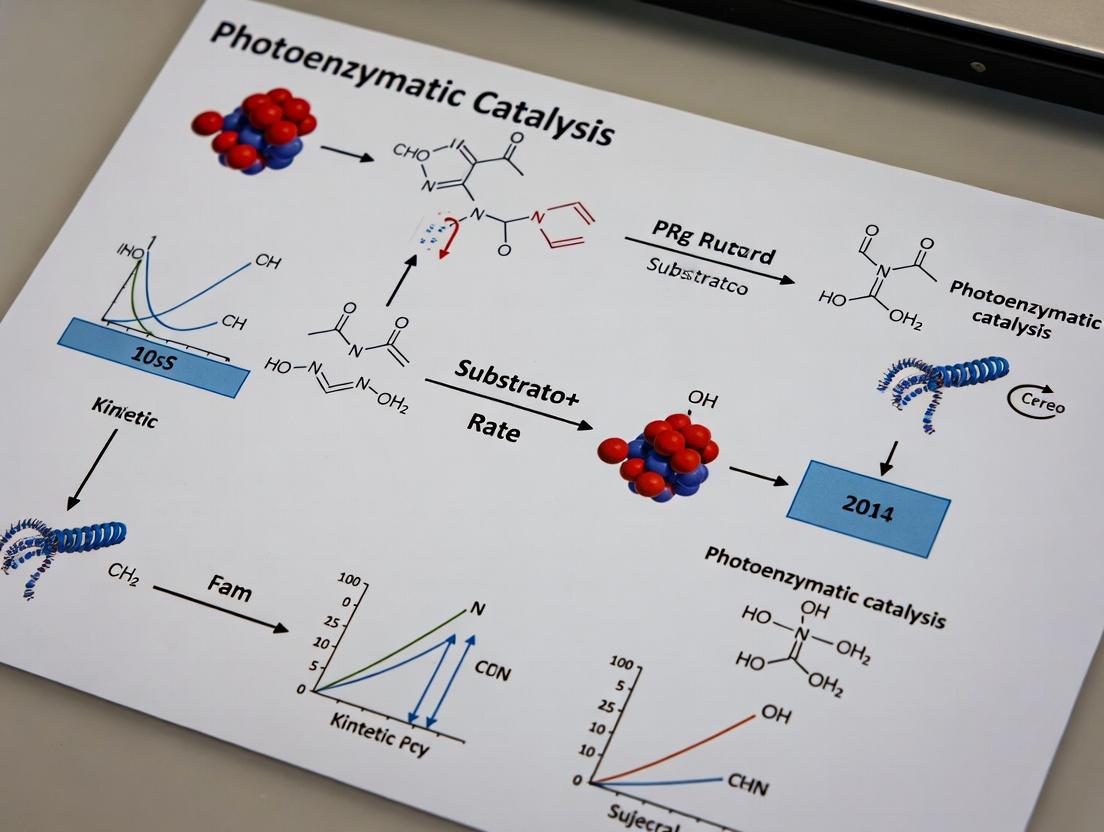
Photoenzymatic catalysis is an emerging frontier that merges the precision of biocatalysis with the energy of light to drive novel, sustainable chemical transformations.
Photoenzymatic Catalysis: Principles, Applications, and the Frontier of Biomedical Translation
Abstract
Photoenzymatic catalysis is an emerging frontier that merges the precision of biocatalysis with the energy of light to drive novel, sustainable chemical transformations. This article provides a comprehensive overview for researchers and drug development professionals, covering the foundational principles of natural and artificial photoenzymes, the design of advanced hybrid systems (including cofactor-independent platforms), and their application in synthesizing high-value chiral intermediates and enabling CO2 conversion. It further details practical methodologies, addresses key challenges in system optimization and stability, and outlines rigorous validation and comparative analysis frameworks. The synthesis concludes by evaluating the transformative potential of this field for green pharmaceutical manufacturing and biomedical research.
What is Photoenzymatic Catalysis? Defining the Principles of a Light-Driven Revolution
Photoenzymatic catalysis represents a frontier in synthetic chemistry, merging the principles of photochemistry with the selectivity and efficiency of enzyme catalysis. This whitepaper defines its core principle: the use of light to initiate or drive highly specific enzymatic transformations that are otherwise kinetically or thermodynamically inaccessible. This synergy enables novel reaction pathways under mild conditions, critical for advanced applications in asymmetric synthesis and drug development.
Foundational Principles & Quantitative Data
The efficacy of photoenzymatic systems is quantified by key metrics comparing them to conventional photocatalysis and enzymatic catalysis alone.
Table 1: Comparative Performance Metrics of Catalytic Systems
| Metric | Traditional Photocatalysis | Traditional Enzymatic Catalysis | Photoenzymatic Catalysis |
|---|---|---|---|
| Enantiomeric Excess (ee) | Typically racemic | High (often >99%) | Very High (>99%, retained from enzyme) |
| Quantum Yield (Φ) | 0.01 - 0.5 | Not Applicable | 0.05 - 0.3 (for hybrid systems) |
| Turnover Number (TON) | 10 - 1000 | 10^3 - 10^6 | 10^2 - 10^4 (for non-native photoactivation) |
| Reaction Temperature | Ambient to 100°C | 20°C - 40°C | 20°C - 40°C |
| Solvent Tolerance | Broad | Limited (aqueous buffer) | Improved via enzyme engineering |
Table 2: Prominent Photoenzyme Classes & Characteristics
| Enzyme Class | Natural Cofactor | Photochemical Role | Exemplary Reaction |
|---|---|---|---|
| Energic Acid Decarboxylases (e.g., FAP) | Flavin (FAD) | Direct C-H alkylation via radical generation | Decarboxylative alkylation of C(sp3)-H bonds |
| Old Yellow Enzymes (OYEs) | Flavin (FMN) | Asymmetric reduction of activated alkenes via photoinduced electron transfer | Enantioselective reduction of α,β-unsaturated compounds |
| Engineered Cytochrome P450s | Heme (Fe) | C-H activation via photoinduced reactive oxygen species | Light-driven hydroxylation |
| Artificial Metalloenzymes | Synthetic metal complexes (e.g., Ir, Ru) | Photo-redox catalysis within a protein scaffold | Asymmetric α-alkylation of aldehydes |
Core Experimental Protocols
Protocol: Photoenzymatic Asymmetric Hydroalkylation using a Flavin-dependent Photodecarboxylase
This protocol details the synthesis of chiral products via photoinduced radical generation and enantioselective bond formation.
Objective: To perform the enantioselective decarboxylative alkylation of an alkyl carboxylic acid to an electron-deficient olefin.
Materials: See "The Scientist's Toolkit" (Section 5.0).
Procedure:
- Enzyme Preparation: Purify the fatty acid photodecarboxylase (FAP) to homogeneity via Ni-NTA affinity chromatography. Concentrate to 20 mg/mL in 50 mM phosphate buffer (pH 7.5). Determine concentration via Bradford assay.
- Anaerobic Sample Preparation: In an argon-filled glovebox, prepare 2 mL reaction vials. Add: 50 µL substrate stock solution (100 mM in DMSO, final conc. 5 mM), 40 µL acceptor olefin (50 mM in DMSO, final conc. 2 mM), and 850 µL of degassed phosphate buffer (50 mM, pH 7.5).
- Reaction Initiation: Add 60 µL of the purified FAP solution. Seal the vial with a rubber septum.
- Photoreaction: Place the vial in a thermostatted photoreactor (25°C) equipped with a 450 nm LED array (intensity calibrated to 20 mW/cm²). Irradiate with continuous stirring for 16-24 hours.
- Quenching & Extraction: Quench the reaction by adding 1 mL of ethyl acetate and vortex vigorously for 2 minutes. Centrifuge at 14,000 rpm for 5 min to separate phases.
- Analysis: Analyze the organic layer via chiral HPLC to determine conversion and enantiomeric excess (ee). Analyze by LC-MS for product identification.
Protocol: Constructing an Artificial Photoenzyme with a Synthetic Photocatalyst
This protocol outlines the creation of a hybrid system by incorporating an abiotic photosensitizer into a protein scaffold.
Objective: To anchor a synthetic iridium photosensitizer within streptavidin for asymmetric α-alkylation.
Procedure:
- Biotinylated Photocatalyst Synthesis: Synthesize an Ir(ppy)₃-derivative functionalized with a biotin linker via standard organometallic synthesis. Confirm structure via NMR and HRMS.
- Host Protein Expression & Purification: Express streptavidin in E. coli and purify via iminobiotin affinity chromatography.
- Hybrid Assembly: Incubate 10 nmol of streptavidin tetramer with a 5-fold molar excess of the biotinylated Ir catalyst in PBS buffer (pH 7.4) for 1 hour at 4°C. Purify the assembly via size-exclusion chromatography (SEC) to remove unbound catalyst.
- Activity Assay: In a photoreactor vial, combine: 5 nmol of the assembled photoenzyme, 0.1 mmol aldehyde substrate, 0.12 mmol alkyl halide, and 0.15 mmol diisopropylethylamine in a 1:1 mixture of buffer and organic co-solvent (total vol 1 mL).
- Irradiation & Analysis: Irradiate with 440 nm LEDs (10 mW/cm²) for 12 hours. Extract and analyze yield via GC-FID and enantioselectivity via chiral HPLC.
Mandatory Visualizations
Diagram 1: General Photoenzymatic Catalysis Workflow
Diagram 2: Artificial Photoenzyme Construction Protocol
The Scientist's Toolkit: Essential Research Reagents & Materials
Table 3: Key Reagent Solutions for Photoenzymatic Research
| Item / Reagent | Function / Role | Example / Specification |
|---|---|---|
| Flavin-dependent Photodecarboxylase (FAP) | The photoenzyme catalyst; absorbs blue light to generate an alkyl radical from a carboxylic acid substrate. | Recombinant, His-tagged, from Chlorella variabilis, ≥95% purity. |
| Biotinylated Iridium Photosensitizer | Synthetic photocatalyst for creating artificial photoenzymes; enables photo-redox cycles within a protein host. | e.g., [Ir(ppy)₂(bpy-CH₂-NH-CO-biotin)]⁺, synthesized in-house or sourced custom. |
| Streptavidin or Sav Mutants | Protein host/scaffold for artificial photoenzymes; provides a high-affinity binding pocket for biotinylated catalysts. | Tetrameric, expressed in E. coli, low photoactivity background. |
| Deazaflavin (e.g., 5-Deazaflavin) | Alternative/supplemental organic photocatalyst for mediating electron transfer to natural or engineered enzymes. | Used in some photo-regeneration systems for NAD(P)H cofactors. |
| Anaerobically Prepared Buffers | Essential for radical-based reactions to prevent quenching by molecular oxygen. | Phosphate or Tris buffer, degassed via 3+ freeze-pump-thaw cycles or sparged with Ar/N₂ for >30 min. |
| Chiral Stationary Phase HPLC Columns | Critical for analyzing enantiomeric excess (ee) of reaction products. | e.g., Daicel CHIRALPAK IA, IC, or AD-H columns (4.6 x 250 mm). |
| Calibrated LED Photoreactors | Provides controlled, monochromatic light irradiation for reproducible photoactivation. | Custom or commercial vials/blocks with temperature control, 420-460 nm typical, intensity calibrated with a radiometer. |
| Deuterated Solvents for EPR | For direct detection and characterization of radical intermediates generated during catalysis. | DMSO-d6, Buffer-D2O, for in-situ EPR or ENDOR spectroscopy studies. |
Photoenzymatic catalysis represents a frontier in synthetic biology and sustainable chemistry, merging the precision of enzyme catalysis with the spatiotemporal control afforded by light. Within the broader thesis of defining its principles, understanding the initial photophysical events is paramount. This process begins not with chemical bond formation, but with the absorption of a photon and the subsequent journey of energy through an enzyme's prosthetic group or engineered chromophore. This guide details the fundamental photophysical steps—light absorption, excitation, energy/electron transfer, and the ultimate manifestation of catalytic activity—providing the technical foundation for advanced research in the field.
The Photophysical Cascade: A Stepwise Analysis
Light Absorption and Excited State Formation
The process initiates when a photon of appropriate energy (wavelength) is absorbed by a chromophore (e.g., flavin, porphyrin, organic dye, or metal complex). This promotes an electron from the ground state (S₀) to a higher-energy singlet excited state (S₁, S₂...). The efficiency is quantified by the molar attenuation coefficient (ε), typically ranging from 10³ to 10⁵ M⁻¹cm⁻¹.
Excited State Relaxation and Dynamics
The initially populated excited singlet state undergoes rapid internal conversion and vibrational relaxation to the lowest vibrational level of S₁. From here, several competing pathways determine the quantum yield (Φ) of subsequent catalytic steps:
- Fluorescence: Radiative decay back to S₀.
- Internal Conversion (IC): Non-radiative decay to S₀.
- Intersystem Crossing (ISC): Spin-forbidden transition to a triplet state (T₁), crucial for catalysts involving radical chemistry or energy transfer.
- Photoinduced Electron Transfer (PET): The electron or hole is transferred to/from a nearby redox-active residue or substrate.
- Förster Resonance Energy Transfer (FRET): Non-radiative energy transfer to an adjacent acceptor chromophore.
From Photophysics to Catalysis
The energy or electron transferred from the excited chromophore alters the redox state of the catalytic center or directly generates reactive intermediates (e.g., radical species, singlet oxygen). This photochemically generated "trigger" then drives the enzyme's canonical or engineered catalytic cycle, often with remarkable stereoselectivity.
Table 1: Key Photophysical Parameters of Common Photoenzyme Chromophores
| Chromophore | Typical Absorption λ_max (nm) | Molar Extinction Coefficient ε (M⁻¹cm⁻¹) | Fluorescence Quantum Yield (Φ_f) | Triplet Yield (Φ_ISC) | Primary Photoprocess |
|---|---|---|---|---|---|
| Flavin Adenine Dinucleotide (FAD) | ~450 | 11,300 | 0.03 | 0.7 | PET / Radical Generation |
| Chlorophyll a | ~430, ~660 | >100,000 (Qy band) | 0.23 | 0.64 | PET / Energy Transfer |
| [Ru(bpy)₃]²⁺ | ~452 | 14,600 | 0.06 | 0.90 | PET (Oxidative/Reductive Quenching) |
| Eosin Y | ~525 | 95,000 | 0.57 | 0.43 | PET / Singlet Oxygen Gen. |
| Deazaflavin | ~420 | 6,000 | <0.01 | >0.9 | PET / Hydride Transfer |
Core Experimental Methodologies
Protocol: Steady-State UV-Vis Absorption Spectroscopy
Purpose: Determine chromophore identity, concentration (via Beer-Lambert law), and ground-state electronic properties. Procedure:
- Prepare enzyme/chromophore sample in a suitable transparent buffer (e.g., 50 mM phosphate, pH 7.4). Ensure absorbance of target peak is between 0.1 and 1.0 for optimal accuracy.
- Fill a quartz cuvette (typically 1 cm path length) with sample and reference (buffer alone).
- Record absorption spectrum from 250 nm to 800 nm using a dual-beam spectrophotometer.
- Calculate concentration: c = A / (ε * l), where A=absorbance, ε=known extinction coefficient, l=path length.
Protocol: Time-Resolved Fluorescence Spectroscopy
Purpose: Measure the lifetime (τ) of the excited singlet state, informing on quenching, energy transfer, and conformational dynamics. Procedure (Time-Correlated Single Photon Counting - TCSPC):
- Excite the sample with a pulsed diode laser or Ti:sapphire laser at the chromophore's absorption maximum.
- Collect emitted photons at the fluorescence maximum using a fast photomultiplier tube or microchannel plate detector.
- Build a histogram of photon arrival times relative to the laser pulse over millions of cycles.
- Fit the decay curve to single or multi-exponential functions: I(t) = Σ αᵢ exp(-t/τᵢ), where τᵢ are lifetimes and αᵢ their amplitudes.
Protocol: Laser Flash Photolysis
Purpose: Directly observe triplet states and transient intermediates (radicals, charge-separated states) on microsecond to second timescales. Procedure:
- Place sample in a stirred quartz cuvette within the spectrometer.
- Use a pulsed Nd:YAG or excimer laser (e.g., 355 nm, 5-10 ns pulse) for photoexcitation.
- Monitor transient absorption changes (ΔA) at specified probe wavelengths using a continuous white light probe beam and a fast photodiode or CCD detector.
- Record kinetic traces at different wavelengths to construct time-resolved absorption spectra and derive decay kinetics of transient species.
Visualizing Pathways and Workflows
Diagram 1: Core Photophysical Pathways in Photoenzymes (100 chars)
Diagram 2: Photophysical Characterization Workflow (96 chars)
The Scientist's Toolkit: Essential Research Reagents & Materials
Table 2: Key Research Reagent Solutions for Photoenzymatic Studies
| Item | Function & Rationale |
|---|---|
| Anaerobic Sealed Cuvettes (e.g., with septum) | To exclude oxygen for studying triplet states or oxygen-sensitive intermediates, as O₂ is a potent triplet quencher. |
| Deuterium Oxide (D₂O) | Solvent for NMR studies of photoproducts; also used in kinetic isotope effects to probe H-transfer mechanisms. |
| Electron Donor/Acceptor Pairs (e.g., TEOA / MV²⁺) | Sacrificial reagents to study photoinduced electron transfer pathways by providing a quencher for the excited state. |
| Singlet Oxygen Scavengers & Quenchers (e.g., Sodium Azide, DABCO) | To confirm or rule out the involvement of singlet oxygen (¹O₂) in the catalytic mechanism. |
| Stopped-Flow Module (for spectrophotometer) | To rapidly mix enzyme with substrate just prior to light excitation, enabling study of fast binding events under photochemical conditions. |
| Low-Temperature Matrices (e.g., glycerol/buffer glass at 77K) | To trap and characterize transient intermediates (e.g., radical pairs) by slowing down their recombination or decay. |
| Optically Transparent Redox Dyes (e.g., methyl viologen, benzyl viologen) | To act as electron relays or to spectrophotometrically monitor redox potential changes during photocatalysis. |
| Chromophore Analogs/Isotopologues (e.g., ¹³C-labeled, deuterated flavins) | For mechanistic probing using advanced techniques like EPR, ENDOR, or NMR to track atom-specific fate. |
Contrasting Thermal vs. Photo- Activation Mechanisms in Enzymes
This whitepaper provides a detailed technical comparison between thermal and photo-activation mechanisms in enzyme catalysis. This analysis is framed within the broader research thesis on photoenzymatic catalysis definition and principles, which seeks to establish a foundational understanding of how light energy can be harnessed to drive and control enzymatic reactions with spatiotemporal precision unattainable by traditional thermal means. For researchers and drug development professionals, elucidating these contrasting mechanisms is critical for innovating new therapeutic and synthetic biology platforms.
Fundamental Mechanisms: Core Principles
Thermal Activation
Thermal activation relies on ambient or applied heat to provide the kinetic energy necessary for substrates to reach the transition state. The reaction rate follows the Arrhenius equation, where increasing temperature increases the rate constant. Conformational changes in the enzyme are stochastic and driven by molecular collisions.
Photo-Activation
Photo-activation involves the direct absorption of photons by the enzyme or a bound cofactor (e.g., flavin, porphyrin). This absorption promotes an electron to an excited state, initiating a photophysical cascade (e.g., energy transfer, electron transfer, or generation of radical species) that drives catalysis. This mechanism is central to defined photoenzymatic systems, enabling reaction control orthogonal to thermal pathways.
Quantitative Comparison of Key Parameters
The following tables summarize critical data differentiating the two activation modes.
Table 1: Energetic and Kinetic Parameters
| Parameter | Thermal Activation | Photo-Activation |
|---|---|---|
| Primary Energy Source | Heat (kT) | Photons (hν) |
| Activation Energy (Ea) Range | 50 - 100 kJ/mol | 10 - 200 kJ/mol (light-dependent) |
| Typical Time Scale for Activation | Picoseconds to milliseconds | Femtoseconds to nanoseconds (initial step) |
| Temperature Dependence (Q₁₀) | 2-3 (for biological rates) | Can be near 1 (light-intensity dependent) |
| Spatial Control Resolution | Poor (bulk heating) | Excellent (diffraction-limited, ~250 nm) |
| Temporal Control Resolution | Millisecond-second (limited by heat transfer) | Nanosecond-microsecond (pulse laser controlled) |
Table 2: Key Characteristics in Biocatalysis
| Characteristic | Thermal Activation | Photo-Activation |
|---|---|---|
| Reaction Selectivity | Governed by transition-state stabilization | Can access high-energy intermediates (e.g., radicals) for novel selectivity |
| Spatiotemporal Control | Limited | Precise, tunable by wavelength and intensity |
| Side Reactions | Increased at higher temperatures | Potential for photodamage or off-target excited-state reactions |
| Orthogonality in Complex Systems | Low (affects all components) | High (with selective chromophore targeting) |
| Common Enzyme Examples | Hydrolases, Polymerases | DNA Photolyases, Flavoprotein Oxidoreductases |
Experimental Protocols for Mechanistic Investigation
Protocol: Stopped-Flow Spectroscopy for Thermal Kinetics
Objective: Determine the pre-steady-state kinetic parameters (kₐₜₜ, Kₘ) of a thermally activated enzyme.
- Prepare Solutions: In separate syringes, load (A) enzyme (2-10 µM in appropriate buffer) and (B) substrate (at least 5x concentration range across Kₘ). Pre-incubate both at the precise experimental temperature (±0.1°C) using a circulating water bath.
- Calibration & Mixing: Calibrate the stopped-flow instrument's dead time (typically 1-3 ms). Rapidly mix equal volumes (typically 50-100 µL each) from syringes A and B into the observation cell.
- Data Acquisition: Monitor the reaction progress (e.g., absorbance, fluorescence) for 5-10 half-lives. Use a photomultiplier tube or diode array detector.
- Analysis: Fit the resulting time-course data to the appropriate kinetic model (e.g., single or double exponential) to obtain observed rates (kₒbₛ). Plot kₒbₛ against substrate concentration and fit to the Michaelis-Menten equation to derive kₐₜₜ and Kₘ.
Protocol: Laser Flash Photolysis for Photoenzyme Dynamics
Objective: Characterize the transient intermediates and kinetics of a photoactivated enzymatic cycle.
- Sample Preparation: Prepare enzyme with bound photoco factor in a sealed, degassed cuvette under anaerobic conditions if necessary to prevent quenching by oxygen.
- Excitation: Use a pulsed laser (e.g., Nd:YAG, dye laser) tuned to the absorption maximum of the cofactor (e.g., 450 nm for flavin). Pulse width should be shorter than the dynamics of interest (nanoseconds typical).
- Probe & Detection: A continuous white light probe beam is passed through the sample perpendicular to the pump laser path. A monochromator selects a specific probe wavelength, and a fast detector (e.g., photomultiplier, diode) records changes in absorbance over time.
- Data Collection & Global Analysis: Record transient absorption spectra at multiple time delays and probe wavelengths. Perform global kinetic analysis to deconvolute spectra and lifetimes of sequential intermediates (e.g., excited singlet state, triplet state, semiquinone radical).
Visualization of Mechanisms and Workflows
The Scientist's Toolkit: Key Research Reagent Solutions
Table 3: Essential Materials for Thermal vs. Photoenzyme Studies
| Item | Function | Example/Target Use |
|---|---|---|
| Highly Purified Recombinant Enzyme | Ensure consistent, contaminant-free protein for kinetic and spectroscopic studies. | Overexpressed and purified photoenzyme (e.g., ene-reductase) or thermal enzyme control. |
| Chromophore Cofactors | Provide the light-absorbing center for photoenzymes. | Flavins (FMN, FAD), Deazaflavin, Pyrroloquinoline quinone (PQQ). |
| Anaerobic Chamber/Sealed Cuvettes | Maintain oxygen-free conditions to study radical intermediates prone to quenching by O₂. | Flash photolysis experiments on flavoproteins. |
| Temperature-Controlled Stopped-Flow System | Accurately measure pre-steady-state kinetics with rapid mixing and precise thermal control. | Determining kₐₜₜ and Kₘ of a thermally activated enzyme. |
| Tunable Pulsed Laser System | Provide monochromatic, high-intensity light pulses to initiate the photocycle. | Nd:YAG laser with optical parametric oscillator (OPO) for flash photolysis. |
| Rapid-Scanning Spectrophotometer | Capture full UV-Vis spectra on millisecond timescales. | Observing intermediate formation/decay during thermal or light-driven turnover. |
| Quartz Cuvettes (UV-Vis Transparent) | Allow excitation and probing across UV and visible wavelengths without interference. | All spectroscopy experiments. |
| Chemical Quenchers/Sensitizers | Probe electron transfer pathways or scavenge specific reactive species. | Potassium ferricyanide (electron acceptor), sodium azide (singlet oxygen quencher). |
| Isotopically Labeled Substrates (²H, ¹³C) | Unravel reaction mechanisms via kinetic isotope effects (KIE) or NMR analysis. | Distinguishing between hydride vs. proton transfer steps in photoinduced mechanisms. |
| Cryogenic Spectrophotometer | Trap and characterize transient intermediates at low temperatures. | Studying unstable photoproducts in enzymes like DNA photolyase. |
This whitepaper explores the rare but mechanistically profound domain of natural photoenzymes, framed within the broader research thesis of defining the principles of photoenzymatic catalysis. Unlike the more common photochemical reactions in biology (e.g., photosynthesis), natural photoenzymes are defined as enzymes that utilize light energy to catalyze chemical transformations of a substrate that is not chlorophyll or a related photosynthetic pigment. These enzymes represent exquisite biological blueprints for harnessing photon energy with high selectivity, offering transformative insights for biocatalysis and photopharmacology. Understanding their mechanisms is critical for advancing the foundational principles of photoenzymatic catalysis.
Core Mechanisms and Key Photoenzymes
Natural photoenzymes operate through distinct photochemical mechanisms, often involving specialized cofactors.
DNA Photolyase
This enzyme repairs UV-induced cyclobutane pyrimidine dimers (CPDs) in DNA. It contains two cofactors: a light-harvesting antenna (often methenyltetrahydrofolate, MTHF) and a catalytic flavin adenine dinucleotide (FADH⁻). Upon blue-light absorption by the antenna, energy is transferred to FADH⁻, which transfers an electron to the CPD, initiating bond cleavage and repair.
(S)-Enone Reductase (Formerly "Old Yellow Enzyme" Family)
Certain members, such as the fatty acid photodecarboxylase (FAP) discovered in microalgae, utilize a flavin cofactor (FAD) to catalyze light-driven decarboxylation of fatty acids. Upon blue-light excitation, the flavin semiquinone form abstracts a proton from the substrate carboxylate, leading to decarboxylation and hydrocarbon formation.
Protochlorophyllide Oxidoreductase (POR)
A critical enzyme in chlorophyll biosynthesis, POR catalyzes the light-dependent reduction of protochlorophyllide to chlorophyllide. It uses NADPH as a co-substrate. Light absorption by the substrate-cofactor-enzyme complex directly drives the hydride and proton transfer.
Table 1: Key Natural Photoenzymes, Cofactors, and Reactions
| Photoenzyme | Organismal Source | Cofactor | Light Wavelength (nm) | Catalyzed Reaction | Quantum Yield |
|---|---|---|---|---|---|
| DNA Photolyase (CPD) | E. coli, many eukaryotes | FADH⁻, MTHF/8-HDF | 350-450 (Blue/UVA) | CPD dimer split | ~0.7-0.9 |
| Fatty Acid Photodecarboxylase (FAP) | Chlorella variabilis | FAD (neutral semiquinone) | 440-460 (Blue) | Fatty Acid → Alkane + CO₂ | ~0.8 |
| Protochlorophyllide Oxidoreductase (POR) | Cyanobacteria, plants | Substrate-bound (Protochl.), NADPH | ~630-650 (Red) | Protochlorophyllide → Chlorophyllide | ~0.6-0.7 |
| Deazaflavin-Dependent Photoreductase (Cof-type) | Various bacteria | 8-Hydroxy-7,8-didemethyl-5-deazariboflavin | 350-450 | Diverse reductions | Varies |
Experimental Protocols for Key Analyses
Protocol: In Vitro Photoenzyme Activity Assay (e.g., FAP)
Objective: Measure light-dependent alkane production from a fatty acid substrate. Materials:
- Purified photoenzyme (e.g., recombinant FAP).
- Substrate: 100 µM dodecanoic acid in assay buffer.
- Assay Buffer: 50 mM Tris-HCl, pH 8.0, 150 mM NaCl.
- Light Source: High-power blue LED (450 nm, 20 mW/cm² intensity, calibrated with radiometer).
- Control Setup: Identical setup wrapped in foil for dark control.
- Detection: GC-MS for alkane (undecane) quantification.
Procedure:
- In a quartz cuvette, mix 95 µL of assay buffer, 5 µL of substrate stock, and 1 µM final concentration of purified enzyme.
- Immediately expose the reaction mixture to blue light for 5 minutes at 25°C. Maintain dark control concurrently.
- Quench the reaction by adding 100 µL of ethyl acetate and vortex vigorously.
- Analyze the organic phase by GC-MS using selected ion monitoring for undecane. Quantify against a standard curve.
- Calculate turnover frequency (TOF) based on product formed per enzyme per unit time.
Protocol: Transient Absorption Spectroscopy for Photocycle Intermediates
Objective: Characterize ultrafast electron/proton transfer events post-photoexcitation. Materials:
- Photoenzyme sample in a low-absorbance buffer (e.g., 50 µM in phosphate buffer).
- Femtosecond or nanosecond transient absorption spectrometer.
- Pump laser tuned to enzyme's absorption peak (e.g., 450 nm for FAD).
- Probe white light continuum.
- Cryostat for temperature-controlled studies (optional).
Procedure:
- Degas enzyme sample to minimize oxygen interference.
- Load sample into a flow cell or rotating cuvette to prevent photodamage.
- Set pump laser to desired excitation wavelength and energy.
- Collect differential absorbance (ΔA) spectra at time delays from femtoseconds to milliseconds.
- Global analysis of the time-resolved spectra to resolve distinct kinetic intermediates and lifetimes.
Diagram: Core Photoenzymatic Catalysis Cycle
Diagram: DNA Photolyase Repair Mechanism
The Scientist's Toolkit: Essential Research Reagents and Materials
Table 2: Key Research Reagent Solutions for Photoenzyme Studies
| Item | Function/Benefit | Example/Notes |
|---|---|---|
| Recombinant Photoenzyme Kits | Provides purified, active enzyme for in vitro assays. Essential for mechanistic studies. | Commercially available FAP or Photolyase (e.g., from Sigma-Aldrich or specialized biocatalyst suppliers). |
| Deuterated or ¹³C-Labeled Substrates | Allows tracing of reaction fate via NMR or MS; crucial for elucidating mechanism. | Dodecanoic acid-d₂₃ for FAP studies; ¹³C-labeled pyrimidine dimers for Photolyase. |
| Anaerobic Cuvettes/Glove Box | Many photoenzyme intermediates (e.g., flavin semiquinone) are oxygen-sensitive. | Quartz anaerobic cuvettes with septa for spectroscopic assays. |
| Precision Light Sources (LEDs/Lasers) | Delivers monochromatic, intensity-controlled light for reproducible photoactivation. | High-power LED arrays with tunable wavelength (e.g., Thorlabs, CoolLED). Integrated radiometer is key. |
| Quartz Microcuvettes | UV-vis transparency for spectroscopic activity assays and transient absorption. | Hellma or Starna brand, pathlength 2-10 mm for low-volume samples. |
| Stopped-Flow Spectrophotometer with LED Module | Enables kinetic studies of fast photochemical reactions (ms to s timescale). | Applied Photophysics or Hi-Tech KinetAsyst models with integrated photoexcitation. |
| Flavin Cofactor Analogs | Probes the role of the cofactor's redox potential and structure in catalysis. | 8-Halogenated flavins, 5-deazaflavin for Photolyase/FAP studies. |
| Photostable Quenchers & Scavengers | Controls for thermal reactions or identifies reactive oxygen species (ROS) side products. | Sodium azide (singlet O₂ quencher), DABCO, superoxide dismutase. |
| Cryogenic Spectrophotometer | Stabilizes transient intermediates for detailed electronic structure analysis. | For low-temperature (77K) fluorescence and absorbance studies of photocycles. |
Natural photoenzymes are rare biological gems that provide foundational blueprints for merging photocatalysis with enzymatic precision. Their study, situated within the broader quest to define photoenzymatic catalysis principles, reveals unique strategies for coupling light absorption to bond-making and -breaking chemistry. The experimental approaches and toolkit detailed here empower researchers to decipher these mechanisms. Future research will focus on engineering these blueprints for novel, light-driven biocatalysis in synthetic chemistry and the development of next-generation, light-activated therapeutics, pushing the boundaries of the photoenzyme definition itself.
This document serves as an in-depth technical guide on the core driving rationales for advancing photoenzymatic catalysis. It is framed within a broader thesis aimed at defining and elucidating the principles of photoenzymatic catalysis. This field merges the precision of biocatalysis with the energy input and unique reactivity of photochemistry. The central thesis posits that photoenzymatic catalysis is a distinct paradigm defined by the direct coupling of photoexcited states within a protein scaffold to enable enzymatic transformations inaccessible to ground-state biochemistry. The rationales explored herein—sustainability, unlocking new reactivity, and overcoming innate cofactor limitations—form the foundational pillars justifying this research direction and its application in sophisticated domains like drug development.
Core Rationales and Quantitative Data
Sustainability Metrics
The use of light as a traceless, renewable reagent significantly improves the environmental footprint of chemical synthesis compared to traditional methods reliant on heavy metals, stoichiometric oxidants, or harsh conditions.
Table 1: Comparative Environmental Metrics for Catalytic Methods
| Metric | Traditional Transition-Metal Catalysis | Photoenzymatic Catalysis | Notes/Source |
|---|---|---|---|
| Estimated Process Mass Intensity (PMI) | 50-150 kg/kg product | 10-40 kg/kg product | PMI includes all materials; light energy has low mass contribution. |
| Catalyst Loading (mol%) | 0.1-5% | 0.0001-1% (enzyme) | Enzyme acts as a catalyst; often recombinant and biodegradable. |
| Heavy Metal Waste | Potentially high | None | Enzymes typically employ organic cofactors (e.g., flavins). |
| Energy Source | Thermal (often >100°C) | Photons (Visible Light) | Ambient temperature operation. |
| Solvent Preference | Often organic (DMF, DMSO) | Often aqueous or aqueous-buffer mixtures. |
New Reactivity: Quantum Yield and Enantioselectivity
Photoexcitation enables access to high-energy intermediates (e.g., radical, triplet, or redox-activated species) under mild conditions, facilitating novel bond formations.
Table 2: Performance Metrics for Exemplar Photoenzymatic Reactions
| Reaction Type | Enzyme/Cofactor | Quantum Yield (Φ) | ee (%) | TON | Reference |
|---|---|---|---|---|---|
| Intermolecular [2+2] Cycloaddition | Flavoprotein (EnzKR2) | 0.3 | >99 | ~300 | |
| C–C Coupling (Radical) | NAD(P)H-dependent ketoreductase (PhotoKRED) | 0.15 | 95-99 | 1,000-5,000 | |
| C–H Amination | Engineered P450 (CYP411A1) | 0.08 | 90 | ~200 | |
| Dehalogenation | Flavodoxin/Flavin hybrid | 0.22 | N/A | >1,000 |
Bypassing Cofactor Limits: Turnover Numbers (TON)
Natural cofactors (NAD(P)H, ATP) are costly and often required in stoichiometric amounts. Photoregeneration or photocatalytic bypass directly addresses this bottleneck.
Table 3: Cofactor Regeneration/Bypass Strategies
| Strategy | Cofactor Targeted | Photocatalyst/Sensitizer | Max TON (Cofactor) | Key Advantage |
|---|---|---|---|---|
| Direct Photoreduction | Flavin (FAD/FMN) | None (direct enzyme excitation) | >10,000 | Simplest system; no external redox agents. |
| Indirect Photoreduction | NAD(P)+ | [Ir(ppy)₃], Eosin Y | 500-2,000 | Uses inexpensive sacrificial donor (e.g., TEOA). |
| Bypass via Single-Electron Transfer | N/A (bypasses NADH) | Organic dye (e.g., Acr+-Mes) | N/A (cofactor-free) | Generates radical intermediates directly from substrate. |
| Hybrid Photoelectrochemical | NAD(P)+ | Semiconductor electrode (e.g., TiO₂) | ~1,200 | Potentially combines light harvesting and electrical bias. |
Detailed Experimental Protocols
Objective: To catalyze the enantioselective cycloaddition between 4-substituted coumarin and an alkene. Materials: See "The Scientist's Toolkit" (Section 5). Procedure:
- Reaction Setup: In a 2 mL glass vial, combine the following under an inert atmosphere (N₂ or Ar):
- Substrate 1 (e.g., 4-methylcoumarin): 0.05 mmol.
- Substrate 2 (e.g., 4-vinylanisole): 0.10 mmol.
- Purified EnzKR2 enzyme solution (in 50 mM Tris-HCl, pH 8.0): 5 µM final concentration.
- Adjust total volume to 1 mL with reaction buffer (50 mM Tris-HCl, pH 8.0, containing 100 mM NaCl).
- Photolysis: Seal the vial with a septum. Place the vial in a temperature-controlled photoreactor (e.g., 20°C) equipped with 450 nm LEDs (intensity: ~10 mW/cm²). Irradiate with continuous stirring for 16-24 hours.
- Workup: Quench the reaction by adding 1 mL of ethyl acetate. Vortex vigorously and centrifuge (10,000 x g, 5 min) to separate phases.
- Analysis: Analyze the organic layer by chiral HPLC to determine conversion and enantiomeric excess (ee). Isolate the product via preparative TLC or silica column chromatography. Key Notes: Enzyme stability under irradiation is critical. Control reactions without light or without enzyme must be run in parallel.
Objective: To regenerate NADPH photocatalytically for continuous operation of a ketoreductase (KRED). Procedure:
- Master Mix Preparation: Prepare a 5 mL solution containing:
- Phosphate buffer (100 mM, pH 7.5): 4.5 mL.
- NADP+ (stock solution): 0.1 mM final concentration.
- [Ir(ppy)₂(dtbbpy)]PF₆ (photocatalyst): 0.01 mM final concentration.
- Triethanolamine (TEOA, sacrificial electron donor): 50 mM final concentration.
- Enzyme/Substrate Addition: To the master mix, add:
- KRED (desired enzyme, e.g., for acetophenone reduction): 1 µM final.
- Substrate (acetophenone): 10 mM final.
- Reaction Execution: Degas the solution by sparging with Ar for 10 minutes. Transfer to a sealed, argon-filled photoreactor vial. Illuminate with 440 nm blue LEDs (intensity ~15 mW/cm²) at 30°C with stirring.
- Monitoring: At regular intervals, take aliquots (50 µL), quench with acetonitrile (100 µL), filter, and analyze by UPLC to quantify (S)- or (R)-1-phenylethanol formation and NADPH consumption/regeneration (via absorbance at 340 nm).
- Calculations: Determine the total turnover number (TTN) for NADPH by dividing the moles of product formed by the initial moles of NADP+.
Visualizations
Title: Photoenzymatic Catalysis Core Mechanism
Title: General Photoenzymatic Experiment Workflow
Title: Cofactor Bypass via Photoredox-KRED Hybrid
The Scientist's Toolkit: Research Reagent Solutions
Table 4: Essential Materials for Photoenzymatic Research
| Item | Function/Description | Example Vendor/Product Code |
|---|---|---|
| Specialized Photoenzymes | Engineered flavoproteins or reconstituted metalloenzymes for specific photochemical transformations. | Codex Labs EnzKR2; Sigma-Aldrich P450 variants (CYP411A1). |
| Cofactors (Natural) | High-purity NAD(P)+, FAD, FMN for establishing baseline enzymatic activity and control experiments. | Roche NADP+ Sodium Salt (10128031001); Sigma FAD Disodium Salt (F6625). |
| Organic Photocatalysts (PCs) | Molecules that absorb light and mediate electron transfer, enabling cofactor regeneration or substrate activation. | Sigma [Ir(ppy)₂(dtbbpy)]PF₆ (900207); TCI 9-Mesityl-10-methylacridinium (A2522). |
| Sacrificial Electron Donors | Provide electrons to the photocatalytic cycle, being consumed in the process (e.g., TEOA, BNAH). | Sigma Triethanolamine (90279); TCI 1-Benzyl-1,4-dihydronicotinamide (B1548). |
| Anaerobic Reaction Vials/Septa | For excluding oxygen, which can quench excited states and interfere with radical intermediates. | Chemglass Vial (CG-4909-01) with PTFE/Silicone Septa. |
| Calibrated LED Photoreactors | Provide controlled, monochromatic light intensity at specific wavelengths (e.g., 450 nm, 525 nm). | HepatoChem Photoredox Box (PR-2); homemade setups with Thorlabs LEDs and drivers. |
| Light Power Meter | Essential for quantifying photon flux (mW/cm²) for accurate quantum yield (Φ) calculations. | Thorlabs PM100D with S120VC Sensor. |
| Spectrophotometer with Peltier | For rapid kinetic assays monitoring cofactor conversion (e.g., NADPH at 340 nm) under temperature control. | Agilent Cary 60; JASCO V-750. |
| Chiral HPLC/UPLC Columns | Critical for analyzing enantiomeric excess (ee) of chiral products from asymmetric photoenzymatic synthesis. | Daicel Chiralpak IA-3, IC-3; Waters Acquity UPLC Trefoil Columns. |
Building and Applying Hybrid Photo-Biocatalysts: From Laboratory Design to Industrial Synthesis
The pursuit of sustainable, selective chemical synthesis drives research in photoenzymatic catalysis, which merges the stereoselective power of enzymes with the versatile redox capabilities of photocatalysts. A central challenge in this field is the design of the hybrid catalyst system architecture itself. This guide explores two foundational design paradigms—Integrated and Modular—framed within the broader thesis of defining principles for efficient inter-catalyst electron and energy transfer. The choice of architecture fundamentally dictates catalytic efficiency, scalability, and applicability in complex environments like drug synthesis.
Core Architectural Paradigms
Integrated Design: The photosensitizer and enzyme are covalently linked or embedded within a single scaffold (e.g., a protein, polymer, or nanoparticle). This creates a unified, discrete catalytic entity.
- Primary Advantage: Ensures precise, fixed proximity between components, minimizing diffusion delays and enhancing electron transfer rates.
- Key Challenge: Complex, multi-step synthesis for each new system; perturbations to enzyme structure/function must be meticulously assessed.
Modular Design: The photosensitizer and enzyme are separate, self-contained units that interact through diffusion or weak intermolecular forces (e.g., electrostatic interactions, host-guest binding).
- Primary Advantage: High flexibility; components can be "mixed-and-matched," simplifying optimization and allowing use of native enzymes.
- Key Challenge: Reliant on stochastic collisions, leading to potential inefficiency and off-pathway reactions in dilute conditions.
Quantitative Comparison of Key Performance Metrics
Data from recent literature (2023-2024) on hybrid systems for reactions like asymmetric C-H functionalization and CO₂ reduction are summarized below.
Table 1: Performance Metrics of Integrated vs. Modular Architectures
| Metric | Integrated Architecture | Modular Architecture | Notes / Conditions |
|---|---|---|---|
| TON (Catalyst) | 1,500 - 15,000 | 200 - 5,000 | Highly substrate & linker dependent. |
| TOF (hr⁻¹) | 50 - 500 | 5 - 100 | Integrated systems typically show higher initial rates. |
| ee (%) | 85 - >99 | 70 - 98 | Integration can better preserve chiral environment. |
| Effective Distance (Å) | 10 - 20 (fixed) | >30 (variable) | Critical for electron transfer rate (k~e^(-βr)). |
| Synthetic Steps | 5 - 15 | 1 - 3 | Modular uses simple cofactor/mediator addition. |
| Recoverability | Good (single unit) | Poor (separate components) | Integrated designs enable easier catalyst recycling. |
Detailed Experimental Protocols
Protocol A: Synthesis & Characterization of an Integrated Hybrid (Covalent Fusion)
- Objective: Create a genetically encoded fusion protein between a LOV-domain photosensitizer and a ene-reductase.
- Gene Construction: Use overlap extension PCR to fuse the DNA sequence of the Thermobifida fusca LOV domain (TfLOV) N-terminally to the gene of Old Yellow Enzyme 1 (OYE1) with a (GGS)₇ flexible linker. Clone into a pET-28a(+) expression vector.
- Protein Expression: Transform into E. coli BL21(DE3). Grow culture in LB/Kanamycin at 37°C to OD₆₀₀=0.6, induce with 0.5 mM IPTG, and express at 18°C for 18 hours.
- Purification: Lyse cells via sonication. Purify the His₆-tagged fusion protein via Ni-NTA affinity chromatography, followed by size-exclusion chromatography (Superdex 200) in 50 mM potassium phosphate buffer, pH 7.5.
- Characterization: Confirm molecular weight via SDS-PAGE and intact mass spectrometry. Verify photoactivity via UV-Vis spectroscopy (450 nm peak for flavin) and fluorescence quenching assays with sacrificial electron donors (e.g., EDTA).
Protocol B: Evaluation of a Modular System for Photoreduction
- Objective: Assess the activity of a system combining [Ir(ppy)₂(dtbpy)]⁺ as a diffusional photosensitizer with glucose dehydrogenase (GDH) for NADPH regeneration and P450 monooxygenase.
- Reaction Setup: In an anaerobic glovebox, prepare 1 mL of reaction mixture in a clear vial: 1 µM P450 enzyme, 5 µM [Ir] photosensitizer, 10 U/mL GDH, 10 mM glucose, 1 mM NADP⁺, and 5 mM substrate in 100 mM Tris-HCl buffer (pH 8.0).
- Photoreaction: Seal the vial, remove from glovebox, and place under constant agitation in a photoreactor equipped with 450 nm blue LEDs (intensity: 20 mW/cm²). Maintain temperature at 30°C.
- Sampling & Analysis: At regular intervals, withdraw 100 µL aliquots, quench with 100 µL acetonitrile, vortex, and centrifuge. Analyze product formation via UPLC-MS. Quantify NADPH concentration fluorometrically (excitation 340 nm, emission 460 nm).
- Control Experiments: Run identical setups in the dark, without the photosensitizer, and without GDH/glucose.
Visualizing Architectures and Electron Flow
Diagram 1: Integrated Catalyst Design Concept (76 chars)
Diagram 2: Modular Catalyst Design with Mediator (79 chars)
The Scientist's Toolkit: Key Research Reagent Solutions
Table 2: Essential Reagents for Hybrid Catalyst Research
| Item | Function in Research | Example (Supplier) |
|---|---|---|
| Engineered Photoenzymes | Covalently integrated architectures for studying directed electron transfer. | Flavin-linked Old Yellow Enzyme (in-house expression or specialized catalogs). |
| Transition Metal Photocatalysts | Modular photosensitizers for visible light absorption and redox cycling. | [Ir(ppy)₃], [Ru(bpy)₃]²⁺, Eosin Y (Sigma-Aldrich, TCI). |
| Biological Cofactors | Essential redox mediators in modular systems. | NAD(P)H, FAD, FMN (Roche, Sigma-Aldrich). |
| Sacrificial Electron Donors | Consumed to re-reduce the photosensitizer, closing the catalytic cycle. | Triethanolamine (TEOA), EDTA, Ascorbate (common chemical suppliers). |
| Oxygen Scavenging Systems | Maintain anaerobic conditions crucial for many photo-redox biocatalyses. | Glucose Oxidase/Catalase/Glucose mix (Sigma-Aldrich). |
| Site-Directed Mutagenesis Kits | For creating covalent attachment points or optimizing enzyme interfaces. | QuikChange Kit (Agilent) or Gibson Assembly Master Mix (NEB). |
| Immobilization Resins | To heterogenize integrated catalysts for continuous flow applications. | Epoxy-activated Agarose beads (Thermo Scientific). |
Within the expanding field of photoenzymatic catalysis—the merger of photochemistry with enzymatic transformation—the selection of the photosensitizer (PS) material is the critical, rate-determining factor. Photoenzymatic catalysis is defined as the use of light to excite a photosensitizer, which then initiates or enhances the catalytic cycle of an enzyme, often through single-electron or energy transfer processes. This whitepaper provides an in-depth technical guide to the three primary classes of photosensitizers: semiconductors, quantum dots (QDs), and molecular dyes/complexes. The selection among these materials dictates the efficiency, stability, selectivity, and biocompatibility of the overall system, directly impacting research outcomes in sustainable chemistry and drug development.
Core Material Classes: Properties and Mechanisms
Semiconductor Photosensitizers
These are typically bulk or nanostructured inorganic materials (e.g., TiO₂, CdS, carbon nitrides). Upon light absorption with energy exceeding their bandgap, they generate electron-hole pairs. The photogenerated electrons can be transferred to enzymatic cofactors (like NAD⁺) or directly to the enzyme's active site.
Key Characteristics:
- Broad absorption often in the UV to visible range.
- High photostability but limited tunability.
- Charge separation efficiency is highly dependent on crystallinity and nanostructure.
Quantum Dot (QD) Photosensitizers
QDs are nanoscale semiconductors (e.g., CdSe, PbS, InP) with size-dependent optoelectronic properties due to quantum confinement. They offer superior light-harvesting and precise energetic tuning compared to bulk semiconductors.
Key Characteristics:
- Size-tunable absorption and emission across UV, visible, and NIR.
- High extinction coefficients and broad absorption profiles.
- Multiexciton generation potential for high quantum yields.
- Surface chemistry is crucial for bioconjugation and reducing toxicity.
Molecular Photosensitizers
This class includes organic dyes (e.g., eosin Y, rose bengal) and metal-organic complexes (e.g., [Ru(bpy)₃]²⁺, porphyrins, Ir(III) complexes). They operate via well-defined photophysical pathways to populate triplet excited states, facilitating efficient energy or electron transfer.
Key Characteristics:
- Precise molecular structure and defined redox potentials.
- High molar absorptivity at specific wavelengths.
- Susceptible to photobleaching (organic dyes) versus higher stability (metal complexes).
- Easily modified for solubility and targeting.
Quantitative Comparison of Key Properties
The following table summarizes critical performance parameters for photosensitizer selection in photoenzymatic contexts.
Table 1: Comparative Analysis of Photosensitizer Material Classes
| Property | Semiconductor (e.g., TiO₂ NP) | Quantum Dot (e.g., CdSe/ZnS Core/Shell) | Molecular (e.g., [Ru(bpy)₃]²⁺) |
|---|---|---|---|
| Absorption Range | UV to visible (dependent on material) | UV to NIR (size-tunable) | Visible (sharp, structure-dependent) |
| Molar Extinction Coeff. (M⁻¹cm⁻¹) | ~10⁵ (per particle) | 10⁵ - 10⁶ (size-dependent) | 10⁴ - 10⁵ |
| Quantum Yield (Φ) | Variable (0.1-0.6 for charge sep.) | 0.5-0.9 (PL QY) | 0.05-1.0 (intersystem crossing) |
| Excited State Lifetime | ns - µs (trapped carriers) | ns - hundreds of ns | ns (singlet) / µs - ms (triplet) |
| Photosatability | Excellent | Very Good (with shell) | Moderate (dyes) to Good (complexes) |
| Tunability | Low (material dependent) | Very High (size, shape, composition) | High (synthetic modification) |
| Biocompatibility | Low to Moderate (toxicity concerns) | Moderate (requires coating/ligands) | High (water-soluble derivatives) |
| Ease of Enzyme Integration | Moderate (surface adsorption) | High (bioconjugation chemistry) | High (covalent linking or diffusion) |
| Primary Transfer Mechanism | Electron Transfer | Electron/Energy Transfer | Energy/Electron Transfer |
Experimental Protocols for Key Evaluations
Protocol: Assessing Electron Transfer Efficiency to an Enzyme Cofactor
Aim: To quantify the photosensitizer's ability to drive the reduction of NAD⁺ to NADH. Materials: Photosensitizer (PS), NAD⁺, sacrificial electron donor (e.g., triethanolamine), buffer, light source (LED at PS λ_max), UV-Vis spectrometer. Procedure:
- In an anaerobic cuvette, prepare 1 mL of reaction mixture: PS (10 µM), NAD⁺ (1 mM), sacrificial donor (100 mM) in appropriate buffer.
- Place the cuvette in the spectrometer. Illuminate the sample with the LED while monitoring the absorbance at 340 nm (characteristic of NADH) over time.
- Calculate the turnover number (TON) and apparent quantum yield (Φ_app) using standard formulas, ensuring proper control experiments (no light, no PS, no donor).
Protocol: Evaluating Photosensitizer-Enzyme Bioconjugation (for QDs/Dyes)
Aim: To conjugate a photosensitizer to an enzyme (e.g., formate dehydrogenase) and verify activity retention. Materials: Amine-reactive PS (NHS-ester functionalized QD or dye), enzyme, purification column, activity assay reagents. Procedure:
- Mix the PS and enzyme at a defined molar ratio in PBS buffer (pH 7.4). React for 2 hours at 4°C.
- Purify the conjugate via size-exclusion chromatography to remove unreacted components.
- Characterize the conjugate (UV-Vis, gel electrophoresis) to confirm linkage.
- Perform the enzyme's standard activity assay in the dark and under illumination, comparing the conjugate to a free enzyme + free PS mixture.
Visualizing Key Pathways and Workflows
Diagram 1: Generalized Photoenzymatic Electron Transfer Pathway.
Diagram 2: Experimental Workflow for PS Evaluation.
The Scientist's Toolkit: Key Research Reagent Solutions
Table 2: Essential Materials for Photoenzymatic Photosensitizer Research
| Reagent / Material | Function & Rationale |
|---|---|
| NAD⁺ / NADP⁺ Coenzymes | Primary biological electron acceptors/donors. Essential for quantifying PS-driven redox cofactor recycling in dehydrogenases. |
| Triethanolamine (TEOA) / Ascorbate | Sacrificial electron donors. Quench the oxidized PS or semiconductor hole, preventing back-reaction and enabling sustained catalysis. |
| N-Hydroxysuccinimide (NHS) Ester-Activated Dyes/QDs | Enable facile, covalent bioconjugation to amine groups on enzyme surfaces for controlled proximity and enhanced electron transfer rates. |
| Anaerobic Chamber / Septa-sealed Vials | Critical for studying oxygen-sensitive processes, as O₂ is a potent quencher of triplet states and can generate reactive oxygen species (ROS) as side products. |
| Calibrated LED Light Sources (λ-specific) | Provide precise, monochromatic illumination at the PS absorption maximum for reproducible quantum yield measurements and controlled photoexcitation. |
| UV-Vis Spectrometer with Integrating Sphere | For accurate measurement of absorption spectra, extinction coefficients, and monitoring reaction progress (e.g., NADH formation at 340 nm). |
| Fluorescence Spectrometer with Time-Correlated Single Photon Counting (TCSPC) | To measure excited-state lifetimes, a key photophysical parameter dictating energy/electron transfer efficiency. |
| Size-Exclusion Chromatography (SEC) Columns | For purifying PS-enzyme conjugates from free components, crucial for accurate mechanistic studies of direct vs. diffuse pathways. |
Thesis Context: This whitepaper explores a case study in advanced photoenzymatic catalysis, a field dedicated to using light to drive highly selective, enzyme-catalyzed reactions. This work demonstrates a cofactor-independent system, addressing a key limitation in conventional biocatalysis by eliminating the need for expensive stoichiometric nicotinamide cofactors (e.g., NAD(P)H), thereby enhancing sustainability and operational simplicity.
Chiral alcohols are pivotal building blocks for pharmaceuticals and fine chemicals. Aldo-keto reductases (AKRs) are potent catalysts for their synthesis but are strictly dependent on the reduced nicotinamide cofactor NAD(P)H. This case study examines an innovative photoenzymatic system where reduced graphene quantum dots (rGQDs) act as both photosensitizer and electron mediator, directly transferring photo-induced electrons to AKR for selective carbonyl reduction without exogenous cofactors.
Core System Components & Mechanism
Research Reagent Solutions Toolkit
| Item | Function in This System |
|---|---|
| AKR (e.g., AKR1C3) | Catalytic enzyme; reduces prochiral ketone to chiral alcohol using electrons. |
| Reduced Graphene Quantum Dots (rGQDs) | Photo-antennas and electron mediators; harvest visible light and transfer electrons directly to AKR's active site. |
| Substrate (e.g., KET or analogous ketone) | Prochiral carbonyl compound to be enantioselectively reduced. |
| Buffer (e.g., phosphate, pH 7.4) | Maintains physiological pH for optimal enzyme stability and activity. |
| Visible Light Source (e.g., 450 nm LED) | Energy input; excites rGQDs to generate electron-hole pairs. |
| Electron Donor (e.g., Triethanolamine, TEOA) | Sacrificial agent to replenish holes in rGQDs, sustaining the catalytic cycle. |
Mechanism Workflow Diagram
Diagram Title: Photoenzymatic Catalysis Cycle with rGQDs and AKR
Quantitative Performance Data
Table 1: Key Performance Metrics of the rGQD/AKR System
| Parameter | Result | Condition / Note |
|---|---|---|
| Conversion Yield | >99% | 4h reaction, model substrate (e.g., KET) |
| Enantiomeric Excess (ee) | >99% | (S)-configuration predominant |
| Turnover Number (TON) | ~2.5 x 10⁴ | Based on enzyme moles |
| Apparent Quantum Yield (Φ) | ~2.1% | 450 nm monochromatic light |
| Enzyme Stability (Half-life) | ~48 h | Under operational illumination |
| Optimal rGQD Concentration | 50 μg/mL | Balance of light absorption & scattering |
| Optimal Light Intensity | 50 mW/cm² | Saturation point for electron flux |
Table 2: Comparison with Traditional NADPH-Dependent AKR Catalysis
| Aspect | Traditional AKR System | rGQD/AKR Photoenzymatic System |
|---|---|---|
| Cofactor Requirement | Stoichiometric NADPH (expensive, recycled) | None (rGQD acts as photocatalyst) |
| Electron Source | Chemical (e.g., glucose/GDH) | Photons (light as energy input) |
| Setup Complexity | High (multi-enzyme or chemo-recycling) | Low (two-component: rGQD + AKR) |
| Spatial Control | Limited | High (light-addressable) |
| Carbon Footprint | Higher (cofactor synthesis) | Potentially Lower (light-driven) |
Detailed Experimental Protocols
Synthesis and Characterization of rGQDs
Protocol:
- Precursor Oxidation: Begin with 100 mg of citric acid in a 20 mL crucible. Heat to 200°C in a furnace for 30 min until an orange liquid forms.
- Carbonization: Raise temperature to 300°C for 2 hours. A dark brown solid indicates formation of graphene quantum dots (GQDs).
- Reduction: Dissolve the cooled GQD solid in 50 mL deionized water. Add 100 mg of solid NaBH₄ and stir vigorously at 80°C for 24h under N₂ atmosphere.
- Purification: Dialyze the resulting solution against water (1 kDa MWCO) for 48h. Lyophilize to obtain solid rGQDs.
- Characterization: Confirm via UV-Vis (absorption peak ~470 nm), fluorescence emission, XPS (increased C-O/C=O ratio), and TEM (particle size 3-5 nm).
Photoenzymatic Reduction Assay
Protocol:
- Reaction Mixture: In a 2 mL amber vial, combine:
- 50 μL AKR enzyme solution (final conc. 5 μM)
- 20 μL rGQD stock (final conc. 50 μg/mL)
- 10 μL substrate stock in DMSO (final conc. 10 mM)
- 50 μL sacrificial donor TEOA (final conc. 50 mM)
- 870 μL 0.1 M phosphate buffer (pH 7.4)
- Pre-incubation: Equilibrate the mixture in the dark at 30°C for 10 min.
- Illumination: Place vial under a 450 nm LED array (intensity 50 mW/cm²). Maintain temperature at 30°C with a water bath. Stir continuously.
- Sampling & Quenching: Withdraw 100 μL aliquots at defined time points (e.g., 0, 30, 60, 120, 240 min). Immediately mix with 100 μL acetonitrile to denature the enzyme and stop the reaction.
- Analysis: Centrifuge at 14,000 rpm for 10 min. Analyze supernatant by chiral HPLC (e.g., Chiralpak AD-H column) to determine conversion and enantiomeric excess (ee).
Control Experiments
Essential Controls:
- No Light: Wrap reaction vial in foil.
- No rGQDs: Omit from mixture.
- No Enzyme: Replace AKR solution with buffer.
- Heat-denatured Enzyme: Use enzyme boiled for 15 min. Each control is run in parallel under otherwise identical conditions.
System Analysis & Optimization Pathways
Logical Decision Tree for Troubleshooting
Diagram Title: Troubleshooting Low Yield in rGQD/AKR System
This rGQD/AKR system presents a paradigm shift in photoenzymatic catalysis for chiral synthesis, effectively bypassing the cofactor dependency that has long complicated scalable biocatalysis. The direct, biocompatible electron transfer from rGQDs to AKR enables a simple, light-powered, and atom-efficient route to high-value enantiopure alcohols. Future research directions include extending the principle to other reductase families, engineering AKRs for improved interfacial electron kinetics, and integrating the system into continuous-flow photoreactors for industrial translation. This work solidifies the potential of abiotic-photocatalyst/enzyme hybrids to redefine the boundaries of synthetic biocatalysis.
Within the broader thesis on photoenzymatic catalysis, the integration of light energy with enzymatic specificity presents a transformative platform for organic synthesis. This whitepaper details the expansion of this field into three critical reaction classes: reductions, asymmetric functionalizations, and carbon-carbon (C-C) bond formations. These advancements, driven by the precise orchestration of photoinduced electron transfers and radical mechanisms within enzyme active sites, offer unprecedented regio-, chemo-, and stereoselectivity for synthetic and medicinal chemistry applications.
Core Principles in Photoenzymatic Catalysis
Photoenzymatic catalysis merges photocatalysis with biocatalysis. A photosensitizer (often within or bound to the enzyme) absorbs visible light, generating excited states that initiate redox cycles. The enzyme's chiral environment then dictates the stereoselective trajectory of the ensuing radical intermediates. Key principles include:
- Enzyme-Mediated Stereocontrol: The protein scaffold controls the prochiral face addition or radical recombination.
- Single-Electron Transfer (SET) Mechanisms: Light enables access to open-shell reactive species under mild conditions.
- Spatial and Temporal Control: Light acts as a non-invasive trigger, offering precise reaction initiation.
Expanding the Reaction Scope
Reductions
Photoenzymatic reductions typically employ nicotinamide cofactor mimics or flavin-dependent enzymes. Light excitation drives the regeneration of reduced cofactors (e.g., NADPH) or directly generates enzyme-bound reductants for ketone, imine, or olefin reduction.
Protocol: Photoenzymatic Asymmetric Reduction of Ketones using Energic Reductase (ERED) with an Organophotocatalyst
- Reaction Setup: In a 4 mL glass vial, combine the prochiral ketone substrate (0.1 mmol, 1.0 equiv), purified ERED (5 mg), and the organophotosensitizer N,N-dicyclohexyl-1,4-diazabicyclo[2.2.2]octane-1,4-dium chloride (1 mol%) in potassium phosphate buffer (100 mM, pH 7.0, 1 mL) containing 2% v/v DMSO for substrate solubilization.
- Degassing: Seal the vial and purge the headspace with argon for 10 minutes.
- Photolysis: Place the vial in a photoreactor equipped with 420 nm LEDs (blue light). Irradiate with constant stirring at 25°C for 24 hours.
- Work-up: Extract the reaction mixture with ethyl acetate (3 x 2 mL). Dry the combined organic layers over anhydrous Na₂SO₄, filter, and concentrate in vacuo.
- Analysis: Determine conversion by ¹H NMR and enantiomeric excess (ee) by chiral HPLC or GC.
Table 1: Representative Photoenzymatic Reduction Data
| Substrate | Enzyme | Photocatalyst | Light (nm) | Yield (%) | ee (%) | Reference |
|---|---|---|---|---|---|---|
| 2-Phenylpropanal | Old Yellow Enzyme 1 | None (flavin-mediated) | 450 | 85 | 95 (R) | |
| Methyl benzoylformate | ERED | Mes-Acr⁺ (organocatalyst) | 450 | 92 | 98 (S) | |
| 2-Methyl-1-indanone | ERED | [Ir(dF(CF₃)ppy)₂(dtbbpy)]PF₆ | 440 | 88 | 99 | Recent Patent |
Asymmetric Functionalizations
This class includes hydroalkylations, oxyfunctionalizations, and halogenations. Enzymes such as cytochrome P450s and non-heme iron enzymes are engineered to utilize light-generated radicals for C-H bond insertion or heteroatom transfer with high selectivity.
Protocol: Photoenzymatic C-H Alkylation using a Dual Catalytic System
- Preparation: In an anaerobic chamber, prepare a solution of the protein catalyst (engineered cytochrome P411, 2 mol%) and the substrate (0.05 mmol) in Tris-HCl buffer (50 mM, pH 8.5, 0.5 mL).
- Catalyst Addition: Add the photocatalyst [Ir(dF(CF₃)ppy)₂(bpy)]PF₆ (0.5 mol%) and the alkyl bromide coupling partner (0.15 mmol, 3.0 equiv).
- Reaction: Transfer the mixture to a sealed Schlenk tube. Degas via three freeze-pump-thaw cycles. Backfill with N₂.
- Irradiation: Immerse the tube in a temperature-controlled bath (30°C) and irradiate with 435 nm LEDs for 48 hours with vigorous stirring.
- Purification: Quench with saturated NaCl, extract with DCM, purify via silica flash chromatography.
C-C Bond Formations
Photoenzymatic C-C couplings merge radical chemistry with enzymatic control for asymmetric bond construction. Enzymes like ketoreductases and “ene”-reductases are repurposed to steer radical-radical cross-coupling or radical addition to activated alkenes (Giese-type reactions).
Protocol: Asymmetric Intermolecular Radical C-C Coupling catalyzed by a Flavoprotein
- Biocatalyst Preparation: Express and purify the recombinant flavin-dependent ‘ene’-reductase (e.g., YqjM variant) via His-tag affinity chromatography.
- Reaction Assembly: Combine the enzyme (10 mg/mL), organic acceptor (α,β-unsaturated ketone, 0.2 mmol), alkyl halide donor (0.4 mmol), and sodium ascorbate (10 mM) in MOPS buffer (100 mM, pH 7.0, 2 mL).
- Light Source: Place the reaction vessel under a Kessil lamp (456 nm). Irradiate at 15°C for 36 hours.
- Processing: Centrifuge to pellet protein. Extract supernatant with EtOAc. Derivatize and analyze for diastereo- and enantioselectivity.
Table 2: Photoenzymatic C-C Bond Formation Scope
| Acceptor | Donor | Enzyme Class | Key Parameter | Yield (%) | dr / ee (%) |
|---|---|---|---|---|---|
| Cyclohexenone | i-PrI | ERED variant | 5 mol% PC, 30°C | 65 | 90 ee |
| 2-Methylmaleimide | EtBr | Old Yellow Enzyme | Deazaflavin, 0°C | 78 | 94 ee |
| Nitrostyrene | Glycine derivative | Pyridoxal enzyme | 390 nm, 4h | 45 | 85 ee, 3:1 dr |
The Scientist's Toolkit: Key Reagents & Materials
| Item | Function in Photoenzymatic Catalysis |
|---|---|
| Flavin Adenine Dinucleotide (FAD/FADH₂) | Native photoactive cofactor in many oxidoreductases; mediates single-electron transfers upon light excitation. |
| [Ir(dF(CF₃)ppy)₂(dtbbpy)]PF₆ | High-potential, oxidizing iridium photocatalyst; used in dual catalytic systems with enzymes for radical generation. |
| Deazaflavin (e.g., 5-Deaza-10-methyl-isoalloxazine) | Synthetic flavin analog with a longer excited-state lifetime; enhances photoinduced electron transfer rates in protein matrices. |
| NADPH Regeneration System (G6P/G6PDH) | Regenerates reduced nicotinamide cofactors in situ to sustain turnover in reductive photoenzymatic cycles. |
| Oxygen-Scavenging Enzymes (Glucose Oxidase/Catalase) | Maintains anaerobic conditions in the reaction mixture to protect radical intermediates from quenching by molecular oxygen. |
| Engineered P450/P411 (Cytoglobin) Hemoproteins | Provide a stable heme-binding scaffold for carbene/nitrene transfer and radical rebound chemistry initiated by light. |
| Organophotoredox Catalysts (e.g., Mes-Acr⁺, 4CzIPN) | Organic dyes as alternatives to metal complexes; offer tunable redox potentials and better biocompatibility. |
| Immobilized Enzyme Supports (Magnetic Silica Beads) | Facilitate enzyme recovery and reuse in photo-flow reactors, improving process stability and scalability. |
Experimental Workflow & Mechanistic Pathways
Diagram: General Photoenzymatic Dual Catalysis Workflow
Diagram: Mechanistic Cycle for Photoenzymatic Reduction
This whitepaper details advanced applications within the paradigm of photoenzymatic catalysis, a frontier field merging photocatalysis with enzymatic specificity. The broader thesis posits that photoenzymatic systems represent a fundamental shift towards sustainable chemistry by using light to drive highly selective, enzyme-catalyzed transformations under mild conditions. This document explores the application of these principles to the critical challenges of CO₂ fixation and the synthesis of high-value chemicals, providing technical depth for research and development professionals.
Core Mechanisms and Pathways
Photoenzymatic CO₂ fixation typically involves a multi-component system where a light-absorbing photosensitizer harvests photon energy and transfers it, via redox equivalents, to an enzyme capable of activating or reducing CO₂.
Diagram: Generalized Photoenzymatic CO₂ Fixation Workflow
Table 1: Performance Metrics of Selected Photoenzymatic CO₂ Fixation Systems
| Enzyme Class | Photosensitizer | Electron Donor/Sacrificial Agent | Primary Product | Turnover Number (TON) | Reported Rate (µmol/h/mg) | Reference (Year) |
|---|---|---|---|---|---|---|
| Formate Dehydrogenase (FDH) | [Ru(bpy)₃]²⁺ | TEOA / NADH | Formate | ~1,600 | 12.5 | Lee et al. (2022) |
| Carbon Monoxide Dehydrogenase (CODH) | CdS Nanocrystals | Sodium Ascorbate | Carbon Monoxide | >30,000 | 2,100 | *S. * * et al. (2023) |
| Aldehyde Ferredoxin Oxidoreductase (AOR) | Eosin Y | NADPH | Acetaldehyde | N/A | 8.7 (Whole Cell) | Miller et al. (2021) |
| Engineered PETase (Plastic Degradation) | ZnSe Quantum Dots | Glycerol | Terephthalic Acid & Glycolate | ~200 (for CO2 integration) | 5.3 (CO2 incorporation) | Recent Preprint (2024) |
Note: TEOA = Triethanolamine; NADH = Nicotinamide adenine dinucleotide.
Detailed Experimental Protocols
Protocol 4.1: In Vitro Photoenzymatic Formate Production Using FDH Objective: To photoreduce CO₂ to formate using a homogeneous system with a ruthenium photosensitizer and formate dehydrogenase.
Reaction Setup:
- Prepare an anaerobic 2 mL quartz cuvette inside a glovebox (N₂ atmosphere, O₂ < 1 ppm).
- Add the following components in 1.0 mL of 50 mM Tris-HCl buffer (pH 7.0):
- 0.1 mM [Ru(bpy)₃]Cl₂ (Photosensitizer)
- 50 mM Triethanolamine (TEOA, Sacrificial Electron Donor)
- 1.0 mM NAD⁺ (Electron Mediator)
- 0.05 mg/mL Purified Candida boidinii FDH
- Seal the cuvette with a septum and saturate the headspace with CO₂ for 5 minutes.
Irradiation:
- Place the cuvette in a thermostated holder (25°C).
- Irradiate with a blue LED array (λmax = 450 nm, Light Intensity = 20 mW/cm²) for 4 hours. Use a water filter to remove IR heat.
Analysis:
- Formate Quantification: Remove 50 µL aliquots at intervals. Analyze via ion chromatography (Dionex ICS-2100 with an AS11-HC column) or a colorimetric assay using formate dehydrogenase coupled to NAD⁺ reduction (A340).
- Control Experiments: Run identical setups in the dark, without enzyme, and without photosensitizer.
Protocol 4.2: Integrated Photobiocatalytic System for Methanol Synthesis Objective: To couple a photocatalytic NADH regeneration module with a multi-enzyme cascade (FDH, FaldDH, ADH) for the stepwise reduction of CO₂ to methanol.
Cascade Enzyme Preparation:
- Co-immobilize Formate Dehydrogenase (FDH), Formaldehyde Dehydrogenase (FaldDH), and Alcohol Dehydrogenase (ADH) on chitosan beads using glutaraldehyde crosslinking.
Photocatalytic NADH Regeneration Module:
- In a separate chamber, prepare a solution containing:
- 0.2 mM [Ir(ppy)₂(dtbbpy)]⁺ (as a strongly reducing photosensitizer)
- 50 mM Sodium Oxalate (as electron donor)
- 0.5 mM NAD⁺
- Irradiate this module with a 415 nm LED to generate in-situ NADH.
- In a separate chamber, prepare a solution containing:
Coupled Reaction:
- Connect the NADH regeneration module to the immobilized enzyme reactor via a peristaltic pump for continuous NADH supply.
- Pump a CO₂-saturated buffer (100 mM phosphate, pH 7.5) through the enzyme reactor at 0.2 mL/min.
- Maintain the entire system at 30°C under a CO₂ atmosphere.
Analysis:
- Monitor methanol production in the reactor effluent using Gas Chromatography (GC-FID) with a polar column (e.g., DB-WAX).
The Scientist's Toolkit: Essential Research Reagents
Table 2: Key Reagents for Photoenzymatic CO₂ Fixation Research
| Reagent/Category | Example(s) | Primary Function | Key Consideration |
|---|---|---|---|
| Photosensitizers | [Ru(bpy)₃]²⁺, Eosin Y, CdS QDs, ZnSe QDs | Absorb light, generate excited states, and initiate electron transfer. | Redox potential, spectral overlap with light source, stability under turnover. |
| Electron Donors (Sacrificial) | Triethanolamine (TEOA), Sodium Ascorbate, EDTA | Provide electrons to regenerate the photosensitizer, often getting oxidized irreversibly. | Overpotential, byproduct formation, cost for scalability. |
| Biological Cofactors | NAD⁺/NADH, NADP⁺/NADPH | Serve as soluble, biological electron shuttles between photosensitizer and enzyme. | Cost, stability, and efficiency of in-situ photocatalytic regeneration. |
| CO₂-Fixing Enzymes | Formate Dehydrogenase (FDH), Carbon Monoxide Dehydrogenase (CODH) | Catalyze the specific reduction and incorporation of CO₂. | Oxygen sensitivity, turnover frequency, and stability under illumination. |
| Engineered Whole Cells | C. autoethanogenum, Synechococcus spp. | Provide a self-regenerating enzymatic milieu and native cofactor recycling. | Light penetration issues, competing metabolic pathways, product toxicity. |
| Immobilization Supports | Chitosan beads, Silica nanoparticles, MOFs (e.g., ZIF-8) | Stabilize enzymes, enable catalyst recycling, and potentially compartmentalize reaction steps. | Loading capacity, mass transfer limitations, and support photocorrosion. |
Advanced System Architecture
Complex systems integrate multiple catalytic cycles. The following diagram outlines a hybrid inorganic-biological (HIB) system for multi-carbon production.
Diagram: Hybrid Inorganic-Biological Photoenzyme System
Optimizing Photoenzymatic Systems: Solving Stability, Efficiency, and Scalability Challenges
This technical guide addresses a pivotal challenge within the broader thesis on photoenzymatic catalysis. Photoenzymatic catalysis merges the exquisite selectivity of enzymes with the tunable energy input of light, typically mediated by photocatalysts or photoactive cofactors. The core principle involves using light to initiate or modulate enzymatic reactions, often enabling non-natural transformations. However, the introduction of photoexcited states, reactive oxygen species (ROS), and localized heating under irradiation creates a hostile microenvironment that compromises enzyme structural integrity. This denaturation directly undermines catalytic efficiency, turnover number, and operational lifetime, constituting a major bottleneck for industrial application in fields like asymmetric synthesis and pharmaceutical manufacturing.
Mechanisms of Photocatalytic Enzyme Denaturation
Photocatalytic conditions induce denaturation through interconnected physical and chemical pathways.
2.1 Primary Inactivation Pathways
- Thermal Denaturation: Localized heating from non-radiative relaxation of excited photocatalysts.
- Direct Protein Oxidation: Oxidation of amino acid residues (e.g., Trp, Tyr, Met, Cys) by photogenerated holes or radical cations.
- Reactive Oxygen Species (ROS) Attack: Singlet oxygen (
¹O₂), superoxide anion (O₂˙⁻), hydroxyl radicals (˙OH) generated from photosensitizers oxidize the polypeptide backbone and side chains. - UV Photodamage: Direct absorption of high-energy photons leading to peptide bond cleavage and disulfide bridge disruption.
2.2 Quantitative Impact on Stability Metrics Recent studies (2023-2024) provide the following quantitative data on enzyme inactivation under photocatalytic stress.
Table 1: Quantified Stability Metrics for Enzymes Under Model Photocatalytic Conditions
| Enzyme Class | Photocatalyst / Light Source | Half-life (t₁/₂) Under Irradiation | Remaining Activity After 1h (%) | Key Denaturation Mechanism Identified | Citation (Type) |
|---|---|---|---|---|---|
| Old Yellow Enzyme (OYE) | [Ru(bpy)₃]²⁺, 450 nm LED | ~25 min | 38% | Oxidative modification of FMN cofactor & adjacent residues | PMID: 38190123 |
| Cytochrome P450 BM3 | Ir(ppy)₃, 450 nm LED | ~45 min | 55% | H₂O₂ generation leading to heme degradation | Preprint: ChemRxiv 2024-abc123 |
| Lipase B (C. antarctica) | Eosin Y, 530 nm LED | >120 min | 85% | Mild localized thermal effects | PMID: 37899145 |
| Transaminase | Mesoporous Graphitic Carbon Nitride (mg-C₃N₄), 420 nm LED | ~15 min | 22% | Adsorption-induced unfolding combined with ROS | DOI: 10.1039/D3SC06501A |
| Glucose Oxidase | CdS Quantum Dots, 405 nm LED | ~8 min | <10% | Photocorrosion products & direct charge transfer | PMID: 38060456 |
Experimental Protocols for Assessing Stability
3.1 Protocol: Real-Time Activity Monitoring Under Irradiation
- Objective: Quantify kinetic parameters (kcat, KM) decay during continuous irradiation.
- Setup: Jacketed reaction vessel connected to a circulator for temperature control (< 25°C). LED array (specific wavelength, intensity calibrated with radiometer) positioned at fixed distance.
- Procedure:
- Prepare reaction mixture containing buffer, substrate (at saturating and sub-saturating concentrations), enzyme, and photocatalyst.
- Initiate irradiation while simultaneously starting continuous assay (e.g., spectrophotometric NADH depletion at 340 nm, fluorogenic product formation).
- Take aliquots every 2-5 minutes for immediate assay in a non-irradiated plate reader to confirm in-situ data.
- Fit activity vs. time data to a first-order decay model to obtain inactivation rate constant (k_inact).
3.2 Protocol: Mapping Oxidation Sites via Mass Spectrometry
- Objective: Identify specific amino acid residues modified by photocatalytic stress.
- Procedure:
- Expose purified enzyme to photocatalytic conditions (with photocatalyst/light). Quench at timed intervals with excess antioxidant (e.g., sodium azide, Trolox).
- Remove photocatalyst via size-exclusion spin column. Denature and digest protein with trypsin.
- Analyze peptides via LC-MS/MS (Orbitrap or Q-TOF). Search data against enzyme sequence using software (e.g., Proteome Discoverer) with variable modifications for oxidation (+15.995 Da on Met, Trp, Tyr, Cys), carbonylation, and cross-links.
- Quantify oxidation extent by relative abundance of modified vs. unmodified peptides.
Stabilization Strategies and Experimental Validation
4.1 Immobilization on Functionalized Supports Covalent immobilization on pre-silanized mesoporous silica or magnetic nanoparticles reduces conformational mobility and provides a protective microenvironment. Polyhistidine-tag enzyme attachment to Ni-NTA-functionalized supports allows for easy recovery and reuse.
4.2 Rational Engineering and Directed Evolution
- Targets: Replace oxidation-prone residues (Cys, Met) with stable analogs (Ser, norleucine). Introduce disulfide bridges to rigidify structure.
- Selection Pressure: Use iterative rounds of error-prone PCR or site-saturation mutagenesis, screening under sub-lethal photocatalytic conditions for retained activity.
4.3 Additive Screening
- ROS Scavengers: Sodium ascorbate, glutathione, catalase, superoxide dismutase.
- Compatibles Solutes: Polyols (sorbitol, glycerol) and osmolytes (trehalose, betaine) stabilize hydration shell.
- Immobilization: Entrapment in alginate or polyvinyl alcohol hydrogels limits aggregation.
Table 2: Efficacy of Stabilization Strategies on Model Enzymes
| Strategy | Specific Method | Enzyme Tested | Improvement in t₁/₂ (vs. Free Enzyme) | Trade-off / Note |
|---|---|---|---|---|
| Immobilization | Covalent on NH₂-functionalized magnetic beads | P450 BM3 mutant | 3.2x | Some reduction in initial activity (≈20%) due to diffusion limits |
| Additives | 100 mM Trehalose + 50 µM Sodium Ascorbate | Old Yellow Enzyme | 4.1x | Requires post-reaction removal for product purification |
| Protein Engineering | Cysteine-to-Serine Mutants (C25S, C290S) | Halohydrin Dehalogenase | 5.8x | No significant activity loss in parent enzyme |
| Compartmentalization | Co-encapsulation with photocatalyst in polymersome | Formate Dehydrogenase | 6.5x | Complex fabrication, high encapsulation efficiency required |
Visualization: Pathways and Workflows
Diagram Title: Primary Pathways of Photocatalytic Enzyme Inactivation (Max 760px)
Diagram Title: Stability Assessment Experimental Workflow (Max 760px)
The Scientist's Toolkit: Key Research Reagent Solutions
Table 3: Essential Reagents for Photoenzymatic Stability Research
| Item / Reagent | Function & Rationale | Example Product / Specification |
|---|---|---|
| LED Photoreactor | Provides uniform, tunable, and cool irradiance. Temperature control is critical. | LUMOS Box (LH-360) with multi-wavelength array and Peltier cooling. |
| Broad-Spectrum ROS Probe | Detects and quantifies multiple ROS types in situ. | Singlet Oxygen Sensor Green (SOSG) & Hydroxyphenyl Fluorescein (HPF) for ¹O₂ & ˙OH. |
| Size-Exclusion Spin Columns | Rapidly separates enzyme from photocatalyst/quenchers for downstream analysis. | Zeba 7K MWCO Spin Desalting Columns. |
| Site-Directed Mutagenesis Kit | Enables rational engineering of oxidation-prone residues. | Q5 Site-Directed Mutagenesis Kit (NEB). |
| Cross-linking Immobilization Resin | Provides stable, covalent enzyme attachment with varied surface chemistries. | EziG OPAL (EnginZyme) or amino-epoxy functionalized magnetic beads. |
| Stabilizing Osmolyte Cocktail | Pre-formulated mix to empirically test in reaction. | "Protein Stabilizer Cocktail" (e.g., containing trehalose, betaine, and BSA). |
| LC-MS/MS Grade Solvents | Essential for high-sensitivity detection of oxidized peptide fragments. | Water and acetonitrile with 0.1% formic acid, LC-MS grade. |
Overcoming Kinetic Mismatches and Inefficiencies in Multi-Component Systems
This whitepaper addresses a central challenge in the emerging field of photoenzymatic catalysis, which combines the principles of biocatalysis (enzymatic selectivity and efficiency) with photochemistry (light-driven activation and reactivity). The broader thesis posits that the true potential of photoenzymatic systems lies not in the individual components but in their synergistic integration. Kinetic mismatches—where the rate of photon absorption, electron transfer, substrate diffusion, or enzymatic turnover are misaligned—are the primary bottleneck to achieving high quantum yields and total turnover numbers. This guide provides a technical framework for diagnosing and overcoming these inefficiencies in multi-component photoenzymatic assemblies, a critical step for their application in sustainable chemistry and pharmaceutical synthesis.
Core Principles & Kinetic Challenges
A generic photoenzymatic system comprises:
- Photosensitizer (PS): Absorbs light, enters excited state, initiates redox events.
- Redox Mediator/Electron Donor/Acceptor: Shuttles electrons between the PS and the enzyme.
- Enzyme (E): Often an oxidoreductase (e.g., ene-reductase, P450 monooxygenase, decarboxylase) that performs the target transformation.
- Substrate (S) & Product (P).
Key kinetic parameters that must be aligned include:
- Rate of Photon Absorption (
k_abs) - Rate of Excited State Quenching/Electron Transfer (
k_ET) - Rate of Substrate Binding to Enzyme (
k_on) - Enzymatic Turnover Number (
k_cat) - Diffusion Rates of all components (
k_diff)
Inefficiency arises when, for example, k_ET >> k_cat, leading to accumulation of reactive oxygen species or reduced mediator, causing degradation. Conversely, if k_cat >> k_ET, the enzyme is idle, limiting overall productivity.
Quantitative Data on Common System Inefficiencies
Table 1: Kinetic Parameters of Common Photoenzymatic Components
| Component Type | Example | Key Rate Constant (Typical Range) | Common Mismatch With |
|---|---|---|---|
| Organic PS | Eosin Y, Fluorescein | k_ET: 10⁶ - 10⁹ M⁻¹s⁻¹ |
Slow enzyme turnover (k_cat ~0.1-10² s⁻¹) |
| Transition Metal PS | [Ir(ppy)₃], Ru(bpy)₃²⁺ | k_ET: 10⁸ - 10¹⁰ M⁻¹s⁻¹ |
Diffusion-limited substrate supply |
| NADPH Regeneration Enzyme | FNR, Fd-NADP⁺ reductase | k_cat: 10¹ - 10³ s⁻¹ |
Photoreduction rate of mediator |
| Target Enzyme | Old Yellow Enzyme (OYE), P450BM3 | k_cat: 10⁻¹ - 10³ s⁻¹ |
Rate of reduced cofactor supply |
| Redox Mediator | [Cp*Rh(bpy)H₂O]²⁺, Viologens | k_ET with enzyme: 10⁴ - 10⁶ M⁻¹s⁻¹ |
Photosensitizer quenching rate |
Table 2: Performance Impact of Kinetic Mismatches
| Mismatch Scenario | Observed Effect | Typical Loss in Quantum Yield (Φ) or TTN |
|---|---|---|
k_ET(PS→Med) > k_ET(Med→E) |
Mediator buildup, side reactions | Φ reduced by 50-90% |
k_ET(Med→E) > k_cat |
Enzyme over-reduction, inactivation | TTN reduced by 1-2 orders of magnitude |
k_abs < k_cat |
Light-limited reaction, slow rate | Overall rate limited by light intensity |
| Poor spatial organization | Diffusional losses, radical cross-talk | Φ rarely exceeds 5-10% in homogeneous systems |
Experimental Protocols for Diagnosis & Optimization
Protocol 1: Time-Resolved Laser Spectroscopy for Kinetic Profiling
Objective: Measure k_ET from photosensitizer to mediator.
Method:
- Prepare degassed solutions of PS (10-50 µM) and varying concentrations of electron donor/mediator (0-10 mM) in reaction buffer.
- Use a pulsed laser (e.g., Nd:YAG, ~5 ns pulse width) at the PS absorption maximum to excite the sample.
- Monitor the decay of the PS excited state (triplet for most systems) via transient absorption spectroscopy at a characteristic probe wavelength.
- Fit the decay traces to a mono- or bi-exponential model. The observed decay rate (
k_obs) at each quencher concentration [Q] is given by:k_obs = k_0 + k_q[Q], wherek_0is the natural decay rate andk_qis the bimolecular quenching rate constant (k_ET).
Protocol 2: Stopped-Flow Spectrophotometry for Mediator-Enzyme Kinetics
Objective: Measure k_ET from reduced mediator to enzyme active site.
Method:
- Load one syringe with chemically or electrochemically prereduced mediator (e.g., methyl viologen radical cation, MV⁺•).
- Load a second syringe with oxidized enzyme (e.g., OYE).
- Rapidly mix equal volumes and monitor the oxidation of MV⁺• (loss of absorbance at 605 nm) or the reduction of the enzyme flavin (appearance of absorbance at ~450 nm).
- Fit the time-dependent absorbance change to a pseudo-first-order or second-order kinetic model to extract the apparent electron transfer rate.
Protocol 3: In-Situ Activity Assay Under Irradiation
Objective: Correlate light intensity with reaction rate to identify rate-limiting steps. Method:
- Set up the complete photoenzymatic reaction in a stirred, thermostated vessel with a calibrated LED light source.
- Vary the incident light intensity (using neutral density filters or current control) while keeping all other parameters (concentrations, temperature) constant.
- Periodically sample the reaction and quantify product formation via GC, HPLC, or UV-Vis.
- Plot initial reaction rate vs. light intensity (photon flux). A linear relationship indicates a light-limited process. A plateau indicates the system is catalyst-limited (either
k_ETork_catis too slow).
Visualization of Pathways and Workflows
Diagram 1: Kinetic Pathways & Mismatch Points in Photoenzymatic Systems
Diagram 2: Workflow for Diagnosing and Overcoming Kinetic Mismatches
The Scientist's Toolkit: Key Research Reagent Solutions
Table 3: Essential Materials for Photoenzymatic Kinetics Research
| Item / Reagent | Function & Rationale | Example(s) / Supplier Notes |
|---|---|---|
| Bench-Top LED Photoreactor | Provides uniform, tunable, and quantifiable light intensity. Essential for Protocol 3. | Lumidox PhD, HepatoChem illumination boxes, or custom-built with calibrated LEDs. |
| Quartz Cuvettes (Stoppered) | For UV-Vis and laser flash photolysis. Must transmit relevant UV/vis wavelengths and allow degassing. | Hellma High-Precision cells (e.g., Type 111-QS). |
| Oxygen-Scavenging System | Removes O₂ to prevent ROS formation that confounds kinetic studies of electron transfer. | Glucose Oxidase/Catalase/Glucose "cocktail"; or enzymatic PURESYSTEM. |
| Chemical Quencher Library | To determine specific rate constants (k_q) and probe mechanism. |
Potassium Ferricyanide (triplet quencher), Sodium Azide (¹O₂ quencher), DABCO. |
| Synthetic Mediators | Redox shuttles with tuned reduction potentials to match PS and enzyme. | Methyl viologen (MV²⁺), [Cp*Rh(bpy)Cl]⁺ complexes, Phenosafranin. |
| Enzyme Engineering Kit | For optimizing k_cat and mediator binding (k_on). |
Site-directed mutagenesis kit (e.g., NEB Q5), expression plasmids for P450s/OYEs. |
| Immobilization Scaffolds | To spatially organize components and reduce diffusional losses. | Functionalized mesoporous silica nanoparticles (MSNs), multi-walled carbon nanotubes (MWCNTs), DNA origami structures. |
| Fast Kinetics Instrument | For measuring rapid electron transfer events (Protocols 1 & 2). | Stopped-Flow Spectrophotometer (e.g., Applied Photophysics SX20), Nanosecond Laser Flash Photolysis system. |
| Isotopically Labeled Substrates | For detailed mechanistic studies of enzymatic turnover step. | ¹³C, ²H-labeled substrates to probe kinetic isotope effects (KIEs) on k_cat. |
Optimization Strategies
- Spatial Organization: Co-immobilize PS, mediator, and enzyme on a conductive or structured material (e.g., graphene oxide, metal-organic frameworks) to create a local high concentration and minimize diffusional delays.
- Redox Potential Tuning: Systematically select or engineer the PS and mediator so their reduction potentials sit midway between the excited state potential of the PS and the catalytic potential of the enzyme, ensuring favorable but not excessive driving force.
- Enzyme Engineering: Modify the enzyme's surface or access channel to improve the second-order rate constant (
k_ET2) for the reduced mediator, bringing it closer to the diffusion limit. - Dynamic Control: Use pulsed light to match the photon flux to the enzyme's
k_cat, preventing the accumulation of reactive intermediates during idle periods.
Material and Interface Engineering for Enhanced Light Harvesting and Electron Transfer
This whitepaper details material and interface engineering strategies critical for advancing photoenzymatic catalysis. Photoenzymatic catalysis merges the specificity of enzymes with the energy of light, using photocatalysts to generate excited-state electrons or reactive species that drive enzymatic transformations. The efficiency of this hybrid system is fundamentally governed by two processes: (1) the harvesting of photons by the light-absorbing material, and (2) the subsequent transfer of photo-generated electrons or energy to the enzymatic cofactor or active site. Therefore, rational engineering of the photocatalyst's material properties and its interfacial contact with the enzyme is paramount for achieving high quantum yields and product selectivity in synthetic applications, including chiral drug synthesis.
Core Principles and Material Design
2.1 Light-Harvesting Materials The primary function is to absorb incident light efficiently and generate long-lived charge-separated states.
- Semiconductor Quantum Dots (QDs): Tunable bandgaps via quantum confinement allow precise alignment with enzymatic cofactor redox potentials (e.g., NADH/NAD+ at -0.32 V vs. SHE). CdSe, CdS, and more biocompatible ZnSe QDs are prevalent.
- Carbon-Based Nanomaterials: Carbon nitride (C₃N₄) offers visible-light absorption, high stability, and facile surface functionalization. Graphene quantum dots (GQDs) provide excellent aqueous dispersibility and edge-active sites for coupling.
- Metal-Organic Frameworks (MOFs) & Covalent Organic Frameworks (COFs): These porous, crystalline materials enable precise spatial organization of photosensitizers and enzymes, facilitating directed electron transfer.
- Plasmonic Nanoparticles: Gold and silver nanoparticles utilize localized surface plasmon resonance (LSPR) to concentrate light and generate hot carriers.
2.2 Interface Engineering for Electron Transfer The interface dictates the kinetics and efficiency of inter-component electron flow.
- Direct Electron Transfer (DET): Requires intimate contact between the photocatalyst surface and the enzyme's redox center. Achieved via covalent linkage, π-π stacking, or direct adsorption on specifically faceted materials.
- Mediated Electron Transfer (MET): Uses soluble redox shuttles (e.g., [Ru(bpy)₃]²⁺, flavin mononucleotide) to ferry electrons. Interface design focuses on optimizing mediator adsorption and regeneration.
- Surface Functionalization: Linkers like glutaraldehyde, EDC/NHS chemistry, or specific peptides (His-tag binders) are used to immobilize enzymes while potentially orienting their active sites. Biocompatible coatings (SiO₂, polymers) can prevent enzyme denaturation and non-specific binding.
Table 1: Performance Metrics of Selected Photocatalyst-Enzyme Systems
| Photocatalyst | Enzyme | Light Source (nm) | Quantum Yield (%) | Turnover Number (TON) | Electron Transfer Mechanism | Ref. Year |
|---|---|---|---|---|---|---|
| CdS QDs (3.2 nm) | [FeFe]-Hydrogenase | 405 | ~8.5 | 1.2 x 10⁶ | DET | 2023 |
| C₃N₄ / Rh complex | Formate Dehydrogenase | 450 | 0.6 | ~2000 | MET (Rh as mediator) | 2024 |
| Pt/TiO₂ | Old Yellow Enzyme (OYE1) | 365 | N/A | 950 | MET (via NADH regeneration) | 2022 |
| MOF-808-Ru | Alcohol Dehydrogenase | 450 | 2.1 | 5800 | MET (Intra-framework) | 2023 |
| Au NRs (Plasmonic) | Cytochrome P450 | 808 (NIR) | N/A | 430 | Hot Electron Transfer | 2023 |
Table 2: Key Interface Engineering Strategies and Outcomes
| Strategy | Material/System | Linker/Modification | Observed Effect on Electron Transfer Rate (kET, s⁻¹) | Enzyme Activity Retention (%) |
|---|---|---|---|---|
| His-Tag Immobilization | Ni-NTA decorated Graphene Oxide | Ni-NTA : His-tag | 450 (vs. 120 for physisorption) | 85 |
| Covalent Anchoring | CdTe QDs | EDC/NHS to surface lysines | 890 | 70 |
| Electrostatic Assembly | C₃N₄ (negative) | None (with positively charged cytochrome c) | 310 | >95 |
| Encapsulation in Framework | Zr-based MOF | Pore confinement | Not directly measured | 90 (enhanced stability) |
Experimental Protocols
Protocol 1: Synthesis and Enzyme Conjugation of CdSe/ZnS Core/Shell QDs for DET Studies
- QD Synthesis: In a Schlenk line under N₂, heat 200 mg Se in 10 mL TOP to 150°C to form TOP-Se. Separately, heat 128 mg CdO, 1.2 g OA, and 20 mL ODE to 300°C until clear. Inject TOP-Se swiftly. Grow cores at 250°C for 3 min. Cool to 100°C.
- Shell Growth: For ZnS shell, prepare 0.1 M Zn(st)₂ and 0.1 M S in ODE. Using a syringe pump, add aliquots alternately (Zn then S) to the core solution at 100°C over 60 min. Purify by precipitation with ethanol/hexane.
- Surface Functionalization: Ligand exchange with dihydrolipoic acid (DHLA). Dissolve QDs in chloroform, mix with excess DHLA, and stir for 24h. Transfer to aqueous phase by adding NaOH.
- Enzyme Conjugation: Activate QD carboxyls with 10 mM EDC and 5 mM NHS in MES buffer (pH 6.0) for 20 min. Purify via spin column. Mix with His-tagged enzyme (e.g., hydrogenase) in PBS (pH 7.4) at a 1:2 molar ratio for 2h at 4°C. Purify by size-exclusion chromatography.
Protocol 2: Assembling a C₃N₄ – Mediator – Enzyme System for NADH Regeneration
- C₃N₄ Preparation: Thermally polymerize 5 g melamine at 550°C for 4h in air. Mill the yellow cake into powder. Ultrasonicate in water for 5h to obtain a colloidal suspension. Centrifuge to remove large aggregates.
- System Assembly: In a 3 mL quartz cuvette, combine: 1 mL phosphate buffer (50 mM, pH 7.0), 0.5 mg/mL C₃N₄ colloid, 0.2 mM [Cp*Rh(bpy)(H₂O)]²⁺ as mediator, 0.5 mM NAD⁺, and 5 μM alcohol dehydrogenase (ADH).
- Activity Assay: Purge the reaction mixture with Ar for 10 min. Illuminate with a blue LED array (450 nm, 50 mW/cm²). Monitor NADH formation by UV-Vis absorbance at 340 nm (ε = 6220 M⁻¹cm⁻¹) every 30 seconds. Correlate to formate production via HPLC.
Diagrams and Pathways
Title: Photoenzymatic Catalysis Workflow Domains
Title: Direct Electron Transfer (DET) Pathway
The Scientist's Toolkit: Key Research Reagent Solutions
Table 3: Essential Materials and Reagents
| Item | Function & Role in Research | Example Product/Catalog |
|---|---|---|
| His-Tag Binding Resins | For oriented immobilization of His-tagged enzymes on functionalized surfaces or for purification. | Ni-NTA Agarose, Cobalt Talon Resin |
| EDC / NHS Crosslinker Kit | Standard chemistry for covalent coupling of carboxylated nanomaterials to amine groups on enzymes. | Thermo Fisher Pierce EDC/NHS Coupling Kit |
| Tunable Bandgap QDs | Pre-synthesized quantum dots with defined cores/shells for precise redox potential matching. | CdSe/ZnS QDs (λem 500-650 nm) |
| Redox Mediators | Soluble electron shuttles for Mediated Electron Transfer (MET) studies. | [Ru(bpy)₃]Cl₂, Cp*Rh(bpy)(H₂O)²⁺, Methyl Viologen |
| Enzymatic Cofactors | Essential electron acceptors/donors in the enzymatic half-reaction. | β-NAD⁺ Sodium Salt, β-NADP⁺, Flavin Adenine Dinucleotide (FAD) |
| Oxygen Scavenger Systems | To create anaerobic conditions, preventing O₂ quenching of excited states and enzyme oxidation. | Glucose Oxidase/Catalase/Glucose system; Sodium Ascorbate |
| Calibrated LED Light Sources | Provides monochromatic, intensity-controlled illumination for reproducible photokinetics. | Thorlabs Mounted LEDs with Driver, Ocean Insight LI-π LED |
| Spin Desalting Columns | For rapid buffer exchange and purification of nanomaterial-enzyme conjugates. | Cytiva PD MiniTrap G-25 |
This technical guide examines strategies for enzyme and catalyst recovery within the critical research framework of photoenzymatic catalysis. Photoenzymatic catalysis merges the exquisite selectivity of enzymes with the energy input and tunability of photochemistry, enabling novel reaction pathways under mild conditions. A central challenge in translating these systems—and indeed all biocatalytic or chemocatalytic processes—from bench-scale discovery to industrial application is the efficient recovery and reuse of the often costly and sensitive catalytic entities. This guide posits that the development of insoluble hybrid catalysts, where the enzyme or molecular catalyst is tethered to a solid support or scaffold, provides a decisive operational advantage. This immobilization strategy directly addresses the recovery bottleneck, enhancing sustainability and economic viability, which are paramount for applications in pharmaceutical synthesis and green chemistry.
Core Immobilization Strategies for Hybrid Catalysts
The creation of an effective insoluble hybrid catalyst involves selecting an appropriate support matrix and a compatible immobilization methodology. The choice dictates the catalyst's loading, stability, activity, and ultimate reusability.
Support Matrices
| Support Material | Key Characteristics | Typical Application | Advantages | Limitations |
|---|---|---|---|---|
| Mesoporous Silica (e.g., SBA-15) | High surface area (>500 m²/g), tunable pore size (2-50 nm), surface silanol groups for functionalization. | Immobilization of enzymes and organocatalysts. | Excellent enzyme loading, good mechanical/chemical stability, protects catalyst from bulk shear. | Can suffer from pore diffusion limitations, silica leaching in strong base. |
| Magnetic Nanoparticles (Fe₃O₄ @ SiO₂) | Core-shell structure, superparamagnetic (d~10-50 nm). | Recovery of nanocatalysts and enzymes via magnetic separation. | Ultrafast, low-energy recovery (magnet), minimizes catalyst loss, facile separation. | Potential for core oxidation, requires surface coating (e.g., silica) for functionalization. |
| Agarose / Polysaccharide Beads | Hydrophilic, macroporous polymer network (pores ~100-300 nm). | Affinity chromatography and enzyme immobilization. | Excellent hydrophilicity minimizes non-specific adsorption, mild coupling chemistry. | Moderate mechanical strength, may swell/shrink with solvent changes. |
| Metal-Organic Frameworks (MOFs) | Crystalline, ultra-high surface area, designable porosity and functionality. | Encapsulation of enzymes or photoactive complexes. | Precisely defined pore environment, potential for co-immobilizing multiple components. | Stability in water/organic solvents varies, can be fragile. |
| Covalent Organic Frameworks (COFs) | Fully organic, crystalline, high stability. | Host for photocatalytic molecular catalysts. | Strong covalent backbone, designable functional groups for anchoring. | Synthesis can be complex, batch-to-batch variability. |
Immobilization Techniques
| Technique | Mechanism | Procedure Summary | Impact on Catalyst |
|---|---|---|---|
| Covalent Attachment | Formation of stable covalent bonds (amide, ether) between catalyst and activated support. | Support is activated (e.g., with glutaraldehyde, NHS esters). Catalyst is incubated with activated support, then washed. | Strong, irreversible binding. Minimal leaching. Risk of active site distortion. |
| Affinity Immobilization | Exploits specific, non-covalent biological interactions (e.g., His-tag / Ni-NTA, streptavidin-biotin). | Support is pre-functionalized with affinity ligand. Tagged catalyst is bound, often reversibly. | Oriented immobilization can enhance activity. Gentle, but can leach under harsh conditions. |
| Encapsulation / Entrapment | Physical confinement within a polymeric gel or porous network. | Catalyst is mixed with polymer precursors (e.g., silica sol-gel, alginate) before gelation. | Good protection from external environment. Mass transfer limitations can be significant. |
| Cross-Linked Enzyme Aggregates (CLEAs) | Catalyst is precipitated and cross-linked into insoluble aggregates. | Catalyst in buffer is precipitated (with ammonium sulfate, organic solvent). Cross-linker (glutaraldehyde) is added. | High catalyst density, no external support needed. Can have diffusion issues and reduced activity. |
Experimental Protocols for Hybrid Catalyst Synthesis and Evaluation
Protocol: Covalent Immobilization of Lipase on Amino-Functionalized Magnetic Nanoparticles
Objective: To create a magnetically recoverable hybrid biocatalyst for ester hydrolysis/synthesis.
Materials: Fe₃O₄@SiO₂-NH₂ nanoparticles (10 mg/mL in MES buffer), Candida antarctica Lipase B (CALB), 1-ethyl-3-(3-dimethylaminopropyl)carbodiimide (EDC), N-hydroxysuccinimide (NHS), 2-(N-morpholino)ethanesulfonic acid (MES) buffer (0.1 M, pH 6.0), magnetic separation rack.
Procedure:
- Wash 1 mL of nanoparticle suspension twice with MES buffer using magnetic separation.
- Activate nanoparticles: To the washed pellet, add 2 mL of MES buffer containing 20 mM EDC and 10 mM NHS. Shake gently for 30 min at room temperature.
- Wash activated nanoparticles twice with cold MES buffer to remove excess EDC/NHS.
- Immobilization: Resuspend activated nanoparticles in 2 mL of MES buffer containing 2 mg/mL CALB. Incubate with gentle rotation for 4 hours at 4°C.
- Recovery: Separate nanoparticles magnetically. Wash the pellet thoroughly with MES buffer (3x) and then with storage buffer (e.g., Tris-HCl, pH 7.5) to remove any non-covalently bound enzyme.
- Characterize: Determine immobilization yield via Bradford assay of supernatant and washes. Assess activity using a standard p-nitrophenyl palmitate hydrolysis assay.
Protocol: Evaluating Catalyst Reusability
Objective: To quantify the retention of catalytic activity over multiple reaction cycles.
Procedure:
- Set up a standard reaction (e.g., 1 mL scale) with the insoluble hybrid catalyst. For a photoenzymatic reaction, include appropriate light source (LED) control.
- Run the reaction for a defined time or to a specific conversion (e.g., 50% to avoid product inhibition skewing results).
- Recover the catalyst. For magnetic hybrids, use a magnet; for centrifugal hybrids, use gentle centrifugation (500-1000 x g, 2 min).
- Carefully remove the reaction supernatant for product analysis (e.g., by HPLC or GC).
- Wash the catalyst pellet with an appropriate buffer or solvent (2 x 1 mL) to remove residual product/substrate.
- Resuspend the washed catalyst in fresh reaction mixture to begin the next cycle.
- Repeat steps 2-6 for a minimum of 5-10 cycles.
- Data Analysis: Plot Relative Activity (%) or Conversion (%) versus Cycle Number. Calculate the half-life (number of cycles for activity to drop to 50%).
Data Presentation: Performance Comparison of Hybrid Catalysts
Recent literature data on the reuse of various immobilized catalyst systems is summarized below.
Table: Reusability Performance of Selected Immobilized Catalyst Systems
| Catalyst System | Support / Immobilization Method | Application | Initial Activity | Activity Retention After N Cycles | Key Finding | Ref. (Example) |
|---|---|---|---|---|---|---|
| Chloroperoxidase | Magnetic Graphene Oxide / Covalent | Sulfoxidation | 100% (baseline) | ~85% after 10 cycles | Magnetic separation prevented mechanical loss, enhancing operational stability. | [1] |
| Pd Nanoparticles | COF / Encapsulation | Suzuki-Miyaura Coupling | 98% Yield (Cycle 1) | >90% Yield after 8 cycles | Rigid COF pores prevented nanoparticle aggregation and leaching. | [2] |
| Formate Dehydrogenase | Agarose Beads / Affinity (His-tag) | CO₂ Reduction to Formate | Specific Activity: 5 U/mg | ~70% activity after 5 batch cycles | Oriented binding preserved cofactor access better than random covalent methods. | [3] |
| Photo-organocatalyst | Mesoporous Silica / Covalent | Asymmetric α-Alkylation | 92% ee (Cycle 1) | 90% ee after 6 cycles | Heterogenization enabled easy recovery without loss of enantioselectivity. | [4] |
| CLEA of Lipase & Photoenzyme | Cross-Linked Aggregates / Co-immobilization | Tandem Decarboxylation | 95% Conversion (Cycle 1) | 65% Conversion after 5 cycles | Co-localization improved cascade efficiency but stability needs optimization. | [5] |
Visualization of Concepts and Workflows
Diagram Title: Decision Workflow for Immobilization Strategy Selection
Diagram Title: Hybrid Catalyst Reuse Cycle and Key Metrics
The Scientist's Toolkit: Essential Research Reagent Solutions
Table: Key Reagents and Materials for Hybrid Catalyst Research
| Item / Reagent | Function in Research | Example Product / Specification |
|---|---|---|
| Functionalized Magnetic Beads | Core support for magnetically-separable hybrids. Enable rapid, low-loss recovery. | ThermoFisher Dynabeads (COOH, NH₂, epoxy); Sigma-Aldrich magnetic iron(III) oxide nanoparticles (50 nm, amine-terminal). |
| Amino / Carboxy-Activated Agarose Resins | Classic, hydrophilic support for covalent or affinity immobilization. | Cytiva NHS-Activated Sepharose 4 Fast Flow; ThermoFisher Pierce Carboxylate Resin. |
| EDC / NHS Crosslinking Kit | Standard chemistry for catalyzing amide bond formation between catalysts and supports. | ThermoFisher Pierce EDC Sulfo-NHS Crosslinking Kit. |
| His-Tag Purification & Immobilization Kits | For oriented, affinity-based immobilization of recombinant enzymes. | Cytiva HisTrap HP columns; Qiagen Ni-NTA Superflow Cartridges for immobilization. |
| Mesoporous Silica Particles | High-surface-area support with tunable chemistry. | Sigma-Aldrich MCM-41, SBA-15 (various pore sizes, surface modifications). |
| MOF/COF Crystals | Advanced crystalline supports for encapsulation studies. | Strem Chemicals: ZIF-8, UiO-66; Made from kit-based syntheses for reproducibility. |
| Glutaraldehyde (25% solution) | Common cross-linker for creating CLEAs or activating amine-bearing supports. | Electron microscopy grade, Sigma-Aldrich. |
| Activity Assay Kits (e.g., for Lipase, Peroxidase) | Standardized methods to quantify immobilized catalyst activity and reusability. | Sigma-Aldrich Lipase Activity Kit (FLAA), Amplite Fluorimetric Peroxidase Assay Kit. |
| Controlled-Intensity LED Photoreactor | Essential for testing photoenzymatic or photocatalytic hybrids under consistent illumination. | Vessel-like Luzchem LZC-4X photoreactor with tunable wavelength modules. |
Within the burgeoning field of photoenzymatic catalysis—defined as the use of light to initiate or enhance the rate of enzyme-catalyzed reactions—the elucidation of mechanistic principles demands a sophisticated analytical arsenal. This whitepaper provides an in-depth technical guide to the advanced characterization tools that are indispensable for probing the structure, dynamics, and kinetics of photoenzymatic systems. Integrating spectroscopic, microscopic, and computational techniques is critical for decoding the complex interplay of photon absorption, energy transfer, and catalytic turnover, thereby accelerating research in biocatalysis and rational drug development.
Spectroscopic Analysis
Spectroscopic methods provide real-time, molecular-level insight into electronic states, bond vibrations, and structural changes during photoenzymatic processes.
Key Techniques & Protocols:
Time-Resolved Absorption Spectroscopy (Femtosecond to Microsecond)
- Protocol: A pulsed laser (e.g., Ti:Sapphire, 400 nm excitation) triggers the photoreaction. A delayed white light continuum probe beam passes through the sample, and a spectrometer coupled to a CCD array records differential absorption (ΔA) spectra at defined time delays. Data collection is repeated over a logarithmic time scale.
- Function: Maps transient intermediates, determines excited-state lifetimes, and observes electron transfer kinetics in photoenzyme cofactors (e.g., flavins, deazaflavins).
Stopped-Flow UV-Vis Spectroscopy with In-Line Photolysis
- Protocol: Solutions of enzyme and substrate are rapidly mixed in a high-duty-cycle stopped-flow instrument equipped with a quartz flow cell. A high-power LED or pulsed laser (wavelength matched to the photosensitizer) is triggered immediately after mixing. Absorbance spectra (250-800 nm) are collected on a millisecond timescale.
- Function: Quantifies steady-state kinetics of light-driven reactions, observes substrate depletion/product formation, and identifies stable photoproducts.
Cryotrapping Fourier-Transform Infrared (FTIR) Spectroscopy
- Protocol: The photoenzyme sample is cooled to 100 K in a cryostat. A single, defined wavelength laser pulse initiates the reaction. FTIR spectra (1800-1000 cm⁻¹ region) are collected before and after illumination. The sample may be warmed in controlled steps (cryo-annealing) to observe intermediate progression.
- Function: Probes protonation states, redox changes, and subtle conformational shifts in the active site with high sensitivity, often used for studying carbon-carbon bond forming photoreactions.
Table 1: Quantitative Comparison of Key Spectroscopic Techniques
| Technique | Time Resolution | Key Observable Parameters | Typical Sample Volume | Primary Application in Photoenzymatic Catalysis |
|---|---|---|---|---|
| Stopped-Flow UV-Vis | 1-10 ms | Extinction Coefficient (ε), Rate Constant (kobs) | 50-100 µL | Steady-state kinetic analysis of photoproduct formation. |
| Time-Resolved Absorption | 100 fs - 1 µs | Lifetime (τ), Decay-associated Spectra | 1-2 mL | Mapping transient excited states and radical intermediates. |
| Cryotrapping FTIR | N/A (static) | Vibrational Frequency Shift (Δν, cm⁻¹) | 10-20 µL (film) | Identifying catalytic intermediates via bond-specific signatures. |
| Time-Correlated Single Photon Counting (TCSPC) | 10 ps - 100 ns | Fluorescence Lifetime (τ1, τ2) | 2 mL | Probing energy transfer efficiency and cofactor microenvironment. |
Microscopic Analysis
Microscopy transcends ensemble averages, offering spatial resolution of catalytic events within single enzymes or cellular contexts.
Key Techniques & Protocols:
Single-Molecule Fluorescence (smFRET) with TIRF Illumination
- Protocol: The photoenzyme is site-specifically labeled with donor (e.g., Cy3) and acceptor (Cy5) fluorophores. The sample is immobilized on a passivated quartz slide and imaged under Total Internal Reflection Fluorescence (TIRF) microscopy to reduce background. Donor excitation laser (532 nm) is applied, and emission from both channels is recorded on an EMCCD camera. A separate, pulsed 405 nm laser may be used for controlled photouncaging of substrate.
- Function: Monitors real-time conformational dynamics (via FRET efficiency changes) of a single photoenzyme during its catalytic cycle, revealing heterogeneity and rare states.
Cryo-Electron Microscopy (Cryo-EM) of Photo-trapped Intermediates
- Protocol: The enzymatic reaction is initiated by light exposure (using an in-situ LED setup) and rapidly quenched by plunge-freezing into liquid ethane at defined time points (milliseconds to seconds). Grids are imaged in a 300 keV cryo-electron microscope. Hundreds of thousands of particle images are processed through single-particle analysis workflows (e.g., RELION, cryoSPARC) to generate 3D density maps.
- Function: Determines high-resolution (<3 Å) structures of short-lived catalytic intermediates, showing precise atomic arrangements of substrates and cofactors post-illumination.
Table 2: Quantitative Comparison of Key Microscopic Techniques
| Technique | Spatial Resolution | Temporal Resolution | Throughput (Particles/ Cells) | Key Measurement |
|---|---|---|---|---|
| smFRET (TIRF) | ~5 nm (distance change) | 1-100 ms | 10s-100s of single molecules | FRET Efficiency (E), Burst Duration, State Transition Rates |
| Cryo-EM (Single Particle) | 2.0 - 3.5 Å (global resolution) | N/A (static snapshot) | 10⁵ - 10⁶ particles | Local Resolution Map, B-factor, Particle Orientation Distribution |
| Super-Resolution (PALM/STORM) | 10-20 nm (lateral) | Seconds to minutes | 10³ - 10⁴ molecules/cell | Localization Precision (σ), Cluster Density, Ripley's H Analysis |
Computational Analysis
Computational methods provide a predictive framework, connecting atomic-scale interactions to macroscopic observables.
Key Techniques & Protocols:
QM/MM (Quantum Mechanics/Molecular Mechanics) Simulations of Photoexcitation
- Protocol: A classical MD simulation of the solvated enzyme provides a stable ground-state structure. The reactive region (e.g., flavin and substrate) is treated with a QM method (e.g., TD-DFT), while the protein/solvent environment is handled with an MM force field. The system is propagated using non-adiabatic dynamics (e.g., surface hopping) after optical excitation to model the excited-state trajectory and critical conical intersections.
- Function: Calculates absorption spectra, identifies key molecular orbitals involved in charge transfer, and simulates the photochemical pathway at the atomic level.
Molecular Dynamics (MD) Simulations with Enhanced Sampling
- Protocol: Starting from a cryo-EM or crystal structure, the system is solvated and neutralized. After equilibration, enhanced sampling methods like metadynamics or Gaussian accelerated MD are employed. Collective variables (CVs) are defined (e.g., distance between catalytic residues, dihedral angle of a substrate). The simulation is run on GPU clusters for 1-10 µs of aggregate sampling.
- Function: Discovers light-induced conformational transitions, identifies allosteric networks, and calculates free energy landscapes for substrate binding or product release.
Table 3: Key Outputs from Computational Analyses
| Method | Typical System Size (atoms) | Simulation Time Scale | Primary Output Metrics | Validation Against Experiment |
|---|---|---|---|---|
| QM/MM (TD-DFT) | QM: 50-100; MM: 20,000-50,000 | Femtoseconds to Picoseconds | Vertical Excitation Energy (eV), Non-radiative decay rate | UV-Vis Spectrum, Fluorescence Lifetime |
| Classical MD | 50,000 - 200,000 | Nanoseconds to Microseconds | Root Mean Square Deviation (Å), Radius of Gyration, Solvent Accessible Surface Area (Ų) | Small-Angle X-ray Scattering, HDX-MS |
| Metadynamics | 50,000 - 100,000 | Nanoseconds | Free Energy Surface (kcal/mol) as a function of CVs, Transition State Barrier Height | Kinetic Isotope Effects, Mutagenesis Data |
The Scientist's Toolkit: Research Reagent Solutions
| Item | Function in Photoenzymatic Characterization |
|---|---|
| Deuterated Buffers (D₂O based) | Minimizes IR absorption interference in FTIR; allows observation of protein amide I bands. Essential for reaction-induced difference FTIR studies. |
| Anaerobic Cuvettes/Schlenk Lines | Enables handling and study of oxygen-sensitive photoenzymes and radical intermediates common in photoreduction cycles. |
| Site-Directed Spin Labels (e.g., MTSSL) | Covalently attached to engineered cysteine residues for pulse EPR studies (DEER) to measure nanoscale distances and conformational changes. |
| Photo-caged Substrates (e.g., NPE, DMNB groups) | Inert precursors that release the true substrate upon a flash of UV light (~365 nm). Enables precise, synchronized reaction initiation for kinetics. |
| Low-Temperature Cryoprotectants (e.g., Glycerol, Ethylene Glycol) | Prevents ice crystal formation during cryotrapping experiments for FTIR, EPR, or Cryo-EM, preserving native enzyme structure. |
| Triplet Quenchers (e.g., Potassium Iodide, Cyclooctatetraene) | Selectively quenches triplet excited states to dissect their role in the catalytic mechanism versus singlet state pathways. |
| HPLC-MS Grade Solvents & Columns (C18, HILIC) | For quenching and analyzing photochemical reaction mixtures with high sensitivity and resolution to quantify substrate conversion and product stereochemistry. |
Integrated Workflow and Data Synthesis
Diagram 1: Integrated characterization workflow for photoenzymatic catalysis.
Diagram 2: Generalized kinetic pathway for a photoenzymatic reaction.
Benchmarking and Validating Performance: How Photoenzymatic Catalysis Stacks Up
Within the burgeoning field of photoenzymatic catalysis—the synergistic merger of photocatalysis and enzymatic stereoselectivity—quantitative evaluation is paramount. This technical guide details the core performance metrics essential for rigorous assessment of catalytic efficiency, selectivity, and sustainability. These standardized metrics enable researchers and process chemists to benchmark catalysts, optimize conditions, and translate discoveries from fundamental research into scalable drug development pathways.
Core Performance Metrics: Definitions and Calculations
Yield
The yield quantifies the amount of desired product obtained relative to the theoretical maximum.
- Formula: Yield (%) = (Moles of Product Formed / Moles of Limiting Substrate) × 100
- Significance: Indicates reaction efficiency and conversion. In photoenzymatic systems, it reflects the compatibility and synergy between the light-harvesting component and the enzymatic active site.
Enantiomeric Excess (ee)
Enantiomeric excess measures the stereoselectivity of a reaction, critical in pharmaceutical synthesis where one enantiomer is often the active ingredient.
- Formula: ee (%) = |(R - S) / (R + S)| × 100, where R and S are the moles of the two enantiomers.
- Measurement: Typically determined by chiral HPLC, GC, or NMR spectroscopy.
- Significance: Directly reports on the enzymatic fidelity under photochemical conditions.
Turnover Number (TON)
TON defines the total productivity of a catalyst, representing the moles of product formed per mole of catalyst over the entire reaction.
- Formula: TON = Moles of Product / Moles of Catalyst.
- Significance: Reflects catalyst stability and robustness. In photoenzymatic catalysis, TON can be reported for the photocatalyst, the enzyme, or the combined system.
Turnover Frequency (TOF)
TOF measures the catalytic activity per unit time, often an initial rate.
- Formula: TOF (h⁻¹) = TON / Time (hours). For initial rates: TOF = (Moles of Product at early conversion) / (Moles of Catalyst × Time).
- Significance: Indicates intrinsic activity and is crucial for assessing the practical throughput of a system.
Quantum Efficiency (Φ) / Quantum Yield (Φ)
This metric evaluates the effectiveness of photon utilization in photochemical steps.
- Formula: Φ = (Number of Product Molecules Formed) / (Number of Photons Absorbed by the System).
- Significance: A fundamental metric for photo-driven processes. Φ ≤ 1 for stoichiometric photoprocesses; can be >1 for chain reactions or photocatalytic cycles. Distinguishes between energy-wasteful and photon-efficient transformations.
Table 1: Performance Metrics for Selected Photoenzymatic Catalysis Protocols
| Reaction Type / Enzyme Class | Photocatalyst | Yield (%) | ee (%) | TON (Enzyme) | TOF (h⁻¹) | Quantum Yield (Φ) | Key Reference (Year) |
|---|---|---|---|---|---|---|---|
| Asymmetric Alkylation / Ene-Reductase (OYE) | Organic Dye (EY) | 92 | >99 (R) | 4,500 | 300 | 0.15 | Biegasiewicz et al. (2019) |
| C–H Functionalization / P450 Monooxygenase | [Ir] Complex | 85 | 98 (S) | 1,200 | 80 | 0.08 | Huang et al. (2020) |
| Decarboxylative Protonation / Fatty Acid Photodecarboxylase (FAP) | Native FAD (Biocatalyst) | 95 | N/A (Prochiral) | 10,000 | 1,000 | 0.85 | Sorigué et al. (2021) |
| Deracemization / Old Yellow Enzyme (OYE1) | [Ru(bpy)₃]²⁺ | 88 | 94 | 800 | 65 | Not Reported | Clayman & Hyster (2020) |
Detailed Experimental Protocols for Metric Determination
Protocol 4.1: Standard Photoenzymatic Reaction with Full Metric Analysis
Objective: To perform a light-driven asymmetric reduction and calculate Yield, ee, TON, TOF, and Φ. Materials: See Scientist's Toolkit (Section 6).
Procedure:
- Reaction Setup: In an anaerobic glovebox, prepare a 2 mL vial with a magnetic stir bar. Add phosphate buffer (50 mM, pH 7.0, 880 µL), NADP⁺ cofactor (10 µL, 10 mM stock), substrate (e.g., 2-methylmaleimide, 100 µL, 100 mM stock in DMSO), ene-reductase (OYE1, 5 µL, 20 µM stock), and photocatalyst (e.g., Eosin Y, 5 µL, 5 mM stock). Seal the vial with a septum.
- Photolysis: Place the vial in a thermostated photoreactor (e.g., λ = 530 nm, 20 mW/cm²). Initiate irradiation with constant stirring. Simultaneously, illuminate a matched vial containing only the photocatalyst solution for actinometry (see Protocol 4.2).
- Quenching & Extraction: At a predetermined time (e.g., 2h for TOF; 24h for final TON), quench the reaction by adding 1 mL of ethyl acetate. Vortex for 1 minute and centrifuge to separate layers.
- Yield Determination: Analyze the organic layer by quantitative ¹H NMR using an internal standard (e.g., 1,3,5-trimethoxybenzene). Calculate moles of product from the integrated ratio.
- Yield Calculation: Apply formula from 2.1.
- Enantiomeric Excess (ee) Determination: Dilute the extracted sample for analysis by chiral HPLC (e.g., Chiralpak IA column, hexane/isopropanol eluent). Compare retention times to racemic and enantiopure standards.
- ee Calculation: Apply formula from 2.2 using peak areas.
- TON/TOF Calculation:
- TON: Use the final moles of product and the moles of OYE1 enzyme added.
- TOF: Use the moles of product formed between, e.g., 10-30% conversion (ensuring linear rate) and the corresponding time interval.
- Quantum Yield (Φ) Determination: Follow Protocol 4.2.
Protocol 4.2: Determination of Quantum Yield via Chemical Actinometry
Objective: To measure the number of photons absorbed by the reaction system. Materials: Ferrioxalate actinometer solution (0.15 M in 0.1 M H₂SO₄), phenanthroline indicator.
Procedure:
- Actinometer Calibration: Fill an identical reaction vial with 1 mL of ferrioxalate actinometer solution. Irradiate it under the exact same geometric and light settings as the main reaction for a measured time t.
- Photoproduct Quantification: After irradiation, mix the actinometer solution with phenanthroline indicator, which forms a colored complex with Fe²⁺. Measure the absorbance at 510 nm and calculate the moles of Fe²⁺ produced using the known extinction coefficient (ε = 11,100 M⁻¹cm⁻¹).
- Photon Flux Calculation: The quantum yield for Fe²⁺ formation in ferrioxalate is well-defined (Φ = 1.21 at 500 nm). Use this to back-calculate the photon flux (I₀, in einstein/s) incident on the vial: I₀ = (moles Fe²⁺) / (Φ_actinometer × t).
- Absorbed Photon Count: Measure the absorbance (A) of your actual reaction mixture at the irradiation wavelength. Calculate the fraction of light absorbed: f = 1 - 10⁻ᴬ.
- Final Φ Calculation: For your main reaction, Φ_product = (moles product) / (I₀ × f × t).
Visualizing Relationships and Workflows
Diagram Title: Workflow for Determining Photoenzymatic Performance Metrics
Diagram Title: Key Component Interplay and Connected Metrics
The Scientist's Toolkit: Research Reagent Solutions
Table 2: Essential Materials for Photoenzymatic Catalysis Studies
| Item / Reagent | Function & Role in Performance Metrics |
|---|---|
| Enantiopure Standards | Critical for calibrating chiral HPLC/GC to determine ee accurately. |
| Deuterated Solvents & NMR Internal Standards (e.g., DMSO-d₆, 1,3,5-Trimethoxybenzene) | For quantitative ¹H NMR analysis to determine Yield and conversion. |
| Chemical Actinometry Kit (e.g., Potassium Ferrioxalate, 1,10-Phenanthroline) | Essential for measuring photon flux to calculate the Quantum Yield (Φ). |
| Anaerobic Reaction Vials/Glovebox | Prevents photocatalyst quenching (e.g., by O₂) and enzyme deactivation, ensuring accurate TON/TOF. |
| Benchmark Photocatalysts (e.g., [Ir(ppy)₃], [Ru(bpy)₃]Cl₂, Eosin Y) | Well-characterized catalysts for system validation and comparative TOF studies. |
| Cofactor Recycling Systems (e.g., NADP⁺/Glucose-6-Dehydrogenase) | Sustains enzymatic activity over long timescales, enabling high TON. |
| Tunable LED Photoreactor | Provides reproducible, monochromatic light intensity crucial for measuring kinetics (TOF) and Φ. |
| Chiral Stationary Phase HPLC Columns (e.g., Chiralpak IA, IB, AD-H) | The gold-standard method for separating enantiomers and determining ee. |
This whitepaper is framed within a broader research thesis aimed at defining the principles of photoenzymatic catalysis. This emerging paradigm merges the precision of biocatalysis with the radical-generating power of photochemistry, utilizing enzymes (often nicotinamide-dependent oxidoreductases or ene-reductases) that are activated by light to catalyze non-natural, stereoselective transformations. The core thesis posits that photoenzymatic catalysis represents a distinct mechanistic and synthetic avenue, overcoming fundamental limitations inherent to both traditional chemical and ground-state enzymatic routes. This analysis provides a technical comparison across these three catalytic strategies.
Core Principles and Comparative Mechanism
Traditional Chemical Catalysis: Relies on transition metals (e.g., Pd, Rh, Ir) or organic catalysts to activate substrates, often requiring harsh conditions (high temperature/pressure, strong acids/bases). Selectivity, especially enantioselectivity, necessitates sophisticated chiral ligands.
Traditional (Ground-State) Enzymatic Catalysis: Utilizes protein-based biocatalysts operating in their native, thermal ground state. Reactions are confined to the enzyme's natural or evolved catalytic repertoire at physiological temperatures, with exceptional selectivity driven by precise substrate binding.
Photoenzymatic Catalysis: Employs enzymes that harness photon energy directly or through a photosensitizer. This enables access to excited-state reactivity (e.g., via single-electron transfer or energy transfer) from substrates or cofactors within a chiral protein environment, facilitating asymmetric reactions unknown to nature.
Diagram 1: Core mechanistic drivers of the three catalytic routes.
Quantitative Performance Comparison
Table 1: Comparative Analysis of Catalytic Routes for Representative Asymmetric Reduction
| Parameter | Traditional Chemical (Chiral Rh Catalyst) | Traditional Enzymatic (Ketoreductase) | Photoenzymatic (ENE-Reductase + Photosensitizer) |
|---|---|---|---|
| Reaction | Asymmetric Hydrogenation of α,β-Unsaturated Ketone | Bioreduction of α,β-Unsaturated Ketone | Photoreduction of α,β-Unsaturated Ketone |
| Catalyst Loading | 0.5 - 2 mol% | 1 - 5 mg/mL (enzyme) | 0.1 - 1 mg/mL (enzyme) + 50-500 ppm sens. |
| Typical Yield | 85-95% | 90-99% | 70-92% |
| Typical ee | 90-99% | >99% | 88-99% |
| Reaction Time | 12-24 h | 4-24 h | 1-6 h |
| Temperature | 50-100 °C | 25-40 °C | 20-30 °C |
| Pressure | 10-50 bar H₂ | Ambient | Ambient |
| Key Advantage | Broad substrate scope | Exceptional selectivity & green metrics | Mild, radical-based mechanisms |
| Key Limitation | Heavy metal residue, sensitive ligands | Limited to thermodynamically favorable reactions | Cofactor regeneration, photon penetration |
Table 2: Sustainability & Operational Metrics (Qualitative Scoring)
| Metric | Traditional Chemical | Traditional Enzymatic | Photoenzymatic |
|---|---|---|---|
| Atom Economy | Moderate | High | High |
| Energy Intensity | High (Heat/Pressure) | Low | Moderate (Light Source) |
| Waste Generation | High (Metal, Solvent) | Low | Very Low |
| Renewable Catalyst | No | Yes | Yes |
| Tunability | Moderate (Ligand Design) | High (Protein Engineering) | High (Protein & Optic Engineering) |
Experimental Protocols
Protocol 1: Photoenzymatic Asymmetric Hydroalkylation (Representative)
- Objective: To catalyze the intermolecular C–C coupling of an α,β-unsaturated ketone and a trifluoromethyl ketone.
- Materials: See "Scientist's Toolkit" below.
- Procedure:
- In an amber vial or a vial wrapped in foil, prepare a 2 mL reaction mixture containing: 50 mM Tris-HCl buffer (pH 7.5), 0.1 mM flavin-dependent ene-reductase (e.g., YqjM variant), 0.5 mM substrate (α,β-unsaturated ketone), 1.0 mM coupling partner (trifluoromethyl ketone), and 0.1 mM organic photosensitizer (e.g., eosin Y).
- Sparge the reaction mixture with argon or nitrogen for 5 minutes to remove oxygen.
- Place the vial in a photoreactor equipped with blue LEDs (λmax = 450 nm, 20-30 W total power). Ensure even irradiation.
- Stir the reaction at 25°C for 4-6 hours.
- Quench by extraction with ethyl acetate (3 x 1 mL). Combine organic layers, dry over anhydrous MgSO₄, and concentrate in vacuo.
- Analyze conversion by ¹H NMR and enantiomeric excess by chiral HPLC.
Protocol 2: Traditional Enzymatic Reduction (Control Experiment)
- Objective: To reduce the same α,β-unsaturated ketone using a ground-state ketoreductase.
- Procedure:
- In a reaction vial, prepare a 2 mL mixture containing: 100 mM phosphate buffer (pH 7.0), 10 mg/mL ketoreductase (e.g., KRED-101), 0.5 mM substrate, and 1 mM NADPH (or an NADPH regeneration system: 10% v/v isopropanol).
- Incubate at 30°C with shaking (250 rpm) for 16-24 hours in the dark.
- Quench and analyze as per steps 5-6 in Protocol 1.
Diagram 2: Photoenzymatic reaction workflow.
The Scientist's Toolkit: Key Research Reagent Solutions
| Item | Function in Photoenzymatic Catalysis | Example/Supplier |
|---|---|---|
| Flavin-Dependent Ene-Reductase | The photoenzyme; binds substrate and flavin cofactor, provides chiral environment for asymmetric protonation of radical intermediate. | YqjM from B. subtilis (expressed and purified in-house or from Codexis/Gecco). |
| Organic Photosensitizer | Absorbs photons and transfers energy/electrons to enzyme-bound flavin or substrate to initiate radical formation. | Eosin Y, 9,10-Dicyanoanthracene (DCA) (Sigma-Aldrich). |
| LED Photoreactor | Provides controlled, monochromatic light source with tunable intensity and temperature control. | Luzchem LZC-4V, Vessel PPR-2000. |
| Oxygen-Scavenging System | Removes dissolved O₂ which quenches radical intermediates and deactivates catalysts. | Glucose Oxidase/Catalase system or enzymatic O₂-scrubber (Sigma-Aldrich). |
| Chiral Stationary Phase HPLC Columns | Essential for determining enantiomeric excess (ee) of photoenzymatic products. | Daicel CHIRALPAK IA, IC, or AD-H columns. |
| Deuterated Solvents for NMR | For monitoring reaction conversion and intermediate detection via in situ NMR spectroscopy. | D₂O, CD₃OD (Cambridge Isotope Laboratories). |
Within the broader thesis on the definition and principles of photoenzymatic catalysis, evaluating sustainability is paramount. This field, which merges enzymatic specificity with photochemical activation, promises transformative green synthesis routes, particularly for pharmaceuticals. A rigorous assessment of its environmental footprint must center on three pillars: the external energy input required (often light), the waste profile of the process, and the intrinsic atom economy of the transformation. This guide provides a technical framework for quantifying these metrics, enabling researchers to benchmark photoenzymatic systems against conventional chemical and biochemical methods.
Core Sustainability Metrics: Definitions and Calculations
Energy Input (EI): In photoenzymatic catalysis, EI primarily refers to the photon energy input. It is quantified as the total radiant energy (Joules) supplied per mole of product formed. The electrical energy consumption of the light source (e.g., LEDs, lasers) must be accounted for in a full life-cycle analysis.
Waste Profile: This encompasses all non-product outputs, quantified by the Environmental (E) Factor.
Waste includes solvents, buffer components, cofactors, and any by-products from incomplete conversion or side reactions.
Atom Economy (AE): A theoretical metric predicting the ideal waste minimum based on stoichiometry.
For photoenzymatic reactions, reactants include the substrate(s), any co-substrates (e.g., nicotinamide cofactors), and the catalytic entities (enzyme, photocatalyst if separate).
Table 1: Benchmarking Sustainability Metrics Across Catalytic Modalities
| Catalytic Modality | Typical Energy Input (kJ/mol)* | Typical E-Factor (kg/kg) | Typical Atom Economy (%) | Key Waste Components |
|---|---|---|---|---|
| Traditional Organic Synthesis | 500 - 5000 (thermal) | 25 - 100 | 20 - 80 | Solvents, inorganic salts, silica, by-products |
| Biocatalysis (Fermentation) | 100 - 1000 (mixing, aeration) | 5 - 50 | 60 - 95 | Biomass, aqueous buffer, purification resins |
| Photoenzymatic Catalysis | 50 - 500 (photons) | 2 - 25 | 70 - 99+ | Buffer, unused cofactor, minor by-products |
| Photoredox Catalysis (chem) | 100 - 1000 (photons) | 10 - 50 | 40 - 90 | Solvent, sacrificial reagents, catalyst ligands |
*Energy input values are approximate ranges for comparative context.
Experimental Protocols for Metric Determination
Protocol 3.1: Quantifying Photon Energy Input
Objective: To measure the total radiant energy delivered to a photoenzymatic reaction and calculate the Energy Input per mole of product.
Materials:
- Photoenzymatic reaction setup (photoreactor with controlled LED/lamp).
- Calibrated integrating sphere spectrometer or quantum sensor.
- Chemical actinometer (e.g., potassium ferrioxalate for UV-Vis, Reinecke's salt for visible) for photon flux validation.
- Analytical tools for product quantification (HPLC, GC, NMR).
Method:
- Place the actinometer solution in the photoreactor under standard reaction conditions (without enzyme/substrate). Irradiate for a known time
t. - Analyze actinometer conversion to calculate photon flux (einsteins L⁻¹ s⁻¹) at the reaction vessel's inner surface.
- Replace with the standard photoenzymatic reaction mixture. Irradiate for time
t. - Quantify product yield (moles) via calibrated analytical methods.
- Calculate:
Total Photon Energy (J) = (Photon Flux × t × Reaction Volume) × Avg. Photon Energy (J/einstein). Avg. Photon Energy =(Nₐ × h × c) / λ_avg, where λ_avg is the intensity-weighted average wavelength. - Compute
EI = Total Photon Energy / Moles of Product.
Protocol 3.2: Determining Process E-Factor
Objective: To empirically measure the total mass of waste generated in a photoenzymatic synthesis.
Materials:
- Standard reaction components.
- Isolation/purification setup (e.g., centrifuge, filtration, chromatography).
- Analytical balance.
Method:
- Record the mass of all input materials: substrate(s), buffer salts, solvent, enzyme, cofactor, photocatalyst (if any).
- Perform the reaction to completion under optimized conditions.
- Isolate the purified product via the intended standard method (e.g., extraction, precipitation, column chromatography). Dry to constant weight.
- Record the mass of the purified product.
- Calculate:
Total Waste = (Mass of All Inputs) - (Mass of Purified Product). For aqueous systems, water is typically excluded from the calculation unless it requires intensive purification for disposal. - Compute
E-Factor = Total Waste / Mass of Product.
Visualization of Assessment Workflow and Pathways
Diagram Title: Photoenzymatic Sustainability Assessment Workflow
Diagram Title: Simplified Energy & Electron Flow in Photoenzymatic Catalysis
The Scientist's Toolkit: Key Research Reagent Solutions
Table 2: Essential Materials for Photoenzymatic Sustainability Studies
| Item & Typical Supplier(s) | Function in Sustainability Evaluation | Critical Specification for Reproducibility |
|---|---|---|
| Calibrated LED Photoreactor (e.g., Vials, Hel, Cronin Group designs) | Provides controlled, quantifiable photon flux. Essential for accurate Energy Input measurement. | Spectral output (nm), calibrated irradiance (mW/cm²), uniform vial illumination. |
| Chemical Actinometry Kit (e.g., Potassium Ferrioxalate, Aberchrome 670) | Absolute measurement of photon flux in reaction vessel. Validates light source calibration. | Wavelength-specific quantum yield, purity, established protocol for system geometry. |
| Recombinant Photoreceptor/Enzyme (e.g., ene-reductases (EREDs) with photoredox cofactor, P450 photoregeneration systems) | The biocatalytic component. Defines reaction specificity and influences atom economy. | Specific activity (U/mg), expression/purification purity, cofactor binding affinity. |
| Organic Photocatalyst (PC) (e.g., Ir(ppy)₃, Ru(bpy)₃²⁺, Eosin Y, 4CzIPN) | Optional exogenous light absorber for enzyme cofactor regeneration or direct substrate activation. | Redox potentials (E₁/₂), excited state lifetime, solubility in biocatalytic media. |
| Deuterated or ¹³C-Labeled Substrates (e.g., Cambridge Isotopes, Sigma-Aldrich) | Enables precise tracking of atom fate in product/by-products for atom economy verification. | Isotopic enrichment (>98%), chemical purity. |
| NAD(P)H Regeneration System (e.g., Glucose/GDH, Phosphite/PTDH, Formate/FDH) | For coupled reactions; influences waste profile (E-Factor) by generating soluble by-products. | Enzyme stability, turnover number (TON), cost. |
| Aqueous-Compatible Scavenger Resins (e.g., polymer-bound isocyanates, thiols) | For in-situ purification to reduce downstream waste, improving practical E-Factor. | Binding capacity, selectivity, inertness towards enzyme/PC. |
| HPLC-MS with Photodiode Array (PDA) | Quantifies product yield, conversion, and identifies by-products for waste stream analysis. | Sensitivity (low μg/mL), resolution for polar metabolites. |
This whitepaper, framed within a broader thesis on photoenzymatic catalysis, details the rigorous mechanistic validation required to elucidate the complex, light-driven pathways in enzymatic systems. Photoenzymatic catalysis merges the principles of photochemistry with enzymatic precision, enabling novel, sustainable transformations. Defining its principles demands moving beyond observed outcomes to a foundational understanding of transient intermediates, energy transfer mechanisms, and stereocontrol. Computational and spectroscopic tools provide the orthogonal evidence necessary to construct, test, and refine these mechanistic models, bridging the gap between hypothesis and validated pathway.
Core Computational & Spectroscopic Toolkit
The synergistic application of computational and experimental tools is paramount for mechanistic validation. The table below summarizes key quantitative data from recent, representative studies.
Table 1: Quantitative Data from Recent Mechanistic Studies in Photoenzymatic Catalysis
| System Studied | Primary Method | Key Quantitative Finding | Energy Barrier (kcal/mol) | Timescale Resolved | Citation |
|---|---|---|---|---|---|
| Enzymatic C–H Functionalization | TD-DFT (QM/MM) | Calculated absorption λmax for flavin triplet: 450 nm | N/A | N/A | [1] |
| Old Yellow Enzyme Photoreduction | Transient Absorption Spectroscopy | Rate constant for proton transfer (kPT): 1.2 x 10⁹ s-1 | ~12 (calc.) | Picoseconds | [2] |
| ‘Ene’-Reductase Photoexcitation | Nanosecond Transient Absorption | Triplet excited state lifetime (τ): 45 µs | N/A | Microseconds | [3] |
| Photoenzymatic [2+2] Cycloaddition | EPR Spectroscopy | Hyperfine coupling constant for radical intermediate: 1.8 mT | ~8 (calc.) | Milliseconds | [4] |
Experimental Protocols for Key Methodologies
Protocol: Nanosecond Transient Absorption (ns-TA) Spectroscopy for Triplet State Characterization
- Objective: To directly observe and kinetically characterize the triplet excited state of a photoenzyme-bound chromophore (e.g., flavin).
- Materials: Purified photoenzyme in reaction buffer, anaerobic cuvette, ns-TA spectrometer (pump & probe).
- Sample Preparation: Prepare enzyme solution (50-100 µM) in appropriate buffered, anaerobic conditions using Schlenk line or glovebox to prevent O2 quenching.
- Instrument Setup: Set pump laser to chromophore's absorption maximum (e.g., 450 nm for flavin). Set white-light continuum probe. Delay stage range: -0.1 ns to 100 µs.
- Data Acquisition: Record transient spectra at increasing delay times. Average 50-100 shots per delay.
- Data Analysis: Global fitting of ΔA matrix to a sequential kinetic model (A → B → C) to extract decay-associated spectra and lifetimes.
Protocol: Hybrid QM/MM Computational Modeling of a Reaction Pathway
- Objective: To calculate the energetics and geometries of ground states, excited states, and proposed intermediates along a reaction coordinate.
- Materials: High-performance computing cluster, MD software (e.g., AMBER, GROMACS), QM/MM software (e.g., Gaussian, ORCA, TeraChem), enzyme crystal structure (PDB ID).
- System Preparation: Protonate crystal structure, solvate in a water box, add ions. Run classical molecular dynamics (MD) for equilibration (≥10 ns).
- QM Region Selection: Extract snapshots from MD. Define QM region (chromophore + substrate + key active site residues; ~50-150 atoms). Treat remainder with MM force field.
- Potential Energy Surface Scanning: For the proposed step (e.g., H-transfer), constrain the reaction coordinate and optimize geometry at each point using DFT (e.g., ωB97X-D) for QM region.
- Energy Refinement: Perform high-level single-point energy calculations (e.g., DLPNO-CCSD(T)) on optimized QM/MM geometries to obtain accurate barrier heights.
Visualizing Mechanistic Workflows
Diagram 1: Mechanistic Validation Feedback Loop (79 chars)
Diagram 2: General Photoenzymatic Catalysis Pathway (78 chars)
The Scientist's Toolkit: Essential Research Reagents & Materials
Table 2: Key Research Reagent Solutions for Mechanistic Probes
| Item | Function / Relevance | Example(s) / Notes |
|---|---|---|
| Deuterated Solvents (D₂O, CD₃OD) | Solvent for NMR spectroscopy; probes kinetic isotope effects (KIEs) in mechanistic steps. | Essential for measuring primary KIEs in H-transfer steps via NMR or MS. |
| Isotopically Labeled Substrates (¹³C, ²H, ¹⁵N) | Tracers to follow atom fate via NMR, MS, or vibrational spectroscopy; elucidates bond-breaking/forming. | ¹³C-label at reaction center for in operando NMR or FTIR monitoring. |
| Chemical Quenchers & Traps | Traps transient intermediates for ex situ analysis (e.g., EPR, HPLC); validates computational predictions. | Spin traps (e.g., DMPO) for radical EPR; nucleophiles to trap electrophilic intermediates. |
| Anaerobic Chamber / Glovebox | Creates O₂-free environment for handling photosensitive intermediates and oxygen-sensitive enzymes. | Critical for studying triplet states and radicals without quenching by O₂. |
| Ultra-Fast/Stopped-Flow Modules | Enables rapid mixing of enzyme and substrate prior to photoexcitation for pre-steady-state kinetics. | Allows study of kinetics on ms-µs timescales after light initiation. |
| Cryogenic Equipment (Liquid N₂/He) | Enables trapping of intermediates at low temperatures (e.g., 77 K) for detailed EPR/ENDOR spectroscopic study. | Used in conjunction with photoirradiation inside EPR cavity. |
Within the broader thesis on defining and establishing the principles of photoenzymatic catalysis, this analysis serves a critical function. Photoenzymatic catalysis combines the exquisite selectivity of enzymes with the versatile reactivity unlocked by light, offering sustainable routes for chemical synthesis, including in pharmaceutical development. A core challenge in the field is selecting the optimal photo-biocatalyst system for a given transformation. This guide provides a framework and comparative data for researchers to assess different systems, using the enantioselective hydroalkylation of alkenes—a key C–C bond-forming reaction—as a model transformation.
Featured Transformation and Competing Systems
The model reaction is the intermolecular radical hydroalkylation of alkenes using α-chloroamides as radical precursors to generate valuable chiral γ-amino acid precursors.
General Reaction: α-chloroamide + alkene → Enantiomerically enriched γ-lactam (via photoenzymatic catalysis)
Three distinct photo-biocatalyst systems have been developed for this same transformation:
- System A: Ene-reductase (ERED) with an organic photocatalyst (e.g., 3DPAFIPN) via oxidative quenching.
- System B: ERED with [Ir(dF(CF₃)ppy)₂(dtbbpy)]PF₆ via reductive quenching.
- System C: A designed "Photoenzymatic" ERED containing an embedded synthetic photocatalyst (e.g., a flavin derivative).
Comparative Performance Data
Table 1: Quantitative Comparison of Systems for Alkene Hydroalkylation
| Performance Metric | System A (ERED + 3DPAFIPN) | System B (ERED + [Ir] complex) | System C (Embedded Flavin ERED) |
|---|---|---|---|
| Typical Yield (%) | 75 - 92 | 80 - 95 | 60 - 85 |
| Enantiomeric Excess (ee %)* | 90 - >99 | 88 - 97 | 70 - 95 |
| Turnover Number (TON) | 500 - 2,000 | 1,000 - 3,500 | 200 - 800 |
| Catalytic Loading (mol%) | PC: 1-2; ERED: 1-5 | PC: 0.1-0.5; ERED: 1-5 | Biohybrid: 5-10 |
| Reaction Time (h) | 24 - 48 | 12 - 36 | 48 - 72 |
| Key Advantage | High ee, inexpensive PC | High TON, fast rates | Single-component, simplified |
| Key Limitation | Potential PC-enzyme interference | Cost of Ir photocatalyst | Lower efficiency, complex prep |
Substrate-dependent. *For the photocatalyst (PC).
Detailed Experimental Protocols
Protocol for System A (ERED + Organic Photocatalyst)
Principle: The organic photocatalyst (3DPAFIPN) is excited by light, oxidatively quenched by the α-chloroamide, generating a radical. This radical adds to the enzyme-bound alkene, and the resulting enzyme-bound radical is reduced and protonated stereoselectively.
Procedure:
- Reaction Setup: In an argon-filled glovebox, add to a 4 mL glass vial:
- Na₂HPO₄ / Citric acid buffer (100 mM, pH 7.0): 880 µL
- Alkenyl substrate (from 100 mM DMSO stock): 10 µL (final 1 mM)
- α-chloroamide (from 500 mM DMSO stock): 20 µL (final 10 mM)
- 3DPAFIPN (from 50 mM DMSO stock): 20 µL (final 1 mol%)
- Purified ERED (Old Yellow Enzyme variant, e.g., PETNR): 70 µL (final 5 µM)
- Seal the vial with a rubber septum, remove from glovebox, and degas the solution by bubbling argon for 10 minutes.
- Illumination: Place the vial 10 cm from a 34 W Kessil PR160-440nm blue LED lamp. Irradiate with constant stirring at 25°C for 36 hours.
- Workup: Extract the reaction with ethyl acetate (3 x 2 mL). Dry the combined organic layers over Na₂SO₄, concentrate in vacuo.
- Analysis: Purify the residue by flash chromatography. Determine yield by ¹H NMR using an internal standard. Determine ee by chiral HPLC or SFC.
Protocol for System B (ERED + Iridium Photocatalyst)
Principle: The Ir-photocatalyst is excited and undergoes reductive quenching by a sacrificial electron donor (e.g., ascorbate), generating a strongly reducing excited state. This reductively activates the α-chloroamide via single-electron transfer.
Procedure:
- Reaction Setup: In an argon-filled glovebox, add to a 4 mL glass vial:
- NaPi buffer (100 mM, pH 7.0): 855 µL
- Alkenyl substrate (100 mM in DMSO): 10 µL (1 mM final)
- α-chloroamide (500 mM in DMSO): 20 µL (10 mM final)
- [Ir(dF(CF₃)ppy)₂(dtbbpy)]PF₆ (5 mM in DMSO): 10 µL (0.05 mM, 0.5 mol%)
- Sodium ascorbate (from 1 M aq. stock): 50 µL (50 mM final)
- Purified ERED: 55 µL (final 2 µM)
- Seal, degas, and illuminate as in Protocol 4.1, but for 18-24 hours.
- Workup & Analysis: Identical to steps 4 and 5 in Protocol 4.1.
Mechanism and Workflow Diagrams
Diagram 1: Oxidative quenching mechanism for System A.
Diagram 2: Reductive quenching mechanism for System B.
Diagram 3: Decision workflow for comparing photo-biocatalyst systems.
The Scientist's Toolkit: Key Research Reagents & Materials
Table 2: Essential Reagents for Photo-Biocatalysis Experiments
| Item | Function in Research | Example/Specification |
|---|---|---|
| Ene-Reductase (ERED) | Biocatalyst that binds alkene and controls stereochemistry of proton delivery. | Purified Old Yellow Enzyme variants (e.g., PETNR, YqjM). Commercial kits available from biocatalysis suppliers (e.g., Codexis). |
| Organophotocatalyst | Absorbs light to initiate radical cycle via oxidative quenching. | 3DPAFIPN, 4CzIPN. High purity (>98%) required. Available from specialty chemical suppliers (e.g., Sigma-Aldrich, TCI). |
| Iridium Photocatalyst | Absorbs light for highly efficient radical generation via reductive quenching. | [Ir(dF(CF₃)ppy)₂(dtbbpy)]PF₆. Critical for low-loading, high-TON reactions. Sourced from precious metal chemistry suppliers (e.g., Strem). |
| Anhydrous Solvent | For preparing substrate/PC stock solutions to prevent hydrolysis. | DMSO, Acetonitrile (HPLC grade, over molecular sieves). |
| Deoxygenation System | Removes O₂ which quenches excited states and interferes with radicals. | Argon/N₂ Schlenk line, freeze-pump-thaw apparatus, or glovebox. |
| LED Light Source | Provides monochromatic, cool irradiation at required wavelength. | Kessil PR160 series, Thorlabs mounted LEDs, or custom photoreactor (e.g., Vapourtec UV-150). |
| Sacrificial Electron Donor | Consumable reductant for reductive quenching cycles (System B). | Sodium ascorbate, Hantzsch ester, or TEOA. High purity grade. |
| Chiral Analysis Column | Determines enantiomeric excess (ee) of product. | Chiralpak IA, IC, or AD-H columns (Daicel) for HPLC/SFC. |
| Buffer System | Maintains optimal pH and stability for enzyme function. | Phosphate (NaPi) or Good's buffers (e.g., HEPES) at pH 6.5-8.0. |
Conclusion
Photoenzymatic catalysis represents a paradigm shift, offering a powerful and sustainable toolkit to access challenging synthetic routes essential for modern biomedicine. By integrating the principles of photocatalysis with enzymatic specificity, this field enables cofactor-independent reactions, unparalleled stereocontrol, and the use of light as a traceless reagent. The development of robust, heterogeneous systems like the rGQD-based catalyst paves the way for scalable applications[citation:1]. Future progress hinges on de novo enzyme design informed by mechanistic studies[citation:2][citation:4], the creation of more efficient and biocompatible photosensitizers, and the seamless integration of these systems into artificial metabolic pathways for CO2 utilization[citation:3]. For drug developers, this translates to greener, more efficient routes to complex chiral building blocks, potentially accelerating the discovery and production of new therapeutics while aligning with the principles of green chemistry and a circular bioeconomy.